
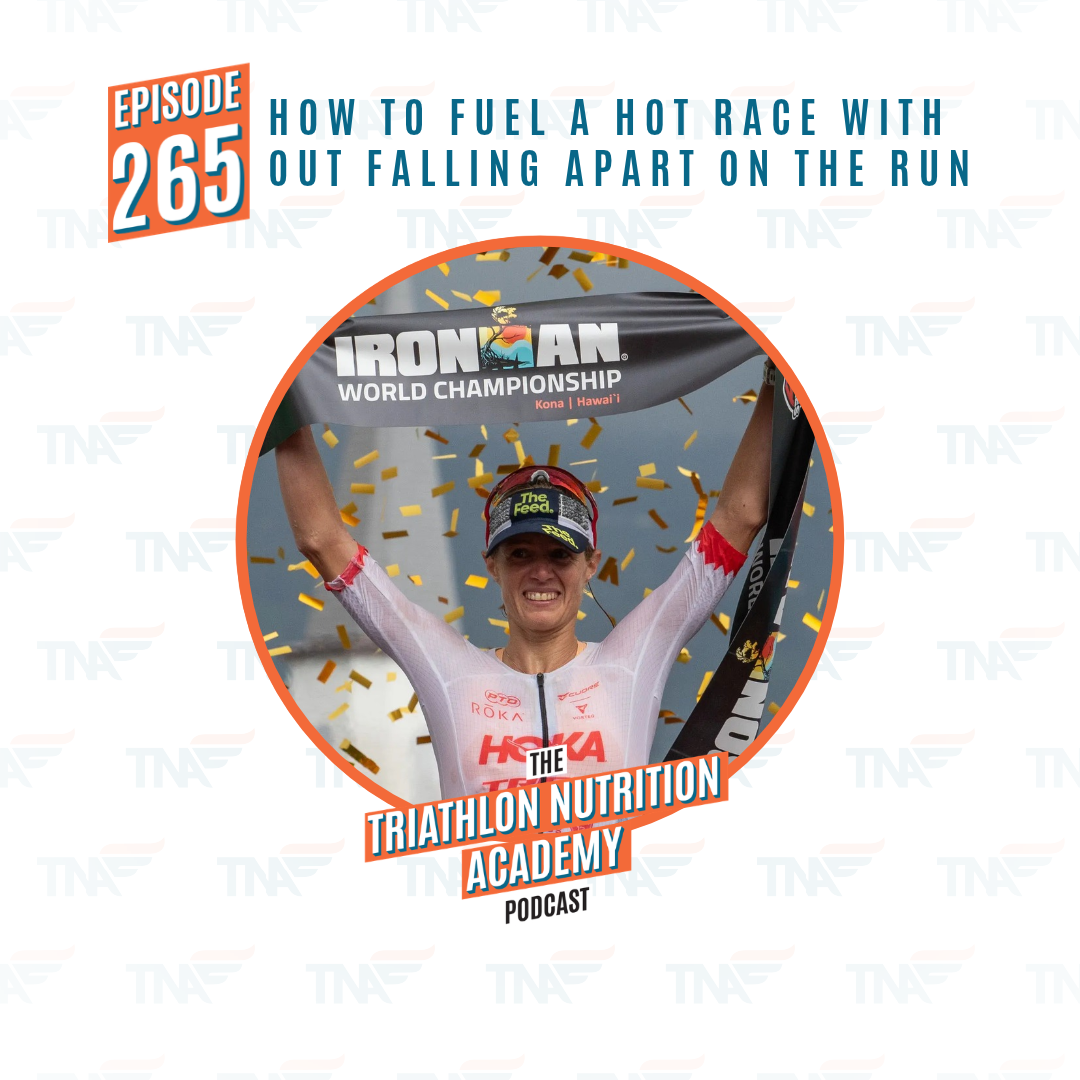
Episode 265 - How to Fuel a Hot Race Without Falling Apart on the Run

Two of the best triathletes on the planet came undone in the Kona heat in back-to-back years, so how do you fuel a hot race without falling apart on the run?
After two decades of working with triathletes, I can tell you that most hot races are won or lost before the gun even goes off. As an age-grouper you’re out on course for hours longer than the pros, in the hottest part of the day, often on a race nutrition plan you built and tested through winter. I break down what the heat actually does to your body, why falling apart in a hot race comes down to much more than toughness and what should change in your plan when the forecast says it’s going to be a scorcher.
WHAT YOU’LL LEARN
- Why your body burns through stored carbohydrate faster in the heat, and why your aid stations can only top up so much
- The 3 ways triathletes fall apart in a hot race that look identical from the side of the road, and why they need opposite fixes
- Why “it’s hot, drink more” is the advice that puts age-groupers in the medical tent
- What heat does to your gut, and why backing off your fuel can make it worse
- The 4 mistakes I see over and over when the forecast is hot
- How one of my Academy athletes went from walking between poles at Spudman to crossing the line at the 70.3 World Championship in Nice
Links:
Check how well you’re doing when it comes to your nutrition with our 50 Step Checklist to Triathlon Nutrition Mastery
Start working on your nutrition now with my Triathlon Nutrition Kickstart course
It’s for you if you’re a triathlete and you feel like you’ve got your training under control and you’re ready to layer in your nutrition. It's your warmup on the path to becoming a SUPERCHARGED triathlete – woohoo!
Connect with me:
To learn more about the Triathlon Nutrition Academy, head HERE | dietitianapproved.com/academy
See behind-the-scenes action on Instagram: @dietitian.approved
Follow along on Facebook: @DietitianApproved
Join our FREE Dietitian Approved Crew Facebook group
Enjoying the podcast?
Let me know what you loved about it and what you learnt by tagging me @dietitian.approved on Instagram!
Subscribe & Review in Apple Podcast!
Are you subscribed to the podcast?
If not, today's the day! I'm sharing practical, evidence-based nutrition advice to help you nail your nutrition and I don't want you to miss an episode. Click here to subscribe to iTunes!
Now if you’re feeling extra warm and fuzzy, I would be so grateful if you left me a review over on iTunes, too. Those reviews help other people find my podcast and quality nutrition advice. Plus they add a little sparkle to my day.
CLICK HERE to review, select “Ratings and Reviews” and “Write a Review” and let me know what your favourite part of the podcast is.
You're awesome! Thank you!
Episode Transcription
Episode 265: How to Fuel a Hot Race Without Falling Apart on the Run
Welcome to the Triathlon Nutrition Academy podcast. The show designed to serve you up evidence-based sports nutrition advice from the experts. Hi, I'm your host Taryn, Accredited Practicing Dietitian, Advanced Sports Dietitian and founder of Dietitian Approved. Listen as I break down the latest evidence to give you practical, easy-to-digest strategies to train hard, recover faster and perform at your best. You have so much potential, and I want to help you unlock that with the power of nutrition. Let's get into it.
With less than a mile to go at the World Championships in Kona, Solveig Løvseth was leading by just over a minute. Then she started to fall apart. She couldn’t run, gosh, she could barely stand, and before long she was sitting on the side of the road while Taylor Knibb ran past her to win the world title.
Løvseth got back up and she walked across the finish line in eighth. Solveig’s manager reckons that that last mile cost her close to a million dollars once you add up the prize money, the Pro Series money and her sponsor bonuses. Taylor Knibb became the first American to pair an Olympic medal with a Kona title.
Twelve months ago, it was the exact opposite. Taylor was the one sitting on the side of the road and Solveig ran past her to win. That is two of the best triathletes on the planet undone in the heat in back-to-back years. From my experience working with triathletes for the last two decades, I can tell you that most hot races are won or lost before the gun even goes off.
Now, for you as an age group triathlete, you are out there for many more hours compared to the pros in the hottest part of the day, and on a race nutrition plan you probably haven’t dialled in as much as they have. So let’s break it down by looking at some of the science. How do you fuel a hot race without falling apart in the run?
First things first, let’s dive into what is the difference in a hot race environment. A hot race asks your body to do a completely different job when we compare that to the cold, and most athletes haven’t actually adjusted for it. Because in the heat, your body is running two jobs at once. It’s trying to fuel the working muscles to get you moving, and it’s also trying to get rid of heat to cool you down.
In the heat, the body sends more blood to the peripheries, to your skin, to try and help with heat evaporation. So your heart has to work even harder to try and do the skin cooling as well as keep your muscles going, all while your sweat rate is climbing compared to the cool. We also know that exercise pulls blood away from the gastrointestinal tract, and in the heat it’s worse because there’s more blood flow to the skin and less perfusion in the gut.
Hold that thought, because we’re going to come back to that later. We also know that you burn through your stored carbohydrates way faster when it’s hot. A 2025 review from Mougin et al. pulled together 51 studies, and they found that carbohydrate and glycogen use both go up in the heat. Glycogen burn was about 25% higher, and slightly less, about 10% less, of the carbohydrate in the athlete’s sports drink actually got used.
So think of it like a road trip that you take in your car. In the heat, your car is burning through gas or fuel faster than normal, and every gas station that you stop at to top up, AKA your aid stations, only lets you put a little bit back in. So in the heat, the fuel tank that you leave home with matters a whole lot more.
And yet most age group triathletes turn up to a hot race with the exact same race nutrition plan as a cool race. Same bottles, same gels, same plan, same everything. Then they wonder why it all goes pear-shaped. When an athlete falls apart in the heat, it usually comes down to three things, and from the side of the road, they all look almost identical.
The first one is overheating. Your core temperature when you exercise is constantly moving hotter and hotter, and it does that until your body reefs the handbrake back to get you to slow down so it doesn’t get too hot. I’ll link a couple of papers in the show notes for you. One study found that the cyclists stopped when their core temperature reached 40 degrees Celsius, which is 104 Fahrenheit, no matter how warm they were when they started.
That was the handbrake pull zone. Another study looked at when people hit that fatigue point, how much fuel was left in their tank, and they discovered that there was plenty of glycogen still there. You can be well fuelled and have fuel in the tank, but just cooked. The second reason an athlete’s going to fall apart in the heat is because of overdrinking.
This is called hyponatraemia, or low blood sodium, and it comes from drinking more than you’re losing. It can show up as nausea, confusion, vomiting, collapse, which looks the same as heat illness and under-fuelling often. That’s why it’s really important for medical teams to work out exactly which one they’re dealing with before they do anything to fix the problem.
[00:05:00] And unfortunately, it happens in age groupers far more than it happens in the pros. At a full distance race in New Zealand, 18% of finishers had low blood sodium, and it was fluid overload that caused most of the really severe cases. Another study looked at Boston Marathon runners, and they found that runners slower than four hours had about seven times the odds of hyponatraemia compared to runners running under three and a half hours.
Putting on weight during the event was the biggest red flag. So that generic advice, “It’s hot, drink more,” is sometimes what puts age groupers in the medical tent. The third reason why you might fall apart in the run in a hot race is because you’re low on fuel and/or fluid. If we think through an under-fuelled bike, dehydration quietly building in the background and then the run falls apart.
Back to Solveig, I’m not going to diagnose her. I don’t know specifically what went wrong in her race, and watching some of her post-race interviews at the time, I don’t think she really understands what happened either. She thought it was maybe some overheating, but she’s going to dive into it and see if she can understand what the actual problem was for her.
But she had ridden the second fastest bike split of the day out of the pro women and was literally running away with the world title. She was in incredible form, and she even said in her post-race interviews that she was feeling really good, until she wasn’t. Now, the point is, from the outside, those three issues, overheating, overdrinking and under-fuelling/dehydration, they all need opposite responses to fix it.
More fluid is the right call if you’re dehydrated, but more fluid in a hyponatraemic situation is the wrong call. Are you still with me? If you want to dive deeper into sweat and electrolytes, go back to episode 214 where I dove into some of the sweat science. Now let’s go back to talking about your gut, because hot races are where your gut goes to die.
When you exercise, your gut is already short on blood flow for digestion. Add heat to that equation, and it’s really getting hammered. There’s a lot of cool research coming out of the Australian sports labs around gut and the heat. In one study by Snipe et al., they ran runners for two hours at 35 degrees Celsius, that’s about 95 Fahrenheit, and then again at 22 degrees Celsius, or about 72 degrees Fahrenheit, and they found that the markers for gut damage rose more than three times as much in the heat compared to the cool, and nine out of 10 runners had gut symptoms, which were also far worse compared to running in the cool.
Now, the counterintuitive bit is what do you do, or what do most athletes do when it’s hot and you’re feeling bothered and you’re not feeling particularly great? Generally, they stop fuelling or stop eating. When this same research group gave the runners carbohydrate during two hours in the heat, their gut damage markers were a fraction of what they were when they fuelled with water alone.
So backing off your fuel because it’s hot and you’re feeling a bit funky can actually make your gut worse, not better. Now, this is a skill that you can hone. Fuelling in the heat and adjusting your race nutrition plan for the hot versus the cold is one of the things that I teach my athletes inside the Triathlon Nutrition Academy, which is my online program where I teach triathletes everything they need to know to swim, bike and run.
One of our newbies in the latest cohort joined specifically to do this because her race plan from the heat is falling apart in the cool and vice versa. Your gut is so trainable, but you have to do some serious work to be able to do that, not just cross your fingers and hope for the best. That’s not a strategy.
So let’s get into some of those mistakes that I see over and over with age groupers when the forecast says it’s going to be a scorcher. The first mistake, which I’ve already shared, is that you’re using a cool day race nutrition plan on a hot day. Taking a plan that you built and trained through winter for, and expecting to use that in a hot race, is how you’re going to end up having a terrible day out in the office. The second mistake is drinking and salting to someone else’s numbers, or just blanketly having a heap of sodium because that is what the internet is feeding us at the moment.
Between athletes, sweat rates can run from about 150 mils, which is about half a cup, all the way up to three and a half litres an hour. And the amount of sodium in sweat can be up to eight times higher in one athlete compared to another. So there is absolutely no one size fits all. Your training buddy’s electrolyte tablets were built for your training buddy’s plan, not yours.
So the sooner you understand your numbers, the better. The third mistake is backing off your fuelling on the bike because it’s suddenly hot. It makes sense to dial it back, but it’s also protective to have some fuel on board, so it really comes down to practising. Number four is not training in the heat.
Training in the winter, training in the cool and then travelling to race in a hot race. Your body adapts surprisingly fast to the heat. You get more blood volume, you’re better at sweating and cooling yourself and your sweat is less salty. Most of that change happens in the first week or so. So that means that a plan that you’ve only ever tested in the cool isn’t going to translate to the physiological changes that happen for us in the heat.
The golden rule of racing is never try anything new on race day, and a hot race day counts as a new race day if you haven’t trained for it. One of my Academy athletes raced Spudman. It’s a local race in Idaho, and it was crazy hot. It was so hot she was sweating in her wetsuit waiting for the start, and by the time she was running, it was about 86 degrees Fahrenheit, which is about 30 degrees Celsius, with no shade on the run course whatsoever.
She had a headache on the bike, and on the run she ended up walking between poles. After the race, her shoelaces were covered in salt, and at that time, I don’t think she’d done enough heat-specific prep that we would normally build into a plan for a hot race. She did some sweat testing, and it turns out she’s a salty margarita, losing around 1,400 milligrams of sodium an hour on a hot ride.
Now, that is a big number, and it’s her number. It could be the wrong number for you, so please don’t take that as a number to replicate. So we rebuilt her plan for the heat, and she practised it in lots of hot sessions in the lead-up. Less than two months after that, she was on the start line of the 70.3 World Champs in Nice, which is a very hilly bike ride and a very hot run along the Promenade des Anglais in the baking sun. She made the bike cutoff on the really hilly course, and she crossed the finish line, calling it the most amazing experience of her life.
I think the word that she used was transformative. Now, my point is, she didn’t just toughen up between Spudman and Nice. She got the specific data that she needed for herself, built her plan for the heat and rehearsed the shit out of it. You cannot turn up to a hot race and not have put in all that groundwork.
So what actually changes when you check the forecast and it’s going to be hot and spicy, like 32 degrees Celsius plus, 90 degrees Fahrenheit plus? Let’s think about race week and your fuel tank. Carb loading matters more on a hot day. Think back to our road trip earlier. The heat is going to burn through your stored form of carbohydrate, your glycogen, faster than in the cool, and you can only top up so much when you’re out on the racecourse because your gut is the rate-limiting step, and in the heat it works even less.
So that fuel tank that you toe the start line with matters even more in the heat. It’s your buffer. It’s your safety net. If you need to understand how to carb load, so you know specifically how much and when and what to actually eat without feeling heavy and bloated, I’ve broken that down in a standalone masterclass all about carbohydrate loading.
You can find that at dietitianapproved.com/carb-loading. And if you want to learn more about carb loading, go back and listen to episode 251 where I talked about how do you carb load for a triathlon, and episode 253, is carb loading a myth? No. But the caveat to all this is carb loading is not going to stop you from overheating.
It’s not a cooling strategy. Overheating is typically going to hit you before your fuel tank runs dry. So carb loading is one piece of the puzzle in the heat, it’s not the entire plan. Okay, so that is race week and heading into the race. What about race morning and out on course? Your plan for your sodium, your fluid, your fuelling and cooling should all be made well before race day.
You’re not making these decisions on the fly at the aid station when you’re hot, and you’re cooked, and you’re not really thinking straight, okay? An aid station at 2:00 in the afternoon is not the place to be making big maths calculations and life-changing decisions. That’s how people end up drinking whatever they’re handed and overdrinking, particularly if you’re doing a lot of walking.
It doesn’t make any sense to me that athletes leave this to chance. You spend so much time training and invest so much money in this sport, it doesn’t make any sense to me why you wouldn’t have your nutrition fully dialled in. And then you need to have a plan for when it goes wrong. If we think back to Taylor Knibb, after the race she explained what happened to her last year and how that shaped how she responded when Solveig caught up to her at Kona.
Rather than fight a battle she didn’t think she could win, she focused on cooling down, getting fuel in and getting to the finish line safely. She’d been here before, and she knew what to do when it started to go wrong, and that is the bit that I want you to steal from the pros. So let me try and wrap this up in a nice little bow for you.
A hot race asks your body to do a different job. You’ve got more heat to dump, a faster carb burn and your gut is under serious pressure. Overheating, overdrinking and running low on fuel or fluid can look the same from the outside, but they need opposite things to fix them. So general rules like drink more or drink to thirst aren’t going to serve you well.
We don’t want to back off fuel in a really aggressive way in the heat because your gut actually needs it. But you’re going to need different fuelling targets for the heat versus the cool. Don’t copy anyone else’s numbers though. Your sweat, your sweat rate, your sweat sodium, your fuelling needs are uniquely yours, and the sooner you understand that, the better.
Rehearse your plan in the heat. I cannot stress that enough. You cannot do all of your training in a cool environment, travel to a hot race and expect it to just work out perfectly. You need to start the race with a full fuel tank, so carbohydrate load properly, and have a plan of attack for what you’ll do when things go wrong.
How are you going to troubleshoot? Because it’s more likely to go wrong in the heat. If you’re listening to this right now and you’re in the off-season, it’s winter, it’s freezing, and you’re thinking, “Nah, I don’t need to worry about that right now, Taryn,” you do. It is the perfect time to build this plan for next summer.
And if you do have a hot race coming up in the next 12 months, start with filling the fuel tank. Head to dietitianapproved.com/carb-loading and grab my Carb Loading Masterclass so that you can rock up and toe the start line with a full fuel tank, not just cross your fingers and hope for the best.
Hopefully that helps you to start to think about hot race fuelling a little bit differently so that you’re not walking through to the finish line because it’s all fallen apart in the run. I’ll see you next week.
Thanks for joining me for this episode of the Triathlon Nutrition Academy podcast. I would love to hear from you. If you have any questions or want to share with me what you've learned, email me at [email protected]. You can also spread the word by leaving me a review and taking a screenshot of you listening to the show. Don't forget to tag me on social media, @dietitian.approved, so I can give you a shout out, too. If you want to learn more about what we do, head to dietitianapproved.com. And if you want to learn more about the Triathlon Nutrition Academy program, head to dietitianapproved.com/academy. Thanks for joining me and I look forward to helping you smashed in the fourth leg - nutrition!