Is AG1 Worth It? A Sports Dietitian’s Honest Review (And Why I've Never Recommended It)
Apr 28, 2026
If you're a triathlete who's ever been tempted by AG1, the green powder promising to cover all your nutritional bases in one daily scoop, and wondered whether it's actually worth it, this is for you.
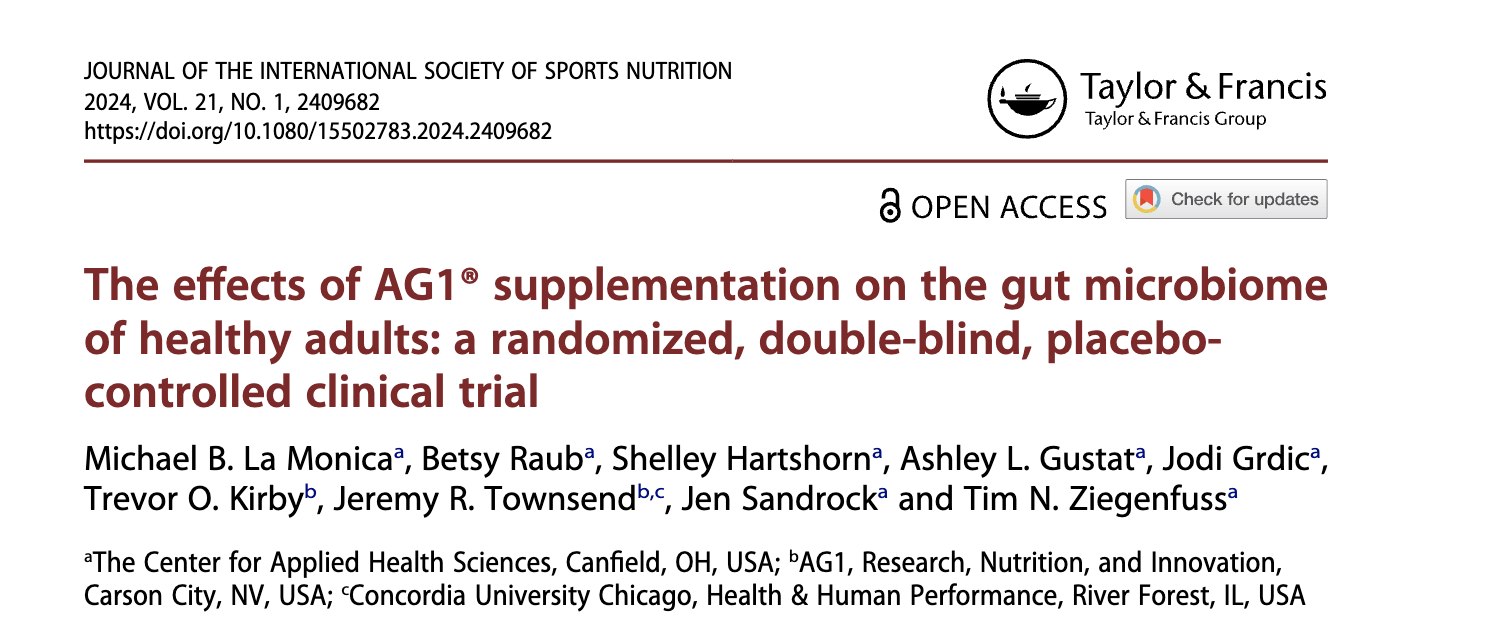
A peer-reviewed study dropped in the Journal of the International Society of Sports Nutrition examining the effect of AG1 on the gut microbiome. I read the whole thing. And combined with what I already know about this product, I have a lot to say.
Spoiler: I've never recommended AG1 to a single athlete. Here's exactly why.
The Company Behind the Product
AG1 used to be called Athletic Greens. They rebranded in 2022. If you're wondering why a billion-dollar supplement company quietly changes its name, investigative journalist Scott Carney did the digging for us.
His reporting, which AG1 attempted to shut down with one of the most expensive law firms in the United States, revealed that the company's founder fled New Zealand before proceedings concluded on almost 50 counts of breaching fair trading laws in a criminal real estate scam. Shortly after Carney's video hit 800,000 views, the founder stepped down as CEO.
You can read Carney's full investigation here.
I'll let you form your own opinion. But it does tell you something about the culture of a company that spends more on influencer commissions and legal intimidation than on transparent ingredient disclosure.
Proprietary Blends: The Oldest Trick in the Supplement Industry Book
Each serve of AG1 is 13 grams. Nine of those grams are proprietary blends.
A proprietary blend is a combination of ingredients where the manufacturer doesn't disclose how much of each ingredient is actually in the product. AG1 lists over 70 ingredients across their formula without telling you the dose of a single one.
This matters because ingredient doses determine whether a supplement actually does anything. Without knowing the dose, you have no way of knowing whether the active ingredients are present in amounts supported by research, or whether the bulk of that 9 grams is made up of the cheapest fillers on the list (like silica).
Any sports dietitian worth their registration will tell you the same thing. If a company won't disclose the doses of their ingredients, ask yourself why.
And while you're asking questions... AG1 recently signed Hugh Jackman as their global ambassador. Nobody knows exactly what that deal cost, but celebrity ambassador contracts at that level typically run into the tens of millions of dollars. When you're paying $149 a month for AG1, a significant chunk of that is funding his fee. Not the quality of what's in your scoop.
Here's another question nobody seems to be asking.
Even if we accepted the ingredient list at face value, has anyone independently tested what actually comes out the other end of production?
Many vitamins and minerals are heat-sensitive. Vitamin C, B vitamins, certain antioxidants degrade with heat, light and time. The process of manufacturing a powder from 70+ raw ingredients involves significant processing. What goes in is not necessarily what ends up in your scoop.
AG1 claims NSF Certified for Sport testing, which checks for banned substances and label accuracy for key nutrients. But it does not guarantee that every ingredient listed survives the manufacturing process in a biologically meaningful dose. Independent third-party testing of the final product's full nutrient content? I haven't seen it. And until I do, the question remains open.
What the Research Actually Shows
A study, published in the Journal of the International Society of Sports Nutrition, examined what AG1 does to the gut microbiome in 30 healthy adults over 4 weeks.
Before we get to the results, check the disclosure statement buried at the bottom of the paper. This study was funded in part by AG1. Two of the paper's authors are employees of Athletic Greens International.
Industry-funded research isn't automatically wrong. But it does mean you need to read every word carefully.
What AG1 did:
AG1 enriched two probiotic strains: Lactobacillus acidophilus and Bifidobacterium bifidum. These are the exact same strains already in the product. They found what was already in the powder showing up in stool samples. For $149 AUD a month, that's the headline result.
What AG1 didn't do:
There were no significant differences between AG1 and the placebo for stool consistency, bowel frequency, digestive quality of life or any clinical safety markers. The one positive finding, a 62.5% improvement in digestive symptom quality of life, was not statistically significant. In research terms: we cannot conclude AG1 caused it.
The placebo problem:
Here's the part that stopped me in my tracks. The placebo used in this study was maltodextrin, a processed carbohydrate that the paper itself acknowledges is not entirely inert and can disrupt the gut microbiome, and not in a good way.
So they compared AG1 against something that may actively harm gut health. AG1 still produced no significant results. In some bacterial measures, the maltodextrin group showed more beneficial changes.
This is a textbook example of flawed supplement research design. Use a problematic comparator, get a relatively flattering result, publish it and let the marketing team run with it.
This study showed maltodextrin was more beneficial for the gut compared to AG1!
What This Study Will Never Show You
No research has compared AG1 to a diet built around whole, varied, real food. Because there is no marketing money in funding that study.
What decades of nutrition science consistently demonstrates is that your gut microbiome thrives on dietary diversity: vegetables, fruits, legumes, wholegrains and fermented foods. Real food feeds and diversifies the beneficial bacteria in your gut in ways that no 13-gram powder with undisclosed ingredient doses can replicate.
A green sachet is not a substitute for eating well. It never was.
My Honest Take as a Sports Dietitian
AG1 is safe. The paper does confirm that. It won't hurt you.
But $149 AUD a month for proprietary blends with undisclosed doses, from a company whose founder fled criminal proceedings, compared in their own funded research against a flawed placebo, with no significant benefit shown across any meaningful health marker?
That's nearly $1,800 a year. For a green powder that enriched the probiotic strains already in it and showed no significant improvement in any health marker we actually care about.
I wouldn't spend my money on it. I never have. And I'd encourage you not to either.
That $149 a month is better invested in the quality of your daily food. More variety. More colour. More fermented foods. More real food that your gut microbiome actually runs on, and that your training genuinely needs.
Real food first. It's not sexy, but it will always be way more beneficial than a manufactured powder.
Save your money and invest in learning how to eat to support your health and performance.
Read the full research paper: https://doi.org/10.1080/15502783.2024.2409682
Ready to fuel your training properly?
Start with the Triathlon Nutrition Kickstart Course.
The ULTIMATE
Triathlon Nutrition Checklist
Wondering how well you're nailing your nutrition to support triathlon training and racing?
Download my FREE 50 step checklist to triathlon nutrition mastery.
We hate SPAM. We will never sell your information, for any reason.
Author