Protein for Masters Athletes: Why More Isn't Working
Aug 21, 2026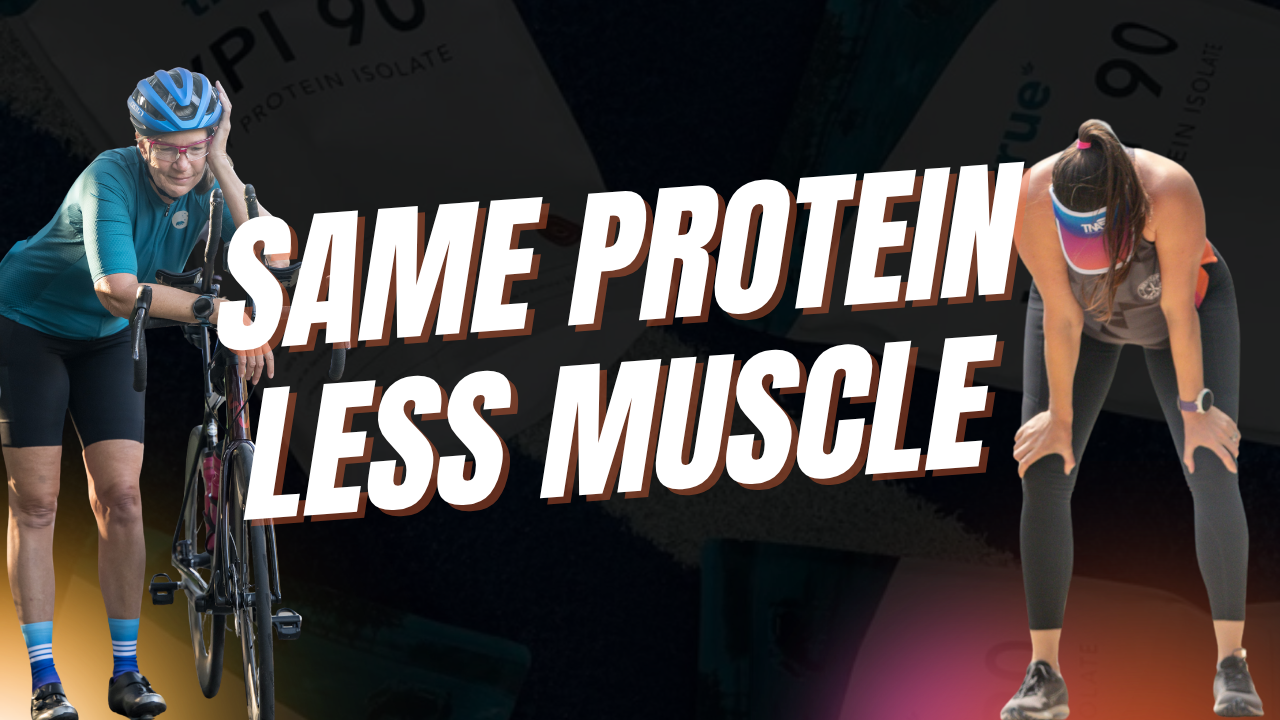
Protein for Masters Athletes: Why More Isn't Working
Quick answer: Protein for masters athletes is not a volume problem. As you get older your muscles do less with the same protein, a change called anabolic resistance, but the research shows that simply eating more does not undo it. When researchers doubled the post-exercise protein dose in masters triathletes, recovery did not significantly improve and cycling time trial performance was unchanged (Doering et al., 2017, International Journal of Sport Nutrition and Exercise Metabolism). What protects your power after 45 is the size of each dose, how many times a day you hit it, and where those doses sit relative to the sessions that damage muscle.
Everywhere you look at the moment, something is fortified. Cereal, yoghurt, bars, coffee, and these days even the water. In January 2026 the US dietary guidelines lifted their protein recommendation from 0.8 grams per kilo a day to 1.2 to 1.6 grams, which for a 75 kg adult is a jump from around 60 grams to somewhere between 90 and 120. That was overdue, and I am glad it happened.
But those are guidelines written for a general, sedentary population. They are not guidelines for someone swimming, riding and running 10 to 15 hours a week, and they are not a plan.
If you are over 45 and your power has stopped going up, you have almost certainly already been told the answer is more protein. That advice is not wrong. It is incomplete in a way that quietly costs masters athletes years.
What Changes About Protein for Masters Athletes After 35?
Something real does change, and you are not going to like it (sorry).
As you get older, your muscles respond differently to the protein you eat. The amino acids (the building blocks that protein breaks down into) still get delivered exactly as they always did. Your muscle simply does less with them. The technical name for this is anabolic resistance, which in plain English means the same protein going in produces less muscle repair and less muscle building coming out.
The clearest evidence for this in endurance athletes comes from an Australian group including Peter Reaburn and Stuart Phillips. They took 5 masters triathletes with an average age of 53 and compared them with 6 younger triathletes averaging 27. Everyone completed the same 3 days of hard endurance training, including a 30 minute downhill run designed to cause muscle damage, with 20 km cycling time trials at 10, 24 and 48 hours afterwards. Everyone ate the same controlled diet, matched for protein per kilo and spread across meals, plus 20 grams of whey protein straight after the downhill run.
Over those 3 days the masters athletes showed a significantly lower myofibrillar fractional synthetic rate (the speed at which they rebuilt muscle protein) than the younger athletes, at 1.49% per day compared with 1.70% per day, along with a trend towards slower cycling time trials (Doering et al., 2016, Medicine & Science in Sports & Exercise). Same training. Same food. Worse repair, and worse recovery of performance.
It is a small study. Eleven athletes, and it is still the only one of its kind. But it makes the point cleanly: the nutrition that worked for you at 30 is not doing the same job at 50.
This is the bit I want you to hear properly. You did not get it wrong. You just never evolved your nutrition through the different stages of your life, because the rules changed at about 35 and nobody sent you the memo. If you want the training side of this, Joe Friel and I covered how masters athletes get fast and stay fit after 50 in Episode 179.
Does Eating More Protein Fix It?
If anabolic resistance is real, and it is, then the logical next move is to eat more protein. That is exactly what the internet is telling you to do right now.
The same research group went and tested it. Eight masters triathletes completed two trials 7 days apart in a randomised, double blind, crossover design. Same muscle damaging downhill run, then an 8 hour recovery period on either a moderate protein intake of 0.3 grams per kilo per feed or a high one at double that, 0.6 grams per kilo, delivered in 3 feeds at 2 hour intervals starting immediately after exercise. For a 75 kg athlete that is roughly 22 grams per feed versus 45 grams, so a genuinely meaningful difference.
Doubling the protein did not significantly improve recovery, and cycling time trial performance was unchanged (Doering et al., 2017, International Journal of Sport Nutrition and Exercise Metabolism).
It was not entirely without effect. The high dose group lost less strength across the afternoon and reported feeling significantly less wrecked over the 8 hours, which is worth having if you are training twice in a day. But the headline result stands. Doubling the protein did not buy back performance.
So:
- If you train once a day and you want more power, then doubling your daily protein is not where your improvement is hiding.
- If you train twice a day and you need functional legs again by the evening session, then a larger post-session dose is worth trialling for the fatigue benefit alone.
This is my problem with the way more protein is being sold at the moment. The total amount is being treated as the only lever you have, and it is far more nuanced than that.
Why Is Hitting a High Protein Target So Hard for Triathletes?
There is also a practical problem the research design hides. Study participants get handed their food. You do not.
The pattern is predictable, and I have watched it play out more times than I can count. Week one goes brilliantly. You add cottage cheese, high protein yoghurt, an extra chicken breast and maybe a shake, and you still arrive at dinner a fair way behind your target, so you cram the rest in late, feel horribly full and sleep badly. Week two you are still going. By weeks three and four you cannot look at another tub of cottage cheese (nobody can), so you stop, and you conclude that protein just is not going to work for you.
The protein was fine. Hitting a high protein target as a triathlete is legitimately difficult, because you are already eating a decent volume of carbohydrate around training, your appetite is blunted after hard sessions, and you have a job, a family and a life to run alongside all of it. You are not sitting around with unlimited stomach space waiting for someone to hand you your next feed.
The internet gives you a number and then walks away. The number was never the hard part.
What Matters More Than Your Total Protein Intake?
Your total does matter. But once you are in a reasonable range, pushing it higher stops buying you much. Like most things in triathlon nutrition, more is not automatically better.
A study on masters swimmers shows this beautifully. Their total daily protein intake was comfortably where it should be at 1.9 grams per kilo. Almost all of it, though, was stacked into two meals, with an average of 66.7 grams at lunch and 48.0 grams at dinner (Santos de Souza et al., 2025, Nutrition and Health). The total was excellent. The pattern was not.
Here is the mechanism. Every time you eat protein, you increase muscle protein synthesis. Every time you train, you increase muscle protein synthesis. To get the most out of both, you want them happening together, repeatedly, across the day. You are a human, not a snake. You cannot eat once and expect it to hold you, particularly when you are doing two sessions in a day.
If I audited your food right now, I would bet good money your breakfast is the weak link, because it usually is. I went deep on what happens when you try to cram it all into one sitting in Episode 141, affectionately known around here as the barbecue study.
The 5 Protein Levers for Masters Athletes
There are 5 levers you can pull to work with anabolic resistance rather than against it:
- How much protein you get in one sitting. The dose per meal, not the daily figure.
- How many times a day you hit that dose. Frequency, spread across your waking hours.
- Where those doses sit relative to the sessions that damage muscle. Timing against your program, not against the clock.
- The type of protein and how biologically available it is. Not all protein sources are created equal.
- Your total daily protein intake. The one everybody starts with.
Most athletes start at number 5 and never strategise the first four. That is backwards, and it gets more expensive every year you leave it.
Is the Same Mistake Happening With Carbohydrate?
It absolutely is. Triathlon's answer to everything at the moment is more. More carbohydrate during training, more during racing, more grams per hour than the gut of the athlete in front of you.
Eating more is not a strategy. Eating more strategically is. Knowing what to eat and when, so it lines up with your training program, is the whole game, and as you get older it matters more, not less. You want to start paying attention at about 35, not once you have already lost ground.
Frequently Asked Questions
Q: How much protein should a masters athlete eat per day?
A: Most endurance athletes over 35 do well in the range of 1.6 to 2.0 grams per kilo of body weight per day, which for a 70 kg athlete is roughly 112 to 140 grams. That is well above the general population guideline of 1.2 to 1.6 grams per kilo. Requirements are highly individualised though, and the daily total is the easiest part of the equation to get right.
Q: Does more protein improve recovery in masters athletes?
A: Not on its own. When masters triathletes doubled their post-exercise protein from 0.3 to 0.6 grams per kilo per feed, recovery did not significantly improve and cycling performance was unchanged (Doering et al., 2017). They did lose less strength across the afternoon and reported feeling less fatigued, so there is a benefit if you train twice a day, but it did not buy back performance.
Q: What is anabolic resistance?
A: Anabolic resistance is the reduced muscle-building response to protein and training that develops as you age. The amino acids still arrive in your bloodstream, your muscle just does less with them. Masters triathletes have been shown to rebuild muscle protein more slowly than younger triathletes on identical training and identical food (Doering et al., 2016).
Q: At what age does protein stop working as well?
A: The shift starts earlier than most athletes expect, from around 35, which is why it catches so many age-groupers by surprise in their forties. It is gradual rather than a switch flicking, and the athletes who adjust their nutrition early hold onto their power far better than the ones who wait until it becomes obvious.
Q: Is it better to eat protein before or after training?
A: Both, ideally. Every feed of protein and every training session independently increases muscle protein synthesis, so the aim is to have them overlapping across the day rather than choosing one. Spreading roughly 0.3 to 0.4 grams per kilo across 4 to 5 eating occasions, with one of those landing close to your hardest session, does more for you than one large hit.
Bottom Line
The blunted response is real. As you get older your muscles do less with the same protein, and that is physiology, not a reflection of how hard you are trying. But more protein has its own ceiling, and that ceiling has been tested and published. What actually moves the needle is the dose, the frequency and the timing around the sessions that damage muscle. It is structure and strategy, not volume.
If you read this and recognised yourself, do not stress. It is a genuinely fixable problem, and it is not about eating more, which means it does not have to be miserable either. What it does need is a plan built around your training program rather than a cookie-cutter number off the internet, because the internet does not know your program, your physiology or your lifestyle.
That is exactly what I teach inside the Triathlon Nutrition Academy, and then troubleshoot with you every week, so you are still doing it in 12 months time. Register your interest for our next cohort and let's get your nutrition working for you, not against you.
Ready to fuel your training properly?
Start with the Triathlon Nutrition Kickstart Course.
The ULTIMATE
Triathlon Nutrition Checklist
Wondering how well you're nailing your nutrition to support triathlon training and racing?
Download my FREE 50 step checklist to triathlon nutrition mastery.
We hate SPAM. We will never sell your information, for any reason.
Author