Body Recomposition for Triathletes: What the Science Says
Sep 25, 2026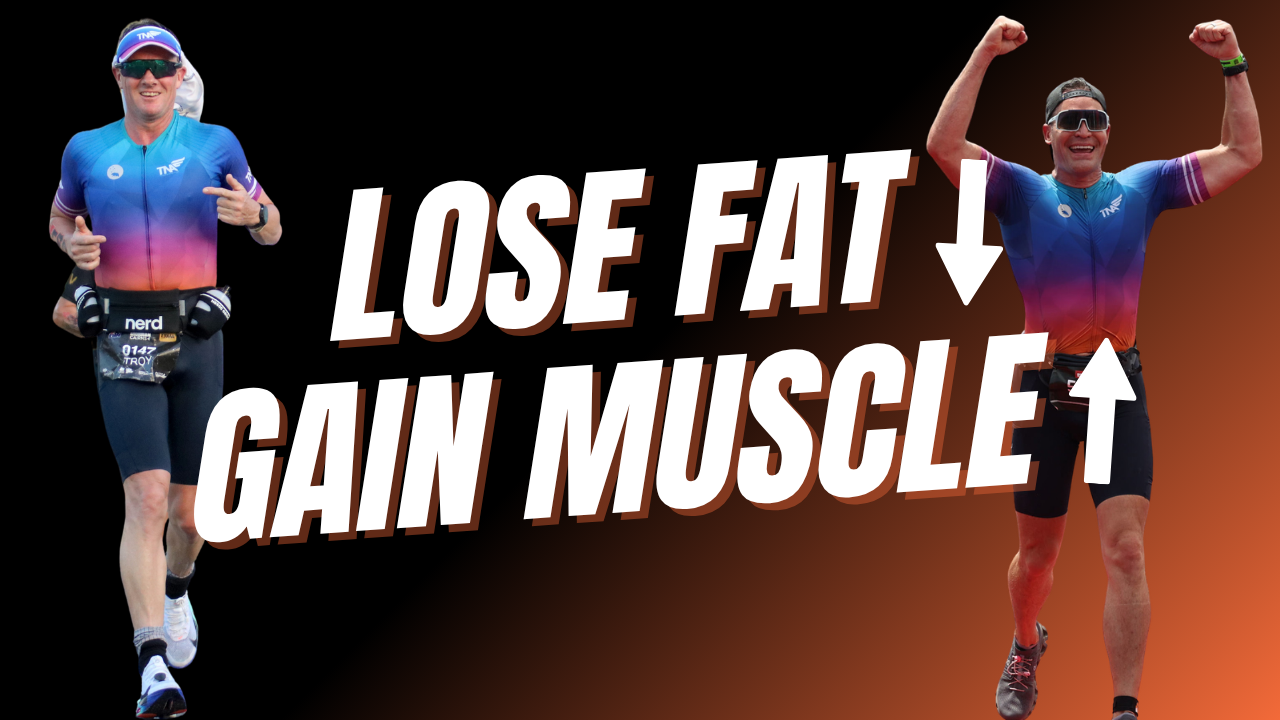
Body recomposition for triathletes means losing body fat while maintaining or increasing lean mass at the same time, and it is genuinely possible. A 2026 trial published in the European Journal of Applied Physiology found that resistance-trained adults eating 250 calories below maintenance lost 2.94 kg of fat mass and gained 1.04 kg of fat-free mass across 10 weeks, while a group eating maintenance calories gained 0.97 kg of fat-free mass and lost 1.41 kg of fat. Both groups ate a high protein intake of 2.5 g per kg of body mass per day and lifted four days a week. The catch for triathletes is that this study was run on gym-only lifters eating roughly a third of the carbohydrate an endurance athlete needs, so the principle transfers but the protocol does not.
For years the advice has been that you have to pick one. Eat in a calorie deficit and lose body fat, or eat in a surplus and build muscle. Trying to do both was treated as a physiological impossibility, and if you have ever asked about it in a triathlon Facebook group you have probably been told exactly that.
The evidence has moved on. Your body does not have to move every tissue in the same direction at once, and there is now a decent body of research showing people losing fat while adding lean mass. A brand new study has put this back in the spotlight, and the version of it doing laps of social media is not the version that is actually in the paper.
I want to walk you through what the researchers really did, what they measured, and then do the part that matters most for you. Because there is a big difference between a study run on 23-year-olds doing four gym sessions a week and a 45-year-old age-grouper swimming, biking and running for 12 hours.
What Is Body Recomposition, and Is It Actually Possible?
Body recomposition means changing the ratio of fat mass to lean mass. In practical terms, losing body fat while holding onto, or adding to, your muscle tissue.
You still have to obey the laws of thermodynamics. Nobody is arguing otherwise. But energy balance is a whole-body ledger, and it does not force every tissue to respond identically. You can lose energy-dense fat tissue while simultaneously increasing fat-free tissue, particularly when protein intake is high and the training stimulus is strong.
If you are relatively new to structured strength work, or you have spent years doing endurance training with no real attention to nutrition, then yes, this is very much on the table for you.
What Did the New Body Recomposition Study Actually Find?
The trial (Vargas-Molina et al., 2026, European Journal of Applied Physiology) ran 30 participants across 10 weeks. They were 18 to 35 years old with at least a year of resistance-training experience, so not beginners, but not 15-year veterans either. Twenty-six of the 30 were men, which is worth holding onto when you think about how well this applies to you.
Three groups, all doing the same program of four sessions per week, three sets of 10 reps with one to two reps in reserve:
- 250 calorie deficit (around 1,000 kilojoules, so roughly one banana and a slice of toast): lost 2.94 kg fat mass, gained 1.04 kg fat-free mass
- Maintenance calories: lost 1.41 kg fat mass, gained 0.97 kg fat-free mass
- Control, no nutrition support: essentially no change in body composition
Both supervised groups beat doing nothing. That is the headline finding, and it is a real one.
What is less widely reported is how small the gap between the two intervention groups was. About 1.5 kg of fat mass across 10 weeks separated eating at maintenance from eating in a deficit. That is not the dramatic difference the internet is selling.
Why Fat-Free Mass Is Not the Same Thing as Muscle
Here is the detail almost nobody quoting this study has mentioned.
The researchers measured body composition with DEXA, which is a genuinely useful tool for tracking change over time. But fat-free mass (everything in your body that is not fat, so muscle, bone, organs, water and glycogen) is a broad category. Over 10 weeks, part of that one kilogram increase could be extra water and extra glycogen (the stored form of carbohydrate sitting in your muscles) rather than new contractile tissue.
The authors say so themselves, and note that MRI, CT or ultrasound would give a clearer picture of actual skeletal muscle change.
So the honest read is an increase in fat-free mass consistent with body recomposition, not one kilogram of brand new muscle. That distinction matters, and it is the difference between reporting research and writing a headline.
There is one more thing buried in the training data. The maintenance-calorie group increased their lower body training load roughly 10 times more than the other two groups did. It is not clean to say nutrition did all the work here. The training changed too, and it changed a lot in one group. (The unsupervised control group also posted the biggest strength gains of anyone, which the authors themselves suspect may be a spurious result. No offence to the control group.)
How Much Protein Do You Actually Need?
Both intervention groups were prescribed 2.5 g of protein per kg of body mass per day. For an 80 kg athlete that is 200 g of protein daily, which is around seven chicken breasts worth. Every day. For 10 weeks.
You do not need to do that.
Previous research puts 1.6 to 2.2 g/kg/day as sufficient for muscle hypertrophy (Iraki, Fitschen, Espinar & Helms, 2019, Sports). Pushing higher can help when you are dieting, because protein preserves lean mass under energy restriction and it keeps you full. But once you are past roughly 2.2 g/kg, the evidence for additional benefit thins out considerably.
If you are a triathlete, then your protein target competes with everything else in your day. You need carbohydrate to run the swim, bike and run. You need enough total energy to avoid low energy availability. You need adequate fat. You do not have an unlimited budget to cram protein into.
The useful question is not how much protein you can possibly fit in. It is how you distribute your energy and your macros so your entire training program stays supported while your body composition moves. Those are very different questions with very different answers.
Why the Size of Your Calorie Deficit Matters More Than You Think
The thing I like most about this study is how modest the deficit was. Just 250 calories a day.
Compare that to what most people do when they decide to lose body fat. Breakfast gets cut, snacks get cut, carbs get slashed, and a couple of extra cross-training sessions get bolted on. Suddenly you are training for a triathlon while eating like you are prepping for a physique competition.
The researchers chose a modest deficit deliberately, because aggressive energy restriction increases the risk of losing lean mass, and that risk is highest in people who are already lean and already trained.
Your goal is not to make the number on the scales go down. Your goal is to change your body composition without wrecking your training. Those are not the same thing, and confusing them is how people end up as what I call the tired triathlete, needing a nap after every long ride and hunting for sugar by 3pm.
Where Body Recomposition for Triathletes Is Different
This is the part that should stop you copying the protocol.
The deficit group were prescribed around 2.5 g/kg/day of carbohydrate. For an 80 kg participant, roughly 200 g of carbs a day.
An 80 kg triathlete in a normal training block needs somewhere between 400 and 650 g a day depending on load. Those participants were eating about a third of what you need, because they were not endurance athletes. They were doing four gym sessions a week and not much else.
So we cannot take this paper and conclude that this is what happens when a triathlete goes into a deficit. That has not been tested.
What we can take is the principle. If you want to lose fat while holding or building lean mass, then create the conditions that make those adaptations likely: a sensible energy intake, adequate protein, enough carbohydrate to support your actual training, a genuine resistance training stimulus with progressive overload (gradually adding load so your body has a reason to adapt), and enough recovery to absorb it.
Notice what is not on that list. Extreme restriction. Hours of punishing yourself. Cutting carbohydrate to the bone.
Who Is Body Recomposition Best Suited To?
The capacity to recomp is not evenly distributed. The more body fat you have to lose and the less training history you have, the more room there is to move.
The participants in this study averaged around 24.8% body fat at baseline with about 1.5 years of lifting behind them. That is well within the healthy range, and it is also a level where losing fat is relatively straightforward. A leaner, more experienced group would very likely have shown weaker results.
If you are already lean, highly trained and close to your genetic ceiling, then chasing significant muscle gain and significant fat loss simultaneously is probably not your most efficient strategy. You may do better picking one goal for a block.
If you have never done structured strength training, or you have years of endurance work with little nutrition attention, or you have a few months of off season ahead of you, then you have a real opportunity.
This is also why timing matters. Southern hemisphere athletes are heading into race season. Northern hemisphere athletes are coming out the back of theirs. Either way, there is a decision to make about what comes next, and the worst version of that decision is waiting until January, or waiting until you are desperate.
Frequently Asked Questions
Q: Can you build muscle in a calorie deficit?
A: Yes, under the right conditions. The 2026 European Journal of Applied Physiology trial found a 250 calorie deficit combined with 2.5 g/kg/day protein and four resistance sessions per week produced a 1.04 kg increase in fat-free mass alongside a 2.94 kg fat loss over 10 weeks. It is most achievable if you have body fat to lose and limited resistance training history.
Q: How much protein do triathletes need for body recomposition?
A: For most triathletes, 1.6 to 2.2 g per kg of body mass per day is sufficient to support muscle growth and preserve lean mass in a deficit. The 2.5 g/kg used in the study is not necessary and is difficult to fit around the carbohydrate and total energy an endurance program demands.
Q: Will cutting carbs help me lose body fat as a triathlete?
A: Cutting carbohydrate hard tends to backfire. Carbohydrate fuels the sessions your body composition goal depends on, so dropping it too low degrades training quality, raises stress and weakens the very stimulus that protects your lean mass. An 80 kg triathlete typically needs 400 to 650 g per day depending on training load.
Q: How big should my calorie deficit be as a triathlete?
A: Modest. The study used 250 calories, or around 1,000 kilojoules, below maintenance. Aggressive deficits accelerate lean mass loss, particularly in lean and well-trained athletes. Your individual number depends on your training load, body composition and timing in the season, and it is not a fixed figure you set once and forget.
Q: Does fat-free mass on a DEXA scan mean I gained muscle?
A: Not exactly. Fat-free mass includes muscle, bone, organs, water and glycogen. Over a short study period some of that increase can be water and stored carbohydrate rather than new muscle tissue, which is why researchers describe it as a change consistent with recomposition rather than confirmed muscle growth.
The bottom line
Body recomposition is real, and this study adds to the evidence for it. What it does not do is hand you a protocol to copy. The nutrition strategy that worked for a 23-year-old resistance-trained male in a 10-week gym study is not automatically the strategy that works for a 45-year-old age-grouper doing 12 hours a week across three sports.
Your likelihood of pulling it off depends on where you are starting, your training status, your current body composition, your nutrition and your capacity to recover and adapt. Which is exactly why I do not believe in cookie-cutter meal plans, and why you will not find a free downloadable one on my website.
If any of this has hit close to home, do not stress. It is a very fixable problem with the right advice, and the slower you go about it the more likely it is to stick.
Working out how many calories you actually need, when a deficit is appropriate and when it is not, how to spread protein across real food rather than living on shakes, and how to hold all of that together across a training week that looks different every single week is exactly what I teach inside the Triathlon Nutrition Academy. Get your name on the waitlist for the next cohort, because doors only open a few times a year.
Ready to fuel your training properly?
Start with the Triathlon Nutrition Kickstart Course.
The ULTIMATE
Triathlon Nutrition Checklist
Wondering how well you're nailing your nutrition to support triathlon training and racing?
Download my FREE 50 step checklist to triathlon nutrition mastery.
We hate SPAM. We will never sell your information, for any reason.
Author