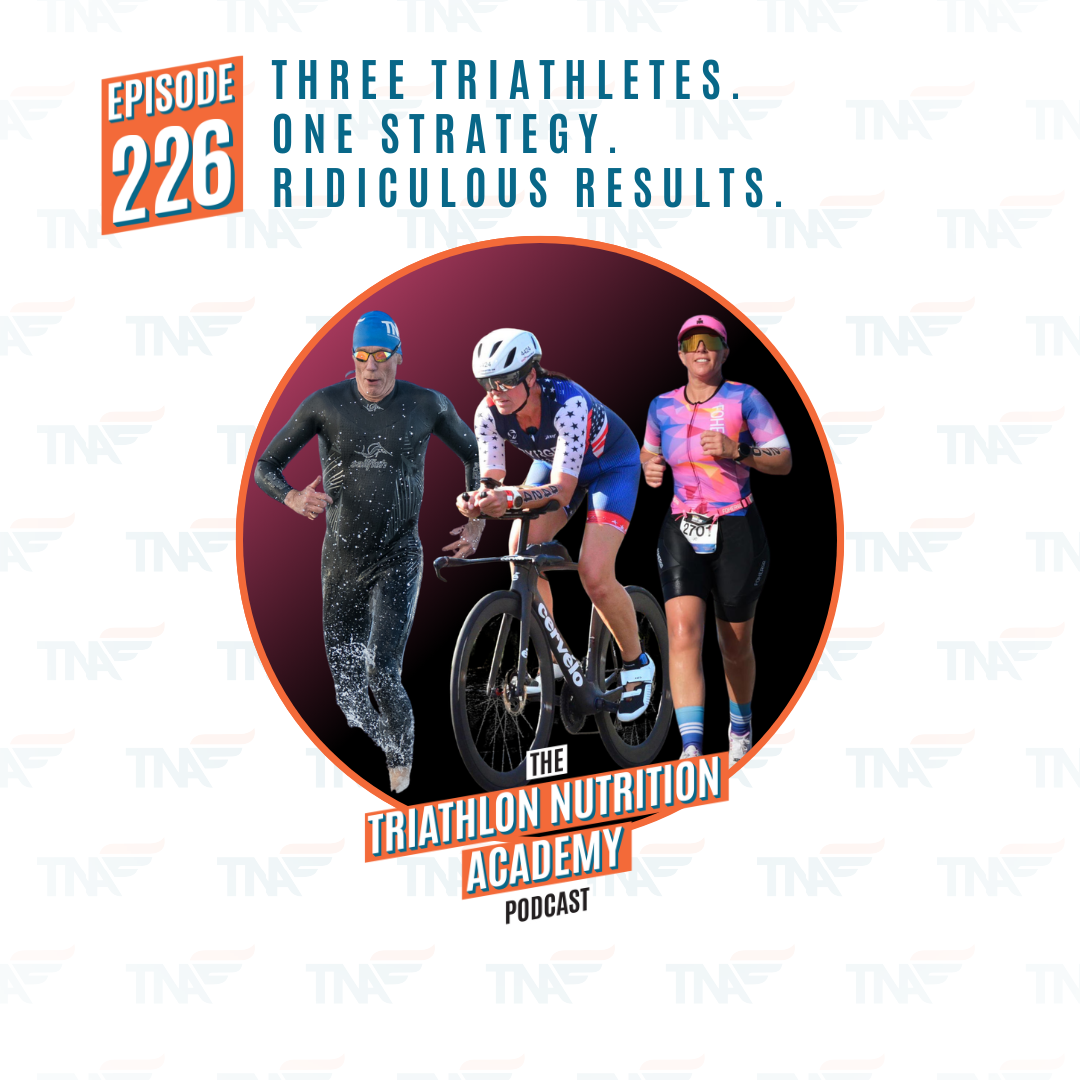
Episode 226 -Three Triathletes. One Strategy. Ridiculous Results

What do a rookie, a masters athlete and a seasoned racer all have in common? They nailed their nutrition strategy - and the results speak for themselves.
In this episode, Taryn sits down with three very different athletes from the Triathlon Nutrition Academy - Jo, Kelly and Erin - to unpack the surprising impact of getting their fuelling right. Each had their own goals, challenges and training loads, but all saw game-changing results after implementing the same evidence-based framework.
If you’ve ever wondered whether nutrition could be your missing link, this episode will show you what’s possible when you get it right.
Links:
Check how well you’re doing when it comes to your nutrition with our 50 Step Checklist to Triathlon Nutrition Mastery
Start working on your nutrition now with my Triathlon Nutrition Kickstart course
It’s for you if you’re a triathlete and you feel like you’ve got your training under control and you’re ready to layer in your nutrition. It's your warmup on the path to becoming a SUPERCHARGED triathlete – woohoo!
Connect with me:
To learn more about the Triathlon Nutrition Academy, head HERE | dietitianapproved.com/academy
See behind-the-scenes action on Instagram: @dietitian.approved
Follow along on Facebook: @DietitianApproved
Join our FREE Dietitian Approved Crew Facebook group
Enjoying the podcast?
Let me know what you loved about it and what you learnt by tagging me @dietitian.approved on Instagram!
Subscribe & Review in Apple Podcast!
Are you subscribed to the podcast?
If not, today's the day! I'm sharing practical, evidence-based nutrition advice to help you nail your nutrition and I don't want you to miss an episode. Click here to subscribe to iTunes!
Now if you’re feeling extra warm and fuzzy, I would be so grateful if you left me a review over on iTunes, too. Those reviews help other people find my podcast and quality nutrition advice. Plus they add a little sparkle to my day.
CLICK HERE to review, select “Ratings and Reviews” and “Write a Review” and let me know what your favourite part of the podcast is.
You're awesome! Thank you!
Episode Transcription
Episode 226: Three Triathletes. One Strategy. Ridiculous Results.
Welcome to the Triathlon Nutrition Academy podcast. The show designed to serve you up evidence-based sports nutrition advice from the experts. Hi, I'm your host Taryn, Accredited Practicing Dietitian, Advanced Sports Dietitian and founder of Dietitian Approved. Listen as I break down the latest evidence to give you practical, easy-to-digest strategies to train hard, recover faster and perform at your best. You have so much potential, and I want to help you unlock that with the power of nutrition. Let's get into it.
Taryn: If you're a triathlete who trains hard cares about doing things properly, but you feel unsure whether your nutrition is actually supporting your training, then this podcast episode is for you. One of the most common patterns I see as a triathlon dietitian with more than two decades of experience working with age group triathletes now is the 110% effort that goes into the training side of things.
[00:00:23] Taryn: You've got a coach, you've got a training program, you've got all the equipment that you need to be successful, and you train like a professional triathlete does you get your sessions done no matter what, yet, only a fraction of that same effort goes into the fuelling side of things. Not because you're lazy, not because you're uninterested, and definitely not because you're not smart enough, because eating for three sports is complex, and most triathletes have not been taught how to do it well. Joining me today are three TNA athletes at very different stages of their triathlon journey, different ages, different racing backgrounds, different goals, but all of them joined the TNA program for the same reason. They all wanted to understand how to fuel properly for three sports. You'll hear from Jo, who is a bit newer to triathlon than the others. She absolutely loves racing and she gives Erin a run for her money in that stakes. And she wanted a way to automate her nutrition so that she could just race confidently without constantly worrying if she was getting it right or wrong. You'll hear from Kelly who is a master's athlete and is the leanest and fastest he's ever been in his entire life and is performing better in his sixties than ever before. You'll hear from Erin, who's been a triathlete for about 10 years now, but discovered that nutrition was the missing link and her biggest breakthroughs in performance and long-term body composition change as a result of getting that right. These are real athletes with real training loads and very real lives outside of triathlon, just like you. Their journeys all look different, but there is a very similar thread that runs through all of them. you are sick of conflicting advice from coaches, podcasts, blogs, training buddies, YouTube, and you want expert evidence backed advice from somebody who actually understands our sport, Then you can join the Triathlon Nutrition academy dietitianapproved.com/academy Inside the program, you'll learn the how, the what and the why of fuelling so that you can build a personalised strategy that fits your training, your lifestyle, your goals, and your race calendar. Let's get into it. Welcome to the podcast You Total Legends. Thank you so much for sharing your story with us. To get started, I wanted to do a rapid fire run around the room, and can you all please give me your name, where you're located, how long you've been doing triathlon for, what distance you love to race, and maybe one word that describes how you feel about your nutrition now that you've got it dialled in. Jo, let's start with you.
[00:03:01] Jo: I'm Joe Hurley. I'm from Gold Coast Australia. I am a newbie. I'm a rookie in triathlon. Although time is going fast, it's been about two and a half years. I really love to do the Ironman 70.3 distances. I've managed to do six of the Oceania races so far, and the world champs recently, which was really cool.
[00:03:20] Jo: How do I feel, what's one word to describe my nutrition now - dialled in
[00:03:25] Taryn: Ew. That's two words.
[00:03:27] Jo: It's a hyphen.
[00:03:28] Taryn: Okay. Thank you. Kelly. You're up next.
[00:03:33] Kelly: Yeah, my name's Kelly Estes. I'm from Idaho in the United States. I've been doing triathlon for a little over four years now. My favourite distance is 70.3. I've done a lot of the Olympic distance and about half a dozen, well probably closer to a dozen of 70 point threes and one full Ironman distance. And 70.3 is the sweet spot for me right now.
[00:03:55] Kelly: And the one word that describes my nutrition is confidence.
[00:03:58] Taryn: Nice. Erin.
[00:04:00] Erin: I am Erin Bryge. I am currently located in Florida, but often live in North Carolina, also in the United States. I have been doing triathlon actually for, this is my 14th year and yep, I was 10 years in ish when I met you, so I can see where you got 10 years from. Um, So yeah, I actually hit my 100th race this past year and I don't think I could pick a favourite distance, uh, but I guess if I had to, probably 70.3 as well.
[00:04:29] Erin: If I don't have to run especially 70.3, and now that I have the nutrition aspect dialled in, I would just say strong.
[00:04:38] Taryn: I love all of those words. I love that they're all different words too. Thank you so much for just setting the scene around who you are and where you're from. I know that a lot of triathlete listening are at all different parts of their journey. They may have only just started. It feels like you've only just started Joe, but you're right, you're at least two years in now and and same as Erin.
[00:04:56] Taryn: Like Erin was like around 10 years in, and now look at her go. I feel like time is flying by, but everyone loves the 70.3 distance turns out, so maybe we have a bias bias there before we get started. My favourite is Olympic distance. Too much running and uh, this body doesn't really hold up, but maybe 70.3 aqua bike.
[00:05:18] Taryn: I could give a go.
[00:05:19] Jo: Mm.
[00:05:20] Erin: Yeah, that's the best.
[00:05:21] Taryn: Go hard and don't have to run. So for you, Joe, when you first started and before you joined the Triathlon Nutrition Academy, what did fuelling for three sports actually feel like for you day to day as somebody that is new or was new to the sport?
[00:05:36] Jo: So I kind of came from a background of no swimming, no riding, no running. I was just a gym. I was a gym girl. Couldn't do any of those sports. Uh, and so, fasted training was like something that I was really used to. I wasn't actually used to eating before training. I was more focused, I guess, on refuelling after.
[00:05:57] Jo: But fasted training was, was just my habit basically. When I started getting into triathlon, I found myself lost very quickly in China, like. Listen and learn just in that rookie mindset of like, from people around me, but they were like mostly men. Different ages, like just completely different body composition, hormones, everything.
[00:06:20] Jo: Like as a, at the time when I first started, 46-year-old woman going through perimenopause and, and all those kinds of things, like immediately I knew that what I was doing didn't really make sense for me and my body and I was struggling. I was very under fuelled. Uh, and even researching some of the, I guess initially listening to the podcast and different things that I was listening to, I could tell that that under fuelling was not setting me up well and I could be facing injuries pretty early in the journey if I didn't get on top of it.
[00:06:56] Taryn: And was that something you were worried about might happen if you did get your nutrition wrong? Now that you've started doing all these different sports that your body's not used to?
[00:07:04] Jo: Initially I wasn't worried at all, but I had other people kind of looking at what I was doing in sessions and like expressing a bit of concern. And so it was probably them more so saying, you know, I, I could have easily gone along oblivious and just being focused on learning the actual sports themselves versus nutrition.
[00:07:22] Jo: But, you know, I bonked on a few rides. Like I, especially group rides, you know, you've got people that are kind of looking out for you as well. And it was obvious that I didn't really have any plan and a lot of the time I had very little on me as well.
[00:07:36] Taryn: Do you think there's a lot of newer triathletes listening who feel exactly the same way as that right now?
[00:07:41] Jo: Oh yeah. I like, I see a lot of confusion and just a lack of confidence, you know, and, and a bit of insecurity too, like not really knowing who to ask or being a bit like embarrassed to ask. What are people eating and how much should I eat? And all that kind of thing. It's just not something that really gets talked about in a healthy way.
[00:08:00] Jo: I think in, in those training environments, I actually experienced a lot more unhelpful conversations around like, you know, I, I can eat whatever I want you know, because I'm doing all this training and I inherently knew that that wasn't true. Like, I knew that I couldn't just suddenly start eating whatever, because I would definitely gain weight if I started eating, you know, just packing on egg and bacon rolls on the group, rice and croissants and stuff like other people were doing.
[00:08:27] Jo: And, and some guys especially can get away with that, but I knew dead set that would not be a good idea for me. So yeah, the idea that you can eat anything
[00:08:37] Jo: and without any talk about what is the right things in the right time is pretty common and pretty unhelpful.
[00:08:44] Taryn: Yeah, there was a lot of that out there. Unfortunately, it's a very noisy space. I find triathletes are very opinionated and everyone's done a lot of work or, you know, spent some time in our sport to understand a few things that work for them, and then really vocal about saying that everyone should try that because it's, it's worked for them and it's great.
[00:09:02] Taryn: And I really get frustrated by that because it might work for some people, but your nutrition is very much individualised to you and you need to almost put your blinkers on when you're new. 'cause there's so much information out there coming at you on all different directions. It's hard to know what's right and what's wrong. So Kelly, as an engineer, you are the type of athlete that. Loves data. You love metrics, you've got a spreadsheet for everything, and you love doing anything that you can to improve your performance. Before joining the Triathlon Nutrition Academy program, how confident were you that your nutrition was actually really supporting your training and recovery as a master's athlete?
[00:09:40] Kelly: Well, I wasn't confident at all, and I really had no idea what to be eating. I, I had been a runner most of my life. I had actually tried a couple of shorter distance triathlons, quite a few years ago, and I knew I needed to have a good nutrition program. But when I started back in the triathlon.
[00:10:00] Kelly: This time around, which was in 2022, I, I didn't really have any idea what to do. And there were so many new products, so many new gels and powders and, and supplements and, and I was buying a lot of that stuff and trying it, but I had no idea if I should be using a protein gel, which now, you know, if I look at it, I'd cringe at the thought of something like that. but there was certain brands that had good marketing and so know, I was just getting started and I wasn't quite sure how it was gonna help me. So I would just be trying stuff. a lot of my training, I didn't know what good felt like. I just would go out and do my training.
[00:10:33] Kelly: Sometimes it was fasted. Sometimes, uh, I would take gels, but mainly it was just to kind of see if, if it worked and, and usually some kind of caffeine, so that I was enjoying it towards the end, I had no idea. What to take. And so I started looking early on and when I started training for the triathlon, I started looking early on for a program or any information that would help.
[00:10:56] Kelly: And so I certainly was looking for some kind of holistic program that put it all together for me to make it easy, right? I wanted something easy to help me know what to do. you know, it didn't take me long to find the triathlon at Nutrition Academy, but before that it was such a mystery and, and I was doing races and I was feeling like crap and I was thinking, this is hard.
[00:11:13] Kelly: You know, there's gotta be an easier way. So, so it was, uh, it was difficult, I think for everybody. It's that way when they start.
[00:11:20] Taryn: Do you think there's a lot of masters athletes out there that are either one way or the other inclined with nutrition in that they know how important it is in this age category and wanna do everything they can to optimise that versus others that, uh, think it's not worth it at their age. And maybe it's, it's, you know, the 10th thing in a line of importances when it comes to starting triathlon or being good at triathlon.
[00:11:45] Kelly: well, I think that word optimising is something that you really don't understand because when you start back in as a novice, from my perspective, you are looking at what are the other triathletes? Using what gels, what products you watch, advertisements you watch what pops up on your Facebook feed.
[00:12:04] Kelly: You watch races and see what the pros are using you try the stuff and see if it makes you feel better and you feel like you're doing the right thing, but, but there's all this mystery and that you don't know if it's the right thing. And you're certainly far from optimising and you're not even sure how to think about optimising, You're far from optimising. I mean, it, it, when you're early on, you're just trying to figure out how do I get through all this training or get through a race without dying. That you get to the finish line and, uh, you know, early on my, my very first races, I remember crossing the first finish line of an Olympic and the race director was there.
[00:12:40] Kelly: It was a small local race, and I just looked over at him and I says, God, that's hard. That was really, really hard. I had no idea how nutrition would make it better, the experience better over time. But at the time I wasn't, I wasn't thinking of nutrition helping as much as it does.
[00:12:55] Taryn: So, Erin, you've been a triathlete for 10 years when I first met you and now you're clocking a hundred races, which is just insane. You also love to race. I think you and Joe have got a competition for how many events you can fit into one weekend, let alone the whole year.
[00:13:10] Taryn: Why do you think for you being in the sport for that long nutrition was the missing piece for so long? Why did you not tackle it earlier?
[00:13:18] Erin: Oh gosh. Why did I not tackle it earlier? 'cause I didn't realise that it was an issue. I had spent those 10 years, really? Yo-yoing, if I look back at pictures, there's years that. I look emaciated. I'm so skinny and there's years that I was carrying around twice what I needed to carry around. And it was kind of whatever my mindset that year was, whether this year was triathlon's job to help me lose weight, and this year triathlon's job is to let me eat whatever I want.
[00:13:46] Erin: So I definitely hit that rollercoaster, uh, up and down several times in those 10 years. And most of the races at that point, I had done a full and maybe five or six, uh, 70 point threes at that point. But most of the races were sprints in Olympics, and you can obviously get away with a lot more at that point, at those distances.
[00:14:09] Erin: And I belonged to a club that, you know, we were sponsored by a brand of gel that, you know, they'd give the gels away at every meeting. So it's not like I wasn't taking in any sort of fuel, I just wasn't intentional about it. And taking in some fuel made me feel better than taking in no fuel. So I thought I had a plan.
[00:14:28] Erin: But once I started. Wanting to perform better. That's when I guess I started looking and wanting to know more.
[00:14:38] Taryn: I don't think you're alone in that. How many athletes do you think are stuck in that same cycle? In fact, a lot of people get into triathlon to lose weight. You know, a lot of people might have a health scare or wanna do all this extra exercise to lose weight and then still have no idea how to eat.
[00:14:55] Taryn: And so it is this big up and down all the time. I don't think you're alone in that. what wasn't working for you, do you think, when it comes to nutrition, despite all of that training that you were doing?
[00:15:04] Erin: Well, I think because I wasn't fuelling intentionally, I wasn't absorbing the training. I like, like you said, I was doing a ton of training and a ton of racing. As a matter of fact. Precinct kind of became my training at that point. So lots of high intensity and because I wasn't fuelling it, I wasn't absorbing it.
[00:15:20] Erin: So, I mean, I was, as you describe in, you know, many things, I was the tired triathlete, laying on the couch, taking a nap after a long run or a long ride every time I had one, because I just wasn't intentional about what I was taking in.
[00:15:32] Taryn: Yeah, and I think that's an another important message too, is that training alone and a lot of training, a lot of racing is not enough. If your nutrition is off, like your body's just not working properly, you're not actually getting to the goals that you wanna achieve, and there's a much easier way that you don't need to be stuck on the couch all day after long sessions having a nap. So for you, Jo, how did learning to fuel properly change the way that you approach your racing and your training?
[00:16:01] Jo: well, my goal coming into the program was to try and automate, the whole nutrition process for a race particularly. I do race a lot, as you said. It's, it's, it's nearly every weekend or every second weekend. And, and for me right now, that is part, that is my training as well. So, because I love to kind of train in the wild, you know, that race environment I find really exciting.
[00:16:24] Jo: And I learn a lot during a race environment from watching others, you know, and actually just testing how I'm going and testing all the equipment and stuff. So for me, automating that process of preparing and, and, and basically executing my nutrition as part of the race was my biggest goal. when I was going into my bay, my first world chance for the 70.3, I was amazed how little energy I needed to put into my nutrition plan.
[00:16:57] Jo: Like for the, for the entire trip. I was actually really worried about the bike course. It was like the first time I really felt like there was a high chance of failure, uh, in a race. I did not know if I could get the bike course done within the time limit. It was, it's not that I couldn't, whether I could get it done, but whether I could get it done in the time allocated basically.
[00:17:20] Jo: Uh, and so because that was taking up a lot of my energy and attention was the bike course and am I gonna be able to do this? It was such a gift. To not be even worrying about the nutrition site. Like it was all just happening automatically, even being in a foreign country. You know, I'd, I'd recently kind of finished the program so I felt so prepared and that I could easily just make food decisions on the go, right through the lead up to the race.
[00:17:49] Jo: And then on the day, I didn't talk to anyone about it, you know, I just said to my coach, I've got it sorted. I had my plan written down, I'd executed it multiple times. I'd already done three 70.3's with similar plans, practiced everything, and it just was no stress on the day.
[00:18:07] Jo: So I think that was the biggest testament for me, for the decision to, you know, kind of spend this time and, and invest in myself too, to be able to get to that point.
[00:18:18] Taryn: You had an amazing journey too, to Marbella, like it's one of the toughest bike courses ever. for you to have that confidence to even go there and do that in a foreign country, you're traveling away from home and like tick off all the, like cross the t's, dot the i's for your racing nutrition plan was awesome.
[00:18:34] Jo: it was great. Like even having, I think like post-race, I knew what was in the bag, what I was gonna have after. I didn't rely on what they were providing and thank God I didn't because it was just junk in there. Like it just wasn't what I needed and I had that ready to go. Like I think post, like that, post-race recovery nutrition is probably the most important.
[00:18:57] Jo: Like the most rewarding part that you've prepared that. Because when I get there, I'm not like searching around going, oh, there's a choice between hot chips and, you know, more like sugar drinks that I do not want to touch whatsoever. You know, I know that I've got my chocolate milk or my protein shake, my protein bars.
[00:19:15] Jo: Like I've got it ready to go and I'm looking forward to it. It brings me back to life. Yeah.
[00:19:20] Taryn: good. You've gotta have, have your thing. It's gotta be, you know, something that you want and will enjoy in that window 'cause you're not feeling particularly funky,
[00:19:27] Jo: No.
[00:19:28] Jo: Exactly. Yeah. I think, um, well, I just did the, um, the dopey challenge at, at run Disney in Orlando. Uh, and that was 5K, 10 k, half marathon in full marathon over four days. the end of that marathon, my daughter, I was lucky, I had my family there and my daughter came up and she was like, oh, do you need anything?
[00:19:48] Jo: I was like, milkshake, get me, get me some chocolate milk immediately. And it was like, like, honestly, it was the best reward at the end of that challenge. Yeah, I was very happy.
[00:20:01] Taryn: That it looked like an awesome event to do.
[00:20:03] Taryn: Erin, was there anything for you once you'd actually understood and learned about nutrition through the program, was there anything that you thought, I can't believe that I've been doing this so wrong for so many years?
[00:20:14] Erin: let me say this. You're, you hear this on all of your podcasts, but it's the recovery nutrition. I mean, sincerely, I, that's one thing I thought I was doing. Okay. Everybody thought they were doing it okay, and nowhere near, that's why I was dead on the couch after, because you gotta do the recovery nutrition, not just after a race.
[00:20:32] Erin: You've gotta do it after your workouts as well. And I just wasn't, I thought I was, but I was not.
[00:20:39] Taryn: Most people think they are. I reckon 99% of listeners are like, don't worry, I got this sorted and then I show you how to do it properly with the right targets for you. And you're like, ah, it was way off damnit. But you're right. It does make a huge
[00:20:50] Taryn: difference to how you feel if you actually get that right.
[00:20:53] Taryn: And that's why we do cover it first in the program because I know that most people are walking around thinking they're doing a good job and they're not. Kelly, how did having the structure and the framework of the program change things for you compared to just kind of guessing your way through nutrition and, and winging what you were doing?
[00:21:11] Kelly: Having a way to calculate certain things, uh, was very helpful. and based on, you know, what you were just talking to Aaron about, I was thinking, you know, nutrition is one of those things where there's not a way that I can just use a spreadsheet and know that I'm magically gonna feel okay when I've done my training and stuff like that, that you still, you still have this element of. How am I feeling as you eat? You know, are, am I eating enough? And it's based on your energy levels. Do you feel like you need to take a nap and things like that. And so, so with the, the framework that you provided and the tools that you provided, I am able to calculate things that give me pretty close right to where then after I get really close to the calculations, I can kind of feel and say, should I eat a little bit more after certain training sessions or can I cut back?
[00:21:59] Kelly: But you get a really good, understanding of how your body responds to that kind of thing. When I first started triathlon I didn't have any tools, it was a struggle. I was tired. I was coming back from training and taking the nap. You provided tools. I learned how to calculate things.
[00:22:14] Kelly: I learned about, uh, sweat testing and sodium and carb intake and, and how to calculate those kinds of things. And from that, I started to get a feel for. What should I have been doing that I hadn't been doing, you know, prior to that, that I, I was really probably under fuelling and not getting it right. I even had an app that I was using for quite a while. It's, you're probably familiar with the Fuel in app. I used that for quite a while. And the Fuel in app is, is a good app in many ways. But what I discovered through Triathlon Nutrition Academy, once I learned how to calculate my own energy needs and I learned how to calculate my daily carb needs, I could compare it to the app and say, you know, the app wasn't really getting me where I needed to be. There were different enough that through the education you provided to us turn, I was able to, to look at it and say, something's not right. And I think I know what it is because I'm able to calculate this stuff and I'm able to make the adjustments that I need to make.
[00:23:11] Kelly: And that got me on the right track to where now I'm, I'm so very, very confident in. What it is that I consume, that my energy needs are matched with my energy intake to where I seldom feel tired after training or even during training or in the mornings when I get up pre-training. I mean, I just have this routine that really works well for me. uh, having that structure and all the tools you provide that include like the athlete's kitchen, which the recipes and things like that, those kinds of things collectively have provided me the confidence that Or let's put it this way, when someone else tells me that I should be eating a certain target amount of carbs in a day, that I can look at that and, and say with confidence either, yes, you're right, or no, you're not.
[00:23:55] Kelly: That it's off by a certain amount and I understand why I, and I can critically evaluate all this other information and know what's right for me. So I don't need somebody else calculating something and telling me that this is what I should be doing. I mean, it's nice to have that, I'll still take that answer and look at it and say, well, for me, I, I need this because I know that I will feel good after the training or before.
[00:24:22] Kelly: And, and so like, as Aaron mentioned this also, that the pre-training, the Darren training and the post-training recovery nutrition that you guys take, and you know, Joe spoke to this also, knowing what that looks like and how to use it properly makes all the difference in your day-to-day training. So it's not just race day performance that you're focused on.
[00:24:42] Kelly: It's every day, it's eating every day to match your energy levels and just keep you feeling good and able to consistently get up and do your training like you should.
[00:24:52] Taryn: That's such a good point, Kelly. And it's something that I talked about on the podcast recently about this whole wave of AI and apps that I know a lot of triathletes are using to help with them with nutrition, which is great. It's getting people thinking about nutrition, it's giving them something to follow.
[00:25:09] Taryn: But I think the, the real world change and the long-term change comes from the education around that and then applying that to you as yourself as an individual athlete because you have the knowledge to look at that app and go, no man, that's way off, or that's about right. Whereas a lot of athletes don't have that knowledge to have any sense of what those numbers mean.
[00:25:30] Taryn: And I think that is. Really valuable for a triathlete. When we do train a lot and we have three sports to fit into a week, and most people wanna do this for a long period of time. If you actually understand why we do the things with nutrition and the strategy behind it, then you don't need an app to tell you what to eat every second of every day.
[00:25:48] Taryn: 'cause you'll know how to do it like Joe does on autopilot. Kelly, one of the things that I've loved to watch Shift in You is your cooking skills. [00:26:00] Potentially we could call them that you know, you're a solo bachelor, you don't love cooking, you don't do a lot of cooking. How realistic has TNA been to apply for you when you don't wanna spend a lot of time in the kitchen?
[00:26:12] Kelly: Well, so in some self-defense, I cook my own meals every day. I seldom go out to eat. I seldom get fast food, so I'm always cooking. It's usually in the microwave or the oven, but I prepare all my own meals from some kind of frozen, you know, things you buy at the grocery store and bring home, and I, I fix it myself.
[00:26:33] Kelly: So, so it's not like I'm a disaster.
[00:26:37] Taryn: Think about what you were eating before I, I say that example
[00:26:40] Taryn: because your recovery, nutrition, when we very first started
[00:26:43] Kelly: yeah. Yeah.
[00:26:44] Taryn: was all packaged foods and
[00:26:47] Taryn: now you prepare something yourself from the recipe database.
[00:26:52] Kelly: yeah, yeah. Yeah. And Nutella, I was spreading Nutella on some toast. It was really good. It was really fattening. It wasn't really even that good for me. but that was part of what was an interesting part of the program, was that you encouraged us to post pictures of what we were eating and then have conversations with the people about what we were doing, and kind of get feedback and stuff.
[00:27:08] Kelly: And it, and it's also, you know, it can be embarrassing. Maybe it can be accountability, what it did for me is it helped me look at this stuff and say, a, am I getting the right protein, carbs, and fats that I should be getting for the day? Am I eating the right foods? Am I getting the appropriate amount of serves, uh, fruits and vegetables that you tell us we should be getting each day?
[00:27:30] Kelly: This, you know, we learn more about that in the healthy lifestyle challenge that people have available to 'em. But, uh, what I ate now is so different than what I ate then, that the result is, as you mentioned earlier, that I'm the fastest and the leanest that I've been since I started my training four years ago.
[00:27:49] Kelly: And I continue to get faster. I don't know how much leaner I would get ' cause I'm not really trying to get leaner. I don't need to be leaner. I, I think strength training, of course, is an important aspect and, and just trying to stay at a healthy weight. But I am getting faster and, and I'm feeling really good.
[00:28:07] Kelly: Feeling really good. And, and it's all thanks to a great nutrition program that goes along with a great training program.
[00:28:14] Taryn: Thank you, Kelly.
[00:28:16] Kelly: I've used some of your recipes from your recipe database, so that's really very helpful. It's there, There's a lot of other things that a bachelor like me can prepare, and you don't really necessarily have to look at it and go, oh, I know I'm a disaster, but I'm just too lazy to do anything better.
[00:28:31] Kelly: I can still be very successful at eating fairly healthy food as a bachelor because I know what it is that I'm trying to do. I know what the good choices are, and most of the time I'm making some pretty good choices. Sometimes I'm not making good choices, but I know the consequences. You know, I've, you've taught us the consequences of what it is.
[00:28:51] Kelly: And so I'm, I'm knowingly making those choices. and hopefully we're gonna get into this a little bit later about. Race performance results, but the [00:29:00] results are there. I'm keep, I keep getting faster. I'm doing really well, and so I feel like my nutrition is getting me where I need to be.
[00:29:08] Kelly: Maybe I could be more optimised, maybe I could improve performance faster, but I don't want triathlon to be this burden, to be this weight around my neck. I want it to be a very enjoyable lifestyle. So I do balance training and healthy nutrition with eating other stuff that I might like to eat once in a while, but still getting performance results that I'm impressed with myself.
[00:29:32] Kelly: You know, I'm, I'm just, I'm impressed with how well things are going.
[00:29:35] Taryn: let's talk about some of those results because you've all achieved some pretty amazing things since I've met you, and now is not the time to be modest. I wanna give you a platform to share some of that stuff, so please don't leave anything out.
[00:29:48] Taryn: Erin, can you share some of your epic achievements? You've done the ultimate trifecta in the time I've known you. You have leaned up, you've put [00:30:00] on muscle tissue, like lean muscle mass. You've built muscle strength and improved your performance pretty much all simultaneously.
[00:30:09] Erin: So the first couple of years that I, right after, so I guess I'm what, two and a half years in now, I guess, uh, to the program. And I'll say the first year and a half I was interested solely in performance. So I was very intentional with my fuelling to make sure that my performance was the best it could possibly be.
[00:30:29] Erin: And then I looked ahead at a schedule that had a very climby course, Ironman Lake Placid, and I knew that I was carrying about 50 pounds more than I would like to carry around that course. So last summer, I as in 2024, so I guess that's a summer and a half ago now. I decided to be not only intentional about eating to performance, but I also got very intentional about being more mindful on how much training I was doing so that I could eat a little bit less and work on prioritising protein honestly, and losing a little bit of weight while still trying to increase muscle mass.
[00:31:16] Erin: And in about six months I lost 48 pounds. And I had done that a few times in my triathlon history, but I'm happy to say that I'm still exactly where I was a year ago. I have not gained that weight back and. Even though I haven't gained any pounds, I have gained mass, so muscle mass. So obviously I've still continued to lose some of the fluff and gotten much stronger.
[00:31:47] Erin: I can now deadlift my future son-in-law's weight
[00:31:52] Taryn: Tick.
[00:31:54] Erin: check. In the meantime, I took two hours off of my Ironman time on the same course 10 years later. I am going to Worlds for Aqua Bike long course this year representing team USA and yeah, I absolutely hit every start line with a real chance of a pr, a podium, or just a better performance than the time before.
[00:32:22] Erin: It's so fun.
[00:32:24] Taryn: I told you not to be modest. What about all that bling that you've got sitting behind you normally in your pain cave? Give us some of the highlights. Come on.
[00:32:32] Erin: So I, one of the ones that I'm definitely the most proud of was I was 2023 Aqua Bike Masters Athlete of the Year. And in 2024 I was, uh, an honourable mention for the same thing. So we don't know 20, 25 results just yet. And because I'm going to Worlds in 2026, I hope that I'll be able to continue at least showing up in on the radar for that every year. 'cause Aqua Bike's definitely my jam.
[00:32:58] Taryn: Yes. And there's plenty more bling to go with that as well. Every time you raced, you did a, some sort of pr, you went faster, like fastest bike split in lots of races. You're standing on the podium, which isn't something that you used to do, or you, you maybe did, but the times were so different to what you've been posting these days.
[00:33:18] Erin: Yeah. Yeah. In a 70.3, I am about an hour faster than I used to be. And like I said, the Ironman, I was almost two full hours faster this time.
[00:33:26] Taryn: crazy.
[00:33:27] Erin: Yeah.
[00:33:27] Taryn: I told you not to be modest. Okay? No holds, but like this is a safe place where you can shout it to the rooftops about how awesome you are. Nobody's gonna judge you.
[00:33:37] Erin: I'm the most proud of keeping the weight off for a full year. That to me is the, the biggest accomplishment of all of it. While still
[00:33:43] Taryn: is amazing to not not do these ones, to just line in the sand. This is it, and now maintain. And you've maintained it for a year now as well. It's not just a short period of time.
[00:33:54] Erin: Yeah, exactly.
[00:33:56] Taryn: Yeah. Amazing. So Joe, you are fresh off the boat from Worlds in Marbella and as a new-ish triathlete, you also took on one of the toughest bike courses ever.
[00:34:07] Taryn: You have a full racing calendar just like Erin, and like you said before, you've just done the Disney Dopey Challenge, which is the 5K, 10 K half marathon marathon in four days.
[00:34:17] Jo: Yep. Yeah,
[00:34:19] Taryn: God knows why. He thought that was a good idea, but you know, it looked fun.
[00:34:22] Jo: it was the medals. The medals and the costumes. Like, uh, it was, it was absolutely amazing. but it is actually not a joke either. Like the dope challenge is actually really hard and all the photos are all smiling and, and I think like. For me, that's amazing. Like to be able to do endurance events and back up every day, like we were up at kind of two o'clock every, like 2:00 AM every day.
[00:34:49] Jo: You know, just to like get all the costumes ready to, you know, to get on the bus and get over and do all of the pre-race stuff like four days in a row and, and then walking through theme parks and jumping on rides every day as well. So it was like, it was such a physical challenge to manage the racing and time with family and fun and all that kind of stuff, and to be able to smile my way through that.
[00:35:14] Jo: And it just, as I went along to the, like building fatigue, yeah, I definitely had a lot of confidence in doing that. I think what I'm most proud of is just having a reputation for. Finishing and finishing with a smile, you know, like, you know, I know for certain that people look at my schedule sometimes and hear the goals that I have and, and how much is back to back and going from one thing to the next goal.
[00:35:38] Jo: Like, I, I never finish a race and don't have, you know, knowing exactly what I'm doing next, you know? Yeah. And there's, I know that sometimes people are like, wow, like, are you really gonna be able to pull that off? And being able to build a reputation for actually pulling it off and, and actually being able to say, yes, I did that. Um, and constantly stepping that up yeah, I'm just most proud of that,
[00:36:01] Taryn: and you can't do that with the, without the right nutrition either. You can't just go and do that and survive.
[00:36:08] Jo: absolutely not. Like it, it's also about managing the energy levels, the recovery, the, you know, just the timing of all the things that you need to plan for to do that. I'm a very meticulous OCD kind of person that you know, like I have all those things in mind.
[00:36:24] Jo: And so it's really good to be able to be so supported by you, Taryn, and, and by the people in this group who I've learned so much from as well. I mean, Erin and Kelly, like, I'm huge fans of both of them. what they are achieving and the things that they're doing are goals of mine as well.
[00:36:42] Jo: You know, I got into triathlon wanting to age well and hopefully over time to be able to get better results as I got older and kind of moved out of rookie stage and into intermediate or, you know, whatever. So I would really like to you know, be able to continue. To be spending time with these athletes who, achieve such amazing things
[00:37:04] Jo: And are, and are all doing it in a way that I think is super inspiring.
[00:37:07] Taryn: I agree. Have to come to Cairns 2026 and Santa Cruz 2027 so we can all hang out together
[00:37:13] Taryn: again. Now Kelly, you're an absolute weapon, as you've already said. You're the leanest, fastest, healthiest you've ever been at 66, and you really feel like you've got everything dialled in and you're confident in your plan, which is amazing.
[00:37:26] Taryn: Can you share some of your awesome achievements over the last few years?
[00:37:30] Kelly: Yeah, certainly. I think one of the most recent achievements is comparing the Sunny Coast 70.3 that we just completed last September, 2025. And I bring that up because I had performed Sunny Coast 70.3 in the year prior in 2024. So I, I seldom repeated race, especially when I have to travel. I, I seldom are, am at the same race venue.
[00:37:54] Kelly: So having the same race venue two years in a row is an excellent opportunity to compare my spreadsheet data. So whenever we raced in 2025, this is, this is, I'm just so happy with my, myself about this. I really trained hard all year round, but I, I trained all year round anyway. You know, I trained a lot. When I went back to sunny coast in 2025, I shaved off five and a half minutes from the swim alone, five and a half minute gain on the swim. That's impressive, right? I mean, I've never made that kind of gains in a swim in all the years, and I've only been doing this triathlon for four years this time around.
[00:38:32] Kelly: So in one year to shave off five and a half minutes was pretty impressive. Then on the bike, I shaved off 13 minutes. Now there I had some new equipment, so equipment contributed a little bit to that. But on the, on the run, I shaved off two and a half minutes and, and that was impressive. In fact, I was feeling really so good on the run that I was having, you know, I did the second half faster than the first half.
[00:38:58] Kelly: Of the, of the run. It was really, I really felt good. And although my legs were a little tired, I really felt like, Hey, I can do better. and I was able to power through it and, and really did well. So, so overall I shaved 21 minutes. If you add all those up, you get about 21 minutes of time saved from the year prior. when I was doing that, I thought back, to whenever I did my first 70.3, which was in, uh, December of 2022. So I'd only been doing triathlon about a year, not quite a year when I had to do my first 70.3, right. We're all trying to hurry and get to our longest distance right away. So I did a 70.3 and I had a finish time of seven hours.
[00:39:37] Kelly: And, and that was hard. It was one of those races where you cross the finish line and I was thinking, God, that's hard. But I went to the award ceremony 'cause I wanted to see what it was like. I mean, I didn't win anything, but I wanted to see. It was my first 70.3 and then a guy there in the 70 to 75. AIDS range he took first place with a time of five and a half hours and I was thinking five and a half hours.
[00:39:59] Kelly: You know, I did seven hours and he, he did five and a half hours. I was thinking, God, that guy, he must have been training his whole life to be able to do that. I mean, that, that's impressive, right? Whether that was impressive. So let's go back to my performance at Sunny Coast, 70.3 in 2025. My finished time was five hours in 25 minutes, or five hours in 29 minutes and some change.
[00:40:20] Kelly: So right at five and a half hours. So I matched that, that this other guy, right? And I was thinking, that's impressive because I've only been doing triathlon now for four years and I went from seven hours to five and a half hours, and how was I able to do it? You certainly can look at the training program and say, yeah, the training program helped me get there. it's a good structured program, but if you don't have the energy. To keep up the motivation to continually go do that training every day, day after day for four years. you think nutrition isn't contributing to that, you're kidding yourself, right? And, and so nutrition is one of those things that it's difficult to know when you're successful or not, right?
[00:40:58] Kelly: You, it's difficult to know, but if you just look back at how you feel every day and how your performance has been over the years and you shave from seven hours down to five and a half hours and you just shave off 21 minutes over just one period, one year period of time, that's nutrition. So thank you Taryn and your triathlon Nutrition Academy program for helping me be successful, and continue. I expect to continue to be successful in the coming years.
[00:41:26] Taryn: Ah, you are welcome. No pressure. So what would you say to Masters athletes, Kelly, who think it might be too late for them to make such meaningful gains?
[00:41:33] Kelly: Well, well back to, I've only been doing this four years, and so if I've shaved an hour and a half off my 70.3 time in just four years, you, you know, that means this was pretty good improvements each year. I mean, that wasn't all just, I didn't shave an hour and a half off in just one year. Over those four years, I made incremental grain, uh, gains and everybody else can also, you, you have your inputs, right?
[00:41:59] Kelly: You have your training program. You gotta follow that. You have your nutrition, you gotta follow that. If you have those inputs, you still gotta do the work, right? You still gotta get outta bed and do the work, anybody can see those results. There's nothing special about me and my performance other than I have a training program I follow, I eat the right food that I've been taught.
[00:42:19] Kelly: You know, the education program taught me how to do it, and I, I get outta bed each day and I do the training, I do the work, and I think anybody could see those results. but you need a great training program and you need a great nutrition program.
[00:42:32] Kelly: when I say great nutrition program, I really mean education.
[00:42:35] Kelly: You really need to understand the why behind what you're doing. It's not, I, I don't think it's an app or fragmented information that you piecemeal together or that you get ChatGPT to help you with. I mean, those bits and pieces of information can help you in certain situations, but to put together a holistic day-to-day program that helps you be successful, education is the foundation that a person needs.
[00:43:04] Taryn: Yeah, I've seen some wild things from ChatGPT outputs, giving nutrition advice, and if you don't have the education to see whether that is. Legit or not, or you know, on the right track, then you are still just blindly following advice from God knows where.
[00:43:21] Taryn: Erin, what kind of triathlete do you think would get the most out of TNA.
[00:43:36] Erin: still seeing gains from your training. Now, you have maybe haven't hit that ceiling yet, but if you're not intentional with your nutrition, you're going to hit a ceiling.
[00:43:43] Erin: So, of course, if you've already hit the ceiling. Maybe you wanna join the program, but why wait? Why wait till you hit that ceiling? Because that's why we're all seeing gains. I mean, me 10 years in Joe, when she's new and Kelly a few year, a couple years in, we're all seeing gains since the program [00:44:00] because we've added the layer of intentional nutrition and knowing how to accommodate for the different trainings and the different distances is what's going to remove that ceiling and allow you to continue to improve.
[00:44:12] Taryn: And what about you, Joe, as a new triathlete? Because a lot of newbies don't even think that they need help with nutrition. It's just not on their radar at all. You gotta get so many things right. First, do you have any advice for people that are just starting out in as sport?
[00:44:26] Jo: Uh, I honestly think that nutrition is a foundational skill and the earlier you start, the better. waiting is just setting you up for problems. And I think that the Yeah, definitely. The earlier you start, the better. I mean, I come from the finance industry and I've often felt like people wait to be, you know, they, they think, ah, I don't deserve financial advice or whatever else until I'm wealthy, and then I'll go and get that.
[00:44:51] Jo: It's the same kind of thing, like if you, like, you don't wait to be rich to go and get advice, right. Because you'll never get there. So I think it's the same thing, like if you are identifying as, you know, being a back of the packer or a mid pack or you know, and you don't think it's gonna make a huge difference.
[00:45:08] Jo: Like, I'm never gonna be a podium athlete or whatever. Well, you're writing yourself off before you've even given it a given it a shot basically. I can guarantee that you'll give yourself a much better chance of having longevity in the sport, having more joy in the sport and just more confidence to engage and make decisions and, and to support yourself in the work that you're doing every day.
[00:45:33] Jo: If you prioritize this early in your journey,
[00:45:36] Taryn: I agree. The earlier you can do it, the better. Don't wait.
[00:45:39] Jo: it's surprising how quickly if you, if you get in, and a lot of athletes come in and they're all guns, guns blazing, right? And they sign up to one event, get addicted, and suddenly you, you know, and it's not just triathlon, you're doing marathons and all different things with your friends and, you know, it becomes your whole personality.
[00:45:57] Jo: It's surprising that injuries can stack pretty quickly if you are not fueling properly. And you know, like, like the bone stress can come in and, and all kinds of things. In this program you don't just learn race day nutrition, like it is every element of everything that you do every day.
[00:46:14] Jo: It's the way that you practice things. It's the way that you talk about what worked and what didn't. The way that you use feedback and failures and lessons to improve what you're doing. Like I've learned so much and I'm just smarter as not only an athlete, but as a mom, you know, how I feed my kids, how I feed the family.
[00:46:34] Jo: It's just been life changing.
[00:46:36] Taryn: Oh, thank you. We're gonna wrap up this epicness with a rapid fire question from each of you. if you could tell your pre TNA self one thing about nutrition, what would it be?
[00:46:48] Jo: Well, I would say forget everything that I learned as a kid. I, I just brought so many, like food hangups and things, you know, just from my childhood and everything else. Like, eating can be quite emotional and, and just to let that be in the past and move forward with confidence and support, I think is, yeah, that, that's been my biggest you know, learning that it's okay to let those things go.
[00:47:11] Taryn: That's a big one, Kelly.
[00:47:13] Kelly: whenever I had spent, you know, some time delayed trying to figure out whether I should be starting the program or not, I would say don't delay You might look at it and say, is it worth it or not? But, but what I think you everybody learns is that. It pays off no matter what your performance actually turns out to be, that once you learn how to eat properly and you're able to feel better, whether it's in training or just day to day, that you're gonna wish you had done it earlier.
[00:47:40] Kelly: So there's really, there's really no downside from being involved in a program like the Triathlon Nutrition Academy. It's really helpful. And, and you know, I wanted to go just briefly back to my Sunny Coast, 70.3 performance. You know, my performance was really some of my best performance. I really felt good the entire time.
[00:47:58] Kelly: Uh, my hydration, everything was dialled in. I don't think I've ever had a better time to where I've even come out to call it a personal fueling best, or fuelling personal best. Instead of just personal best. You have a fuelling personal best. You know, I coined that phrase, but that performance gained me a, a podium spot, which also earned me a slot Denise World Championship in September of 2026.
[00:48:22] Kelly: So. Good nutrition helps your dreams come true, whether you've dreamed them yet or not. But what it does is it starts making all these things possible, and so you really could do a lot worse in ways to help yourself. You know, the Good Nutrition program helps you in so many ways that you should start on that journey sooner than later.
[00:48:44] Erin: Yeah, I would tell my pre TNA Erin that understanding and learning how to do nutrition intentionally will unlock all of the potential that you have inside of you.
[00:48:56] Taryn: boom. What a strong message. Thank you so much, legends for sharing a little bit, a little bit about your journey as a triathlete. I know you're all far more modest than I anticipated you would be. They've achieved so much more than what we've talked about today. But if there's one thing that you take away from today's episode, It's that these results didn't come from being extreme or perfect. They came from understanding how to feel yourself properly for three sports and having a framework that actually works in the real world, and then practicing, implementing, tweaking, evolving and adapting over time. It's not a one like magic bullet.
[00:49:36] Taryn: I can't do that. I wish I could. I'm really sorry. Then that would be so much easier. But they have all done the work and they are reaping the rewards from doing that. You've heard from age group triathletes at very different stages of their triathlon journey. They all have different goals, different constraints, and different lives outside of their training program. But the common thread running through all of their stories is the clarity and the confidence they have when it comes to eating and nutrition. Clarity around what to eat, when to eat, why we need to do it, and how to adjust their nutrition to their training, their racing, and their lives as it changes over time. so if you recognised any of yourself in this conversation and wanna turn nutrition into your secret weapon, like the three of these athletes, the Triathlon Nutrition Academy is designed to teach you exactly how to do inside the Academy, you'll learn how, what and why of fuelling for triathlon, so you can build a personalised nutrition strategy that fits your training, your lifestyle, and your race calendar.
[00:50:36] Taryn: You can find all of the details dietitianapproved.com/academy. Thank you so much to Joe, Kelly and Erin for sharing their stories, and I'll see you next week.
Thanks for joining me for this episode of the Triathlon Nutrition Academy podcast. I would love to hear from you. If you have any questions or want to share with me what you've learned, email me at [email protected]. You can also spread the word by leaving me a review and taking a screenshot of you listening to the show. Don't forget to tag me on social media, @dietitian.approved, so I can give you a shout out, too. If you want to learn more about what we do, head to dietitianapproved.com. And if you want to learn more about the Triathlon Nutrition Academy program, head to dietitianapproved.com/academy. Thanks for joining me and I look forward to helping you smashed in the fourth leg - nutrition!