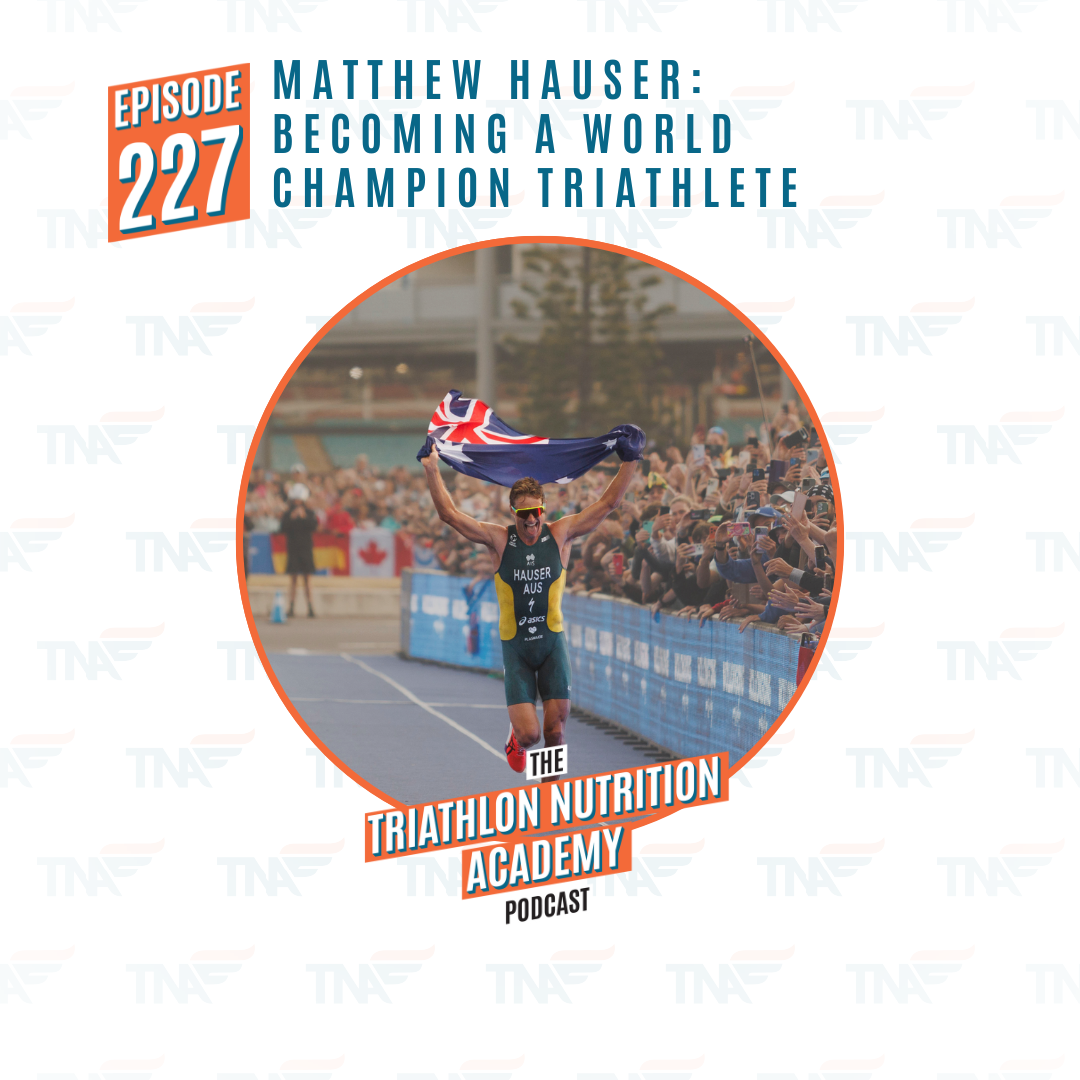
Episode 227 -Matthew Hauser: Becoming a World Champion Triathlete

What does it take to go from a promising junior to a world champion triathlete?
In this episode, I sit down with Aussie triathlete and 2025 World Champion Matt Hauser for a real, behind-the-scenes chat about his training load, nutrition evolution and what’s driven his rise to the top of the world triathlon stage. Matt shares what his day-to-day looks like, how his mindset and fuelling approach have shifted over time, and the routines that support peak performance.
Whether you're an age-grouper trying to balance work and training, or just keen to hear what it takes to compete at the highest level, this episode is packed with golden takeaways.
Links:
Check how well you’re doing when it comes to your nutrition with our 50 Step Checklist to Triathlon Nutrition Mastery
Start working on your nutrition now with my Triathlon Nutrition Kickstart course
It’s for you if you’re a triathlete and you feel like you’ve got your training under control and you’re ready to layer in your nutrition. It's your warmup on the path to becoming a SUPERCHARGED triathlete – woohoo!
Connect with me:
To learn more about the Triathlon Nutrition Academy, head HERE | dietitianapproved.com/academy
See behind-the-scenes action on Instagram: @dietitian.approved
Follow along on Facebook: @DietitianApproved
Join our FREE Dietitian Approved Crew Facebook group
Enjoying the podcast?
Let me know what you loved about it and what you learnt by tagging me @dietitian.approved on Instagram!
Subscribe & Review in Apple Podcast!
Are you subscribed to the podcast?
If not, today's the day! I'm sharing practical, evidence-based nutrition advice to help you nail your nutrition and I don't want you to miss an episode. Click here to subscribe to iTunes!
Now if you’re feeling extra warm and fuzzy, I would be so grateful if you left me a review over on iTunes, too. Those reviews help other people find my podcast and quality nutrition advice. Plus they add a little sparkle to my day.
CLICK HERE to review, select “Ratings and Reviews” and “Write a Review” and let me know what your favourite part of the podcast is.
You're awesome! Thank you!
Episode Transcription
Episode 227: Matthew Hauser: Becoming a World Champion Triathlete
Welcome to the Triathlon Nutrition Academy podcast. The show designed to serve you up evidence-based sports nutrition advice from the experts. Hi, I'm your host Taryn, Accredited Practicing Dietitian, Advanced Sports Dietitian and founder of Dietitian Approved. Listen as I break down the latest evidence to give you practical, easy-to-digest strategies to train hard, recover faster and perform at your best. You have so much potential, and I want to help you unlock that with the power of nutrition. Let's get into it.
[00:00:00] Matthew: typical week for me would look like 25 to 30 hours a week of training. 350 on the bike at the moment, 80 k in the run, and 20 k, 20 2K in the swim. So, you know, that mixed in with physiotherapy two gym sessions a week as well. Yeah, dietician consults and, and everything in between.
[00:00:19] Matthew: It's, it certainly makes up a more of a lifestyle and, and a full-time job than, And just a sport. I do.
[00:00:25] Taryn: Welcome to the podcast. I'm so excited to welcome today's guest. It is Australian triathlete Matt Hauser. Matt originally Hales from Maryborough in Queensland, but he is currently based on the Gold Coast where he has coached and trains with Dan Atkins he is family established himself as one of Australia's best triathletes on the world stage.
[00:00:46] Taryn: He definitely cut his teeth early, winning the Junior World Championships back in 2017, and has steadily climbed the ranks. Ever since he has represented Australia at multiple major international events, including his Olympic debut in Tokyo 2020 where he finished 24th and the Paris 2024 Olympic Games where he plays an impressive seventh.
[00:01:08] Taryn: He's also competed at the 2018 and 2022 Comm Games. Racing strongly as an individual with a fourth in 2018 and a bronze medal in 2022, while also contributing to bronze medals in the mix. Team Relay on the Gold Coast and in Birmingham. In 2021, Matt added another podium to his impressive resume with a bronze medal at the under 23 World Championships. In recent years, he has been a standout on the World Triathlon Championship series circuit with multiple wins and podiums. And in 2025, Matt had a breakthrough season claiming the World Triathlon Championship series title on home soil here in Wollongong, and helping Australia secure the World Mixed Relay Championship in Hamburg, achieving both of those.
[00:01:57] Taryn: In the same year is a rare and remarkable feat. He is known for his very down to earth nature, tactical smarts, and a powerful swim bike run engine. And his ability to just keep digging right to the finish line. I had the absolute pleasure of working with Matt on his nutrition during my time at Aus Triathlon from 2014 to 2020, and watching his progression from a promising junior into a world champion has been incredible, and I'm looking forward to catching up with him today and finding out whether he still enjoys a glass of red wine with dinner, despite my advice against it.
[00:02:34]
[00:02:36] Taryn: Matt, thank you so much for joining me on the podcast.
[00:02:39] Matthew: Thanks for having me, Taryn. Yeah, absolutely. Pleasure. And yeah, all those years ago, working with each other is, you know, I've got you to thank for, for everything that's come my way, so thank you.
[00:02:49] Taryn: I did nothing. You do all the hard work.
[00:02:52] Matthew: I wouldn't say nothing. Come on now. Everyone plays their role, as I said, so No, it's good to, good to reconnect you know, in a different setting this time.
[00:02:59] Taryn: So Matt, what does it feel like to be the 2025 World Champion?
[00:03:03] Matthew: 12 months before the race, I'd really set myself the target and the lofty goal of becoming world champion on home soil. And now that I've kind of reached that kind of state and uh, and whatnot, I think I can probably feel it more so through.
[00:03:18] Matthew: Other people's recognition and my support crew and, and what it means to them and, and having them along for the journey. So I think that definitely helps me soak it up a little bit more. But, uh, I still don't kind of see myself as, as one, one of Australia's like greats to, to win a world championship.
[00:03:34] Matthew: It's hard to kind of compare myself to, you know. the Chris McCormack, uh, the Emma Moffetts, Emma Snow Sills you know, all that have come before me. So I think obviously I've still got a, a fair way to go and, and maybe it's because because of that, I, I don't quite see myself up there just yet, so I've got a, a few more things to prove.
[00:03:51] Matthew: But, uh, yeah, it's certainly a nice reflection you know, looking back and, and seeing what I achieved last year.
[00:03:57] Taryn: You are very humble and it is, you're right, hard to compare yourself to those people that are, you've idolized for your entire career, but you are there. You've made it my friend, and maybe it'll sink in after you've got a few more accolades and feathers in your cap.
[00:04:12] Matthew: Hopefully, yeah, I think maybe that's what's kind of holding me back from. taking it all in so much. 'cause I know that there's still, you know, a real big job for me to do. Olympic success is something I haven't really tasted over the past two cycles, so that's something that's really motivating me.
[00:04:26] Matthew: And the fact that maybe the world champs last year wasn't as hotly contested with Alex and Hayden being outta the picture for, for the majority of the year, I think, while it was nice to, to celebrate a successful year and and campaign there in Wollongong, it was, it was very much like, I enjoy that, I embrace it, and now it's kind of back to work.
[00:04:44] Matthew: 'cause I know that the, the challenges are gonna come, you know, hot and fast, uh, in the next
[00:04:49] Taryn: typical triathlete
[00:04:49] Matthew: I know we don't, we don't let us, we don't let ourselves enjoy it too much till we, we can't. which is a shame, but I think it's also got, you know, a lot to do with the, the psyche of, of being a true competitor and, and wanting to always better yourself.
[00:05:01] Matthew: So it's a, it's a double-edged sword, that's for sure.
[00:05:04] Taryn: Yeah. And there's always more to do and more to improve and more training like Dan. Dan in particular is like, all right, next,
[00:05:10] Matthew: Yeah, yeah,
[00:05:11] Taryn: get back into training.
[00:05:12] Matthew: Exactly right. Don't let the highs get too high. Don't get the lows too low. Control what you can control and everything else doesn't matter, so, yeah.
[00:05:19] Taryn: That's good advice. So run me through what a typical day in the life of Matt Houser looks like. what do you do in terms of training, nutrition? Because I know a lot of people listening don't really have a concept of what an elite triathlete does.
[00:05:36] Matthew: Yeah, for sure. I think it's, it's still evolving, right? Like I think we've flashed back to like 15, 20 years ago and the, the sporting scape kind of looked completely different in, in our attitude towards nutrition and fuel. So I think for me, I'm, I'm constantly learning and, uh, constantly adapting and what I feel is right for, for, for getting the most outta my body.
[00:05:56] Matthew: But I've eased up a little bit on the wines. Uh, you, you'd be happy to know. Uh, I still enjoy one, one or two on the weekend, but yeah, obviously it's, uh, it's not ideal for, for recovery, uh, alcohol. So I've learned
[00:06:10] Taryn: am glad that message has finally sunk
[00:06:12] Matthew: It's fine. I, I think, you know, as, as much as you can kind of hammer it home and, and tell me and lecture me about it, I think you, it's a, it's a journey.
[00:06:19] Matthew: You have to go on yourself. Like a lot of things in professional sport, like you could be lecturing a 18, 21-year-old like junior going through the process of becoming an elite athlete and, and they, you might be one in, in one ear out the next. But for them to actually, you know, properly adhere to those.
[00:06:36] Matthew: Those lessons and teachings, they kind of need to go on the journey themselves. So that's definitely what I've done in terms of my day to day, like, you know, obviously it's about fueling throughout the day in terms of dietician and nutrition work, I've learned a lot in that space. Um. typical week for me would look like 25 to 30 hours a week of training. 350 on the bike at the moment, 80 k in the run, and 20 k, 22K in the swim. So, you know, that mixed in with physiotherapy, two gym sessions a week as well. Yeah, dietician consults and, and everything in between.
[00:07:10] Matthew: It's, it certainly makes up a more of a lifestyle and, and a full-time job than, than just a hobby. And just a sport. I do. So,
[00:07:18] Taryn: It is very much a full-time job. I don't think people age groupers in particular really understand that. You just said you did basically full-time hours of trading itself, and then you've gotta add the physio in how many times you go to the physio a week?
[00:07:32] Matthew: probably only once at the moment, but yeah, it's just, things just kind of add up, right? Like.
[00:07:37] Taryn: Massage, Massage all that. Yeah. Psych as well. Yeah, exactly right. That being said, like it is a very privileged life. Like we get the opportunity to have a nap in the AFT early afternoon, whereas, you know, a lot of age group is out there, especially for the Ironman and and half Ironman distance that they're managing, you know, maybe a 10 to 15 hour hour training load on top of a 35, 40 [00:08:00] hour week.
[00:08:01] Matthew: Um, of work and, and balancing kids and family and everything like that. So it is a privileged life. We get to do it as a full-time job, thankfully. And there's not a lot of money in the sport, but I think when you are at the top and you do have a lot of opportunities to, to kind of chase races and, and, you know, maximize your earning potential.
[00:08:18] Matthew: So, I consider myself very lucky to be living this life.
[00:08:21] Taryn: So how does your day start? What time does the alarm go off in the morning? What do you eat? What's your first session? What does it look like?
[00:08:28] Matthew: Yeah, I think if I was in Spain it'd be like eight o'clock, nine o'clock, wake up, and
[00:08:34] Matthew: then just really slowly get into the day. No one works before that. That kind of time. And that,
[00:08:40] Matthew: that's, yeah, Europe Times, it's definitely more like the pro hour times. But on the Gold Coast, when it's a bit busier out in the roads and the sun comes up really early and, and the heat.
[00:08:50] Matthew: Heat smacks down on you pretty quickly. I think it's important to get out the outta the door early. So probably I'm waking up like five quarter plus five in the morning for about a six o'clock start most days. So this morning for instance, we, we went out on the bike at six o'clock, did a three hour ride just around the Gold Coast, like zone two aerobic.
[00:09:12] Matthew: But before then I'd, I'd probably make either an aeropress uh, if I couldn't be bothered. Chucking on the espresso machine. Or an espresso or, or a flat white or whatever it be. Um, and then maybe some like muesli granola with some yogurt, uh, and, and and a banana or two. yeah, set up my nutrition. So it'd be like Morton Mix, uh, Maurten 320 mix on for my bottles.
[00:09:34] Matthew: Uh, and then like a solid, like a Maurten solid. Then maybe another banana and a muesli bar on top of that. So just quick, easy snacks at carbohydrate dense yeah, train in the morning and then probably have like a second breakfast slash brunch, uh, like mid-morning. So I think today I had like two hash browns, two eggs, a bagel with cream cheese, crispy chili oil, which I've been [00:10:00] smashing lately.
[00:10:01] Matthew: Uh, half an avocado, 50 grams of feta cheese.
[00:10:06] Taryn: Got It dialed Matt.
[00:10:07] Matthew: I know that's, that was, that was a really good bre this morning actually. That's, it's a, probably not a, probably not a typical bre, but, uh, everything was, was in the fridge and packed, so it was good. and then, you know, an hour or two later, I'd probably look to have.
[00:10:20] Matthew: Lunch, uh, probably not like a huge lunch, but just another top up on top of that brunch. Whether that be like tuna or rice or like a sandwich or a toastie or something like that. Um, and then I go into my afternoon session, which today is a swim at one 30. Uh, we'll do 5K mainly aerobic endurance with a few sprints and, and start working there.
[00:10:42] Matthew: And then after that, I'd probably, I'd probably go to the servo and get a chocky milk. To be honest, like some, sometimes I am, I am topped up and prepared with like a, a pillar performance protein shake with some collagen in there as well. Um, but other than that, I [00:11:00] probably, yeah, go to the server and get like an oak protein drink.
[00:11:04] Matthew: Maybe a pack of chips. I think that's probably something that I haven't really kicked from when I started training as a young gun on the Gold Coast to now is like I am. Um, I am partial to a chocky milk and a packet of chips from the servo post training. So anything to get it, get the fuel in just after in that 30 30 minute window.
[00:11:23] Matthew: in the late afternoon, I'll probably go for like a half hour jog this afternoon. And I find like over time I've gotten. A lot better at, uh, you know, training my stomach to, to deal with having different foods and different consistencies in there. And I think that really is, really is important, especially when you do get to the longer distance as well.
[00:11:42] Matthew: Like to be able to train your gut and to, to manage everything that you put in there. Solids, liquids and everything in between I think is super important. however, way. You can get your carbs in and get it in quick is, uh, is the most important part. And then yeah, into dinner, which tonight will be a, a barbecue and yeah, do it all again tomorrow.
[00:12:02] Taryn: I love that you're cooking for yourself and you've got it all organised.
[00:12:05] Matthew: Of course. Well, mom and dad are coming tonight actually from down from Harvey Bay, so I'm, I'm treating them to a barbecue, so.
[00:12:12] Taryn: Oh, nice. I'm sure they'll appreciate
[00:12:14] Matthew: Definitely on a normal week, it probably, it'd be like, I'd say like a five, two mix in between like either getting takeout or going out for a meal and then, and then cooking just how it is.
[00:12:26] Matthew: Life gets busy and, and you get a little bit lazy sometimes, but you can afford yourself that every once in a while.
[00:12:31] Taryn: Yeah, as long as you're eating for you, I
[00:12:33] Matthew: Exactly right. Yeah. No matter what, whether it's a packet of chips or what.
[00:12:37] Taryn: Yeah, and so what does the gym look like for you as an elite athlete? What sort of numbers are you hitting in the gym? I think that's also really important to highlight. You know, you're going twice a week.
[00:12:48] Matthew: Mm. Yeah.
[00:12:49] Taryn: What do you squat? What do you deadlift? What do you bench? Give us some numbers, Matt,
[00:12:53] Matthew: It's real. I don't bench at all. Brandon Copeland, my training partner's actually been benching at the moment, so I don't know what he's trying to get outta.That bigger chest maybe gets so. Yeah, yeah. Yeah. I'm not too sure, but, uh, look, squatting numbers, say for instance, so we build, we're building up slowly at the moment, but for a set of four by eight, I'll probably be at 80 kilos.
[00:13:16] Matthew: Um, so it's, at the moment it's like kind of higher reps, low weight, and then we'll into like the, the power phase closer to, to racing. We'll probably dial that up a little bit and bring the reps back. For me at the moment, we've been focusing on. a lot of like lower leg strength. 'cause I've actually had a bit of plenty plantar fasciitis at the moment, so trying to manage that.
[00:13:38] Matthew: That's where collagen like is having a pretty good role with that. Making sure the blood is, is working in those areas in the right ways. So yeah, in, in gym I, I tend to mix collagen and protein together and just sip on that throughout the, throughout the session to make sure I'm getting topped up.
[00:13:53] Matthew: Not just post, but, but during uh,
[00:13:56] Taryn: C in there.
[00:13:57] Matthew: vitamin C I have vitamin C in the morning.
[00:14:00] Taryn: Need some vitamin C with your collagen, my friend. I'll talk to you about that after.
[00:14:03] Matthew: All right. All right. Does it work in the same way that iron? It does with iron?
[00:14:08] Taryn: No, but it'll help, help get the collagen into your, uh, tendons where you need them.
[00:14:12] Matthew: Okay. Sweet, sweet. Perfect. I should be listening more.
[00:14:16] Taryn: Pillar, I don't know about pillar. I'll have a look for you. It might have some vitamin C in the product.
[00:14:21] Matthew: Potentially. Yeah. Yeah. I'll have to check as well. That's probably me being the bad sponsored athlete, not knowing Exactly.
[00:14:27] Taryn: to sort it out for you.
[00:14:29] Matthew: Uh, so yeah, probably 2, 2 1 hour sessions in the gym. Uh, and then focusing on hamstring strength as well. Like I've probably been. It is probably been cases and races where I've been cramping a little bit more than I probably should be, uh, in the back end of the 10 k run in the Olympic distance.
[00:14:44] Matthew: So yeah, just trying to work on all those like, specific areas that I kind of struggle and have deficiencies in. But yeah, we're not, we're not throwing big, big weight around. We're not, we're no hybrid rock stars in the gym. So
[00:14:55] Taryn: Hi rocks.
[00:14:56] Matthew: no high rocks athletes there.
[00:14:58] Taryn: you're still lifting heavier than a lot of people, I think would realise. A lot of triathletes think they're gonna get too sore by lifting weight. So you know, this guy trains 25, 30 hours a week, and two of those hours is actually lifting heavy in the gym to build strength. And I also love that you mentioned that you're doing strength to prevent cramping.
[00:15:18] Taryn: You're not sucking back magnesium powders or taking pickle juice or anything like that. You're actually building that resilience in the muscles so it's not fatigued at the end.
[00:15:27] Matthew: For sure. Yeah. I mean, cramping can be defined in a lot of areas, but mainly it's just a weak muscle. Like it's just a weak muscle not being able to cope with the demands. So strengthen that shit up.
[00:15:40] Taryn: Thanks Matt. So What is your favourite post-training recovery food of all time.
[00:15:47] Matthew: I mean, probably something that I don't have to make too much of an effort with. Like, it, it'd be like a, like a Ruben toasty from a cafe. Like something just easy. Nice carbohydrate protein mix, I guess. And yeah, something that I don't have to like, wait around 20, 30 minutes for while I'm, while I'm bonking, like,
[00:16:08] Taryn: Yeah.
[00:16:09] Matthew: I'm, I'm deficient.
[00:16:10] Matthew: So, uh, yeah, I'd say anything from a ca, like from a cafe, just like a bacon egg burger or something like that, that would be like a guilty pleasure where you know, you, you're having a treat, but it feels like you, you're feeling yourself in, in the right ways.
[00:16:23] Taryn: And something that somebody else has made for you, I
[00:16:25] Taryn: think is really important there.
[00:16:26] Matthew: Yeah. Well, yeah, you, you've done the, you've done the work, so you don't, you've already done the work this morning, so you don't wanna be cooking, cooking everything as well.
[00:16:35] Matthew: Exactly. Right. Coffee order.
[00:16:37] Taryn: your coffee order?
[00:16:38] Matthew: small, double shot, flat, white Or a piccolo. Or a filter. I've kind of been liking filters lately, so it kind of comes and goes in waves.
[00:16:45] Matthew: But yeah, small double flatty would be, would be the mainstay, I reckon.
[00:16:48] Taryn: I do remember you guys all getting a little bit nerdy on the coffee when we're on the Gold Coast together. 'cause it was, I don't know, you kind of start. You start drinking at that age and you start getting into coffee,
[00:17:02] Matthew: Yeah,
[00:17:02] Taryn: and there's some great places on the Gold Coast now.
[00:17:04] Matthew: Absolutely. Yeah. Yeah. Gold Coast does coffee and food like brunches really well. I haven't found too many like specialty coffee places, but I think they, they do the brunch really well, so that's always nice.
[00:17:18] Taryn: So you fuelled through your junior years. You know your time developing through the a IS system and now you're like a legit professional athlete. Yay. How has your relationship with food and fuelling changed over that time and was there anything that you used to do early on that you look back now and go, man, why was I doing that?
[00:17:40] Taryn: That was silly.
[00:17:41] Matthew: definitely it's changed for sure. I think back then a lot of your philosophy around eating is, is reactive rather than proactive. I feel hungry, I'm gonna eat. You know, I, I've got an empty stomach, I, I need to eat kind of thing. Whereas it's like, now I see fuelling and food as more of like a, a vessel to, to maximise training.
[00:18:05] Matthew: Yeah, kind of like breaking it down into like chemical terms. It's like these are just, this is just fuel I need to get in before a session to, to maximise my workload. Even to things where, like before races, I remember like. Even 20 15, 20 16 junior world champs, like pre-race, I was having like a foot long sub with mayo and chicken teriyaki and all these different fibers and stuff like that.
[00:18:30] Matthew: And it's like, you know, it probably wasn't the best to maximise my carbohydrate intact intake at the time. Whereas now fast forward seven, eight years, I'm, I'm having plain rice basically with honey or yogurt or something too, to dress it up a little bit. But I'm really getting banged for my, for my buck now.
[00:18:48] Matthew: And that's kind of where my relationship with foods change, where it's like, yeah, it's a lot more strategic, um, not just for the enjoyment of it, but for, for actually having a purpose behind, behind the fuelling. So yeah, definitely.
[00:19:03] Taryn: That is something that does take a lot of time and, and knowledge to build that too. And, you know, trial and error, you've kind of landed on things that you know work for you that feel good. And that's really important because your nutrition is so unique to you. And you even mentioned that in before around training.
[00:19:19] Taryn: Like understanding what training is, is best for you and what your body is absorbing. So it is an evolution. And in the beginning, you know, you move outta home, you move. Down from up north, you don't have your parents. You need to understand how to cook. You're living alone or with a buddy, and it's a huge learning curve when you don't have a lot of time in the week to, you know, make elaborate meals.
[00:19:39] Taryn: It's gotta be fast, it's gotta hit the right targets.
[00:19:42] Matthew: yeah, there was a lot of, a lot of $5 Cole's pizza days. Definitely. I remember Dan Coleman, I used to obviously live with him and he would like get a $5 Cole's pizza, but he would be like, nah, I'm gonna do it a healthy way. I'm gonna add some broccoli pieces on top. And he'd just sprinkle some broccoli pizza just like, like, oh my goodness me.
[00:20:03] Matthew: Like, this is just a bachelor's diet, isn't it? But
[00:20:06] Taryn: like Dan Coleman.
[00:20:07] Matthew: sure. Yeah. But, uh.
[00:20:08] Taryn: Oh my goodness. now you've probably got a bit more money to pay for food as well. Like people don't really realise that when you're developing, you don't have the funding, you don't have the sponsorship, you are not getting paid. So it can be a really hard battle to get to that level when you know people don't see that hard work in the background either.
[00:20:28] Matthew: Yeah, definitely food. Food is a massive limiter in that way where might be stopping off at a cafe and, you know, you kind of. Want to and need to eat, but it's like, oh no, I'm gonna wait an extra 45 minutes. 'cause I know I've got like a little bit of food at home that I can muster up or it.
[00:20:44] Matthew: It's all about investing in, in your health and your sport and, and your performance at, at the end of the day. And yeah, that's a, that's a big thing yeah, that I've learned is like, I, I don't really spend money on. Heaps of clothes or like treat myself like the treating myself is like going to cafes, like, you know, spending money on food that I know that's gonna directly like impact on my performance and my career.
[00:21:06] Taryn: That's really important. when you were first identified and supported as an elite athlete, you were very young, uh, quite early on in your career, what was that actually like growing up day to day? Did you ever feel like you missed out on normal teenager life or did that structure of triathlon and having those goals and that focus give you maybe something that most kids don't get when they're growing up?
[00:21:33] Matthew: yeah, I think obviously moving the Gold Coast and knowing a, a few people from, from the sport, uh, was able to broaden my social kind of, social skills and also just to have some mates in and out of the sport definitely made, uh, you know, the tough times a bit easier. Yeah, moving out, out of home and being independent and whatnot. I, I think talent got me a, a long way, like in those early years of being a teenager in, in a high performance environment, [00:22:00] like I did rely on talent for a lot of my, my junior years. And, and that probably made, the fact that like I was still able to do some social things, but then also back it up and training and racing a little bit easier.
[00:22:13] Matthew: You know, like, like
[00:22:16] Taryn: some wine.
[00:22:17] Matthew: drink some wine. No worries. Back it up the next day. Like that's just, you kind of feel like you're invincible back then. So in, in a way, I was kind of able to do a little bit of both. But the realisation came, um, in my early twenties, like after my first Olympics, that you know, you can't really.
[00:22:34] Matthew: Have both sides of the coin. It needs to be, you know, on either heads or tails. So, yeah, I knew that in order to progress my, my career, that that step further and not just rely on talent, but also put in the hard work as well. Um, I needed to probably cut back on a few of those, you know, teenage, early twenties, things that.
[00:22:51] Matthew: It's just natural part of life. Like, it's just you're exploring things and, and what, what you are and, and what like kind of social hangouts and groups you, you kind of connect yourself with. So, if I was told like, oh, you need to do this, you need to do that, you need to be more disciplined.
[00:23:06] Matthew: Like, I probably would've wouldn't have connected as much if as if I didn't like go through that journey myself. So, yeah, I definitely don't regret anything.
[00:23:14] Taryn: You are so young too. You know, you train like a professional triathlete from a very young age, and it's just part of the lifestyle in a way, and everyone is doing it. So it's really easy to have a really, you know, nice, fun life when you're swimming, biking, running in a week, and you're loving it, and your friends are all doing the same.
[00:23:35] Matthew: for sure. Yeah, and I think it's, it's given me so many lifelong friends and taken me to so many places and given me so many opportunities. like people speak about is all that hard work and sacrifice of hours and stuff like that worth the few minutes of, of recognition or fame or, you know, standing on the di and, and whatnot.
[00:23:57] Matthew: It's like, probably not if you just isolated it just to that one instance of recognition and, and, you know. Gold medal and whatnot. It, it's about everything that comes after that through life and, and the experiences you have and in and around it, like it, it is a hundred percent worth it. I, I'd live this life over and over and over again
[00:24:16] Taryn: Yeah. And it is your legacy forever as well. It's never gonna go away
[00:24:20] Matthew: for sure.
[00:24:21] Taryn: from the outside. Your career does look like it's been a steady rise. As you've gone through development and inter professional, but inside that process there's always ups and downs. There's always setbacks. Were there any moments throughout your career so far where you genuinely questioned whether this was the path that you wanted to do, whether it was worth it, and whether you'd actually make it as a professional triathlete?
[00:24:49] Matthew: Yeah, there was probably a few. Times I, I think what's kind of rung true throughout my whole career is like, like my belief in myself. Like I always believed I was gonna get there. It was just about like when and if I had the patience to, to be able to do so. Like when I first started out, I. obviously had a lot of success as a junior triathlete, but I thought it'd just all come to me thick and fast.
[00:25:17] Matthew: Like I, I modelled, tried to model myself around the Braley and Alistair Braley and seeing him, you know, go from like junior to under 23 to, to senior world champion in the space of just three years. Like that just meteoric rise.
[00:25:33] Taryn: Mm.
[00:25:33] Matthew: I kind of saw myself trying to attempt that too and just getting to the top as soon as possible.
[00:25:39] Matthew: And once that didn't happen and I had a few setbacks, like a few bike crashes and, and bits and pieces, like, I kind of definitely had to, to be accepting of the fact that this, this journey isn't gonna be perfect. Like searching for perfection just isn't the way to go about things. So, yeah, for me, I think just accepting that and accepting it as like a longer journey and just, just getting obsessed with like the little things.
[00:26:04] Matthew: Being obsessed and addicted to, to getting a little bit better each year or getting a little bit better each week. And just, I think the, the feeling that progression gives you in training like the, everyone can attest to it. Like, I think. You know, you're four or five weeks into a run block or something like that, and suddenly it just starts feeling that little bit easier, or you start hitting those times just a little bit more comfortably, or you start running a little bit quicker.
[00:26:27] Matthew: Like that's the most addictive feeling like on earth for me. seeing those kind of progressive states and, and getting the most outta yourself and, and bettering yourself you know, as an athlete and as a human. I think that's, that's kind of never made me truly question like why I'm doing it.
[00:26:44] Matthew: Just those little. Little goals along the way that kind of keep you going. like a golf analogy. Like if you, you may hit 17 horrible holes, but it's that last hole that if you hit a hit, a birdie or par or you just one good pu or something, like, that'll keep you coming back from more and more and more.
[00:27:01] Taryn: Triathlon is very addictive like that, isn't it? Especially when there's three sports involved. 'cause you've got so much you can tweak and finesse and, and perfect in each of the disciplines. So it's, it's never ending game of getting better and better.
[00:27:15] Matthew: that's why we love it and hate it at the same time, but mostly love it.
[00:27:21] Taryn: I can hear from what you're saying though, that you know, when I met you and we were working together, you were developing and you know, you did have a lot of natural talent and you still do have a lot of natural talent and use that to carry you.
[00:27:34] Taryn: And now I can see this big shift in you where you were thinking more strategically and. Trying to go above that natural talent and actually put in the hard work with training and nutrition rather than just using that to carry you, which is a massive shift for you, I think, Matt, and it's really good to hear that in what you're saying today.
[00:27:54] Matthew: Thank you. Yeah, I, I think it's something I now like pride myself on, but also it's probably come from being at the peak to the. Peak to latter end of my career now. It's like I'm not just, I can't just rely on time. Like I'm not like a 21, 20 2-year-old now I'm like getting to the, to the peak of my powers in this sport.
[00:28:15] Matthew: and it's gonna end eventually. So I think having it laid out to me is like a bit of a timeline and being towards the back end of that timeline now, the middle to back end of that timeline now it's like, yeah, I've gotta do everything I can to, to make the most of it while I, while I can do that. So that's, that's part of the natural progression I think.
[00:28:31] Taryn: if you could go back and speak to Teenage Matt, young and Reckless, Matt, you know, before all the medals, before the pro career, what's one thing you wish someone had told you about success or the pressure or enjoying the process and the journey?
[00:28:48] Matthew: big cliche would just to be like, oh, you know, every decision I made has gotten me to where I am now. So why, why would you change anything? 'cause I'm enjoying, I'm an enjoying like, where I am now and, [00:29:00] and where I'm at life and, and sport.
[00:29:02] Matthew: But it's probably more so just to reiterate to, to back yourself and to trust yourself. not compare yourself to others too much. You know, have, have that fuel you know, the desire to get better. But just yeah, trust what, what you have and, yeah, commit a hundred percent to it.
[00:29:17] Matthew: I think just whatever you do, just commit a hundred percent to it. 'cause yeah, opportunities will come from that. So, yeah.
[00:29:24] Taryn: No regrets.
[00:29:25] Matthew: No regrets. No regrets. No way.
[00:29:29] Taryn: One of the things that I've seen in your rise in your career also is that you've always been, you know, Matt, the triathlete. For most of your life, really. So how do you protect your identity outside of triathlon? Is that something you've had to work on? Uh, or something you don't even think about particularly is the expectations around your, I don't know, performance and public attention around you grows.
[00:29:55] Matthew: yeah, I mean, I've always been someone to, to value, [00:30:00] to, well, to try. It's been, it's been a conscious try to, to value life outside of sport as much as I do. Value life inside of the sport. Like I think for me, at times I've, I've had to learn how to do that, but it, it's, there's still a conscious effort to, to be able to do that.
[00:30:17] Matthew: 'Cause ultimately when I'm not gonna be a professional triathlete forever never say never to the age group years, but I think for, for me, I, I'll need a little bit of time away from the sport after, after my, my career's done and dusted. Yeah, just making sure that you recognize the position you're in, the, the privileged position I'm in, and, to make sure I enjoy life outside of the sport just as much and open myself up to opportunities and be, be a yes man.
[00:30:40] Matthew: You know, to a certain extent. Obviously you can't say yes to everything, but yeah, I guess just embrace life outside of the sport and, and the people that do help me kind of disconnect. you know, from triathlon and, and involve them and, and try and give back to them as much as I can where I can.
[00:30:54] Matthew: 'cause it is a selfish pursuit. It's no one's denying that in triathlon. yeah, I'm probably not the best at, at times, but I, I'm continually trying to work at it and, and to better myself off the course
[00:31:06] Taryn: Did you end up finishing your degree?
[00:31:07] Matthew: I did, yeah, 2020. That was one of the good things about COVID was I got a bit of time to, to lock in and, and knock that over as well. So business marketing at at Griffith if you don't use it, you lose it. So I probably lost it already, but
[00:31:20] Taryn: Still got the piece of paper.
[00:31:21] Matthew: a piece of paper hanging up on the wall, so I'll take that and, and revisit it when I've got a lot of AI models to. to peruse over and, and to Tar Upskill on,
[00:31:32] Taryn: So what's next for you then? You know, you've got a big campaign coming ahead. What's on the plans?
[00:31:38] Matthew: uh, well directly. It'll be the start of the World Series season, which will come in Abu Dhabi at the end of March. So kind of just preparing for that at the moment, I was able to have a bit more of an off season, which was nice, a bit of a later start starting a month and a half later than it was, than it did last year.
[00:31:56] Matthew: So, that's been nice to, to enjoy life outside of the sport for a little bit and, and disconnect. But yeah, for me it's, it's all about trying to go back to back now. The world champ in Torah, Milanos in Spain sorry, Ponte Vera in Spain this year. Like, as I alluded to earlier on it, obviously Alex and Hayden will be wanting to come back and to prove that they're, they're not out of it just yet heading into LA and, and the Olympic cycle kind of starts now with qualification and points and whatnot.
[00:32:21] Matthew: So, yeah, it just feels like massive goal, tick with the wall and gong and it's like straight back into work and straight back into the next thing. Which is kind of what you have to do as a, as an athlete, right? As we, as we spoke about. So, yeah, straight back into that, I think. I've definitely learned over the past year or so that that quality over quantity for me, really, really does work.
[00:32:40] Matthew: And if I can try and master this short course racing, you know, moving into LA and then hopefully Brisbane, if the, if the body holds up you know, I can really make something of it at the Olympic level. So, that's my goal and aim for, for now to, to focus on the simple things and yeah, to kind of perfect that short course racing.
[00:32:59] Taryn: What is your favorite or preferred distance? The Sprint or Olympic?
[00:33:03] Matthew: I'd probably say I've, I've grown to love the, the Olympic more. Like originally it was just sprint because I didn't have the 10 K endurance in my legs. But I think for me, Olympic is obviously what you do, what you take on the Olympic games. So, that's probably where I hang my hat on now. And the ability to, to have more of an influence on the race in the, in the swimming bike as well being a little bit longer and distance.
[00:33:30] Matthew: So, uh, it's more of a challenge as well.
[00:33:33] Taryn: And can you ever see yourself doing a long course event? So 70.3 or full distance sign, man, one day
[00:33:39] Matthew: Always guarantee the question every time I do a pot sporting or triathlon podcast is, when are you going long? I mean, I, I attempted to do it last year in Geelong, but obviously that wasn't meant to be when my bike broke. So, I'm treating that as a bit of an omen for now. Um, I think I'll, I'll definitely get around to it at some stage, but as I mentioned, I really wanna perfect and master the short course racing. Because I think like as soon as you start to waver or, or try too many things or, or test out too many different distances, I mean, we saw it in with Christian when he, when he tried to go Christian Blumenthal, when he went from you know, Olympics to, to long distance, back to Olympics. Like he wasn't quite the same athlete as he was once, once before.
[00:34:19] Matthew: So, I also wanna give it the respect it deserves. Like I know for me, i'll be starting from scratch basically in the, in the TT bike and, and doing stuff with positioning and, and the sports evolve so much now that, that you really need a good 12 to 18 months to be able to dial yourself in correctly to compete with the top guys and the sports just getting faster and faster and it's becoming a bit F1 like as well.
[00:34:41] Matthew: see the enjoyment and, and the thrill I get out of. Um, you know, racing competitors over a shorter, sharper, more intense distance, where, you know, adapting to each move and, and variety of factors throughout the races is the thing that gives me the biggest kick out of the sport. Not just holding power or, or racing [00:35:00] within yourself for, for a long period of time.
[00:35:01] Matthew: So I'd rather go faster for shorter rather than slower for longer.
[00:35:06] Taryn: And the type of racing that you do as an elite is so much more tactical too, because it is, you know, draft legal in the bike and there's so much that can be done on a course to make or break an event. In an event like that.
[00:35:20] Matthew: Definitely. Yeah. And I think the way short course is going now, and it's always evolving, but it's probably heading back towards like the Brownley era where it's like you really do have to be a complete triathlete across the board, swim, bike, and run. And whether that's necessarily true over the longer distance.
[00:35:36] Matthew: Uh, is probably yet to be proven. You know, a lot of guys can kind of bluff their way through the swim and sit on feet and really be an Uber bike and a, and a decent runner and be up there somewhat. So, all in all the sport's got a long way to go, but, uh, I feel for me, my niche is, is certainly suited to the shorter stuff.
[00:35:52] Taryn: Yeah, and any Super League events on the cards for you, those look super fun.
[00:35:57] Matthew: For sure, definitely always a lot of fun. Uh, the, the format's kind of changing again this year, so there might be a few clashes of dates. So I'm yet to kind of work through that. But obviously the, the main priority is, is focusing on world champs. So. I might have to make a few, few decisions around that, but yeah, certainly a lot of fun racing and it feels just like one big family traveling around the world smashing each other for 10, 15 minutes at a time.
[00:36:22] Matthew: So it's, and there's great production value, and it's a production value that's been you know, now combated with the T 100 and, and all those. All those, um, those formats as well. So it's, it's all, they're, we're all pushing the sport forward and we're just, it's just super lucky to be in a sport where we have so many opportunities and distances and varieties of distances to, to race in these days.
[00:36:44] Taryn: Yeah, it's made it a much more spectator friendly sport too, which has been nice.
[00:36:49] Matthew: definitely, yeah. Yeah. It's nice to get the recognition. It, it'll still. Be a participation sport for, for a long time to come, I think. But I think slowly we're, we're marketing and, and we're putting it out there and we're dressing up nicely for, for everyone to consume.
[00:37:03] Taryn: Yeah, there's something like 2.8 million triathletes worldwide or something like there's a lot,
[00:37:08] Taryn: and It's only going up every year.
[00:37:09] Matthew: It's pretty amazing. I remember like back in school when. People would ask me like, oh yeah, when's your next marathon, Matt? Like, when you doing your next marathon? It's like, I don't do marathons, I do triathlons. It's a swim bike and run. Like, you gotta really dress it out to them and spell it out.
[00:37:23] Matthew: But I feel like now it's becoming a little bit more mainstream. you know, obviously the COVID era brought a lot more runners and endurance athletes into the picture, and now they're, they're probably trying to find a different and, and more unique challenge and kind of. Transferring across the triathlon now, which is super cool.
[00:37:39] Matthew: And, uh, I hope it continues to, to happen. 'cause ultimately we, we love the sport and we want it to, to grow.
[00:37:45] Taryn: Yeah, I agree. It's a great sport. Well, Matt, thank you so much for joining me today and fitting me in between your three training sessions that you've got on and amongst all the eating, it's been so good to connect with you again after about five years I think it's been, and just to see how much you've grown.
[00:38:01] Taryn: It's so good to see, and I love how much thought you put into your nutrition.
[00:38:06] Matthew: Thanks Taryn. Yeah, I appreciate it. Yeah, so it's, it's a learning curve. It always is. And obviously I'm still learning now, but yeah, it's been, it's been a good journey. So, so thanks. It could be nice to reconnect.
[00:38:16] Taryn: Good luck for the next, I don't know, eight, 10 years of your career. I've been watching from afar and I've been so proud, but so good to see you dominate the podium and just mop everyone up and I look forward to seeing that happen in the future.
[00:38:29] Matthew: Thank you very much. Appreciate it.
Thanks for joining me for this episode of the Triathlon Nutrition Academy podcast. I would love to hear from you. If you have any questions or want to share with me what you've learned, email me at [email protected]. You can also spread the word by leaving me a review and taking a screenshot of you listening to the show. Don't forget to tag me on social media, @dietitian.approved, so I can give you a shout out, too. If you want to learn more about what we do, head to dietitianapproved.com. And if you want to learn more about the Triathlon Nutrition Academy program, head to dietitianapproved.com/academy. Thanks for joining me and I look forward to helping you smashed in the fourth leg - nutrition!