
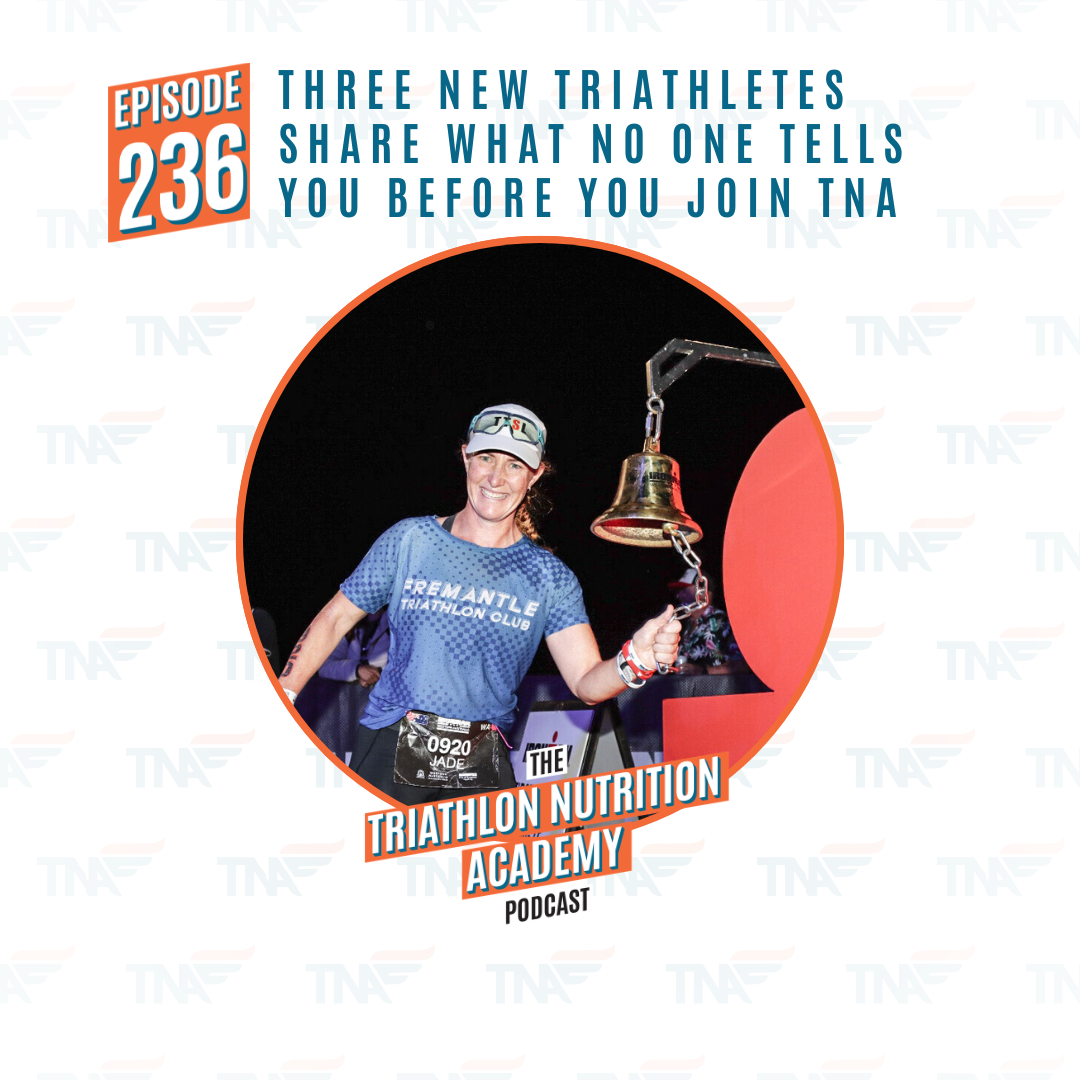
Episode 236 - Three New Triathletes Share What No One Tells You Before You Join TNA

What actually happens when you stop winging your nutrition and start doing it properly?
In this episode, I’m joined by three brand new Triathlon Nutrition Academy athletes who are right at the beginning of their journey and still remember exactly what it felt like on the outside looking in.
From sitting on the fence for months (or years), to finally taking the leap, they share the honest truth about what held them back, what surprised them most and the changes they’ve already noticed in just a few short weeks.
If you’ve ever thought “my nutrition is probably fine” or quietly closed the tab when looking at getting help, this conversation is for you.
Links:
Check how well you’re doing when it comes to your nutrition with our 50 Step Checklist to Triathlon Nutrition Mastery
Start working on your nutrition now with my Triathlon Nutrition Kickstart course
It’s for you if you’re a triathlete and you feel like you’ve got your training under control and you’re ready to layer in your nutrition. It's your warmup on the path to becoming a SUPERCHARGED triathlete – woohoo!
Connect with me:
To learn more about the Triathlon Nutrition Academy, head HERE | dietitianapproved.com/academy
See behind-the-scenes action on Instagram: @dietitian.approved
Follow along on Facebook: @DietitianApproved
Join our FREE Dietitian Approved Crew Facebook group
Enjoying the podcast?
Let me know what you loved about it and what you learnt by tagging me @dietitian.approved on Instagram!
Subscribe & Review in Apple Podcast!
Are you subscribed to the podcast?
If not, today's the day! I'm sharing practical, evidence-based nutrition advice to help you nail your nutrition and I don't want you to miss an episode. Click here to subscribe to iTunes!
Now if you’re feeling extra warm and fuzzy, I would be so grateful if you left me a review over on iTunes, too. Those reviews help other people find my podcast and quality nutrition advice. Plus they add a little sparkle to my day.
CLICK HERE to review, select “Ratings and Reviews” and “Write a Review” and let me know what your favourite part of the podcast is.
You're awesome! Thank you!
Episode Transcription
Episode 236: Three New Triathletes Share What No One Tells You Before You Join TNA
Welcome to the Triathlon Nutrition Academy podcast. The show designed to serve you up evidence-based sports nutrition advice from the experts. Hi, I'm your host Taryn, Accredited Practicing Dietitian, Advanced Sports Dietitian and founder of Dietitian Approved. Listen as I break down the latest evidence to give you practical, easy-to-digest strategies to train hard, recover faster and perform at your best. You have so much potential, and I want to help you unlock that with the power of nutrition. Let's get into it.
[00:00:00] Taryn: I'm so excited for you to wrap this episode around your ear holes because I'm joined by three brand new fresh TNA athletes, each with a unique story about how they actually got here. Jade is a mom from Western Australia. She's been doing triathlon for a few years now and completed her first Ironman in Busso in 2025. She found TNA year ago before she actually joined and has spent that time following along, listening to the podcast and quietly saving in a secret bank account. Jade, welcome and congratulations on finally getting here.
[00:00:31] Jade: Ah, thank you. Hello. It's great to be here.
[00:00:34] Taryn: Kurt joins us all the way from Laguna Vista in Texas. He first came across TNA when I was on another podcast all the way back in 2022, and has spent the last few years saving up, watching along on the sidelines and watching his buddy Kelly Estes, our alumni, and COO getting fitter and faster and just leaving Kurt in the dust.
[00:00:55] Curtis: Yes. I really hope that that I someday can be as fast as Kelly with your help.
[00:01:00] Taryn: Watch out Kelly. And finally, Steve is based in San Diego, California. He is 71 years young and he has been a triathlete for 30 years. He probably has more racing experience than most of us will ever accumulate. And yet this is the first time ever getting proper nutrition education.
[00:01:19] Steve, I wanna hear everything about your story. Welcome.
[00:01:22] Stephen: Thanks I, it's great to be here and I'm anxious to share what my experience is good and bad have been.
[00:01:27] Taryn: Thank you so much all of you for diving in the deep end with me today. I know we've only just met and you're already like, sure, I'll be on a podcast with you, Taryn. So it's testament to the type of people that you are. What I'm so grateful, but I wanted you to share your story because you are in a really unique position because you're still.
[00:01:44] In the very beginning of your journey of nutrition education, and you still remember what it was like before, you know, on the outside Your journey is to get here, all look very different.
[00:01:54] And I'd love to hear from all of you about how you came to join TNA. So can I start with you, Steve? What on earth took you so long? You've been a triathlete for 30 years.
[00:02:04] Stephen: Yeah, and I think I've made about every mistake that you can make, um, nutrition wise, equipment wise, and everything else. yeah, I changed coaches about two years ago and the new coach asked me about my nutrition planning and I said, well, I, you know, I just kind of do what I've been doing for a long time.
[00:02:21] I mean, I put a couple scoops in a bottle and, you know, I don't really have a. Really dialled in target. I just kind of wing it. And she said, why are you doing that? You've been doing the sport for so long. You, you probably lay out all your equipment. You're probably really particular about the bikes you ride.
[00:02:37] Why aren't you being particular about your nutrition? And around the same time we were having these conversations, the, the TNA podcast popped up in my feed somewhere and I began to follow it. And so I looked into it and, and, uh, decided to. Take the plunge because I'm always looking for ways to learn new things and looking for ways to grow.
[00:02:57] I've done over 300 endurance events. That doesn't mean I know everything there is to know about it. There's a lot I still have to learn about it.
[00:03:03] Taryn: I'm so glad that you're here though because oh, there's so much that we can do together and you have really good racing experience. Imagine what you're gonna be like when we layer in the nutrition aspect to that as well. It's so exciting.
[00:03:14] Stephen: the guys in my age group, uh, cowering in fear already.
[00:03:18] Taryn: And Jade, you watch from the sidelines for 12 months. We met about, well, a bit longer than 12 months ago in something that I ran called Endurance Essentials. What finally got you over the line?
[00:03:29] Jade: yeah, I was really intrigued by the endurance essentials. it was a big commitment, um, signing up and training for the Ironman, so I just was unsure how I was gonna fit it all in. Um, so I just, yeah, listened along, and. I dunno, just something inside me said that it just wasn't enough.
[00:03:47] Just not being able to find exactly what I needed, for me. so yeah, 12 months-ish later I was ready to take, take it on and, um, see what else I could do with the support of nutrition.
[00:04:01] Taryn: And can we publicly talk about the secret bank account?
[00:04:03] Jade: it was nice to, um, make that investment into yourself when you are constantly sort of putting your family first, um, and everyone else. So, um, I think it was just, you know, a growing experience for me to just say, Hey, this is actually really important to all the time that I'm investing. Into, into something. So why not, you know, invest properly into something that's, you know, really healthy and important.
[00:04:26] Taryn: Yeah, good on you. It's so important for moms to look after themselves, but you're right, We look after everyone else first and put ourselves last. So it is a bit scary sometimes to do that for yourself, but good on you for doing it. And Kurt, you've watched along from the sidelines also for four years, I think, and you've watched Kelly get fitter and faster and like I said, leave you in the dust.
[00:04:49] Why did you decide to jump into the Academy program now?
[00:04:52] Curtis: I finally had the, the money stashed away. I, my secret bank account finally came through. I was sick and tired of not having the energy. Uh, my wife was sick and tired of me bonking every two hours and getting hangry. I thought I knew what I was doing, but, Obviously I didn't have it all put together.
[00:05:12] Taryn: So, Kurt, you, you heard about TNA years before you joined, and you did, like you said, make that deliberate decision to save up for it and dive in when you're ready. A lot of triathletes look at the price of the program and just quietly close the tab. What was it that made you keep coming back rather than just moving on and saying, you know, it's too expensive.
[00:05:33] I'm never gonna do that.
[00:05:34] Curtis: Well, yeah, I'm, I'm frugal, so I don't even own a new bike. My, my newest bike is 10 years old and has already competed at Kona, so yeah, I, I couldn't see spending the price of a, a brand new bike on, on the course, but I couldn't finish the race. properly. I, I didn't have the energy to finish the race. I didn't, honestly, didn't have the energy to make it through my day without bonking, just going to work.
[00:06:02] So I knew I needed help. Every, every time I listened to you or Kelly, it was just a no brainer that you had the information I needed, and I just had to find a way to, to get into the class.
[00:06:14] Taryn: I'm glad you're finally here. So, Jade, when you first came across the TNA program, you were already training for an Ironman. You're working four days a week, you're raising young kids, like life is busy, and finding time for yourself was a big one for you and, and how you're gonna actually commit. At the time to do it, was there something that you were telling yourself back then about how this just would, would fit or wouldn't fit, and what made you realize that you had to do it and you had to prioritise it in your week to get it done?
[00:06:43] Jade: Yeah, I think, uh, I spent that 12 months just being totally unaware of what Iron Man training would involve and, and how that would fit into family life, and knowing that when I signed up to that. my main priority was not to let it affect my time with my family and friends. so adding on another commitment on top of that for that time seemed impossible.
[00:07:07] But, after the 12 months and realising what was involved and what I could actually achieve and manage. I just couldn't let go of this nutrition piece. There's just, it was so much out there and it's just so important to support all of your training that when I signed up again for Ironman, I just knew that this was gonna be the piece that was gonna help support me through another year of training and make me, Be able to have the energy to continue training and continue life, without, being tired and, and giving up the things that were ultimately so important to me.
[00:07:40] Taryn: How you going? You're in, you're in the phase one, you've just started. How are you going with the time commitment? Is it how, how long are you spending a week, do you think? And have you had to let go of anything to fit it in?
[00:07:49] Jade: no, it's actually, I've been really surprised about how I've been able to manage fitting it in. Um, obviously training's a little bit less at the moment, but, the power hours are great to talk about what you've done in the masterclass and the masterclasses have been a lot, shorter than what.
[00:08:04] I thought they would. So, you know, that sort of half an hour to an hour is totally manageable to find. and then to consolidate all that learning in the power hour and listen to other people's perspectives has just been really important. So yeah, I've, I've felt like I've, it's been great to, again, invest that time because we do all have the time.
[00:08:24] But, you know, we'd probably waste it on things like scrolling. So it's nice to be able to make, making use of that time rather than just, um, yeah, just wasting it away.
[00:08:33] Taryn: I think it's what you value. I say that all the time, but it's, you'll make time for what you do value and if you do value your health and your nutrition and your exercise, which we all do as triathletes, and you find the time, 'cause gosh, you can find the time to swim, bike, and run in a week. I think, you know, if you do value it enough, you can find the time to spend an hour or two on the fourth leg as well.
[00:08:55] Jade: Absolutely. Absolutely. And yeah, you're, you're keeping your body healthy. It's what you're putting into this body that's carrying around in life every day. So it really should be at the forefront of our mind and not something that's, you know, just put or pushed to the side. Why we aimlessly do things that don't really matter.
[00:09:12] Taryn: So Steve, you've been a triathlete for 30 years, which not many people can say. You've raced, you've trained, you've figured out a lot on your own. Be honest with me. Did any part of you think that you probably had your nutrition sorted already? And what did week one due to that idea?
[00:09:31] Stephen: So I always just kind of hand waved the nutrition part, but as I've gotten older, I've had a few more instances where I had. Struggled during races, you know, during 70 point threes bonking on the bike, and then having to walk a long ways hitting every aid station up for as much Gatorade and Coca-Cola as I could pound down before I could start running again.
[00:09:55] Uh, so that was a, a part of the driver for it. And, and when I think about it, um, you know, as triathletes we always talk about free speed. Right. If you can draft someone on a swim, that's free speed. Uh, if you can get a little more aerodynamic on the bike, it's free speed and so on. And I, after the first week, I thought, you know, this is like free speed too.
[00:10:14] If I can figure out what it is I've, I haven't quite been doing right at my nutrition. And it allows me to have a more consistent effort that is gonna be like free speed that is gonna help me perform better. So, yeah, so that's what I saw immediate almost immediately is like, wow, I expected a lot, but this is great.
[00:10:35] Uh, this is really a lot of resources that are gonna dial in what I need specifically. And that's one of the things that I noticed that you do for every one of the athletes who are in your program, is you find a way to dial in that nutrition message for their unique needs.
[00:10:50] Taryn: What's one thing that you wish you had have known 10 years ago that you've already learned,
[00:10:55] Stephen: To eat more before a race, to not just, uh, uh, skimp. Um, because I was worried about having a bunch of food in my stomach. Before a race, and usually, especially before real high profile races like national championships, I get very nervous. I, I think everybody does, and it's really hard to make myself eat.
[00:11:15] But I've been, um, practicing the things that we've talked about, uh, in the course, and I've noticed a difference. I've noticed, uh, I've done a couple races already this year and I've noticed I did feel better by, by, uh, upping the. The grams of carbohydrates before the race, as, as you suggested, this past weekend I did a long bike ride and it has a very difficult hill at the turnaround point on that course.
[00:11:40] I pounded a lot more carbohydrates than I normally would. On that ride, I got to that hill. I just rode up the ride. I turned around and I came back and I felt pretty good and I felt a little bit more engaged mentally during that ride too. So I think it was pretty noticeable because it was about, uh, double the, uh, grams of carbohydrates that I normally would've taken on a ride.
[00:12:00] Taryn: There you go. It's amazing what a bit of extra fuel does. Hey, it doesn't take much though to notice the difference. What would you say then to maybe not the other guys in your age group, but other experienced athletes who, you know, think at this point of their career, they've been doing it for a long time, like, is a nutrition program or educating yourself on nutrition at this stage of your career really worth it?
[00:12:23] Stephen: Well, absolutely. If you're still passionate, you're still competing as you get older. Um, I, I don't think I'll ever stop until I have to, and, uh, I know
[00:12:31] other.
[00:12:32] Taryn: nineties? Are you gonna bust those age group categories for the men?
[00:12:36] Stephen: Uh, I don't know about Kona. Maybe Honu. Certainly lava man. One of my very favorite races. but yeah, I hope to keep doing this into my nineties. Uh, I'm, I'm. In pretty good health, and I come from a long lived family, so maybe there's, maybe I have a shot at doing that. One of my heroes was, uh, bill Bell. He was a local triathlete.
[00:12:56] He's in the, uh, USA Triathlon Hall of Fame, and he was still competing in local races into his early nineties. And so I look at that and I say, well, you know, if, if everything else, a little bit of luck, um, a little bit of hard work and uh, maybe I can get there too.
[00:13:11] Taryn: Maybe some more fruits and vegetables, we can improve your health span. I'm, I'm down for that.
[00:13:16] Stephen: yes, very much.
[00:13:18] Taryn: So you all found a way to get here one way or the other, and now that you're actually in. Can you share a little bit about what it's like? You're like, we're only just weeks into the program. It's all still very fresh and so far we've been tackling our day-to-day nutrition strategies and making sure your daily training nutrition is optimised for whatever training program that you've got.
[00:13:38] What has been maybe one of the biggest things that surprised you about actually being inside the program compared to what you expected from the outside?
[00:13:47] Curtis: So the biggest thing I found right off the bat was how terribly under fuelled I was. Constantly, I guess I was equating, calories as carbohydrates and, that's a myth that you should not fall into. Uh, carbohydrates are specialised calories, you know, the energy in our tank. so I was trying to manage my calorie intake and sacrificing my carbohydrates and so I was.
[00:14:16] Terribly under fuelled on all my training. I had, you know, DOMS uh, you know, the delayed muscle soreness, you know, it would show up two days after a hard workout. I'm not noticing that as much. And I, you know, I recovered from a 70.3 and two days. I was out running again today and felt really comfortable.
[00:14:36] Taryn: Jade, what about you? What's one thing that surprised you now that you're in?
[00:14:40] Jade: yeah, I think for me, uh, it was prioritising the recovery nutrition. you know, last year during an increase in training, I realized that obviously a lot more food and, and fuel had to be consumed, but I wasn't prioritising, the recovery side of it. So if I felt like I'd had a big ride or a big [00:15:00] run. And I rushed off to something, my nutrition for recovery might not be until the end of the day, which is just totally not recovery, nutrition then. I've been really focusing on, on that and yeah, it just helps you get through the day, uh, and feeling great from it. yeah, it's just something that you can make these adjustments straight away.
[00:15:19] It's been, it's been really great.
[00:15:21] Taryn: And just thinking outside the square a little bit too. Like if you're busy and you've got other people to look after you get your training done and you're like, all right, next, you've wrangled your kids into helping you get your perfect recovery meal sorted and handing it to you when you're done. Like, that's perfect.
[00:15:36] You do whatever you gotta do.
[00:15:37] Jade: I have, uh, my, my eldest, he is 11 and he's loving cooking. So yeah, we are talking about what I need, what my requirements are, and he helps me find that. So, um, it's also, um, you know, being a, a health and peer teacher, it's great to be I partying some of that knowledge, into my kids and to, and to share something that's really important to fuel our bodies as well.
[00:15:59] Taryn: What about you, Steve?
[00:16:00] Stephen: You said a couple things early on in the course that really stuck with me, and one of them was, um, a typical, uh, triathlete who goes out and races or does a really long bike ride and comes home and crashes on the couch and is useless for the rest of the day. And I thought, guilty, I've done that many times. So, um, maybe there's a solution to that. And, uh, so that was one of those, those things that really stuck with me early in the course and that I really took to heart.
[00:16:26] Taryn: And then what's one thing that you guys have changed straight away, you know, from the first few weeks? What's one thing, like JJ mentioned, your recovery, nutrition, and actually changing the timing of that, which is a really great example. One change you've made already that you've applied, that you're doing differently compared to a month or two ago.
[00:16:44] Jade: pre-training nutrition as well, it was something I would just get up and go and do something and I wouldn't ever think about the fuelling. You know, a lot of my training was in the morning, so it would just be jumping outta bed and just straight down, um, getting out for a runner on the [00:17:00] bike and just no.
[00:17:01] Thought into I should be doing to fuel. And that's, you know, coming off the back of, you know, sleep. You probably need to do that. Well actually, you don't probably do need to do that. And so, yeah, I've really enjoyed, um, to fuelling myself and, and allowing myself to be in a better space with energy to, to use while I'm, I'm doing those training sessions.
[00:17:23] So that's another thing that, um, was sort of come up early In phase one and with things that I could implement straight away. And that's been like something great, um, that I've really enjoyed as part of the program. It's something that we are learning and we can apply straight away. We don't have to wait for a long time to put it into action.
[00:17:42] It's just sort something we're putting in instantly.
[00:17:44] Curtis: periodisation, I used to, well, a lot of fasted, um, training in the mornings. I don't do that anymore. I would eat for tomorrow's run instead of, uh, recovering. So learning how to eat during the, you know, llwhat to eat during the day based on what you did and what you expect, instead of just thinking it's all tomorrow's fuel has been a great help.
[00:18:10] And, you know, so I, I'm recovering faster. I'm, I'm going to, you know, maintain muscle, build muscle faster. I'm really looking forward to, um, becoming a better triathlete by eating when I need to, what I need to.
[00:18:23] Taryn: I am looking forward to that too for all What about you, Steve? What's one thing that you've already changed or applied? You've already mentioned a couple.
[00:18:29] Stephen: Yeah, so as an older athlete, it's really important that I do strength training and I do it three days a week. And what I never used to do, and I'm doing now is having a little bit of protein right before the strength training and a little bit of protein right after. you know, the. Benefit to me of the course is that it is forcing me to be much more mindful about things like that, about the timing and the type of nutrition that I'm taking in.
[00:18:56] Taryn: So you might being much more proactive. I think you all are rather than reactive, which is where a lot of triathletes sit with their nutrition. They, uh, take a reactive approach and you wait till you're hungry to start fuelling on the bike or outside of training, you fall into a bit of a hole in the afternoons and that's where you start to crank up the snacks 'cause you think you need more.
[00:19:17] But if you actually plan what you're doing. From the moment you wake up to the moment you go to bed and become more proactive around your nutrition, it all kind of just slots into place. only after a few weeks in, how are you feeling about your nutrition system? how dialled in do you feel it is now compared to what it was before?
[00:19:36] Curtis: It's way better than it was before. But I've, I'm new to this, I'm still a novice. I, I have to shop on purpose. Instead of, um, just filling the cart I have to eat on purpose instead of just filling a, a. A hunger need, that is something I'm, it's gonna take a little bit to get used to, but, uh, I've come a long way so far and, but now I know that I, I do need to, look at it more in depthly and, uh, make it happen on purpose all day long instead of just three meals.
[00:20:07] Taryn: Until it becomes habitual. I think it's gonna take a bit of time to get it to be habitual and you don't even have to think about it, which is why we have a nine month program gives you the time to do that without being overwhelmed. How are you going with that, Jade?
[00:20:22] Jade: Uh, yeah, there's definitely, um, weeks that are better than other weeks. Um, but it's always about being mindful And wanting to improve. I mean, it's not always gonna be perfect, but it's about trying to work towards being consistent, um, and reflecting on that and seeing how you feel. Like if you don't, if you feel good when you're doing it, you're more likely to keep doing it, which is, is the case.
[00:20:44] And then when you don't do it, um, you feel the effects of that and you quickly realise that you need to make the adjustments. So, um, yeah. I'm looking forward to, we've got school holidays here in Perth. So I'm looking forward to really sitting down and consolidating all the learning, and, [00:21:00] and making a bit of a plan going forward to help me, um, sort of create those more consistent habits.
[00:21:05] Taryn: Hi, new Steve.
[00:21:06] Stephen: It's better than it was. It's not where I want it to be yet, but I look at it as a process and I'm pretty patient about adapting to changes. So I'm looking forward to some great results down the road. You know, I think the guidelines that, that you've given, and I know you've got more to give, um, those have been very helpful on, on forcing me to challenge my assumptions about what I had been doing and to take a pretty honest look at what I really need to do to nail my nutrition.
[00:21:35] Taryn: Thank you all for sharing that. I think it's really important message that like we can't fix your nutrition in one week or two weeks. Like it is a process. We've all been eating our whole lives and we've got these habits and behaviours built basically from childhood. So as long as you. Respect the process in a way, and you're patient.
[00:21:56] We will get there in time. But these guys have all shared how differently they feel after only just a couple of weeks of getting some of those key components dialled in, like recovery, nutrition, and pre-training, nutrition. And you know, Steve's already training better. Well, everyone's already training better and racing better, which I think is amazing. We have a lot to go. We've still got phase two and phase three. To go in the program, uh, where we start to really dial in all of your race nutrition strategies and everything that goes along with that. So things like carb loading and your pre-race meal, your hydration, your electrolytes, like all the things.
[00:22:31] What are you most excited to learn about coming up in the future?
[00:22:34] Jade: probably learning, I think carb loading is one that gets thrown around so much. there's obviously a way to do it and it's so individualised. So it's something that I'm really looking at forward to getting to know what I specifically as who I am, um, need rather than just sort of going off the cusp of what other people say and winging it. did a version of it last year. but I'm really looking forward to being able to yeah, dial that into what's specific to me, because it is a term that just gets thrown around and I think people say, yeah, I'm carb loading, but don't necessarily have a plan or something that's really specific to them.
[00:23:11] So yeah, that's probably something I'm really looking forward to in the next stage.
[00:23:15] Taryn: It's coming soon.
[00:23:17] Curtis: And Taryn, you keep teasing us saying that it carb loading is not pasta the night before a race. And
[00:23:24] I, I'm looking, I'm looking forward to how long before the race we start doing the carb load and hopefully we talk about fibre too. 'cause I'm scared to death of fibre the day before a race. and I think a lot of people are.
[00:23:38] Taryn: I promise we'll talk about fibre I won't go too deep on all of the nitty gritty of gut issues, although we do get pretty comfortable with each other in Power Hour that we share all those sorts of things openly, and it's fine. Everyone struggles with that in one way or the other.
[00:23:52] Stephen: I've got a unique race situation coming up in about seven weeks. I'm going to multi-sport nationals. I'm gonna do five national championship races in three days, and that they're not long races. The longest race will be under two hours. Um, some of the races will only be 25 minutes, but that is a pretty unique situation in terms of planning.
[00:24:14] Your race nutrition, your recovery, nutrition, and then two hours later you're putting on your wetsuit again and you're hopping in the water again. So I'm looking forward to whatever help I can get. I've done this particular race format many times in the past where I've done multiple races in multiple days, uh, but I've never had anybody come up with a good solution for. What should I be doing with my nutrition before, during, after, and, and then a quick turnaround and going out a very hard effort again?
[00:24:45] Taryn: I'm excited to do that with you. Make sure you bring that to Power Hour and we'll go through it in detail.
[00:24:50] That is a unique situation, but there's lots of things you can do right there to set up each race for your best performance by towing the start line, feeling super comfortable and fuelled and not bonking or heating a wall or just building that fatigue as we go through.
[00:25:04] So yes, we can definitely do that in powwow. That sounds amazing.
[00:25:08] Stephen: That that's great. 'cause my experience has been race number five is kind of a suffer fest. So anything we can do to help with that.
[00:25:18] Taryn: So if, if there's a triathlete listening right now and they've been watching along like you guys did for a while, and they're on the fence, maybe they've been following the podcast for a long time. Uh, they've checked the price and they've quietly closed the tab and it's feeling super uncomfortable, what is one thing you'd love to say to them?
[00:25:35] Curtis: Well, I would definitely tell people that if you're looking at a brand new bike. Triathlon Nutrition Academy will last you a lot longer than that brand new bike, and it will also shave more time off of your encore's time than that new bike will. So this is a steal compared to some of those new carbon fibre bikes with much better return.
[00:25:57] Jade: Yeah. I'd go along the same lines that this is like far more than just a 12 month investment. This knowledge that you acquire, puts you in the driver's seat. Of your nutrition. It's not just something someone else gives you. so you sort of sit there and you know exactly why you are doing things. And it, it doesn't just end after 12 months, it's gonna last you a lifetime.
[00:26:19] And as long as you wanna do triathlon, it's gonna be there with you. So you can keep adapting everything that's going on with. What you are doing, um, as you are getting older and, and making sure you're still continuing to hit those, so those marks. Sorry. yeah, it's, it's not just, oh, it's this much for this long.
[00:26:39] It's actually an investment into your future, um, and into your, into your health and your performance going forward. So yeah, it's, for someone that did sit on the fence for 12 months, I'm glad that, I have sort of. Stepped in to doing this nutrition academy, because I know that it's gonna last me for a really long time.
[00:26:57] Stephen: And I would, I would tell anybody who was on the fence that they've made the commitment to a multi-sport lifestyle or triathlon lifestyle. Um, most people just don't do one and done, they do it for many, many years. And this is an investment that that'll continue to give you returns that entire time. And as, uh, Curtis and Jade have said, you know, you're, you're making an investment that's gonna go beyond just equipment and, and give you, um, a much more satisfying experience.
[00:27:26] Taryn: And you know what? When your $20,000 carbon fibre bike is broken, your body will still be going strong.
[00:27:33] Curtis: I will say that watching other athletes this weekend, not having a, a nutrition plan was terrible for me to sit through. And then, you know, we haven't done on race nutrition yet, but I had so many more options with what I had learned than just relying on the unknowns of what's at the aid stations.
[00:27:55] And it was, It was so adaptable. I, it was great. I didn't feel trapped into, oh my God, I gotta get to that next aid station. And I, I hope they have this, that, or the other thing is, 'cause I, I was prepared to pivot every time at every aid station, um, because I had a little bit more knowledge about what each individual fuel was gonna do for me.
[00:28:17] Taryn: Yeah, it's so crazy that people go into a race with no plan. It still happens. I dunno why, but it still does, which blows my mind. Particularly for long course. I've seen athletes do a full distance Ironman and. Go, I'll just grab whatever's at the aid station. And now we've got the pH 1000 electrolytes as the sports drink option and carbohydrate coming from Morton gels and solids.
[00:28:43] So if you, you are relying on sports drink for your fuelling. And you didn't have a plan. I just just have no idea how you'd do that, particularly with type tray, type A personality, triathletes, right? Everything is organised, everything is planned. Like Steve said in the beginning, we lay all [00:29:00] our gear out, we make sure our bike is working perfectly, and then we completely forget about the nutrition component.
[00:29:05] Doesn't, doesn't make any sense to me.
[00:29:08] Curtis: I did make one mistake. I thought they were gonna have chocolate milk at the, uh, finish line, and there was no chocolate milk. I had no protein till I got back to the hotel room. it was a bummer.
[00:29:18] Taryn: But at least now you know what you need to do after a race. So that's a mistake that you're not gonna make again 'cause you'll have a backup plan.
[00:29:26] Curtis: Yes.
[00:29:27] Jade: Yeah. I used to be scared of, uh. Eating around it because I just, I'd watched videos and things of people having mishaps with their nutrition and I was like, I do not wanna be one of those people. 'cause if I feel sick or if I am sick, like I'm done and I don't wanna waste, have wasted my time. So for a lot of time there in training, I just used to not have anything at all.
[00:29:51] And, um, now I sort of look back and think, God, how did you even do that? yeah, I definitely am, uh, yeah, grateful for the knowledge I have [00:30:00] now to put that fuel in and, um, not be afraid of it being a detriment to my performance, but actually enhancing my performance.
[00:30:08] Taryn: And what's next on the cards for you all? So, Jade, you're doing Busso Ironman again, and we're gonna smash your time of last year. Steve, you're doing your crazy
[00:30:18] Jade: Uh, yeah, I hope so.
[00:30:19] Taryn: day.
[00:30:20] Stephen: Multisport nationals. Yeah. In May. Yeah.
[00:30:25] Taryn: Kurt, what have you got on the cards next?
[00:30:27] Curtis: I've got a half dozen, uh, Olympic distance, uh, throughout the summer, so I'm looking at PR in my favourite race.
[00:30:35] Taryn: What's your favourite race?
[00:30:37] Curtis: Spud man.
[00:30:40] Taryn: Uh, nice. You'll love to meet Kathleen and Kelly who do that often as well
[00:30:44] Curtis: Uh, I'm looking forward to meeting Kathleen. I don't think Kelly's doing it this year, but I will be racing against Kelly in, uh, June or July, I believe.
[00:30:54] Taryn: Oh, the competition's on already.
[00:30:56] Curtis: it is.
[00:30:57] Taryn: do have a highly competitive group. And then if you're comfortable sharing like your BHAG, your big hairy, audacious goal, like what's the grand plan for you all? Like Steve, you've already done everything,
[00:31:08] Stephen: Yeah, I'm really hoping to re-qualify for team USA and compete in worlds next year in Edmonton. And I'm gonna be doing a total of seven national championship races this year. Um, hoping to qualify in at least three of them for worlds.
[00:31:24] Taryn: Sounds good,
[00:31:25] Jade: I think, I never wanted to put a time limit on Ironman, I was just over 14 hours and I would like to go under 13 this year, so that would be taking over an hour off. So, yeah, that is my scary. Very big.
[00:31:43] Haven't said, told anyone that. So here we go, world.
[00:31:47] Taryn: Thank you for sharing.
[00:31:48] Curtis: my goal is a little more long term. I really want to do, um, an Ironman on my 60th birthday and my 70th birthday. So Without the proper nutrition, there's no way I'll be able to do that.
[00:32:01] Taryn: Well, you could. It's just not gonna be anywhere near. It's fun.
[00:32:03] Curtis: True, very true.
[00:32:05] Taryn: So these guys are three different athletes that came from different paths and they all came to the same place and already just a couple of weeks in, they're all saying how much better they feel when they've got that thought and their effort and the confusion around nutrition.
[00:32:23] Way more organised like they have a plan that is. Ed to them for pre-training, nutrition, recovery, nutrition, what they're doing for periodisation day to day, and I'm, I'm sure they won't mind me saying this, but everyone that comes through the program wishes they had done it sooner. I think you're all here at the right time for you, but you know, imagine what your career would've been like if you had done this 30 years ago.
[00:32:47] Steve, can you imagine?
[00:32:48] Stephen: I don't know. I mean, I've had an awful lot of fun and I've had a lot of great races, but, uh, I'm gonna try to do even better going forward.
[00:32:57] Taryn: Yeah, let's beat some of those guys that are still in your age group that are super speedy.
[00:33:02] Stephen: Yeah.
[00:33:03] Taryn: Leave them in the dust.
[00:33:06] Stephen: Yeah. A couple of 'em are lethal fast.
[00:33:09] Taryn: And what I love is that all three, Jade, Kurt, and Steve, didn't come from the same background, the same budget, the same country, or even the same decade of life, but they've all got one thing in common. They kept finding reasons to wait, and at some point they decided that the cost of waiting was higher than the cost of just getting started. and Kurt said it best. It's gonna last a lot longer than a new bike, and it's cheaper than a new bike. If you've been sitting on the fence about joining the Triathlon Nutrition Academy. I wanted you to hear this, that the hesitation that you're feeling right now is exactly what these guys had in their minds as well, you know, before they joined the worried about the time commitment.
[00:33:50] Definitely the money question and the, maybe I already know enough to get by that kind of story that people do tell themselves. I've heard it all before, and none of these three athletes regret jumping into the program because nutrition is not an optional extra. It is the piece of the puzzle that holds everything together.
[00:34:09] Your training, your recovery, your race day performance, your energy at work, your patience with the kids at the end of a big week, and all of that is connected to how you're fuelling yourself on a daily basis. So if you're ready to stop winging it and actually learn how to fuel your body for the sport that you love, head to dietitianapproved.com/academy and get on the list for our next cohort. The doors only open a few times a year, and when they are open, they're only open for a short week. Jade, Curtis and Steve, thank you guys so much for being here and being so open about your journey so far and diving in the deep end to podcasting with me.
[00:34:45] We're doing a bit of nutrition learning, but Now you've also got a side of audio podcasting time skills.
[00:34:54] Stephen: I really enjoyed it. Thank you very much.
[00:34:57] Jade: Thank you.
[00:34:58] Curtis: And we'll crush the fourth leg of triathlon nutrition.
[00:35:03] Taryn: Woo. can't wait to watch what you guys do. You know, once we're further along through the program, we still have so much together to learn and I'm really excited for that. if you are still listening, head to the link below this episode. Get your name on the list and we'll see you on the inside.
Thanks for joining me for this episode of the Triathlon Nutrition Academy podcast. I would love to hear from you. If you have any questions or want to share with me what you've learned, email me at [email protected]. You can also spread the word by leaving me a review and taking a screenshot of you listening to the show. Don't forget to tag me on social media, @dietitian.approved, so I can give you a shout out, too. If you want to learn more about what we do, head to dietitianapproved.com. And if you want to learn more about the Triathlon Nutrition Academy program, head to dietitianapproved.com/academy. Thanks for joining me and I look forward to helping you smashed in the fourth leg - nutrition!