
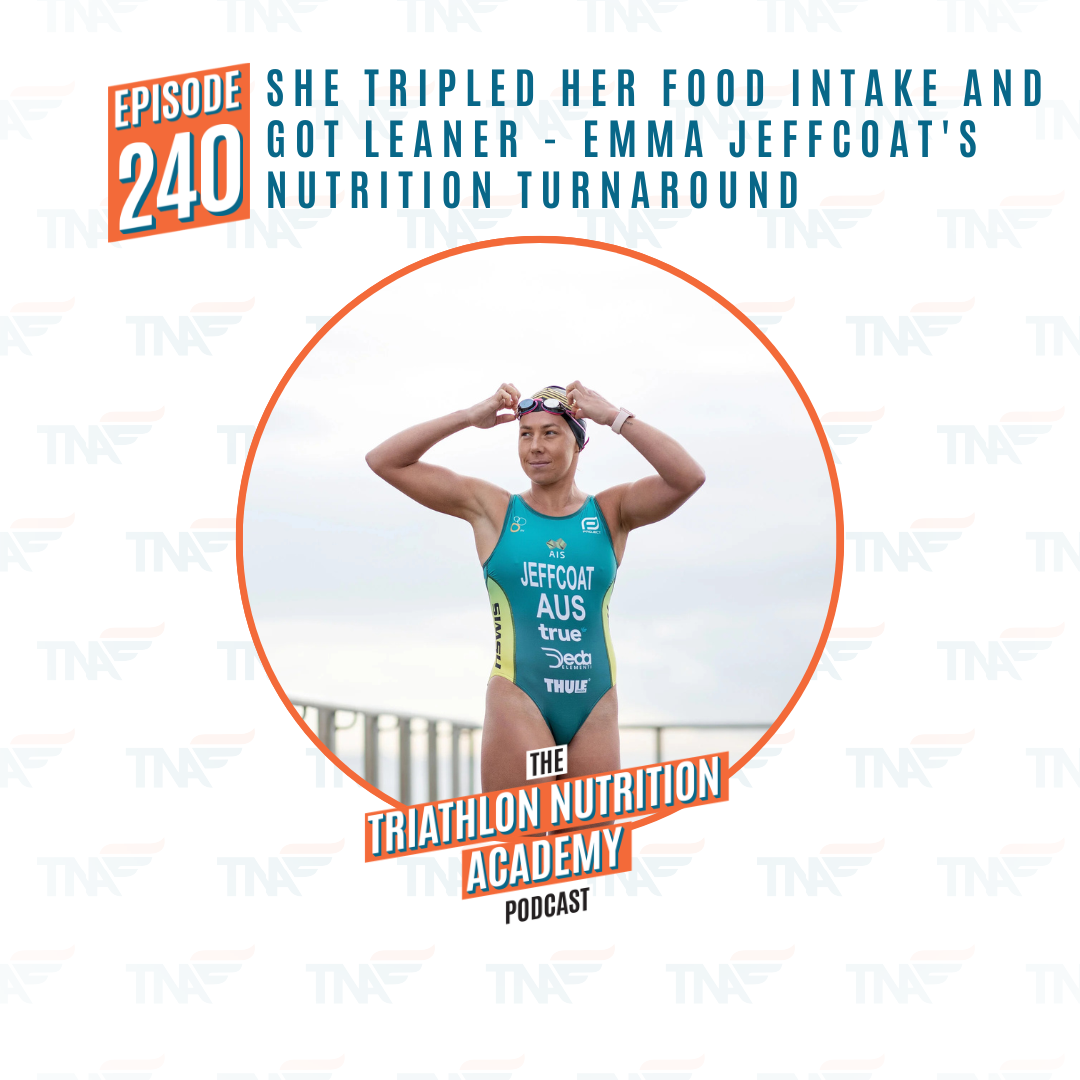
Episode 240 - She Tripled Her Food Intake and Got Leaner - Emma Jeffcoat's Nutrition Turnaround

Can you really recover from ankle reconstruction in half the time? Elite triathlete Emma Jeffcoat did exactly that - and her surgeon wanted to know how.
Emma Jeffcoat returns to the Triathlon Nutrition Academy Podcast for the first time since Episode 91 to share the four-pillar recovery protocol that had her swimming 6km sets and riding above-threshold power just six weeks after a full ankle reconstruction. She also opens up about her decade-long journey through RED-S and disordered eating, what finally clicked when someone showed her the real energy numbers, and how she went from a 40km weekly run cap to 80km weeks and a Mixed Team Relay World Championship title.
Whether you are navigating an injury right now, stuck in a cycle of training hard and breaking down, or wondering whether your nutrition is holding your performance back - this episode is for you.
Links:
Check how well you’re doing when it comes to your nutrition with our 50 Step Checklist to Triathlon Nutrition Mastery
Start working on your nutrition now with my Triathlon Nutrition Kickstart course
It’s for you if you’re a triathlete and you feel like you’ve got your training under control and you’re ready to layer in your nutrition. It's your warmup on the path to becoming a SUPERCHARGED triathlete – woohoo!
Connect with me:
To learn more about the Triathlon Nutrition Academy, head HERE | dietitianapproved.com/academy
See behind-the-scenes action on Instagram: @dietitian.approved
Follow along on Facebook: @DietitianApproved
Join our FREE Dietitian Approved Crew Facebook group
Enjoying the podcast?
Let me know what you loved about it and what you learnt by tagging me @dietitian.approved on Instagram!
Subscribe & Review in Apple Podcast!
Are you subscribed to the podcast?
If not, today's the day! I'm sharing practical, evidence-based nutrition advice to help you nail your nutrition and I don't want you to miss an episode. Click here to subscribe to iTunes!
Now if you’re feeling extra warm and fuzzy, I would be so grateful if you left me a review over on iTunes, too. Those reviews help other people find my podcast and quality nutrition advice. Plus they add a little sparkle to my day.
CLICK HERE to review, select “Ratings and Reviews” and “Write a Review” and let me know what your favourite part of the podcast is.
You're awesome! Thank you!
Episode Transcription
Episode 239: She Tripled Her Food Intake and Got Leaner - Emma Jeffcoat's Nutrition Turnaround
Welcome to the Triathlon Nutrition Academy podcast. The show designed to serve you up evidence-based sports nutrition advice from the experts. Hi, I'm your host Taryn, Accredited Practicing Dietitian, Advanced Sports Dietitian and founder of Dietitian Approved. Listen as I break down the latest evidence to give you practical, easy-to-digest strategies to train hard, recover faster and perform at your best. You have so much potential, and I want to help you unlock that with the power of nutrition. Let's get into it.
Emma: whilst I might have these, like, negative feelings that underlie fuelling, I just kind of put the time into understanding like the facts and the truth behind it and go figure I lent into it and I was so worried I was gonna put on a shit load of weight.
[00:00:12] And I, leaned down.
[00:00:13] I honestly tripled the amount I was eating in a day and I became leaner.
[00:00:16] Taryn: Welcome back to the Triathlon Nutrition Academy podcast. Today I'm joined by Australian Elite Triathlete Emma Jeff Coat. Welcome back. Em.
[00:00:25] Emma: Thanks round two. Thanks for having me back.
[00:00:27] Taryn: So you are actually the very first athlete to ever join me on the podcast. Back at Episode 91, it was called Life of an Elite Australian Triathlete, but that was three years ago.
[00:00:39] Emma: What's been happening in the last three years.
[00:00:41] years, what hasn't been happening? I feel like last time we spoke, well, I know last time we spoke I was down in Melbourne, I wanna say, training down there.
[00:00:52] So I've since relocated back up to Sydney. So I'm back home on the Northern beaches, in New South Wales. I am training under a new coach. I'm training under a kiwi called Tim Braier. we don't hold it against him that he's Kiwi. He's a great guy. still doing triathlon. at the elite level, I've won a mixed team Relay World championship title with the Aussies last year
[00:01:15] Taryn: Yeah, so good.
[00:01:17] Emma: which was epic.
[00:01:18] I think every time I say that, it will forever put a smile on my face. recently in my personal life I got into the Firies, so the New South Wales Fire Brigade, last year. So that's kind of an exciting new chapter that I'll be, yeah, kick starting later in this year.
[00:01:31] Taryn: I saw you at the Aus Try Awards, and you'd just got that role and you were talking about the great work-life balance and the training you get to do at work. If nothing's happening, it just sounds like a perfect fit for you.
[00:01:43] Emma: Yeah, I'm stoked 'cause I've obviously got the nursing background, so, when I finished school, went to nursing, did that nursing degree, and I still love nursing, but it doesn't give that work life balance.
[00:01:53] You work so hard and unfortunately I. You don't really get paid for the work you're putting in or paid well enough to justify it as a triathlete versus the firies in New South Wales. Anyway, it's 24 hour shifts, at the minute, and it's kind of one day on, one day off, one day on, five days off. so working on an eight day roster.
[00:02:11] And then, like I said, yeah, if you've at a station and it's quiet, you essentially can be on the trainer, or in the gym or on a treadmill getting some training in. And then as long as you're good to go, if the bells went off, it's a pretty cool job. it's part of the job to be fit, keep fit and healthy, and be ready to respond.
[00:02:26] So yeah, it's unreal. And I think for me too, it kind of still ticks that emergency response, critical thinking aspect that I loved in the emergency nursing, but just offers a bit more of a long-term stability piece, and allows me to kind of keep doing triathlon from a financial perspective as I get that little bit older, three years older than when we last spoke.
[00:02:45] Taryn: Oh, me too, mate. Me too.
[00:02:47] Emma: I'm at the age where I don't like saying how old I am. I don't know. When you turn like in somewhere in the mid twenties, you kind of flip and then when people ask you, you're like, like 31,
[00:02:58] Taryn: My two hit 40. It's all downhill after that.
[00:03:01] Emma:
[00:03:01] Taryn: And so you've recently been injured as well, which is not new for you unfortunately. But one of the things you've done this time is you've completely fast tracked your recovery. Can you talk us through your injury and how you did that and what you've done to get.
[00:03:19] And recovered so much faster than what is the normal
[00:03:22] Emma: I didn't have a bone stress injury for one of the first times in my life. It actually was tendon. so kind of one of those unfortunate ones where it gave me no real notice. and was an acute rupture of my post T tendon.
[00:03:37] and my spring ligament complex, which is two ligaments that sit underneath your post tib tendon where the tendon attaches in at the navicular. I'm getting very good. I chronically rolled my ankle as a kid growing up and, as I kind of, yeah, progressed, so they also did the lateral ligament reconstruction because they figured while they're in there, may as well fix that as well.
[00:03:57] And then that was, I guess, gonna help keep that ankle really stable, which we really do need now given the amount of kind of trauma that's been done to that medial side.
[00:04:07] essentially I had a full ankle reconstruction, and I had that middle of Feb, I did the, like, it ruptured on me just before the Australia Day, weekend on a, in a track race.
[00:04:18] Um, which was really sad because I, yeah, things were going really, it's always the case. Things were going really, really well in training and I was so excited to get on the track again after many, many years off. and yeah, there we go. But brightside is, yeah, in the long term, I think it's gonna serve me really, really well, giving it the.
[00:04:36] I guess the love and the fixing that it does need and the fact that it's gone so well already given it's only, I'm only six weeks post-op yesterday. and essentially the doctor, when I originally had the surgery told me that it's gonna be like a pretty substantial recovery. So we're looking at like six to 12 months.
[00:04:54] but he said like, straight off the bat, you won't be, you'll be out of a boot at approximately 10 weeks and 10 to 12 weeks and you'll be on crutches for at least eight weeks. Fully non-weight bearing. Uh, and he kind of, the landmark milestones that he kinda gave me from there were pretty bleak. in terms of like, it was just gonna be a long time before I was doing basic, like mobility exercises or just being able to walk.
[00:05:15] So yeah, at the two week mark when I got the half cast off and I put it was put in a. He was kind of blown away by how good the incision looked and how like little swelling there was, which I was stoked with, but again, like very early days. And then I went back and saw him at four weeks and I, at that point was in the boot, fully non-weight bearing and he kind of couldn't believe how good it looked.
[00:05:37] He thought it looked like, ankles. He normally sees it three months and I was only one month in. And yeah, it was kind of blew, it blew my mind. He literally was like, can you stand up? And I was like, have you got the right patient? and I could, and then he got me to walk down the hallway and I could do that.
[00:05:50] And he literally said like, he's like, I don't know how you've done it, but this is miles ahead. And um, obviously we wanna progress you respect in respect to that, [00:06:00] given you're an athlete that wants to return to sports. So yeah, as from the time that you can wait, he said from the time you can wait there for five hours more or longer without the crutches, you can then take your foot out of a boot and start wearing a shoe.
[00:06:11] And I think I was in a shoe the next day. So that was literally. Eight weeks earlier than I was meant to. And then obviously what comes from that is you start using the tissue again. So, you know, that whole leg just got the ability to actually start working and start operating.
[00:06:24] Taryn: I was already swimming with the boot on, but yeah, I got the boot off at four weeks. Started swimming pretty much normally. He said, you know, you can push off a wall, you can kick, you can get on a stationary bike. All these things that were meant to happen months down the line. Um, so yeah, now I'm six weeks post-op and I'm swimming like normally, you know, this morning we swim six K and on the one 20 cycle, like pretty normal, Normal for you, not, not normal for anyone else. like I did a bike session yesterday with like six four miners at like above threshold pal. Like, it's kind of blown my mind to think that I'm only six weeks post-op. The running will still take time. Um, and I'm really respectful of that. We've got a really good opportunity to build as much strength in that left ankle calf, that whole.
[00:07:04] Emma: Left chain. and I really wanna do a great job of that so that when I do start running, it's a smooth progression back and it's not kind of one step forward, two steps back. so that is looking like a timeline that probably won't shift. but yeah, I've got a really good opportunity to, to, yeah, I guess improve my swim bike, which is already a bit of a strength.
[00:07:22] And then also just really make this ankle, both sides left and right as strong as possible so that yeah, hopefully, that run return is smooth. And then once I'm back racing, it's, yeah, I've just got a really stable, and strong lower body.
[00:07:36] Taryn: Sounds amazing. So how did you do that? What were some of the things that you did to escalate all of that and make it so much faster than what is the usual?
[00:07:45] Emma: Yeah, I think it's really cool. The surgeon who's like one of the best in Sydney when it comes to feet and ankles was literally quizzing me on what I've done. So I think that's pretty cool. But, um, I think like the number one, well the few things that I can really reflect on is I think like, just number one from my mindset [00:08:00] perspective.
[00:08:00] Like, I think people that know me well enough know that I'm very much like a go-getter. I am someone that's always kind of busy and off doing things. So naturally being told that you're gonna be complete, like he told me two weeks bedrest. Um, I think the surgeon also knew me well enough to not give me an inch.
[00:08:15] So he said like, strictly two weeks bedrest, like the, the more you can have that leg elevated, um, the better it's gonna be. And I literally like followed that to a t. I think just from a mental perspective, just really giving in and almost embracing the rest. I was kinda like, you know what?
[00:08:28] I don't have a choice in this. I'm having the full surgery. It is what it's, it is like the only thing I can do is kind of just actually let my body rest. I was doing that physically, but also mentally just kind of. Leaning into it. and I think what came from that was just like a whole lot less stress.
[00:08:45] Um, and I was just banking huge amounts of sleep. And I just think from, yeah, I think that stress is something that you just can't underestimate the load that that has on your body and on your hormones. And, um, I just think on your body's your body's ability to recover. So that was number one. Number two was my fuelling and my nutrition.
[00:09:08] So, I worked really hard with my dietician, uh, who I see at N Swiss on a nutrition plan. 'cause I think historically when I've had injuries, although they've been bone stress related, which I think, um, nutrition is critical to recovery, I kind of looked at it as like a challenge of, okay, like I understand my fuel, like my intake is gonna come down because my expenditure is like nothing in terms of, from a training perspective.
[00:09:33] But I also need to understand that my body, I'm asking it to heal a lot and that's. An extra like energy source that I need to respect. and kind of rather than in the past I've looked at it as like, okay, I need to be restricted because I'm not exercising. I think just like the mindset that I now sit in when it comes to fuelling, not only when I'm performing in sport, but also like when things aren't going well is like, okay, well how can I be elite at fuelling my body for recovery, not necessarily training.
[00:09:58] Um, so we really dialled in on that. I started taking, like I was already on collagen, but we were really using collagen. We were using, um, creatine. So from, especially from like a mental, cognitive perspective, I found the creatine really helpful, but also just in like muscle, I guess like. The little rehab that we were able to do, just really trying to maximise that. and I was also taking fish oil, so fish oil also being like a bit of a natural, blood thinner as well. just really helping in that initial post-surgery stages, uh, and also taking magnesium and just keeping on top of like little things like electrolytes, but also I think, being really clever and like, yes, like my intake came down, but like I didn't cut carbs, my carbs, um, I was eating really healthy, like balanced everything in moderation kind of food. yeah. So I think like just keeping it basic like carbs, fats and proteins, they didn't go anywhere. Um, so I think just from a nutrition perspective, I was really nailing that, um, and giving my body everything it needed to do its job. And then I think the other two things that we really kind of reflected on was, I use hyperbaric chamber, so.
[00:11:05] I was in the hyperbaric chamber four times a week for an hour each time. and the surgeon kind of made a comment about if that was something that's financially, um, or I guess accessible to everyone, he would recommend it as like gold standard in recovery from an injury or post-surgery, especially post-surgery with the amount of inflammation that.
[00:11:25] Um, ankle had and yeah, I'm lucky enough to have access to that so I just really maximized it and I found that that's probably been one of the biggest contributors, uh, when it comes to recovery. And then fourth but not least is red light therapy. So I think that's something that I know you're a fan of.
[00:11:41] But we really used a red light therapy. I've got, uh, I, yeah, went out and purchased like a kind of portable little red light mat and I was putting that on my ankle like every evening for about 30 minutes, which is probably a bit of overkill. But um, look, I was already on the couch sitting there, so I just popped the mat on and again, like hyperbaric and the red light therapy, it's so easy 'cause it's passive.
[00:12:02] Like you literally go in the hyperbaric chamber and have a sleep. So it's like ticking both boxes 'cause you're also getting the sleep. and then the red light therapy. Yeah, both like I was able to do that whilst on bed rest. So I just feel like all of those things combined, I just was really trying to do everything I possibly could to fast track that recovery. I think as a result it was then like this positive feedback loop because that meant that, you know, once I came out of the half cast at two weeks, he gave, the surgeon gave me the All Clear to get in the pool and like whilst I had to swim with the boot on, it was like, yeah, it's better than nothing.
[00:12:35] Right? And so then like from a mental perspective, I'm mentally feeling better 'cause I'm able to move my body. Um, and people thought I was crazy, but I was like, when I'm in the water I feel normal. Like I'm able to move freely when I'm on land at the minute, like I'm not mobile, I'm on crutches, it everything takes me a long time to get around.
[00:12:50] As soon as I'm in the water I'm like free. being able to swim for like 90 minutes every morning transforms my mood and how I approach the rest of my, my day. so I think that was key. But then also just the basics of getting your blood flow up. Uh, your, sorry, your heart rate up. So then like a bit of blood flow and oxygen being pumped around.
[00:13:08] The surgeon thinks like in that two to four week. Just having that in the pool where it's completely non-weight bearing and safe was also really helpful for kind of yeah, restoring a bit of life back in that ankle.
[00:13:18] Taryn: That's so good Em, I love the elite strategy for recovery and going into post-surgery with that mindset. It's obviously served you really well while you say those other things like the hyperbaric chamber and red light therapy are passive, you still have the big rock foundations of your nutrition, right?
[00:13:34] First, you're not doing those things first and then hoping that that your body's going to respond to it. You've actually got your nutrition right for this injury recovery phase that those little kind of sprinkles on the icing on the cake are actually having an impact, which is really good. So I've just done a whole masterclass on red light therapy and gone so deep and nerdy in all of that.
[00:13:57] If anybody does want to grab it at dietitianapproved.com/redlighttherapy. I'll give you some extra tips if you need to, to make sure you maximize that, but that's definitely something you could do long term and you can even chuck it on other parts of your
[00:14:09] Emma: Yeah, my face. Yeah. And I think that's probably something like if I think about what I've learned from like the last six weeks and what I'll carry forward is I think like both hyperbaric and red, red light therapy are gonna be things that I continue well past just the recovery phase and the acute injury.
[00:14:26] It'll be something that I look at as, like you said though, like they're little rocks, you know, you need to be getting the big rocks first. Like you need to be getting the sleep, getting the right, um, I guess fuelling to like adequately or in excess, meet the demands that you're asking of your body. And then also I guess like monitoring training loads and training smart.
[00:14:44] It's like, so if we think of them as being like your big rocks, it's like the hyperbaric and the red light are great as long as you're ticking the big like. You've got those big rocks sorted, they're kind of like, yeah, as you said, like the sprinkle on top. But for someone at an elite level or anyone that's trying to approach anything they do at, with an elite mindset, I think they're tools that I found have made a huge impact, and really tangible.
[00:15:06] So like for me, that's huge. Like if I, if I'm already two months ahead in terms of a recovery timeline, it turns like my return to racing comes from July back down to, you know, end of May, which is nuts. Like that's super exciting.
[00:15:19] Taryn: Yeah. it is so good. You are not a stranger to injury, unfortunately. But how do you stay so positive through this process? You're so mentally grounded. I've never seen you ever not smiling. Really. You're always like happy and and chill. How do you stay grounded when you have these setbacks? back? I love that question. I have had a few people reach out and ask that off the back of this injury. One person in particular kind of reached out and they kind of just said like, they flagged that someone they knew who had had like a subsequent injury, you know, they've just kind of recovered from one injury and now just got kind of hit with another one.
[00:15:52] Emma: And they were like, they're, you know, this person they know is really struggling. And so how was I managing it? Because, you know, I'm someone that's been public with my injuries, especially the last few years, and I am no stranger to injury. I genuinely think my attitude, like attitude counts for everything, right?
[00:16:08] And I'm naturally like a glass half full positive person. but that's not to say I don't have moments that I do like struggle and I do, kind of find myself a bit down and out. I guess if I speak for the majority of the time when I am like in a really good head space, I think my attitude is that like.
[00:16:24] Especially like when this injury happened and it kind of gave no warning and everything was like going so well and I was mapping out the year and what so whatnot, like it was so crushing and so devastating. But I kind of respect that feeling and I give that the time and space. So I allow myself to kind of sit with that and be upset and be cranky and be angry and warn, you know, family and friends that I'm gonna be like that for 24, 48 hours.
[00:16:47] But then I'm just very much able to kind of draw a line in the sand and I look at it and go, you know what? Like the time's gonna pass anyway. And that's kind of been my mindset with anything in life. Like, you know, the time will pass so I can either spend the [00:17:00] next six months being utterly miserable and making my life hell.
[00:17:03] Making the life like for the people that care about me and who wanna see me return also pretty uncomfortable. Or I can look at it and go, okay, well I understand that I've got this injury and I've got this challenge ahead of me, but. I can also make the most of the next six months and make sure that each day I'm doing all those little things that get me one step closer to what I want to do and what I love, which is racing.
[00:17:26] And I think when you approach each day with that positive mindset, you then like. Like if you're looking for it, you find it and it's like, if you're looking for these little wins each days, each day and these little positives, you'll find them. If you're sitting there and cranky and bitter, then like, yeah, of course you're gonna see the negatives.
[00:17:42] and that's not saying that there are days that, you know, I find it tough, like, say when racing's on, I always find that tough 'cause you're like, you know, I was meant to be at that race. Or like, I would love to be out there racing, like you have FOMO. And I can acknowledge that, that like, Hey, I'm gonna be a bit more grumpy today because I'm not able to do what I go and like what I love.
[00:17:58] But okay, maybe I focus my attention. Um, and I'm a bit more aware of that. So I organise, you know, that I definitely have say a swim session or a gym session where I'm able to go and move my body and focus on where I'm at and still feel like I'm getting that little step closer towards racing. and I think that's something you have the choice, like attitude's. One thing that we actually have a choice over, there's a lot of things in life that you have no choice, um, or no ability to change, but your attitude is one that every single person has the ability to kind of shift and change.
[00:18:27] So I think that's, I guess probably one of the biggest ones that I like to share with people. but yeah, I guess coming back to the fact of also I'm not someone that is constant, like a hundred percent of the time happy. Like I definitely have periods where I struggle. Um, and I think just being really open that to like, I see my sports psych every fortnight.
[00:18:45] Um, especially over this last kind of six weeks being injured. I've seen him every week. you know, so I'm not someone that's immune to struggling. I, I just know that I. Have tools that I'm able to da to tap into that can help me in those periods. And I'm kind of like to be proactive, just like fuelling or just like recovery.
[00:19:04] It's like, okay, well I'm gonna be proactive with my mental health and know that I'm probably gonna be struggling, so I'm gonna preemptively book in with my sports psych, um, and have those touch points regularly that I can check in. and likewise, just also being really comfortable to have conversations with family and friends and admit that you're struggling and that like Yeah, I know that was, um.
[00:19:24] One that I had to do, with something totally unrelated to injury, but it was the back end of last year. I was just like really mentally struggling and we were going away as a family on holiday and it was just like the best thing I could have done at the start of the trip. Just being like, Hey guys, just a heads up, like I'm just feeling a bit low at the minute.
[00:19:39] So like, if I'm not my usual self or like I'm not, you know, as bubbly conversation, like that's why. And then because you've been able to be open and vulnerable with people, it allows like my siblings, or mom and dad to kind of then just follow up and check in and have, you know, really kind and gentle conversations that then it's kind of on your terms a little bit more with how you wanna share it.
[00:19:59] But yeah, people sometimes don't know that you might be struggling with something and it's, um, as much as we want people to ask us if we need help, you also have to be brave enough to put your hand up and admit you need the help sometimes.
[00:20:11] Taryn: That's so powerful and I feel like you've learned a lot, even since I've spoke to you properly three years ago. You, you've had this whole evolution mentally, physically, and nutritionally as an athlete, which is so good to
[00:20:22] Emma: good to see you.
[00:20:23] Taryn: one of the things that you talked about three years ago was your relationship with food at that time, after you've been through a fairly dark period. I would, I would say, and you know, the guilt around food or having to earn food and, you know, you are aware of significantly under fuelling yourself. where are you at with all those things now? Like I know you've come like almost full circle. You've learned a lot about yourself and you've changed the way you, you eat and you've changed the. Providers that you get help with, with nutrition. I remember in my time at AusTri you, you weren't my athlete.
[00:21:00] You had someone else. And I was always like, what are you working on m like trying to get like little tidbits from you and you, you're always closed and you wouldn't tell me
[00:21:07] Emma: tell me anything.
[00:21:08] Taryn: I,
[00:21:08] Emma: I've come a long way. I genuinely feel like, yeah, I'm, I'm just genuinely really proud of myself. I think in terms of like the journey I've been on with nutrition, like proud of myself from, to be able to have turned it around and to sit in the space that I'm in now, but also probably most proud of like, I guess, yeah, that growth in that I'm now an athlete that has gone through the journey myself, but kind of taking that one step further and being willing to share that journey openly and candidly with others so that other people can take whatever they may need from my own experience and hopefully like maybe.
[00:21:42] Prevent themselves from going down similar rabbit holes and I guess, yeah, dark places that unfortunately do sit within endurance sport and especially like, triathlon, like, we're kidding ourselves if we, if we don't think it's not prevalent still. So yeah, I guess my relationship with food, I just, it's [00:22:00] really healthy.
[00:22:00] Like I am someone that has everything in moderation. I am someone that I think I just approach food, like my fuelling in the best way to describe it would be like proactive. so I really do think about, okay, like if I'm getting organised for the day ahead, not only are you like, you know, safe. Having a bit of a plan for the day, and I'm packing all the gear and like the equipment that I need, but it's also like, okay, from a fuelling perspective, what's required of me tomorrow?
[00:22:28] You know, what do the sessions look like? What do I need to be getting on board during the sessions? What do I need to be having, you know, for breakfast in between? Like, you know, like I pack a esky bag every night, you know, for everything that I need. so like, I guess that proactive approach, number one, consistency.
[00:22:45] So not just nailing nutrition one day, but nailing it every day, which then just is a positive feedback because you recover better and you show up for train, like can show up for repeat sessions each day, but repeat sessions each week. And then for me, who's always constantly stuck in this injury cycle, it's like when you start stacking weeks, then they turn into months and then it turns into like a good, you know, year or two years.
[00:23:07] That's when it's like, okay, you really do see the benefit to these like little, Yeah. Habits that do add up and they compound exponentially. I think I just hit a breaking point where I kind of realise like if I just keep doing the same thing and expecting a different result, like that's mad.
[00:23:22] Like, I'm gonna continue getting injured. And it was a really hard conversation someone had with me when they said that. but, and I think it was like the rock, the final, like strike that broke the damn wall because they weren't the first person that had kind of tried to say the same thing to me.
[00:23:36] But it kind of finally broke through. And I did realise, I think I was just at a point where I was like, I can't do this anymore. Like I cannot continue to keep coming back from injury. and specifically bone stress, which like majority of those injuries I gave myself. So I think just then approaching it and just being so vulnerable and kind of at this low point where I was like, I, I need help and I need to find the right team around me who I trust and who are gonna support me with these positive habits that I need to build. and yeah, then I guess vice versa, I started kind of believing in them and having trust in them so then was more open with them. And then when you're more open with people, they can actually help you. I just have a terrific team around me now where like I'm able to be challenged by them and I don't instantly shut down.
[00:24:22] It's like a really healthy, culture that I have with the team that I've built around myself in, in Sydney. And yeah. And I think it's just a really, now I look at it and yeah, proactive, but just balanced, It was, for a reason.
[00:24:33] You know, I always felt like I was kind of being micromanaged, always, like people didn't believe me, but it's like, well, they shouldn't have believed me because I wasn't being completely truthful. So I was getting frustrated. But like they had every right to be continually checking in and continually challenging me on things because I wasn't doing a good job.
[00:24:49] versus now I have like nothing to hide and, you know, I'm happy for Tim or my physio, or my dietician to like check and challenge me and we have really great conversation off the back of it. and I think, yeah, it's, it's just a really trusting, open communication, communcative and I guess, yeah, supportive network that I've built around me
[00:25:10] Taryn: That's exactly what you need. And I, I love your two kind of big things there. Proactive and consistency, which is, I think it's a no brainer if you're a tri-athlete. There's no way you can get through training for three sports, particularly at the volume that you do as an elite athlete. If you aren't proactive and everything's reactive, like nothing's ever gonna work if you're, on the back foot.
[00:25:31] And then that consistency too, 'cause you, you talked about like training availability. The more availability you have to train day in, day out, that's where all of those beautiful adaptations happen. It's where you build your fitness and it's where you're gonna get that strength and get faster. And if you're constantly taking three steps forwards, 10 steps backwards, you don't have that training, availability and consistency to, to build all of the fitness that you
[00:25:55] Emma: you need to race and
[00:25:56] train at
[00:25:57] that wall. Yeah, a hundred percent. And I feel like I just always used to feel like I was walking on a tight rope. Like I just used to feel like it was like one step the wrong way and I was broken or injured or sick.
[00:26:07] And now it just feels like, you know, naturally in our sport we are walking a fine line, but I generally feel like I'm walking like a bridge. Like it doesn't feel like a tight rope. It doesn't even feel like a plank of wood. Like it just feels like I have a really healthy, solid base underneath me. Ironic, given I've literally just had an ankle reconstruction, but like almost a bright side to that is that like, that came from like me.
[00:26:30] like an acute injury, not a chronic one that was related to an, you know, reds essentially. And it kind of came from us doing new things like track racing and plyometrics and, you know, I guess. Challenging me in terms of a running perspective where it's like, well that's almost like a silver lining in the sense that I was someone that used to only run 40 K's week because I, my body couldn't handle more than that.
[00:26:59] And it was likely this cap I got put on me that they were like, you can't run more than 40. 'cause otherwise you'll break down. And it's like, now the last, you know, after world champs until Jana was running like. 80 k week on week, on week and like backing up for sessions and you know, running the best I ever have that you're like this, that I wouldn't have been able to be doing that, if I wasn't as healthy.
[00:27:18] And, I guess looking after myself from a fuelling perspective. And that's what I think gives me the confidence. Again, silver lining, but it gives me the confidence to be able to return back to that. 'cause it's like, I know I was doing all the little things right, that shows in how well I'm recovering. yes, it's been a setback, but it's like, it could be like from a structural perspective of what we've now fixed.
[00:27:38] It's really exciting because I know that like those, all those big rocks and little rocks we're looking after, it's just a matter of giving this kind of acute injury, the chance to recover and then being able to kind of build back to where I was, having now fixed like those foundational structural integrity issues.
[00:27:54] Taryn: Minor technicality be, you've got like bionic ankle now,
[00:27:58] Emma: well literally
[00:28:00] Taryn: Do you still have any of those negative thoughts creep in at times or are you just like, it's it's smooth sailing all the time from here?
[00:28:08] Emma: I feel like, the times like, I mean, timely to be having this chat. I feel like at times, like the negative thoughts creep back in, in periods where like, I mean, again, I haven't had time off training for over two years until this injury. So it's been quite a challenging, like not so much in the last few weeks.
[00:28:24] Once I got back in the pool and started moving, like again, it changed my contin, my whole head space. But like those first two weeks when I was just on bed rest, like it is hard because I feel like my body shape, I don't feel like, which again I think is a testimony to my fuelling, like my body shape hasn't really changed despite not doing.
[00:28:41] You know, any exercise for two weeks and barely any exercise for the kind of next two weeks respectively to what I normally do. But it's like I was looking after my body and so like I feel like in the past when I would've got really restrictive, that's when like your body does maybe change body shape because it's like, it's trying to just like hold onto anything it can.
[00:28:59] And also the fact, like the amount of impact that stress and like hormonal imbalances have on your body when it comes to I guess body composition is huge. And so I feel like it was more just like a Mental negative mindset of like, I'm someone that loves moving my body and I'm not able to move my body.
[00:29:15] So you just feel crappy. and sometimes I think when you're a type A personality and you have had a lot of things taken away, food is an easy one to kind of feel like you have control over it. And it's an easy one to be like, okay, well I'm just gonna get really controlling in what I eat. 'cause that makes me feel like.
[00:29:30] Got a little bit of like, regained that tiny bit of control back. But again, I feel like that was where I just knew that I was gonna maybe have those thoughts. So was proactive in engaging with the dietician, proactive with telling her that I was probably gonna feel that way. So then I had her checking in, making sure I was okay.
[00:29:46] I was open, like I still live at home at the minute, so I had had a similar conversation with my mom, so then had my mom onto me in terms of like, she wasn't gonna have me not eating like five times a day. So it just made like, it just created a really supportive environment. And [00:30:00] because I was open and shared those things, I had people that could support me through that period.
[00:30:03] and I also just knew that that was gonna be natural and. Like there was gonna be negative thoughts creeping in, but I was able to counteract them. but I think one thing that like I feel like I'm very open in speaking about is just like, it is hard these days on social media, with things like Instagram and Strava when it comes to body image, and I know that's another one.
[00:30:22] Like, if I'm not feeling great about my body or like just not feeling great within myself for whatever reason, could just be that it's that time of the month. I just know that for me going on Instagram or going on Strava. Doesn't leave me feeling better about myself. It leaves me feeling worse.
[00:30:36] And the Emma that went on social media versus Emma that left social media, chances are I'm sitting down. I haven't changed, but you know what I mean? Like, you go on there and you leave feeling worse about yourself. Well, the only reason that is because you've just compared yourself to how many highlight reels of every person in the universe who's doing endurance sport at the minute and is an expert about triathlon,
[00:30:55] And you're like, you don't even know what's real and what's actually accurate. it's essentially like their version of a highlight reel. And so I think just being able to be like knowing that that's the case when you go down there, but also just being like, okay, like that's not gonna help me, so I'm just not gonna go on it.
[00:31:10] And you know what? I'm gonna remove Strava from my phone for the next six months because when I can't be running, why would I want to go on an exercise version of Instagram and see everyone else's run session? Like that's not gonna leave me feeling good about myself, or about my body, or about my fitness.
[00:31:24] And like I do it for a living. So it's actually kind of like. You know, my job, let alone everyone that's just doing it for fun. and has this kind of, yeah, whole other life that they're trying to balance on top of enjoying exercise. I just think it's kind of strips that comparison, strips the enjoyment out of a lot of it, and it's something I'm really conscious of and I just kind of know where I'm, how I'm feeling about myself and whether it's something that I wanna engage in that day or not.
[00:31:52] Taryn: If I go one, it makes me feel stressed, so I try and not do it either or not do it in first thing in the morning or the last thing
[00:31:59] at night, because my stress levels like hands down, I think my heart rate gets elevated just from opening the app. It's crazy,
[00:32:06] Emma: It's mad. And I think that's something I've really tried to help, like, I think as part of being a professional athlete, you have to, like in today's society, it's part of your brand. Like if you don't have a presence on social media, I. reality is, you are at a bit of a disadvantage when it comes to things like sponsorship or things like endorsements, or opportunities networking wise.
[00:32:25] So it's something that I, I do need to be on, but I, I, I genuinely am really conscious and I try really hard to be authentic on there. I try really hard to share, like the real stuff, not the highlight reels whether people love it or hate it, but like at least I know that what I'm putting out there is real. And hopefully it just makes people feel a little bit more seen with the content that I put online.
[00:32:44] Taryn: Yeah, we need more of that. We need females to understand what it's like to feel for this sport and the issues that we face with all of our hormone changes and comparisonitis and all of the body composition. Particularly when, I'm just gonna say this out loud. This is [00:33:00] something I've been thinking lately, but all of the sports wear is super small at the moment.
[00:33:05] It's got like no back and yeah, like what's with the sportswear? It's like halted egg things with no
[00:33:11] Emma: Oh yeah. I don't know how you run it. I don't know how you run in that. I'm like, yeah, I don't understand it. When I finish a training session, I'm like red-faced and dripping in sweat, like dripping, and they're nicely, people like posting online. I'm like, you don't have a hair out of place.
[00:33:28] Like what?
[00:33:30] Taryn: Yes. Yeah. All the, all the active wear is very small and tight at the minute the fashion is gone. Into like gymnastic outfit type style maybe. I dunno if that's just in Australia or not, but my gym, I don't know how those people are actually exercising in that 'cause there's no way I would keep the girls down
[00:33:47] Emma: Yeah. Yes. I know. I feel like, I also feel like we're gonna have an epidemic of females that like Yeah. Didn't use a, a supportive of enough sports bra when, since everyone's getting into running. I'm like, [00:34:00] what happened to like a sports bra that actually has like a clip on the back and some underwire? I'm like, I don't know how people run in any, like some of the crop tops getting around.
[00:34:08] I'm like,
[00:34:09] I digress. Sorry, I took us down a random tangent. is there a message that you could help, particularly females, but I think all, all triathletes, a message to help them understand how to fuel themselves properly. This is my whole job is to get athletes to try and understand fuelling for three sports.
[00:34:29] Taryn: You do it at the elite level. Is there any any gold nugget advice that you can give them to get themselves fuelling better when we have this chronic problem with relative energy deficiency in sport and bone stress injuries and just generally under fuelling.
[00:34:45] Emma: I feel like for me, like the biggest thing that helped me kind of flip it around was literally breaking down the energy expenditure I was putting out, day to day or like over a week in terms of like, standardise your training and look at, I guess, the calories that you are, well, I guess like the energy expended and just seeing the number of calories that I needed to put into my body to just meet that, let alone actually have enough energy to maintain normal processes.
[00:35:15] And then also factoring in that it's like, okay, if I'm asking my body to do three training sessions that day, duration of six hours, it's like I'm also asking my body to recover from those training sessions and. Hopefully if I've recovered right, that then means I can make the positive adaptations that I've worked so hard to gain from that training.
[00:35:34] And it's like, okay, well if I'm not even meeting the energy intake required for the expenditure, that's like massive problem. That was me for a long time. But it's like, okay, now that you've gotta add on top normal human functions, then you've gotta add on top that energy like needed for recovery.
[00:35:51] and I think once that number was kind of like shown to me, it was almost like, holy hell, that's actually really challenging to get into your body each day And so then you're like, why the hell would you ever try and be restrictive? Because it's actually a challenge to get enough food on board.
[00:36:06] And so I think that was a massive one for me to just understand from a fundamental perspective. And it kind of took away some of this, like, I don't know if fear is the right word, but in the Headspace I was in like this controlling. Like, I guess fearful attitude
[00:36:18] around food. Yeah. That it was like, okay, Emma, like just objectively it's near impossible for you to be getting enough energy in. like remove that, you're not gonna ever be eating too much. And so it's like once you can kind of park that, it then became, like for me, looking at it and being like, what does that look like energy intake wise in a day so that I can kind of get my head around what I need to be getting on board and then being like, yeah, yeah.
[00:36:43] And repeatable. Right. It's no point being like a grade A student for a few days. It's like, what's actually gonna be repeatable for you? And some, like, I know for me to begin with, like, a lot of it was like liquid, like protein shakes with like carbs, carbs in them or like drinks with carbs. 'cause it was like trying to get that amount of food on board was quite hard and just making like, just yeah.
[00:37:03] Little swaps and changes like I used to have, banana before swim training and now I have a bagel with Nutella and bis bisco and a banana on top. Like, and then I'm fuelling while in the pool with like carbohydrate mix. And then I'm having a protein shake with carbs and protein as soon as I'm out of the pool to then go home and have a second breakfast.
[00:37:21] And you're like, you know what I mean? Like that's, that is such a huge difference. no wonder I feel exponentially better, like from fueling like that way. But I think for me it was just like about breaking it down from like a, just an objective, like trying to remove like, the emotions out of it because my emotions were negative at the time and just putting my nursing brain on and being like, here are the facts.
[00:37:41] and I also understood the facts of like, if I wasn't meeting those fuelling requirements, then I was gonna continue getting injured and run down and not able to ultimately get to the goals that I set for myself. So it's like, whilst I might have these, like, negative feelings that underlie fueling, I just kind of put the time into [00:38:00] understanding like the facts and the truth behind it and go figure I lent into it and I was so worried I was gonna put on a shit load of weight.
[00:38:06] And I, I, like, I leaned down.
[00:38:08] Like,
[00:38:09] I honestly tripled the amount I was eating in a day and I became leaner. it's just a really toxic cycle that so many people, and sometimes I do believe it's naive, they just don't understand the energy expenditure that they're putting out.
[00:38:21] You know, if you've got people that are used to going to the gym of an afternoon that have now taken up running, it's an easy one. Like they don't account for the how many calories that like they're burning when they go out for the run and the recovery like needed for that additional exercise. And it's like, no, you almost like, you kind of need to be like doubling.
[00:38:39] The timing of that fuelling and the repeatability of that, like it all factors in. But yeah, I generally just feel like for me, I was so worried about my body shape changing and putting on weight and I just like kind of was like, you know what? Let's just try it. I'm just going to like follow that food plan and stick to it to a tee and give it a month and we'll see what happens.
[00:39:00] And I have not changed since, and it's so funny, like my metabolism as a result improved exponentially. And now it's like if I haven't eaten all of that food before swimming, my stomach's grumbling by the time I get out. Which is awesome because it's like my body, I've changed my body's ability to actually take food on board and use it for what it's meant,
[00:39:19] Taryn: Yes.
[00:39:21] Emma: Like I get more out of myself in sessions as a result.
[00:39:24] Taryn: You basically just described everything. I try and teach athletes inside the Triathlon Nutrition Academy in about one minute,
[00:39:31] but you are just, yeah.
[00:39:33] You are stoking the fire, right.
[00:39:35] You, you, you put more in and your body just burns it up and then you get fitter, you get faster, and like you said, your body then relaxed and you leaned up despite eating three times as much.
[00:39:46] How, how long did it take you to do that increase? Did you do it in like a week? Did it take you months or were you just
[00:39:52] Emma: just like a
[00:39:52] switch one No, I generally, I I genuinely reckon I switch in about a week. But again, like I, it was at that point that I'd like, I was at such a load that I just felt like I didn't really have another option. I was like, I'm either done or like, I've just give this, give it my all.
[00:40:07] Like I've got nothing to lose at this point because I just can't keep getting injured. Like, and this was 2019, so this was before Tokyo Olympics. and I remember just like telling my mom and like mom kind of like was along for the journey. she's a gem and she just wanted what was best for me. And so she like sharing that food plan and like the knowledge I was gaining with her, she then was so like.
[00:40:31] She bought in for the ride and 'cause I'm living at home, she then like helped food shop and bought all the things that they'd suggested. Like I was adding, like I had a protein shake with carbs and protein, but then I was adding a soup scoop of Stigen into that to then get some more carbs in. So it was all these little things that, like, I just had, like someone providing me with that from a fuelling perspective, someone that had, was taking that into consideration at mealtime and mum being like, you haven't eaten enough.
[00:40:55] And me being like, okay. Yep. Or mum being like, what are you having for supper? Like you're meant to have, you know, two pieces of fruit toast, like after dinner. And so like in that initial like acute phases of trying to turn it around, I feel like that was what I needed. Like, I need someone really kind of keeping an eye on me because I, I wanted to be making the changes.
[00:41:13] It was probably just a bit difficult, I feel like. After about a month when I'd seen no weight gain and my weight was just stable, but I was feeling better. I was like, okay, maybe they're onto something here. And then I think over like the space of a few months where I'd recovered, go figure, I'd recovered ridiculously quick from like a, bone, stress reaction that I'd had.
[00:41:32] Like I had a bone stress reaction in my tibia, which is kind of what sparked it all. And it was like early in the season and I was like, oh my God. Again, like another year where I'm trying to qualify for the Olympics, I've got myself injured in, I think March and go figure four weeks later I'd recovered from it and I was racing Yokohama and I finished 15th.
[00:41:49] And you're like, what? Like how did I do that in that short period of time? And so then like that just led to me buying into it. And then, yeah, at that point, like I didn't have a period, I hadn't had a period for nearly 10 years and that was like the challenging part. I felt like over the next kind of like I got my period back just before Tokyo Olympics, but I feel like kind of over that next 12 months.
[00:42:10] It was hard because I was like, why aren't my hormones looking better? You know, when I do my bloods, why isn't my, period coming back? Why isn't my bone density turning around? And it's like, I, they just kept telling me like, it'll happen, but you
[00:42:23] just need to keep, yeah, it just takes time and it wholeheartedly does like, because then 12 months later my period came back.
[00:42:28] My hormones were, and still are the best they've ever been. and my iron was back up and my bone density looks like a v no, it looks like a tick because it's like dropped and plummeted and now it's like exponentially higher than it ever was prior. which they go figure, I reckon that you can't in your thirties, like your bone density is probably not gonna improve much more.
[00:42:48] I'm like, well, mine's skyrocketed, so,
[00:42:50] yeah. Exactly. So it's like, it just, but like that could have been a time where I was like, oh, none of, but I think because I felt the difference in myself without [00:43:00] seeing like, I guess the data shifting, or that like, yeah, I guess massive indicator with that like return of my period.
[00:43:06] But it's like I'd hadn't had a period in 10 years, like it's gonna take a little bit of time to come back. yeah, I just bought into the process and then I saw like, yeah, I can, by July that year I'd gone and won a World Cup, like, and this is a girl that had, was told that like, you know, the season's ending. my attitude at the time was like looking for those little positives each day. So whilst it kind of felt really hard and really challenging to try to be turning like a really negative relationship with food around, I just kind of focused on how I was feeling each day and like the improvements I was being able to make in training and just how like healthy I was, like in terms of like from an injury and illness perspective for that whole rest of the year.
[00:43:48] Like, I went on that year and did like World Cups after World champs and did Super league, which was something that I'd always struggled with because I was always injured by that point in the season.
[00:43:56] Taryn: It's amazing. Em, even just in three years, like I've, I've connected with you at many touch points over the last 10, 15 years, and I've watched all of that journey unfold, and I'm so proud to see the evolution that you've come on.
[00:44:09] Emma: It's really good. And I generally said, I think that's what I said at the start, like, I'm generally just really proud of myself 'cause it's not easy.
[00:44:14] Like, and I think acknowledging that for people that might be struggling and in a really like toxic head space when it comes to fuelling or body image, like it's really not easy. I wholeheartedly understand that. Like as someone that always felt out of place in triathlon, I always felt like I was too big, wasn't the right
[00:44:30] size. Yeah. Like trying to get strong like
[00:44:33] Emma now.
[00:44:33] Yeah. Like it's really like, I'm just really proud of how I kind of. Yeah, when it, it was pretty dark for a while there, but how I was able to turn it around and then as a result now just be so confident in my strength and what I offered, not only on the racetrack, but also offer from like an athlete's perspective on someone that's lived it and breathed it.
[00:44:53] And being through that journey where it's like, that's where I'm so passionate about being open and sharing it, because I'm like, you never know who needs to hear this stuff. Like same notion in terms of you never know who might need, someone to ask them if they're okay and if they need help.
[00:45:05] It's, there's so many people out there that are kind of fighting these negative, body issue and fuelling struggles. And for me, yeah, I thought no one realised I was going through them for a long period of time, and then I realised probably a lot of people realised I was, yeah. Probably not looking after myself as well as I could have been.
[00:45:23] I just wasn't ready to accept their help. So yeah, I do really appreciate that. Sometimes it can be really difficult and yeah, there are people that are out there that can, Help you get out of that toxic cycle.
[00:45:34] Taryn: I think it's really important that you are spreading that message and people can hear that side of things, and it's not all just sunshine and happy rainbows. One of the things you've shared publicly is your journey with freezing your eggs to set yourself up for your post elite triathlon window. Was that
[00:45:53] Emma: a hard decision
[00:45:54] Taryn: at that time?
[00:45:55] Emma: yeah, it's never easier. I probably didn't realise how hard it was gonna be mentally, at the time. I think, for context as well, like when I was quite little, I was really sick in hospital, and as a result of, yeah, numerous.
[00:46:08] Complications and I ended up losing one ovary, so I always knew and then have like excessive scar tissue that wraps around like my fallopian tubes. So they always were like, they'd never knew whether I was gonna be able to have kids naturally when I was growing up. like when I left hospital, they said that to my mom and dad.
[00:46:26] And so when I was 22 and I was kind of, yeah, wasn't getting a period and had. Essentially lost my period for five years. At that point I did go and see a fertility specialist. Now I know that I was under fuelling, but at the time when I was kind of had my head in the sand, I was like, well, it must just be because of that.
[00:46:42] That's the reason why that it wasn't. But, it was timely 'cause I went and saw the fertility specialist and we did the test like the a MH and egg count and both came back low, but they kind of, I was 22. so it was a little bit different at the time. I just was proactive about it from an early age and then go [00:47:00] figure, you know, seven years later at 28, post Tokyo.
[00:47:02] So I had gotten my period back at this point, but I'd had 10 years, of yeah, amenorrhea and reds and. Yeah, I'm aware of like the impact that that can have on a female's fertility. And so I went back to the same fertility specialist and go figure my a MH and egg count. Well, egg count had remained the same, but my A MH had um, quite literally plummeted.
[00:47:24] So the fertility specialist kind of said like, if I was you and you and my daughter, I would be doing egg freezing as soon as possible. So I think I literally, it's dependent on where you are in your cycle to when you then begin that process. But go figure, I think about two days later I was injecting
[00:47:37] myself to get ready for the first collection.
[00:47:41] Yeah. Yeah. Straight into it. Which is spitting for me. That's how I approach things. But I like, for me, I like want nothing more than to be a mum one day. And it's something that I, again, like attitude is everything and I'm gonna try and do everything I can to be able to have that for myself. So it was a no brainer.
[00:47:56] but yeah, as the fertility specialist kind of highlighted to me, part of it's always gonna be genetic and that's where you can be proactive and get those checks. be it your egg count and be it a MH for a female. It just gives you a bit more information and then what you do with that information is completely up to you.
[00:48:11] But with my friends, or any female like that's around a similar age, that's something that I always kind of recommend doing. And then I obviously had the complexity of like what happened when I was little and that, I guess physiological aspect. But at the end of the day, like the 10 years of a am amenorrhea didn't have a positive impact on my a MH.
[00:48:30] And when I did do the two rounds of egg retrieval, and egg freezing in 2023, I struggled to get many eggs. and I think what the fertility specialist told me that at that point was if we can get 20 eggs and vi viable eggs that we can freeze, that gives you an 80% chance of one live birth. and I currently, well, the best I got was 17 total eggs after I've now done three rounds of egg retrieval.
[00:48:55] So it's a lot better than none. but yeah, it is a bit of a scary perspective I also know that, when the right time comes and the right person comes, like, I'm able to try naturally to have a kid. But I think just being informed that it's probably gonna be a process for me that isn't easy and maybe difficult.
[00:49:11] And if I can set myself up the best way possible, knowing that I still have a few more years left of me in triathlon and a lot more, goals to go after, well then, like how can I be proactive with that and set myself up for life after sport the best way that I can, knowing that there could be, I guess, more challenges involved when it comes to fertility.
[00:49:31] Taryn: How do you balance that your, you know, life? Time goals long term with your like relatively short elite sporting window, like you can only be an elite triathlete for a defined period of time. Like you've had an amazing career and it's nice and long, but it's not like it's a 40 year span. How do you balance that with the long term life, life plans and goals?
[00:49:53] Emma: I think just understanding that they can be fluid. Like that's a conversation that I've had with a friend recently who's in a different sport, but she ultimately hasn't probably reached the goals that she wanted to. And that, I guess the level that she wanted to in her sport and has ultimately made the decision, it'll be her last season in her sport before, moving on to other pursuits in life.
[00:50:12] And I think just, yeah, understanding that, that like it's fluid and there may come a time where you don't love the sport as much as you used to, and that's completely okay. And whether you reach the goals that you had for yourself in that sport or not, that's completely okay. And I think just being okay and comfortable with that.
[00:50:30] And also just validating that like your goals may shift, that goal might shift from sport away, to having a different career path or having a different side passion or having a family one day. traveling the world, whatever that might be, that's completely okay. And I think, for me, like my goals in sport, like there's been periods, I guess over the last kind of two years where I have checked in with myself and challenged that, I think it's not spoken about enough, but as a female, like we do know we have a body clock. like we can't deny that. And I think there's something about turning 30 that makes you feel this like level of pressure that you need to have everything sorted out in your life. So when I turned 30 and was, single female that wanted to have a family one day, but also wanted to keep doing triathlon for the next four years, I was like, what, how am I gonna make this work?
[00:51:15] but I just feel like being able to be like comfortable and open to have those like. I don't know, thoughts or discussions whether I chose to have them with family or friends or my psych, whatever that might be. Just letting them kind of come in, feel those things and then just kind of navigate what I do want.
[00:51:30] And I think that was really helpful that I just gave myself the space to think about that stuff. And what that meant was I ultimately was able to be like, no, I a hundred percent am not done with triathlon. I want to give it everything I've got in terms of trying to make it towards la. especially in that mixed team relay event, especially like even more exciting coming off like such a great result last year.
[00:51:48] I think it just gave us as a country that belief that we can be a team that's really shooting towards. being on the podium in la but also knowing that age would be for me in terms of what I also want in life. And so, I guess, yeah, that's where it comes in. That's like, okay, have I set myself up so that I'm not gonna have any regrets at the end of my sporting career that I, you know, had to give up other things that were non-negotiable to me in life.
[00:52:12] And yeah, having a family one day is definitely one of them. but obviously it takes, you know, well, doesn't that, it doesn't have to take two people, but there's two people involved in that. So I just think, yeah, being just really comfortable with myself and so that I'm authentic or like true to myself in terms of what I do want and do I want it for the right reasons?
[00:52:31] Like do I want it for me or do I want it for, I dunno, external reasons. I feel like I've just got a really good team, especially working with a psych to be able to kind of really understand and have those conversations. and yeah, respect, whatever, wherever that leads,
[00:52:45] Taryn: What is on the cards for the next three years and beyond? What's, what's the grand plan? Em,
[00:52:49] Emma: if I get my way of it, I will.
[00:52:53] So I start in the Fiery College in July. so that's a 16, 14 week course, and then graduate, I'll get placed at a station. that'll mean I have a stable financial income. I might actually be able to move out from home as much as I love it here.
[00:53:07] Um. Why would you leave?
[00:53:09] I know, I know, Why would you leave? But yeah, I guess like, you know, as a young, adult, that's a pretty like awesome stepping stone.
[00:53:17] but yeah, for me, like I a hundred percent am honed in on trying to qualify within, our mixed relay team for la. I am pretty open with saying that that's the focus of mine. not the individual event itself, but I think where my skillset and my strength lies is in that shorter, faster relay format.
[00:53:35] so for me that's something that is super motivating, super exciting, and I genuinely believe we can, um. Be shooting for gold when it comes to la and beyond that, if I could have the, the way of the world, I would be balancing, racing, alongside working, um, based with my team that I currently have in Sydney, which keeps me kind of less time away from home and more time around family and friends and hopefully around the right person for me that, um, once I finish sport and wrap up, more than likely after LA I can start to look at having a family.
[00:54:09] That would be my dream, like next three years. I'm manifesting that on your podcast.
[00:54:14] Taryn: I love that you have it all laid out. Like I've no doubt that you've not thought about that very deeply, but I also have no doubt that you won't achieve it. I feel like anything you set your mind to em, you, you do do, which is really good. Maybe it takes a little bit longer than you want it to,
[00:54:33] Emma: Yes.
[00:54:33] Taryn: all still does work out in the end.
[00:54:36] Emma: It honestly all does. And I think that's, yeah. And again, that comes with like your attitude, but I wholeheartedly like there's been times that I like things happen and you're like, oh, come on. Like kick a girl while she's down. But then honestly, like I put myself like a few months forward and I'm like, you know what?
[00:54:51] Like things do really, whether they happen for a reason, I don't know. Some people believe in that, some people don't. But I think like things happen and you learn and you grow as a result of that. And then that opens like new opportunities for you and new doors and gives you a new perspective and a new strength that you take into the next challenge where potentially before you might not have been equipped to take that on.
[00:55:11] So I generally do kind of embrace everything that comes my way because yeah, I think like I'm gonna give it my all and I'm gonna learn and grow from it. And I think like, yeah, just our conversation today has shown how much I've been able to learn and grow throughout my triathlon career that are gonna be lessons that I take forward into the rest of my life.
[00:55:28] Taryn: Thank you so much, em, it's been a pleasure to have you back on and just see that evolution even over the last three years. But I know it's been a, a longer journey and we need more people like you to share those things openly. You know, even being an elite triathlete, the journey is not linear. There's always setbacks, there's always challenges, and there's so much growth that does happen behind the scenes that people have no idea about.
[00:55:52] Like the social media is very much the highlights real, and you dunno what somebody's going through. So I like your advice to, you know, reach out. [00:56:00] Are you okay? Rather than the negativity that tends to happen on, on
[00:56:04] Emma: Yeah, I.
[00:56:05] Taryn: lately.
[00:56:05] Emma: A hundred percent. I think it's, yeah, it's, it's free. Like kindness is free and it's not hard to just approach things with a curious mindset. We never know what someone else is going through. So rather than kind of just having your own preconceived ideas, maybe just approaching it with a little bit more kindness and empathy.
[00:56:19] I know for me, when I've been struggling with different things here or there, like it can make the world of a difference, whether that's a friend or a family member or a coach, or a support staff member. I think that's something that, yeah, on the whole, has been like a massive. Factor for me in terms of the team that I've built around myself and the trust that I, I then have on them.
[00:56:38] Like I know that they've got my best interests and I know they've got my back. And, I think the AusTri environment, and the team that we have of athletes, I genuinely do, that was one of the biggest things that we walked away from. After the mix team relay, all four of us said like we had each other's back, like anytime we thought that we were down and out.
[00:56:54] And I was just talking about this at a presentation I gave recently when someone asked, in terms of like what they thought our edge was, in winning that mix, team relay. And I generally just do believe like that culture in that US four like had each other's backs and we believed that each athlete could get the job done.
[00:57:12] you kind of just carried that belief with you in your own leg. And I think, yeah, we went out and achieved a result. I don't think anyone thought was possible. And I hopefully, yeah, hopefully that kind of attitude keeps slowing down to the next generation, of triathletes in Australia.
[00:57:26] Taryn: And the summary of that is don't be a dick. I think Emma just said it much nicely, much more nicely than I did.
[00:57:31] Emma: think that's probably accurate. Just be a nice person. It's not hard.
[00:57:35] Taryn: No it's not. It's free. Like you said, I think a lot of age group triathletes listening though will take a lot from the fuelling piece that you talked about right in the beginning. Like whether that's fuelling yourself through injury and being an elite at recovery. I really loved what you said there and, and just building a healthy relationship with food.
[00:57:54] When we're in a sport that eating disorders are rife energy deficiency and low energy availability is rife. You've just gotta see the bigger picture and fuel your body for health, but also performance when you do do a lot of training. So I think there's a lot of gold nuggets in that one.
[00:58:12] Emma: Epic.
[00:58:13] Taryn: Thank you so much.
[00:58:14] Maybe I'll see you in another three years. Em, what do you reckon?
[00:58:17] Emma: Hopefully I see you at a at a race events sooner than that.
[00:58:20] Taryn: Sounds good. Thanks em.
[00:58:23] Emma: Thank you.
Thanks for joining me for this episode of the Triathlon Nutrition Academy podcast. I would love to hear from you. If you have any questions or want to share with me what you've learned, email me at [email protected]. You can also spread the word by leaving me a review and taking a screenshot of you listening to the show. Don't forget to tag me on social media, @dietitian.approved, so I can give you a shout out, too. If you want to learn more about what we do, head to dietitianapproved.com. And if you want to learn more about the Triathlon Nutrition Academy program, head to dietitianapproved.com/academy. Thanks for joining me and I look forward to helping you smashed in the fourth leg - nutrition!