
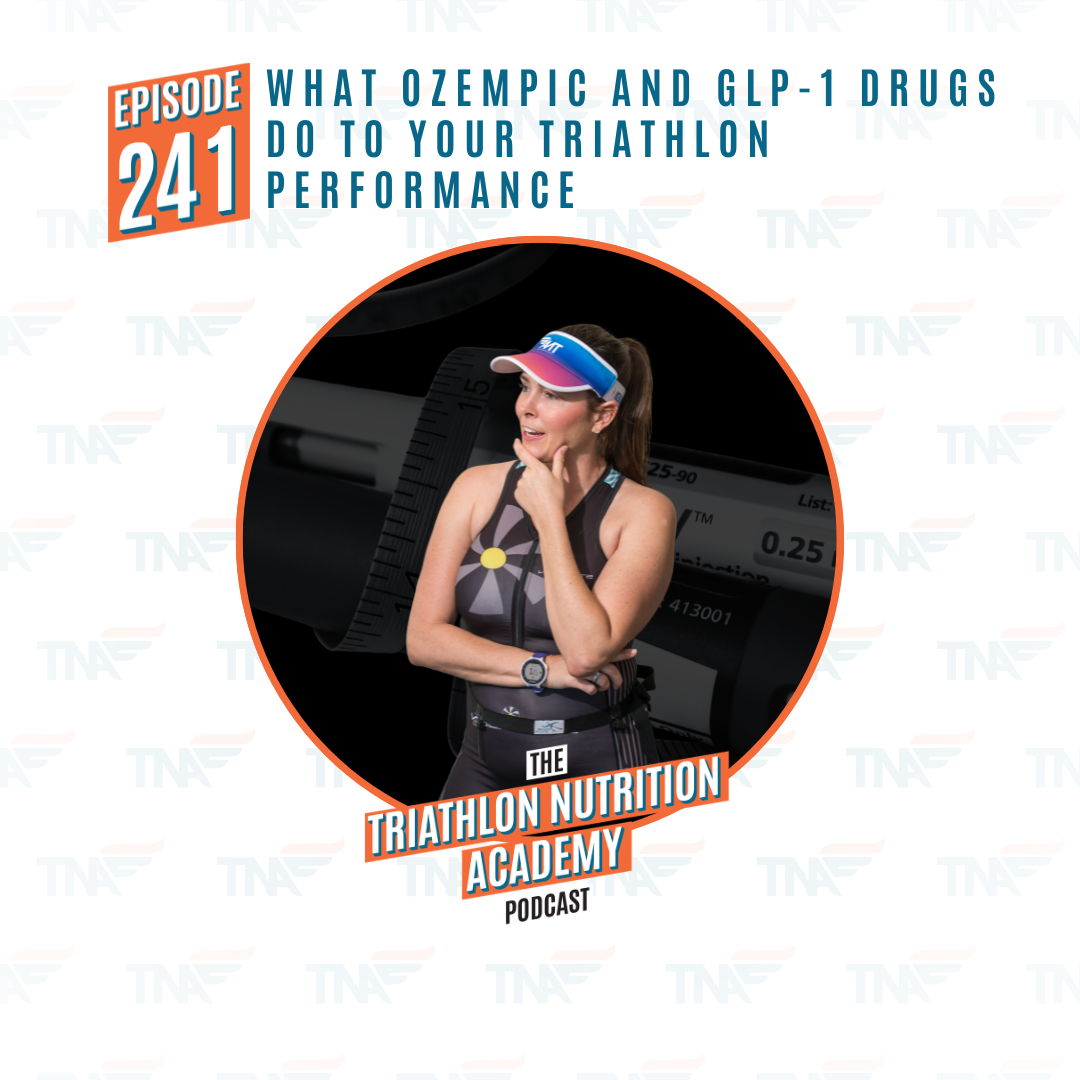
Episode 241 - What Ozempic and GLP-1 Drugs Do to Your Triathlon Performance

Your training buddy suddenly drops 10 kilos, starts climbing hills faster and looks completely different in transition. Naturally, triathletes are starting to ask questions about Ozempic and other GLP-1 medications. But what do these drugs actually do to endurance performance, recovery, muscle mass and race day fuelling?
In this week’s episode of the Triathlon Nutrition Academy Podcast, Advanced Sports Dietitian Taryn Richardson unpacks the growing use of GLP-1 medications like Ozempic, Wegovy and Mounjaro in the triathlon world and explains the very real performance risks athletes need to understand before jumping on the bandwagon.
You’ll learn why rapid weight loss can come at the expense of lean muscle, how these medications affect gastric emptying and gut function during training, and why under-fuelling and RED-S are major concerns for endurance athletes. Taryn also shares practical strategies to protect your health and performance if you are currently taking a GLP-1 medication while training for triathlon.
Links:
Check how well you’re doing when it comes to your nutrition with our 50 Step Checklist to Triathlon Nutrition Mastery
Start working on your nutrition now with my Triathlon Nutrition Kickstart course
It’s for you if you’re a triathlete and you feel like you’ve got your training under control and you’re ready to layer in your nutrition. It's your warmup on the path to becoming a SUPERCHARGED triathlete – woohoo!
Connect with me:
To learn more about the Triathlon Nutrition Academy, head HERE | dietitianapproved.com/academy
See behind-the-scenes action on Instagram: @dietitian.approved
Follow along on Facebook: @DietitianApproved
Join our FREE Dietitian Approved Crew Facebook group
Enjoying the podcast?
Let me know what you loved about it and what you learnt by tagging me @dietitian.approved on Instagram!
Subscribe & Review in Apple Podcast!
Are you subscribed to the podcast?
If not, today's the day! I'm sharing practical, evidence-based nutrition advice to help you nail your nutrition and I don't want you to miss an episode. Click here to subscribe to iTunes!
Now if you’re feeling extra warm and fuzzy, I would be so grateful if you left me a review over on iTunes, too. Those reviews help other people find my podcast and quality nutrition advice. Plus they add a little sparkle to my day.
CLICK HERE to review, select “Ratings and Reviews” and “Write a Review” and let me know what your favourite part of the podcast is.
You're awesome! Thank you!
Episode Transcription
Episode 241: What Ozempic and GLP-1 Drugs Do to Your Triathlon Performance
Welcome to the Triathlon Nutrition Academy podcast. The show designed to serve you up evidence-based sports nutrition advice from the experts. Hi, I'm your host Taryn, Accredited Practicing Dietitian, Advanced Sports Dietitian and founder of Dietitian Approved. Listen as I break down the latest evidence to give you practical, easy-to-digest strategies to train hard, recover faster and perform at your best. You have so much potential, and I want to help you unlock that with the power of nutrition. Let's get into it.
[00:00:00] Taryn: Your training partner has lost 10 kilos or 20 pounds in the last three months. You don't know if it's their new coach, their diet, or Ozempic.
[00:00:08] And if you're honest, maybe you've wondered or there's been a niggly thought in the back of your head wondering if that's something that you should be doing as well.
[00:00:16] GLP-1 medications are now firmly inside the triathlon conversation. Your swim club, your run club, these drugs are everywhere. The weight loss is visible.
[00:00:26] And triathletes are quietly asking questions across forums and all over the internet that they don't really want to be asking out loud.
[00:00:34] I'm Taryn, Advanced Sports Dietitian and Triathlon Nutrition Specialist. Today, I wanted to give you a clear breakdown about what GLP-1s actually do, specifically for the athlete population.
[00:00:46] What they do to your fuelling, your gut function, your muscle mass, and your recovery when you are taking medications like this and also training for three sports.
[00:00:56] Now, I am not here to tell you whether you should be on one or not.
[00:01:00] That is between you and your doctor, the qualified professional that has a medical degree. My job is to translate what we know about them into practical, easy to understand information
[00:01:11] so that you can make informed decisions. Now, stay around to the end because I've got a practical section on exactly what to do if you train with somebody or you are currently taking a GLP-1.
[00:01:23] Before we get into it, if you've been listening to the podcast and you've been thinking that your daily fuelling foundations are a little bit shaky, go and check out the Triathlon Nutrition Kickstart course.
[00:01:33] It is the fastest way to get your fuelling fundamentals right and sorted, and it's going to be especially relevant by the time we get to the end of this episode. So check it out at dietitianapproved.com/kickstart.
[00:01:47] So what actually is a GLP-1? You might have heard about it, but not really sure about exactly what it is or what it does to our body.
[00:01:53] GLP-1 stands for glucagon-like peptide 1. It's actually a hormone that your body makes naturally in your gut after you eat,
[00:02:01] It tells your pancreas to release insulin. It slows down how quickly your stomach empties, so it lowers gastric emptying rates, and it signals to your brain that you're full.
[00:02:13] GLP-1 receptor agonist drugs. Semaglutide is the most well-known. It's sold as Ozempic for diabetes And Wegovy for weight management.
[00:02:22] They mimic the hormone but in a much stronger, longer-lasting way. So instead of a quick post-meal signal, you've got this sustained chemical message running through your system saying, " I'm not hungry. My stomach's full. Don't eat." were originally developed for type 2 diabetes. They work really well for that, and there's a lot of literature in that space.
[00:02:43] Then researchers noticed the weight loss side effects. That was really significant. We're talking 15 to 20% of body weight in some clinical trials. And that opened up an entire new use caseThey are not banned in sport. They're currently permitted. But I do need to flag something really important here. From January twenty twenty-six, WADA expanded their monitoring system to include not just semaglutide,
[00:03:10] But also tirzepatide.
[00:03:12] That's the active ingredient in Mounjaro, now both in competition and out of competition. So they're not banned, but WADA is actively collecting data on patterns of use, and if that data begins to show abuse and evidence of abuse
[00:03:30] they could be moved to a prohibited list before the LA Olympics.
[00:03:35] So it is worth paying attention to, particularly if you race at a level where anti-doping rules apply to you. And yes, that does include age groupers. I also wrote a blog post on GLP-1s back in December twenty twenty-five.
[00:03:49] So if you want to go deeper into the mechanisms, I'll drop the link for that into the show notes.
[00:03:55] But whether it's on WADA's radar or not, what matters most to me as a sports dietitian is what these drugs actually do inside an athlete's body. And to be honest, some of it is slightly confronting.
[00:04:09] The first risk, and a big one, is muscle mass.
[00:04:13] Now this number stopped me in my tracks when I went back through the literature to have a look at some of this research. In the Steps trials,
[00:04:20] Those are the large-scale clinical trials of semaglutide.
[00:04:24] Somewhere between 26 and 40% of the weight that participants lost came from lean tissue. Not fat, lean tissue, so muscle.
[00:04:36] To put that in real practical terms, if you lost 10 kilograms on one of these drugs, you're potentially losing 2.6 to four kilograms of that as muscle. Or if you lost 20 pounds, you are potentially losing five to eight pounds of muscle.
[00:04:53] And for a triathlete, muscle mass is not optional. It is your power on the bike. It is your running economy. It is your ability to hold your form in open water when you're fatigued. You cannot afford to lose it, particularly as we get older.
[00:05:09] Now, I do want to be fair here. This lean mass loss is actually similar to what can happen in a diet-only weight loss plan in the general population. It is not specifically unique to GLP-1s.
[00:05:23] But there are definitely ways to drive body fat loss while maintaining lean tissue throughout. A 2025 case series found that patients on these medications who were doing resistance training three to five times a week
[00:05:38] and prioritising their protein intake every single day actually increased their lean tissue. So not just preserved it, not just stopped the reduction of it while they lost body fat, but actually increased it. So it is absolutely possible to protect yourself, but you have to be deliberate about it. You can't just mess around.
[00:05:59] Now, most triathletes are not doing enough resistance training, full stop, let alone three to five times a week And most triathletes are probably not eating enough protein either. So that needs to change if you are on one of these medications, and it's non-negotiable. It needs to be prioritised every single day and not just drift down as your appetite reduces.
[00:06:21] Right. So that's your muscle and your lean tissue, something that you need to really concentrate on as a triathlete generally. Add GLP-1s to the mix and you really need to double down. The second risk is on gut function and fuelling.
[00:06:34] This one is particularly relevant if you do long course training and racing.
[00:06:39] And it is the one that most people using these medications haven't really thought through properly.
[00:06:45] Delayed gastric emptying is a core mechanism of the GLP-1s. That's how they work. Food stays in your stomach longer, and that's the whole point. It keeps you feeling full and stops you from eating when you otherwise maybe shouldn't be eating. And that's okay for the general population. But as a triathlete, on a really long ride or in the middle of a seventy point three or doing a full distance race, that becomes problematic.when you are fuelling for triathlon and particularly long course, you need to be fuelling and absorbing and digesting carbohydrate as quickly and efficiently as possible to keep you well-fuelled. If your stomach is already running slow because of the medication, your gels, your sports drink, whatever race nutrition you're using and your training nutrition are not getting into your system fast enough
[00:07:37] and in time for you to need them.
[00:07:39] And this is in an already challenged system because your rest and digest nervous system, your parasympathetic nervous system is already down-regulated.
[00:07:47] Exercise already slows down gastric motility through its own physiological pathways, specifically via interleukin-6 or IL-6 released from the working muscles. So you've got the drug slowing down your gut and your gut transit, and you've got exercise slowing down your gut, and you're trying to potentially fuel it 90 grams of carbs an hour.
[00:08:10] That is all just a recipe for disastrous gut distress.
[00:08:14] And then there's the thirst equation too. Many athletes that take GLP-1 medications report a blunted thirst response. The same mechanism that makes you feel less hungry also makes you feel less thirsty.
[00:08:27] So in a long race, particularly in the heat, or you're a heavier sweater, relying on thirst to tell you when to drink is a risky strategy. On these medications, it becomes even more unreliable. You might need to drink and fuel to a schedule, not a feeling, because that could just be difficult and you're not gonna keep pace with your needs.
[00:08:50] And that difficulty in not being able to trust your body's signal is exactly what makes the next risk so serious. so the third risk is RED-S and chronic under-fuelling.
[00:09:05] This one worries me the most when it comes to triathletes because under-fuelling in our sport is already rife. I have seen it over and over again in private practice. Athletes who are training 10, 15, 20 hours a week and not eating anywhere enough to support their training load.
[00:09:22] And they aren't really aware of that. They don't know that that's going on because their body has adapted, their appetite has shifted, and the signs creep up quietly. It's not a all or none, you're in or you're out. It is a continuum or a spectrum of relative energy deficiency in sport. GLP-1 medications suppress your appetite powerfully.For somebody who is genuinely in a clinically obese range and sedentary, that suppression is the therapeutic goal. That was what it was designed for. But for a triathlete training hard multiple times a day, that same
[00:09:58] suppression can drive you into a serious energy deficit without you even realising it.
[00:10:04] You might be eating 1,200 calories, training 15 hours a week and thinking, "Great, this medication is working."
[00:10:11] But what is actually happening here is that you are burning muscle, you are tanking your hormones, compromising your immune system, and setting yourself on a trajectory for a stress fracture.
[00:10:22] This is what we call RED-S, Relative Energy Deficiency in Sport. The IOC recently updated their full consensus statement on this. I've done quite a few episodes on RED-S back in the archives. I'll link a couple in the show notes if you want to dive back into those.
[00:10:37] But the short version is your body needs a certain amount of energy to support your daily functions of life And that is separate from the energy needs it has for training.
[00:10:49] And when the gap between what you're eating and what your body actually needs gets too wide, that's when things just start to break down. and on a GLP-1 medication that is suppressing your hunger cues, you might not feel that gap at all.
[00:11:04] So let's get into some of the practical stuff. If you are on one of these medications or you are training alongside somebody who is, here is what I want you to actually think about.
[00:11:13] Firstly, protein first every time.
[00:11:16] When your appetite is suppressed and you're just eating less overall, the first nutrient that needs to be protected is protein. Not carbohydrate, which may surprise you, and not fat, but protein. Because it is your muscle-building material, and it's the first thing that gets sacrificed when energy availability drops.
[00:11:36] So if you want to maintain your lean mass and not just shred away at it, yes, the number on the scales will go down, but you're not losing body fat, then you need to hit your protein targets every single day, even if you don't feel hungry. Spread it across the day in small little meals to make it more achievable.
[00:11:55] And this is not optional.
[00:11:56] The second thing is that your micronutrient density matters so much more when you're eating less overall.
[00:12:03] This question actually came up in one of our Triathlon Nutrition Academy Power Hours this week. One of our alumni athletes has been taking a GLP-1 for about six weeks now.
[00:12:14] And they asked me which fruits and vegetables are going to be the most micronutrient dense. So not the watery ones that fill you up like cucumber, iceberg lettuce the ones that actually pack the most nutrition into smaller volumes. It is a brilliant question, and it's a great example of some of the things that we work on together inside the academy program.
[00:12:35] So let me answer it here too in a broad sense. When you're eating a smaller volume of food, every mouthful has to work hard for you.
[00:12:44] So which fruits and vegetables actually do that?
[00:12:47] The ones with the highest micronutrient density relative to their volume are things like the green leafy vegetables, so things like spinach, kale, silverbeet, because they are packed with iron, calcium, folate, magnesium, vitamins A, C, and K into a very small caloric footprint.
[00:13:05] The cruciferous vegetables like broccoli, Brussels sprouts, and bok choy. Things like berries, particularly blueberries and blackberries for their antioxidant and polyphenols without a big sugar load. capsicum or peppers, especially the red ones for their vitamin C. Avocados for healthy fats and potassium, alongside our fat-soluble vitamins.
[00:13:28] And legumes like lentils and chickpeas, which straddle the line between vegetable and a carb protein source, but are incredibly nutrient dense
[00:13:37] What you want to eat less of, not necessarily cut out, but deprioritise when you are volume constrained are the higher water, lower density options like cucumber, celery, iceberg lettuce. They're not bad foods by any means, but if you have a limited appetite, they're not pulling their weight as well nutritionally.
[00:13:58] The next strategy you might need to implement is to fuel to a schedule, not necessarily to a feeling. In training and in racing, you can't rely on hunger or thirst to tell you when to eat and drink.
[00:14:12] So set a timer, fuel every 20 minutes, 30 minutes, whatever feels right for you.
[00:14:18] Your gut cues are not a reliable guide right now. So not my usual advice, but you're going to have to override that a little bit on a GLP-1 medication.
[00:14:27] And finally, get support from someone who actually understands the sport. Your GP, your medical practitioner prescribed the medication. They understand the whole metabolic mechanisms,
[00:14:40] but they're probably not thinking about what happens to your race day fuelling when your gastric emptying is slowed, or what a 30% lean mass loss means for your run off the bike.
[00:14:51] That intersection between the GLP-1 drug and the sport is where a sports dietitian who works with triathletes
[00:14:59] specifically becomes really valuable. Not to tell you whether to use the medication or not, or to adjust your dosing or anything like that, but to help you manage your nutrition around it so you're not inadvertently digging yourself into a hole.
[00:15:12] If you need help, get your name on the list for our next Triathlon Nutrition Academy cohort at dietitianapproved.com/academy. Or if you want to understand your daily fuelling foundations better for right now, particularly when your body's hunger signals are being dialled down by medication-
[00:15:29] The Triathlon Nutrition Kickstart course is a great place to start. It's six modules, it's self-paced, and it's built specifically for triathletes. So head to dietitianapproved.com/kickstart to get into that now.
[00:15:42] So here's what we've covered today. GLP-1 medications like semaglutide are legal in sport right now, but they are under WADA monitoring, including tirzepatide from twenty twenty-six, that's the situation right now. It may change. The three specific risks for triathletes on GLP-1 medications are: lean mass loss,
[00:16:04] particularly if protein intake is inadequate to start with or it drops, and resistance training is absent or inadequate. Impaired fuelling and gut function during training and racing because of delayed gastric emptying and a blunted thirst cue.
[00:16:20] And the very real risk of drifting into reds because your hunger signals are suppressed and you're not eating enough to support training.
[00:16:29] If you are on a GLP-1, protect your protein like your life depends on it. Choose micronutrient-dense foods,
[00:16:38] particularly when your appetite is limited, and split it across into smaller meals across the day rather than three big ones. Fuel in training and racing to a set schedule rather than being guided by your body's natural cues. And get guidance from somebody that understands both the medication side of things, but the demands of training and racing for three sports.
[00:16:59] If you are training alongside somebody who is on one of these medications, please send them this episode because I know that this conversation is happening in triathlon squads all over the world, and they might as well be equipped with some of the right information that's practical to get them on the right path.
[00:17:16] Thank you for wrapping me around your ear holes today. Go smash your training, eat something healthy, and I'll catch you next week.
Thanks for joining me for this episode of the Triathlon Nutrition Academy podcast. I would love to hear from you. If you have any questions or want to share with me what you've learned, email me at [email protected]. You can also spread the word by leaving me a review and taking a screenshot of you listening to the show. Don't forget to tag me on social media, @dietitian.approved, so I can give you a shout out, too. If you want to learn more about what we do, head to dietitianapproved.com. And if you want to learn more about the Triathlon Nutrition Academy program, head to dietitianapproved.com/academy. Thanks for joining me and I look forward to helping you smashed in the fourth leg - nutrition!