
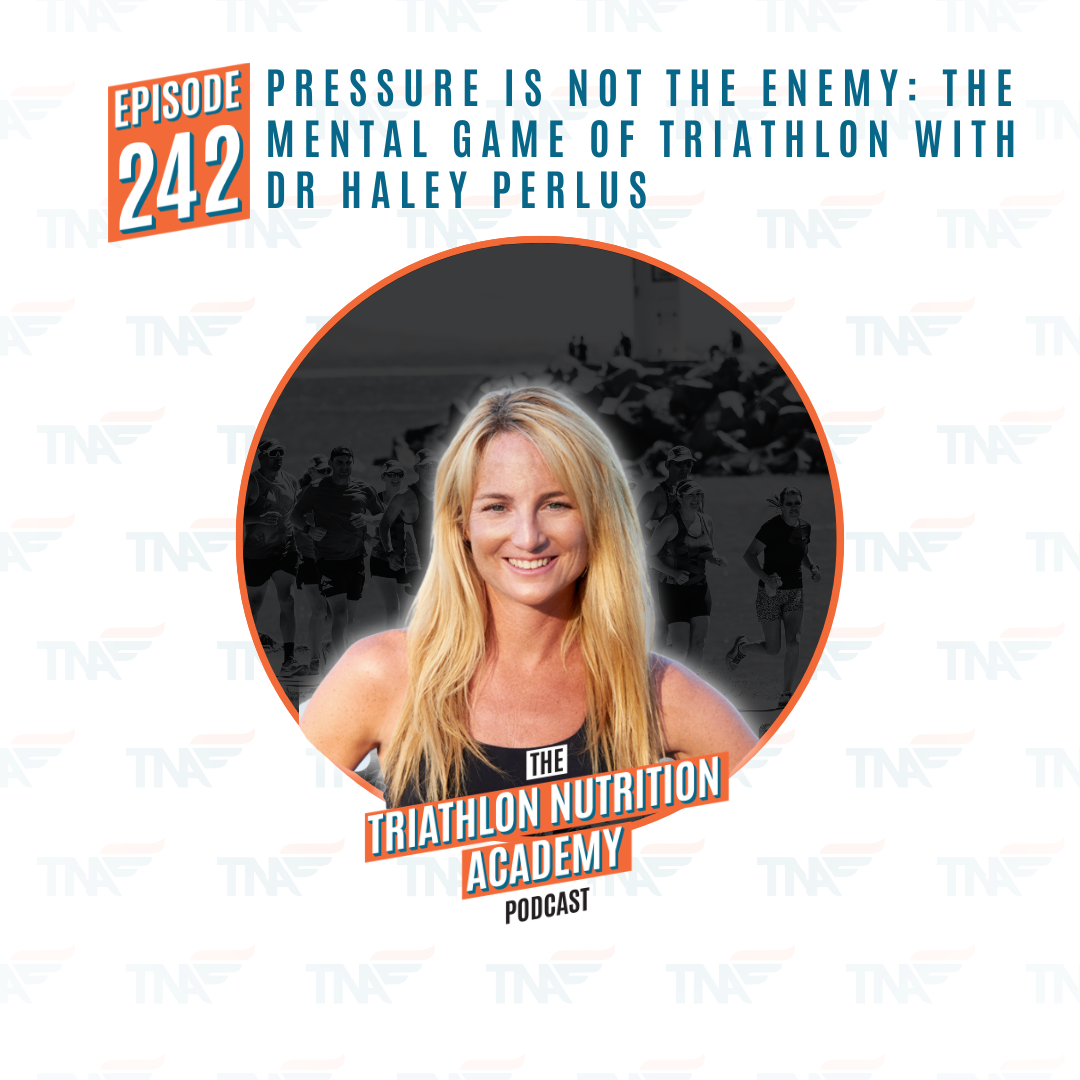
Episode 242 - Pressure Is Not the Enemy: The Mental Game of Triathlon with Dr Haley Perlus

Do race day nerves throw you completely off your game?
Maybe you second-guess your pacing, panic when things don’t go to plan or let pressure spiral into poor decisions around fuelling and performance.
In this episode of the Triathlon Nutrition Academy Podcast, Advanced Sports Dietitian Taryn Richardson sits down with performance psychologist Dr Haley Perlus to unpack the mental side of triathlon and why pressure isn’t something to avoid, but something to work with.
Dr Perlus shares practical strategies to help age-group triathletes build confidence, stay focused under pressure and perform at their best when it matters most. From race day anxiety and perfectionism to resilience, self-talk and mental preparation, this conversation is packed with actionable advice you can apply straight away.
Links:
Check how well you’re doing when it comes to your nutrition with our 50 Step Checklist to Triathlon Nutrition Mastery
Start working on your nutrition now with my Triathlon Nutrition Kickstart course
It’s for you if you’re a triathlete and you feel like you’ve got your training under control and you’re ready to layer in your nutrition. It's your warmup on the path to becoming a SUPERCHARGED triathlete – woohoo!
Connect with me:
To learn more about the Triathlon Nutrition Academy, head HERE | dietitianapproved.com/academy
See behind-the-scenes action on Instagram: @dietitian.approved
Follow along on Facebook: @DietitianApproved
Join our FREE Dietitian Approved Crew Facebook group
Enjoying the podcast?
Let me know what you loved about it and what you learnt by tagging me @dietitian.approved on Instagram!
Subscribe & Review in Apple Podcast!
Are you subscribed to the podcast?
If not, today's the day! I'm sharing practical, evidence-based nutrition advice to help you nail your nutrition and I don't want you to miss an episode. Click here to subscribe to iTunes!
Now if you’re feeling extra warm and fuzzy, I would be so grateful if you left me a review over on iTunes, too. Those reviews help other people find my podcast and quality nutrition advice. Plus they add a little sparkle to my day.
CLICK HERE to review, select “Ratings and Reviews” and “Write a Review” and let me know what your favourite part of the podcast is.
You're awesome! Thank you!
Episode Transcription
Episode 242: Pressure Is Not the Enemy: The Mental Game of Triathlon with Dr Haley Perlus
Welcome to the Triathlon Nutrition Academy podcast. The show designed to serve you up evidence-based sports nutrition advice from the experts. Hi, I'm your host Taryn, Accredited Practicing Dietitian, Advanced Sports Dietitian and founder of Dietitian Approved. Listen as I break down the latest evidence to give you practical, easy-to-digest strategies to train hard, recover faster and perform at your best. You have so much potential, and I want to help you unlock that with the power of nutrition. Let's get into it.
[00:00:00] Haley: pressure isn't the enemy, it's an invitation. What's pressure inviting you to do? But if you're not rehearsing this, if you're not doing the reps, in the heat of the moment, pressure's going to come, and you're not going to think, "Oh yeah, pressure is an invitation.
[00:00:13] What's it inviting me to do?" You're going to say, "Oh, no And you're gonna resort to old dominant behaviours. So we talk about how it - we gotta do the mental reps.
[00:00:23] Taryn: You've trained to swim, you've trained to run, you've trained the bike leg, and hopefully you've done a bit of nutrition training as well. But there is one performance system that age group triathletes haven't even touched, and it is the one that's gonna determine whether you hold it together when everything goes sideways on race day. I'm Taryn Richardson, Advanced Sports Dietitian and Triathlon Nutrition Specialist, and today I'm bringing in someone who specialises in exactly that. Dr Hayley Perlus has a PhD in sports psychology, has worked with elite athletes, Ironman, NASA and the US Air Force, and her entire philosophy is built around one idea, and that's pressure is not the enemy, it's a performance enhancer if you know how to use it properly. And that applies for us not only on race day, but I think it also applies in our daily habits that get you to the start line in the first place.
[00:01:13] Haley: Stick around to the end because Hayley is gonna give you one practical mental skill that you can take into your very next session.
[00:01:21] Taryn: Hayley, welcome to the podcast.
[00:01:23] Haley: Thanks so much, Taryn, for having me.
[00:01:25] Taryn: Now we are both sick, and because we're both high performance, we're like, "Nah, let's just keep going. Let's soldier on." Neither of us decided that we should reschedule, so hopefully this is as good as I have anticipated it will be. But I'm so excited to talk to you. So much that I do in my role as an athlete sports dietitian has this mental element to it, and I've had the pleasure of working alongside a lot of sports psychologists in my role at the Australian Institute of Sport and for Triathlon Australia.
[00:01:55] So today we're gonna tackle some race mental performance, nutrition mindset, and some practical tools and exercises that you can implement at the end of today's episode. So before we get into that, Hayley, can you just briefly explain what is the difference between our mental health and mental performance? I think a lot of listeners will have heard of sports psychology before, and they probably think it's for elite athletes only. It's not for everyday athletes who are just participating and want to perform to their best of their ability.
[00:02:26] Haley: Such a great question and such a great way to start, 'cause it is very different. And in fact, there's different-- You know, I have a PhD in, in performance psychology, not clinical psychology, which would be the mental health, and I think mental health really refers to your psychological wellbeing. if I want to inquire about someone's mental health, I'd probably ask, "How are you doing today?"
[00:02:48] Mental performance is really about performing under pressure. So it wouldn't be, "How are you doing today?" It's, "How well do you perform under pressure?" And that's the difference between mental health and mental performance. they do help each other, but they are different. And I think one of the greatest examples in our world would be, you know, Olympic swimmer Michael Phelps.
[00:03:10] Michael Phelps was - is, you know, 'cause we all know him, and he's been thought of, from all of his coaches and teammates and fellow athletes, as being the one of the most mentally tough athletes to ever to exist. So he had a high level of mental performance. But then he straight out, you know, talks about himself suffer-suffering from mental health.
[00:03:34] So very different, and they do feed each other, they do interact with each other, but we have to do that intentionally.
[00:03:41] Taryn: Yeah, so true. And it's very much a performance tool, like a power meter or a heart rate monitor as well, isn't it? You know, you're training a, a different system to perform to the best of your ability.
[00:03:52] Haley: It lets it all come together. I mean, you just said, you know, you trained your bike, you're in the pool , you're in the water, you're, you know, you're on the trails, you're on the path, you're running, you're biking, you're swimming, you're getting your nutrition, you're conditioning, and then it's amazing that in one moment you could have a thought that totally wipes everything out.
[00:04:11] In addition, that one thought may not help you follow through- On your nutrition, for example. So that's why they're so interrelated and you can't leave it out. In fact, you know, you said that you work - you've worked with a lot of sports psychs. Well, I've worked with a lot of sports nutritionists as well. I even have a certification in nutrition, not to practice it, not to coach it, because I do not.
[00:04:33] That is not my area of expertise, but to understand it. And we were talking about that beforehand. So it's important for, you know, for other people outside of psychology to understand the coaching of psychology and for me to understand nutrition, for example, so that we could help each other work. Because sometimes you'll may tell someone to eat this way, but they mentally have a m-- they have a mental block around it.
[00:04:56] we need both to enhance performance.
[00:04:59] Taryn: Absolutely. I couldn't agree more, and I, I want to try and get into some of that today, 'cause I know every listener-- Like triathletes are a particular type of person, right? To be able to do three sports in a sport, you have to be Cut from a particular type of cloth, and every triathlete I've ever met is a high performer.
[00:05:17] You know, it doesn't mean that they wanna win the race, but they wanna improve themselves every time they race. They wanna do better at training every single week. And they have spent months training that physical performance side of things, and hopefully if they're my athletes, they've spent many months also understanding and training that nutrition performance. But so many of them probably do neglect that mental side of performance. How would you get an athlete to understand the importance of training their mental performance, not only for race performance, but maybe the day-to-day stuff as well?
[00:05:51] Haley: It is an education. I mean, I can tell you just today I was contacted by an athlete, and they have a race next week. That's a Band-Aid effect. That's not going to really educate or solve, you know, bigger problems. If anything, I can put a Band-Aid on that.
[00:06:05] Uh, it's the understanding that when you go and you do all your reps, right? To teach yourself how to run properly, to teach yourself how to keep your cadence on your bike, to teach how you, you know, to maintain a certain stroke when you're swimming. the only way to develop it is to practice it. So your coach can teach you all of the techniques and tactics and strategies, but the only way for your body to learn it and implement it is with repetition.
[00:06:31] And with the mental side of things, it's the exact same thing. I can tell you how to think. I can invite a story. You know, I can-- or I can invite you to start thinking in a story that helps you. Like pressure isn't the enemy, it's an invitation. What's pressure inviting you to do? But if you're not rehearsing this, if you're not doing the reps, in the heat of the moment, pressure's going to come, and you're not going to think, "Oh yeah, pressure is an invitation.
[00:06:56] What's it inviting me to do?" You're going to say, "Oh, no And you're gonna resort to old dominant behaviours. So we talk about how it-- we gotta do the mental reps.
[00:07:07] Taryn: Hmm, I have the same situation too. I have athletes contact me, you know, two weeks out from their Ironman saying, "Can you help me with my race nutrition?" And it's, yeah, it's almost too late by that point 'cause you haven't done all of the day-to-day training nutrition that you should've been doing for the last six months.
[00:07:22] So again, we Band-Aid it, but it may not be ideal and, you know, I'm a high-performing individual. I wanna do the best that I can for my athletes, and that's not writing a race plan for somebody one week out either, same as for yourself.
[00:07:35] Haley: That's true. Mm-hmm. The coolest thing is though, for example, you know, an athlete will come to me a week before, and I'm never - You know, I'll give them something for sure. And then the coolest thing is it works. And then the next question is, "Okay, what do y'all - what else do you have for me?" And then, "What more can I learn?"
[00:07:51] And now you're in it, and now you're educated, and now you're implementing, and now it becomes part of your daily practice.
[00:07:57] Taryn: I think every triathlete that's ever raced, ever towed a start line, or maybe every athlete really in any sport, like something is bound to go wrong at some point, whether that's a mechanical, a gut issue, you start vomiting 30 minutes into the bike leg, you've had a really rough swim and you're 20 minutes behind schedule, you're blowing up on the run course. What is it that separates an athlete that can recover from that and then still finish their race strong versus the ones that are gonna mentally fold and DNF?
[00:08:29] Haley: I call it the optimum energy flow. So what does that mean? Every thought that we have, whether that thought is a real thought, "Oh, no, my bike just broke down. I have a flat tire," whatever it might be, but that thought has an influence on our emotions. And our emotions impact our physiology, heart rate, skin temperature, muscle tension, chemicals and neurotransmitters, and then that influences our behaviour.
[00:08:53] So we need to do is optimise that energy flow and understand that every thought that we have is going to further impact our physiology and then our performance. So what thought can we have when a mistake, and I'll use the word mistake, but maybe it was just an equipment failure, no one-- an uncontrollable thing, right?
[00:09:11] Or maybe it is something that could have been controlled. It doesn't matter. In that moment, something's gone wrong, intentionally, unintentionally, and we need to no longer strive for perfection, but strive to be the best recoverer we can be. And the best athletes are not the perfect athletes. The best athletes that stand on top of the podium at the end of the day are the ones that best recovered.
[00:09:32] So a story that we need to tell ourselves is, "Yes, I want today to be perfect. I want to go out there and run the race I planned." And because we know that's not always gonna be possible, usually never possible. And in addition to striving for perfection as a goal, I'm also gonna strive to be the best recoverer I can be.
[00:09:52] And what does that do? In the heat of the moment, when you do have an equipment failure, because you have trained your brain, best recoverer, best recoverer, best recoverer, your mind, your emotions, your body, and your performance gets into recovery zone. And now you can think more clearly on how to fix that equipment failure, think more clearly on how to get back up and slowly start to pick up, you know, pick up some time, make up some time.
[00:10:15] Taryn: to yourself, like best recovery, best recovery and getting your emotional state to calm down? Or have you got any other practical skills that somebody could maybe try and implement if that happens in their race to
[00:10:28] Haley: that script, that, that goal of best recoverer in your visualisation. So everyone visualises daydreams, imagines the race, but many people only imagine it going their way. So imagine having some type of mistake, failure, malfunction, and eve- imagine yourself going through this optimal energy flow and being the best recoverer.
[00:10:51] Talk about it, practice it in when you are practicing and not racing. When you're in your training, something goes wrong, don't just stop and walk it out, go and fix it. Immediately recover. See, those are the ways that, that you warm up to it. In addition, we have something called a what if plan in sports psychology, and you literally make a list.
[00:11:10] And in triathlons, this is like ' cause there's a lot of what ifs can go wrong, weather, you know? So you make a list of all the things that you, can anticipate, and then you make the fix-it list. What will I do to recover? And here's the thing, you may encounter something that you didn't expect to happen that, you know, you just didn't know what you didn't know, but you've trained your brain to be a recoverer.
[00:11:35] So even though you never intended for this particular thing to happen, it's okay 'cause you can adapt. You can transfer the what if plan from something you knew to the what if plan that you, that you didn't know, and so you now have the skill set. It's really the skill set of being resilience, the skill set of being the best recoverer you can be.
[00:11:56] Taryn: Yeah, I love that. We've seen that a lot in the elite triathlon space lately where people have had their bottle cages completely break. Uh, like I've seen a guy jump on his bike for his flying mount and his seat post has snapped, so he's had to do an entire race without a seat to sit on. And we look to the elites for so many things, you know, nutrition, training, but then people probably gloss over the fact that they have that really strong mental performance and resilience to continue racing.
[00:12:27] So many age groupers would just be like, "Well, I don't have a seat, I'm gonna stop. I'm gonna call my wife to pick me up because my-- I've got a flat tire." But that training, like you've talked about, do that in training so that you have a, a better backup plan on race day. I love that.
[00:12:41] Haley: So here's a great question: What does this moment need from me? What does this next moment need from me? takes you out of panic mode and into strategy mode.
[00:12:50] What does this moment need from me? instead of calling your wife and having them pick you up and, like, nothing I could... Totally out of my responsibility. Total- totally out of my hands. Not the truth. Now you're taking responsibility, and you're gonna have so much personal pride. You know, I like the word pride, acronym, personal responsibility and delivering excellence.
[00:13:09] You're gonna have a lot of that.
[00:13:10] Taryn: Yes. I feel like that could be translated really quickly to parenting as well.
[00:13:15] Haley: Everything, right?
[00:13:17] Taryn: Yeah.
[00:13:18] Or, you know, disaster at work. It's a really nice, uh, strategy that I think everyone could walk away with.
[00:13:23] People don't talk about this much in a race situation, but the post-race emotional crash that sometimes happened.
[00:13:31] We are, you know, type A personalities, like really high achievers. We set really high expectations on ourselves, and you might have trained for six to 12 months to cross the finish line, and your day wasn't what you anticipated or, or wasn't what you expect it to be, and so you feel flat and you feel really disappointed in yourself. What is actually happening there, and how can athletes prepare for that so that they don't set themselves up to have that big slump after a race, despite being able to achieve what 99.99% of the population can't do anyway?
[00:14:05] Haley: it's interesting, Taryn. Sometimes things won't go their way, and so they can't find, they, they can't find the satisfaction, the pleasure, the gratitude in the-- for themselves because it didn't go exactly according to plan, right? It wasn't exactly how I wanted it. And it is a lot of training, and it is a long race.
[00:14:29] And it's not like you can just wake up the next ga- day and go again. It's just, it's just not that type of sport. So I understand the letdown. Yes, so there's that piece. But then I'll also tell you that there are times when athletes will achieve their goal, and they still feel flat. So it, it, it happens for a-- many situations.
[00:14:48] Now, We'll go to the first one that you mentioned. If it doesn't go your way, it's, it's, I think it's because there's just so much pressure that you put on yourself to have it be done perfectly and to be a fortune teller. And so nothing else, nothing else is good enough. And you would never tell your teammate that it's not good enough You would never tell your child that it's not good enough, but you tell yourself that it's not good enough 'cause it wasn't exactly how you planned it to be.
[00:15:22] So that's why I like these visualisation techniques when you're not just visualising the perfect race, you're visualising the perfect race and everything, you know, the really hard race and everything in between, and really understand, I know you want these outcomes. I know you you know, I understand that.
[00:15:40] But overall, what is the purpose of running this race? What is the purpose of entering this triathlon? What is-- what was the real why? Because then the why can bring back the bigger picture instead of just, it didn't go this I didn't get exactly this time that I wanted, or so and so beat me. I know that's a big one.
[00:16:02] Or, you know, or... So I think we just have to remember the greater reason, the purpose behind all of this, and that might bring back a little bit of the enthusiasm and the excitement and just the gratitude for the achievement. In addition, it's okay if you feel flat immediately after. mentally, emotionally, spiritually, physically, this is a big energy.
[00:16:29] Y-you're using a whole lot of energy, and when it is done, when you do cross the finish line, even if you were successful and achieved everything you wanted, you still might feel just flat. Give it, give it a moment, give it a minute, give it an hour, maybe even give it a day, because you might just be drained of all resources.
[00:16:51] And then when you start to renew a little bit of energy, you'll start to bring back that mental clarity, that emotional excitement, you know, the, the, the pride that you feel in your body and in, in your spiritual connection. 'Cause know, endurance racing, endurance sports, there's a lot of spiritual connect- connection there too.
[00:17:09] So you may just need a moment to renew some energy and then come back, come back to life, if you
[00:17:15] Taryn: Yeah, put some nutrition back in the system so your brain works properly, and then think about it.
[00:17:21] Haley: There you go. Add the nutrition back in. Absolutely. It's a huge part of it. It's a huge we're our energy's depleted, so we gotta, gotta get that back energy in, and then maybe you can feel and think all the things, that, that you've earned
[00:17:35] Taryn: I like taking it back to the why, 'cause a lot of us get into triathlon for a particular reason, whether that's a health reason or, you know, a family reason or, or something, and we forget that because we are highly competitive. And if you're in a group environment, you compete against each other, and you do get disappointed when People think or tell you that you can hit a certain time, or you're going to, you know, do really well and you're gonna smash this, and you don't, and it sets them up for failure before they've even started the race.
[00:18:05] So one of the strategies one of our athletes uses is a three-tier goal session. So she's got like a rockstar goal, she's got a super happy goal, and a happy goal, and no matter what happens in the race, she's setting herself up to be happy with her event, no matter whether she, shit hits a fan, something goes pear-shaped, she doesn't hit the time that she wants, she doesn't get on the podium.
[00:18:27] And I really love that strategy because, I don't know, we do it to ourselves. We self-sabotage ourselves a little bit, I think, as triathletes. We, we are such high performers that we forget like how awesome we are just by being able to link three sports together in an event.
[00:18:41] Haley: I once had an athlete and I'd, I'd, you know, I've done that goal strategy with too. It's like the greatest goal that you can set, the, the, the, the great goal and then the okay goal, right? But either, like you said, the happy. And I remember her response to me was, "But if I don't go for the best of the best, then I'm just letting myself off the hook." or I'm not believing that I can achieve the best because then I have this plan B and plan C. And I actually, we had a conversation about it 'cause I agree with you. I looked at it as actually giving yourself s-space, giving yourself expression, giving yourself freedom instead of pigeonholing you into one specific outcome that may or may not happen.
[00:19:23] But just being able to like, "Oh, this could happen, or this could happen, or this could happen." So you've got those three, and then at the beginning of the race when you're at that start, then the thought is, "Let's see what can happen." And the let's see what can happen allows me... Every athlete wants to play free, right?
[00:19:39] Every athlete wants to express themselves and go out there. Well, let's see what can happen allows for that. If this has to happen, all you do is get contracted, and you're forcing it instead of not expre- instead of expressing it.
[00:19:53] Taryn: Yeah. So important.
[00:19:56] a little bit into some nutrition mindset stuff? Because you talk a lot about pressure being a performance enhancer, but I see athletes who use pressure in the complete opposite direction to that. They put so much pressure on themselves to eat perfectly that they will completely abandon the plan and, you know, YOLO and whatever, I'll sort it out on Monday type mental game. If they aren't doing exactly right every single day, they just kind of give up and have to do a full reset. What is happening there, and how does somebody actually interrupt that pattern of perfection, uh, or complete imperfection in a way?
[00:20:34] Haley: There are people that become so rigid and so structured, and on, on one hand, it's really good, right? Like, we, like, we like having routines. We like being structured. That's all very good. But to a point where you actually, you think you're in control, but you're actually not. It's the plan that's controlling you.
[00:20:53] So the minute you make one mistake, there's no, "Let's be the best recover I can be." It's, "You are a failure." And then you're afraid to start again because you don't believe in your ability to. So if you miss out, if you mess up one meal, if you have one brownie, I don't know what the like, you fall off your plan, and it's those individuals that they thought that they were doing it so that they could be in control, but the reality is, is that the plan started controlling them, and then that shakes your whole confidence, and it, and you s- you feel like such a failure, and so you just choose not to start again.
[00:21:30] Whereas, having the structure that you provide, you know, nutrition, and I do-- and I'm not saying it's not serious 'cause it is serious, and there is a plan for, for a reason. But there's also this ability to be malleable. There's a very big skill set, mental skill set in being fluid, mental skill set in going and living your life and then, you know, and being able to compartmentalise a little bit when it's time to go play, when it's, you know, playing at, you know, indulging, indulging.
[00:22:03] You know, I don't know your rule, so, y- I would love to know your, your rule, but I know from a program that I, that I teach, and it's not for sport performance, so I, I would love to know you f- with regards to triathlon performance, but it's an eighty-twenty rule. So eighty percent we eat for performance, twenty percent we eat for living and life and indulgence and fun.
[00:22:27] And it's an interesting thing that when you stop, you know, when you stop being so rigid, you actually get to enjoy both the eighty and the twenty. But if you're trying to be so rigid, you feel like a failure when you go and have the indulgence, and you are not cer- you don't certainly enjoy the, the program because it's controlling you and not the other way around, even though you think you're in control.
[00:22:52] Taryn: I quite like the flexibility that you talked about, like having the ability to adapt to a plan because life is always gonna throw you curveballs, or you might have your birthday to celebrate or something cool happens at work, and if you are stuck in this rigid plan where you've got to eat your chicken, broccoli and rice and not go out and celebrate, like that's not living, Barry. I don't have a rule, it's more around education. Just like yourself, educating triathletes, like I work with adults, right? You're an adult, you can make your own decision. But understanding the foundation of what a really great diet looks like or really great nutrition looks like for health and performance.
[00:23:30] And if, you know, you wanna go and enjoy a beer on the weekend with your friends and live life, I'm totally cool with that. I don't like the all or none approach that a lot of people have, so I try and get them to have this more consistency and then that have some flexibility up and down in that.
[00:23:48] Haley: And there-- And that's a skill set. and then it comes with a story, and then it comes with a follow-through on nutrition, and obviously you need to be eating the right food so that it actually works for you. But it is a skill set to live your life in, in a way where it's not, you know... Well, it bec- I don't wanna say perfect because maybe for me the, like, an eighty/twenty rule is perfect. but it is a skill set to be able to... I guess what I'm trying to say, it doesn't always have to be so serious. And there's a skill set when you're serious and the-- and when you c- when you can go from skill set-- Sorry, just from serious to play, play to serious, serious to play, and enjoy both of it.
[00:24:29] Taryn: Yeah.
[00:24:30] Haley: And there's skill set because there's discipline in that. Knowing when you're celebrating your birthday and knowing when you're about to race,
[00:24:38] Taryn: I think a lot of triathletes will resonate with that because they do
[00:24:41] sort of switch on, for a key event. Some people use an event to switch on, but having that looming goal is a great time for somebody to, okay, go, "I'm gonna focus on nutrition now, I'm gonna focus on training, I'm gonna do all these things leading into this event."
[00:24:58] And then what I try and teach people after the event is it's not just a YOLO, again, all or none. Having the ability to reset or come back to a, a good baseline regardless, so that that up and down is not a big jump either direction every time. We've got this consistency across the year and across the season.
[00:25:18] Haley: I remember being, And I would love to get your thoughts on this one, 'cause I remember as a sports psych I was, I was just, intrigued. I was looking. But I was at, Lake Placid Triathlon. I was not participating in it. I was there with, with an athlete. And everybody at the end, pizza and Coke, and it was just everybody at the end. And, you know, it was just celebration. You know, everyone like, everyone was just really happy and achieving it and just, y-you know, eating. and I thought to myself, you know, I don't know, is that just-- is that part of the, the culture or is that their body's needing those quick carbs and, the sugar immediately?
[00:25:58] So I didn't know, in my mind way back then, I didn't know if it was, you know, just more of my body actually needs this quick energy or if it was celebration indulgence after an achievement.
[00:26:09] Taryn: Maybe a little bit from column A, maybe a little bit from column B. don't feel like eating after a race, so I'm surprised to hear that was happening. We don't have that kind of fanfare in Australia after you
[00:26:18] finish an Ironman. Like, there's definitely food tents, but you guys in, North America seem to go all out with what you provide after a race.
[00:26:26] Haley: I remember seeing it for the first time, and I was like, "Oh, that's interesting." I just didn't really know what to make of it. But maybe... Okay, maybe a combination of both.
[00:26:35] Taryn: I set my athletes up with a specific plan for what macros they need in that window, and how they get it is up to them.
[00:26:41] Haley: it.
[00:26:44] Taryn: have pizza after a race, 'cause if that's what you feel like and you've been waiting to cross a finish line to eat pizza, like go for it. Like I said earlier, you're an adult, you can make your own
[00:26:53] Haley: There
[00:26:54] Taryn: So how do you help somebody also that is paralysed by so much information? Another version I see with triathletes is athletes have read everything. They've listened to every podcast episode. They've watched every YouTube video that they can get their hands on. They know in theory like everything that they should be doing, but they get so overwhelmed by all of the information that they can't make a decision and end up just winging their nutrition anyway.
[00:27:22] Haley: And then nothing works because they didn't commit to anything hol-holy.
[00:27:26] Taryn: there's no consistency. They still have no idea what they're doing, but they feel like they know what to do, they just can't put it on paper and be consistent with that.
[00:27:33] Haley: I do believe this, and I don't-- I, I think we all at the beginning, do your due diligence. Okay? Do your due diligence. Watch as many people, listen to as many people, and then f-see what person-- like, see the voice that you like to listen to, the way they're teaching you, if it resonates with your lifestyle, if it works within your family dynamics, if it's something that you can do.
[00:27:54] So do your due diligence. Don't do a lot of it. Don't spend months 'cause then that's just your paralysis of analysis, right? That's just you never committing. But take a week, take a month, whatever it might be. Do some trial and error. Do your due diligence. Once you have decided on something, what's even more important than it being the perfect program for you or the right program is that you commit to it.
[00:28:16] So once you've made a choice You tune everything else out. You turn everything else off because then you're just getting confused. It's the same thing in my field. If s- I want people to go and watch as many, you know, listen to many sports psychologists, listen to a lot of mental toughness programs, and then if you'd find the way that I t- if you like the way I'm speaking to you, if you like the stories that I'm sharing, if you like the way that I work, that I care, I'm gonna ask you while we're working together, 'cause I have a, like a three-month program, initi- initial program, for that moment, I actually want you to turn everything else off because you won't give us, you won't give our program the attention that it needs and deserves to work if you're confused and getting, you know, getting invaded with other information.
[00:29:07] And again, what's more important than having the exact right coach is committing to that coach so that the... And, and having them commit to you.
[00:29:16] Taryn: I get that from a nutrition perspective too. My athletes are the ones that always send me the stuff to look at. Like, "Look at this. W- look at what this person's saying about carb loading. Is this-- Isn't this funny?" It's like, okay, put your blinkers on, concentrate on this one thing for now, focus on yourself and, and turn up so that you can improve over this period of time, not still be worried about what everyone else is doing.
[00:29:37] Haley: And there are many times when athletes will switch, right? There are many times when athletes will switch sports psychs, sports nutritionists, technical coaches, many times. But I'm hoping that we do it after we've really given the current program a really, like, you know, best effort
[00:29:56] and and best commitment.
[00:29:58] And then, and then you'll have more confidence in your decision if, if you leave or to, or to stay.
[00:30:04] Taryn: Can we talk about the mental load of nutrition a little bit? 'Cause, triathletes, I think, or any athlete, there can be an enormous amount of stress and anxiety
[00:30:14] specifically around nutrition that people carry. Like, these athletes are often the ones that I find like to track their food, and they feel in control by tracking their food every day.
[00:30:25] It just is part of what keeps them safe. But then when they're not in that control phase, they have no idea how to eat around that. You know,
[00:30:35] did I eat too many carbs? Or a c- if I eat too many carbs, is that gonna make me gain weight? I'm gonna have to do extra sessions to burn off those extra calories that I ate today. But from a sports psych perspective, what does that kind of worry actually do to an athlete's performance?
[00:30:52] Haley: optimal energy flow, our thoughts impact our emotions, our emotions alter our physiology, our physiology, um, you know- Either helps or does not help our performance. And if you're worried about your nutrition, you're automatically feeling... So you automatically have a story. "I don't know that this is gonna work.
[00:31:10] I don't know what I, I don't know what I'm doing. I don't know what I can trust." Now you're getting anxious, you're getting worried, you're getting fearful. Now your body's contracting. You may not digest food as well as if you weren't worried. and then obviously everything from there, if you're not, if your metabolism is off, if your min- if your digestion is not functioning, it may not actually be the food at all.
[00:31:32] It's because of the anxiety that's living in your body.
[00:31:34] It's the stress that's living in your body that's preventing that food from doing what it's supposed to do, doing the, what it will do if you let it. It's the same thing with equipment. Sometimes the equipment's gonna work, but we're not letting the equipment work.
[00:31:46] It's like my, when, when I learned how to mountain bike for the first time, I remember my husband telling me, who's my coach, like, "The bike will do it if you let it." The food will do it if you let
[00:31:57] Taryn: Yeah.
[00:31:57] Haley: it. Right? Um, but we have this worry. So that's one thing. So if you d- when- once you do choose your program, right, then it's the ability to allow yourself to let it work.
[00:32:09] I'm also though a big believer... So I do, understand the data. I do understand the journaling. I do understand the recording everything you eat. I get that. I also would love to recommend, and we can all choose, like you said, you're an adult, you can choose how you do this. If it's one meal, if it's one day, if it's half a week, if it's a full week, intentionally do not record.
[00:32:34] Intentionally do not. You know what I mean? And then start to actually listen to your body and feel your way through. Because what all these devices have done for us is that if g- they've given us great information, but we stop asking ourselves how we feel. We start asking ourselves, you know, we start listen- we stop listening to ourselves.
[00:32:55] So I think it's important to not get off the program, but maybe not be so rigid and give yourself a meal or a week or anything in between to see if you can bring the education to life in the moment and trust yourself by listening to yourself. What do you think about that?
[00:33:18] Taryn: That's a really good strategy to try and break away from it. I like the, you know, one meal without or a day without or whatever you can manage. What if somebody doesn't know that they're in this zone? How can somebody identify that they are in that kind of control anxiet- anxiety cycle in the first place?
[00:33:35] Haley: Well, a great way to test it would be to take that meal, and if you freeze, and if you don't know what to eat You know what to eat. You've been being coached by Taryn for how many months, how many weeks, how many, you know, like, but, but y- because you don't get to write down, you're freezing up.
[00:33:52] What that means is that you're not in control. The plan is in control of you. So it's actually a good test. So it's one way to, to develop this skill set of listening to your body again and getting back into real control. And then the, on the flip side, it's actually a great test to see how attached you are to this program and have stopped listening to yourself and stop letting the education that you have live out in re- in your real life.
[00:34:22] Taryn: Yeah. So, it's so important, I think, that people do understand how to eat without tracking. It's one of the key things that I teach athletes inside the Triathlon Nutrition Academy program, is how to eat without having to count every macro and, and every calorie every day, 'cause it is s- debilitating for some people.
[00:34:38] For some people it is, they love it, and it's the control, and they're more comfortable there. But I, I always try and challenge that. I don't know, that's the type of person I am. Like, do you want to be tracking your food, everything you put in your mouth, for the next 60 years? Or do you want to understand how to do this without having to do that?
[00:34:54] Haley: and the biggest, you know, with eating disorders or exercise addiction, you think you're in control, but you're actually not. It's controlling you.
[00:35:02] Taryn: Yeah, I like that. Like, the plan is controlling you, you're not in control. Can we get into some practical tools for listeners?
[00:35:10] a lot of people will think that they may be really mentally strong, but how can an athlete identify how mentally strong they actually are? Is there any, any tool or any yardstick that somebody can, can do to, to test themselves?
[00:35:23] Haley: Unfortunately, I don't have a fabulous answer for you with that question.
[00:35:28] It's more of, in retrospect, did that one poor training day, in retrospect, did I blow it out of control? Did I blow it out of proportion?
[00:35:39] Did it take me a week to mentally and emotionally recover from this race? Now, physically, I understand that it can. Um, but mentally and emotionally, like, am I not just getting over, like, you know, the grand scheme of things.
[00:35:51] sometimes I have other people who, who trust coaches, who know you as an athlete, they may be able to say, "You know what?" Like, " we gotta be able to, to move on from this." so that's just in retrospect, if you look back, were you not able to recover as quickly as You, you, you might think you, you'd like to.
[00:36:12] And I don't mean that there's no room for disappointment, and there's no room for crying, and there's no room for, you know, 24 hours or I don't even wanna put a number on it,
[00:36:24] Taryn: Yeah, just sitting with it
[00:36:25] Haley: just sitting with it. I mean, that is part of being mentally strong. You know, my father once said to me when I was disappointed at something, "Cry so that you can then get up."
[00:36:35] Right? So we have to give ourselves that permission. But sometimes it lingers, and we're just not getting back up on the bike. We're just not allowing ourselves, and so that would be, would be a sign. but what does mental toughness mean to me? It means showing up when you don't want to.
[00:36:50] it means especially in a sport that's an endurance sport, it's enduring and accepting pain and discomfort, and willing to.
[00:37:00] Taryn: the body is capable of so much, isn't it? It's often our mind that holds us back.
[00:37:04] Haley: Oh, yeah. Well, and that's the-- So that's the other thing. It's like often, you know, professional athletes, I would say professional, you know, endurance athletes, they have trained their minds so well that their body will give up before their minds do. For all of us, our minds give up before our bodies do typically.
[00:37:27] Taryn: Yeah.
[00:37:28] Haley: So a mentally strong athlete... Now, and I'm not asking you, like sometimes that's dangerous, right? Sometimes your body is tell- like your mind is telling you, your body's telling you you're done, and your, you know, and your mind won't let it. You know, you'll know if you're mentally strong if you're going through your training and if you're going through your racing, and at the end of every race, you're like, "Ah, I knew I c- like my body had more."
[00:37:49] S- If your body had more to give and you didn't give it, it was your mind or your emotions that got in the way, in my, in my humble opinion. So that's when we go to work. " Yeah, I c- you know, I, I had more in me." Okay. Well, that's a good s- that's a sign that we need some, some mental training.
[00:38:06] Taryn: Yep, and, you know, maybe the right nutrition to go with that mental training.
[00:38:10] Haley: Of course, I keep leaving that out because you do you and I'll do me. But yes, of course. No, of
[00:38:14] course. Yeah.
[00:38:15] Taryn: we work together.
[00:38:16] Haley: Thank...
[00:38:18] Taryn: skill that somebody could start practicing now then to improve their mental toughness and their resilience? Have you got anything practical somebody could try right now if they're out on the bike or going for a long run or, you know, driving in the car?
[00:38:30] What, what's something we could-- they could walk away with
[00:38:34] Haley: Okay.
[00:38:35] After they've checked their nutrition and made sure that they've
[00:38:39] Taryn: Shameless plug.
[00:38:40] Haley: Well, I gotta, you know, shame on me for not, for not bringing that up. Um, there's two things that I'd like to talk about. One is what you brought up from the very beginning. I do believe that pressure is not the enemy. I believe pressure is an invitation, and that's how it is a performance enhancer.
[00:38:55] So when you're on the bike and you start to feel the gruelling of it, you f- you start to, you now, your mind starts to wander. I don't know, maybe you even just get bored. or maybe you really do feel pressure. Maybe someone just passed you, or you're not, you know, on the right time.
[00:39:09] Ask yourself, "I'm feel-" Like, I- you're feeling pressure. Remind yourself pressure is not the enemy, it's an in- it's the invitation, and what is pressure inviting you to do right now? What does this next moment need from me? What am I being invited to do? And I'll share an example, not that I'm in training right now, but I was on my road bike probably two weeks ago, and I found myself getting tired.
[00:39:36] Just... And I don't even... And I probably couldn't even tell you if it was mentally, emotionally, physically. I couldn't even tell you if it was my nutrition, my sleep. I couldn't even tell you. But I do know that I was, getting tired. And so the odd thing is like, "Oh, you're tired. It's okay. Slow it down. Pace yourself.
[00:39:52] Just, you're just out here. Be happy that you're out here." That would be the normal response. I actually did something quite the [00:40:00] opposite. I asked myself, " What am I being invited to do in this moment? Maybe I'm actually being invited to step it up a notch, to pick up the challenge."
[00:40:10] And so I increased my cadence. It was the climb. And I just started, I found a mu- a song with beats per minute that I wanted to... And I actually picked up my pa- my cadence. I picked up the challenge. I didn't go easier on myself, I went harder on myself, and suddenly I got more energised. S- mentally first, 'cause I was like, "Oh, wow," you know?
[00:40:33] "I'm, I'm, I'm achieving this goal that I just set in the spot." And then everything came. So that's one thing. What is pressure inviting you to do? What can, what is this moment inviting you to do? The other thing, which is kind of off the bike, out of the pool, and off the, the running path, is recovery. So we know about recovery, physical recovery.
[00:40:59] [00:41:00] Emotional and mental recovery are just as, if not more, important. I would say just as important, equally important. And people don't know what real recovery is mentally and emotionally. They think it is taking time off to do something else. But what if that something else still requires energy? Then it's not recovery.
[00:41:21] Right? So in a physical, you- it's very easy to understand what is physical stress and what is physical recovery. But mental and emotional, it's not as easy to know what is mental and emotional stress and what is mental and emotional recovery. It is calm and peace. It is taking your mind out of one task and putting it into another one, and that as long as that other task require-- creates calm and peace.
[00:41:48] And that can be done in stillness, meditation, the brilliance of boredom, but it also could be done in active as-- so you're doing something, but something that, that is creating calm and peace while you're doing it. And that then gives you energy to embrace the pressure. That gives you energy to, to walk into the, the race with all the anxiety that's there, all the anxiety that's not going away.
[00:42:17] But now you have the energy, the capacity. So you-- We know we put food in our bodies to increase our capacity. we have to, recover our minds and our emotions so that we renew the capacity to walk into a stressor of the race.
[00:42:32] Taryn: Such valuable advice. I think we could take that and translate that to any element of your life, not just triathlon or, or sporting performance. Like think about work or family. It's such a great skill. Thank you for sharing.
[00:42:46] Hayley, thank you so much. This has genuinely been one of my favourite conversations on the podcast. There's so many good skills in there that I know everyone listening is gonna take away from. There's so many good little nuggets, and that connection between what is happening in your head, what's happening with your nutrition, what's happening in your body is so underestimated. And the athlete who abandons their race plan because one thing goes wrong, the athlete who knows exactly what to do with their nutrition but still doesn't do it, I think there's some really good skills in there that are gonna be valuable for people to just go and try something new, new, and you've just explained why. If we want to find you more and go deeper on the mental side of performance, where's the best place to find you?
[00:43:33] Haley: Um, definitely on Instagram, I believe it's Dr. Haley Perlus, but my website, drhaleyperlus.com, where you'll find everything. And I just-- You, you made me think of one thing, if I can just share In order for us to have mental capacity, we, we do need fuel in the form of food, right?
[00:43:52] Like, food gives our bodies glucose, but it also gives our brains glucose as well. And so we need that energy. And in addition, mindset helps us follow through on nutrition. So it's not just going out there and doing the laps and running the miles and, you know, getting on our bikes. that-- R2 areas allows all that training, that physical training to come to fruition and to come alive, and for everyone out there to realise their, their true potential.
[00:44:22] Taryn: Yeah. You can see that really clearly with athletes that are under-fuelled or, or are bonking or hitting a wall. Like, the, your mental game is much weaker if you are significantly under-fuelled compared to an athlete who is well-fuelled, and I call it supercharged when an athlete will cross the finish line. And h- it's a key KPI in the Academy program that you can cross the finish line with a smile on your face knowing that you've given it your all, but you're actually still mentally feeling good. You're not in a complete deep, dark hole.
[00:44:50] Haley: No, it's true. I get that. Yeah, the supercharge. I like it.
[00:44:53] Yeah. Thank link - Thank you for joining me. I will link all of those things in the show notes if you do wanna find Hayley. Go smash your training, everyone, and I'll see you next week.
Thanks for joining me for this episode of the Triathlon Nutrition Academy podcast. I would love to hear from you. If you have any questions or want to share with me what you've learned, email me at [email protected]. You can also spread the word by leaving me a review and taking a screenshot of you listening to the show. Don't forget to tag me on social media, @dietitian.approved, so I can give you a shout out, too. If you want to learn more about what we do, head to dietitianapproved.com. And if you want to learn more about the Triathlon Nutrition Academy program, head to dietitianapproved.com/academy. Thanks for joining me and I look forward to helping you smashed in the fourth leg - nutrition!