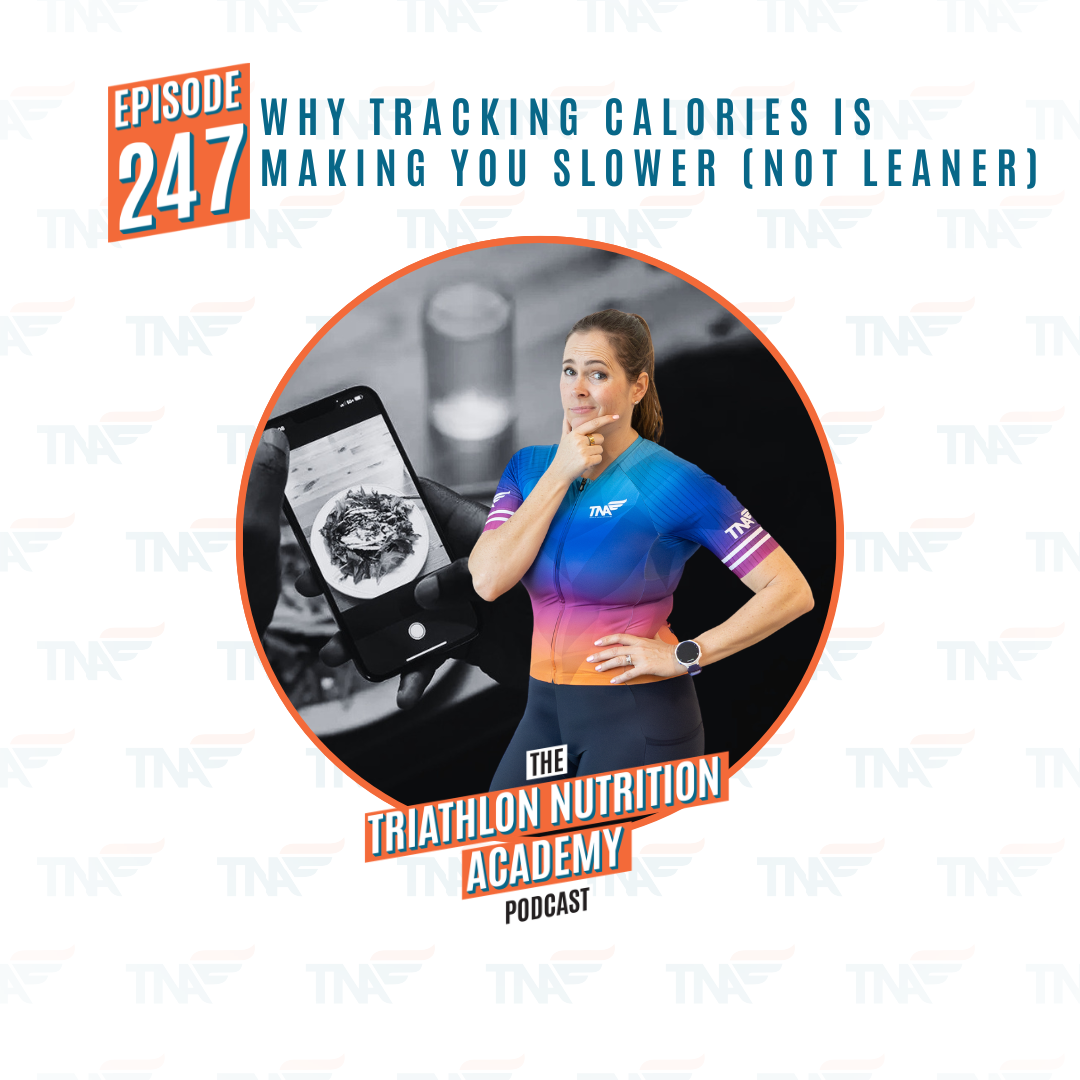
Episode 247 - Why Tracking Calories Is Making You Slower (Not Leaner)

Is your calorie tracking app actually working against you?
You're logging everything, hitting your macros and training hard but your long sessions are falling apart, the scale won't budge and you're exhausted in a way that sleep just isn't fixing. The app says you're on track. So what's going wrong?
In this episode, Advanced Sports Dietitian Taryn Richardson breaks down why calorie and macro tracking apps - even the good ones built for active people - were never designed to teach a triathlete how to eat. The maths is educated guesswork, the protein targets are built backwards, and the app has no idea how to help you when your kid gets sick and your afternoon session gets cancelled.
In this episode you'll learn:
- Why calorie apps were built for the sedentary population and why that model falls over for a triathlete training 10 to 20 hours a week
- How inaccurate your wearable device actually is at measuring calorie burn (spoiler: up to 93% off)
- Why the standard percentage-based protein model cuts your protein at the exact moment you need it most
- The difference between hitting your macro numbers and actually knowing how to eat
- Why underfuelling sneaks in even when you're tracking perfectly - and how quickly it affects your training
- Two real athlete examples: one who was significantly underfuelled despite doing everything the app said, and a vegan athlete whose app couldn't come close to meeting her needs
- What it actually looks like to fuel for the work required, adjust on the fly and never need the app to make a decision for you
Links:
Check how well you’re doing when it comes to your nutrition with our 50 Step Checklist to Triathlon Nutrition Mastery
Start working on your nutrition now with my Triathlon Nutrition Kickstart course
It’s for you if you’re a triathlete and you feel like you’ve got your training under control and you’re ready to layer in your nutrition. It's your warmup on the path to becoming a SUPERCHARGED triathlete – woohoo!
Connect with me:
To learn more about the Triathlon Nutrition Academy, head HERE | dietitianapproved.com/academy
See behind-the-scenes action on Instagram: @dietitian.approved
Follow along on Facebook: @DietitianApproved
Join our FREE Dietitian Approved Crew Facebook group
Enjoying the podcast?
Let me know what you loved about it and what you learnt by tagging me @dietitian.approved on Instagram!
Subscribe & Review in Apple Podcast!
Are you subscribed to the podcast?
If not, today's the day! I'm sharing practical, evidence-based nutrition advice to help you nail your nutrition and I don't want you to miss an episode. Click here to subscribe to iTunes!
Now if you’re feeling extra warm and fuzzy, I would be so grateful if you left me a review over on iTunes, too. Those reviews help other people find my podcast and quality nutrition advice. Plus they add a little sparkle to my day.
CLICK HERE to review, select “Ratings and Reviews” and “Write a Review” and let me know what your favourite part of the podcast is.
You're awesome! Thank you!
Episode Transcription
Episode 247: Why Tracking Calories Is Making You Slower (Not Leaner)
Welcome to the Triathlon Nutrition Academy podcast. The show designed to serve you up evidence-based sports nutrition advice from the experts. Hi, I'm your host Taryn, Accredited Practicing Dietitian, Advanced Sports Dietitian and founder of Dietitian Approved. Listen as I break down the latest evidence to give you practical, easy-to-digest strategies to train hard, recover faster and perform at your best. You have so much potential, and I want to help you unlock that with the power of nutrition. Let's get into it.
[00:00:00] Taryn: So you've been logging every little thing that goes into your mouth for months. Every gel on the bike, every coffee, every last almond or piece of crust that's left over from the morning breakfast, your app says you're at a deficit. You are training your backside off and the scale just won't budge. Your long rides are starting to fall apart in the last hour, and you're fatigued in a way that sleep is just not fixing.
[00:00:28] Right now. There are thousands of triathletes that are doing exactly that, tracking harder, hitting their numbers, and still getting slower, and not achieving your body composition goals either. Trusting some targets from an app that doesn't know anything about you. It hasn't met you, it hasn't swung with you, hasn't ridden with you, it hasn't run a metre in your training.
[00:00:50] It has no idea that your kid is home sick from school today. It has no idea that you are nursing a niggly knee issue and it has no idea that you're sick of bloody eating chicken. Hi, I'm Taryn. I'm an advanced sports dietitian and triathlon nutrition expert, and I have lost count of the number of triathletes who have come to see me doing everything that the app told them, but wondering why they feel like a beat up ponder when they're trying to train to be a Ferrari.
[00:01:19] Today I'm gonna break down why tracking your calories and macros, even with a decent app, can still leave you feeling really stuck as a triathlete and what actually moves the needle. Instead, I'm gonna share two real athlete examples who were doing everything that the app told them and still going nowhere or even backwards.
[00:01:39] And what we did to sort it out, and one of them got his long ride performance back within a few weeks, not by eating less, but by actually eating more. If by the end of this episode you are starting to realise that you've been ticking off the macro boxes and still without ever being taught how to eat, don't stress, I've got you.
[00:02:00] Let's start with where these apps actually came from because this is probably something that you have no idea about or nobody's ever told you. Calorie and macro apps were actually built for the sedentary population for weight loss. So in these apps, the default maths assumes a desk job fairly sedentary and a goal of getting smaller.
[00:02:23] They estimate your baseline of generic population calculations and equations. Then they ask you to log your exercise and top up and eat back some, all or none of it. For a triathlete training 10 to 20 hours a week, that whole model absolutely falls over. You are not a sedentary person who happen to do a workout in your day.
[00:02:47] You're an athlete fuelling a training load every day, even rest days, and an app is gonna treat food as a budget that you need to stay under, but your body treats the food as fuel for the work required, and those two are completely different jobs. Now, not all apps are equal. MyFitnessPal is an example of one that was built for the sedentary population, people trying to drop weight.
[00:03:14] And for a triathlete it's a terrible solution. It's the wrong assumptions, and so it's the wrong starting point for us. There are other apps built specifically for active people and they definitely do a better job. They hopefully have more athlete specific equations under the hood and they should get you closer to your calorie and macro targets.
[00:03:35] So I'm not here to tell you that every solution is absolute garbage. That's not what I'm about. I'm here to educate you so you can make an informed decision. A good app with athlete equations will hopefully get you in the ballpark of what you need. But can I get a little bit nerdy and get a little bit sports dietitian for you?
[00:03:54] Just for a second. Let me start with the limitations with estimating calories out. Your watch that's measuring energy expenditure through whatever modality of exercise you're doing is guesstimating how many calories you burn. It is an estimate based on an algorithm or an equation. It is not actual. In fact, Stanford tested seven of some of the most popular wrist wearable devices against lab grade equipment to estimate people's energy expenditure to see how close the wrist-worn measures were to testing it properly.
[00:04:32] In a research situation, in a lab, heart rate was brilliant. It was really close. Six out of the seven devices were only 5% off when it came to heart rate, but your calorie burn, the best device was off by 27% and the worst was off by 93%. Not one hit an acceptable error rate. So the device trying [00:05:00] to read your fuel gauge can be wrong by nearly double, and that's in either direction.
[00:05:06] You would never tolerate that error in your power metre. Now, if we talk about some of the limitations with estimating or measuring calories in the food we eat, we are genuinely pretty hopeless at estimating the food that we're consuming. Portions get eyeballed oils and extras kind of get missed or they sneak in and that close enough kind of logging.
[00:05:31] Stacks up and adds up over time. Nobody has time to weigh every single scare of food that goes into their mouth. And then what happens when you eat out and you're back to estimating and you have no idea really what went into it At university as a dietitian, one of the things we're trained at is how to estimate intake from food and how to collect that from somebody as well.
[00:05:54] When you're doing a diet history, now we factor in error in this. We know that you have no idea what you ate exactly. And so we are qualified and skilled at collecting that information. I would hazard a guess, no offence, that you probably don't have the skills to do that or at least do it well. So we've got limitations with estimating our energy expenditure, and then we've got limitations with estimating our energy intake.
[00:06:21] And so you stack up these wrong numbers on top of each other. You add a daily deficit to that and we are making a guess, uh, maybe educated, maybe in the right direction, guess, but it's still a guess. And that is the trap, is that apps give you this false precision, a confident scientific number that has limitations that you need to understand in both directions.
[00:06:46] Now here is one of the clearest examples of the number being a bit dumb, a bit deaf, and it's the one that I probably see come up the most and it's protein. Most apps, basic apps, and even like macro pie charts, set your protein as a percentage of your calories. So say 20% protein, 25% protein of your daily calories, 30% protein of your daily calories.
[00:07:11] That looks neat and tidy when it's in a beautiful little pie chart. But it is fundamentally wrong because your protein needs don't track your calorie burn. They track you, your body, your weight, your muscle, and that barely shifts whether you ate 1800 calories or 3,800 calories. So when we tie protein to a percentage, two things break.
[00:07:36] On a big training week, your energy expenditure goes up and your calorie needs increase. They climb and the app has you chasing this wall of protein that you just don't need, and that crowds out the carbohydrate that's actually there or needed to fuel the work. And then on a lighter period, or when you're trying to lose a bit of weight or body fat, your calories may drop.
[00:08:00] So the app drops your protein right along with it, which is absolutely backwards because in a deficit, your protein needs to go up, not down, because that's what's gonna protect your muscle and let you keep adapting and not lower your metabolic rate through this process. The percentage equation cuts your protein at the exact moment that you need it the most.
[00:08:24] And that is not a tracking glitch. That is the whole model being built wrong for an athlete. And the fix isn't a clever app setting that you can just toggle on. It's understanding. How to eat properly for our sport. That protein anchors to your body. That fat needs to sit in a sensible range for your hormones and your health and carbs are the ones that are gonna flex with your training.
[00:08:47] This is one of the first things that we get set up for every athlete inside the Triathlon Nutrition Academy. But honestly, accuracy is not the hill I wanted to die on today because even if the maths was perfect, you'd still have a much bigger problem that nobody seems to be talking about. And that's the difference between being handed a number on a silver platter and actually knowing how to feed yourself.
[00:09:13] How do you translate that to what to eat? Because hitting your macros is not the same as eating well. Tracking is gonna give you a target, it's gonna give you a number. And triathletes love to just be told what to do. Tell me what to do and I'll do it. Give me the number and I will follow it. It's gonna tell you how many grammes of protein you need, how much carbs you need, how much fat you need.
[00:09:35] Maybe it's been broken down by meal, maybe it's not. And so you eat to fit the little boxes and then you get a little tick so you feel like you're achieving something, and you can be hitting every macro target for the day and still eat absolute rubbish following macros. Doesn't say anything about whether you got enough iron today, whether you got enough calcium today, whether you got enough B vitamins, antioxidants, polyphenols, all of the micronutrients that your body needs more of, not less.
[00:10:06] When you are training this hard fitting your macros is not the same as being properly nourished. An app gives you a number, it doesn't teach you how to eat for the day in front of you. A light recovery session and a big heavy training block are two completely different days, and the app kind of just treats them like a bit of a maths problem.
[00:10:31] I've had athletes on genuinely good athlete specific apps who still had no idea how to eat for an easy day versus a hard one. The number was fine, but the understanding just wasn't there. So there's no longevity and consistency in that if you still don't know how to feed yourself. It only works for as long as you are tracking this thing, you're following a tool that was only ever designed to count not to teach.
[00:11:02] So you still have no idea how to eat like a triathlete. And that missing understanding turns into a real problem when life throws you a curve ball. When things go a little off plan. So what happens when it changes? You can't adapt what you don't actually understand. For example, you set your nutrition up for the day to fuel a hard afternoon training session.
[00:11:25] Then your kid gets sick and you get a phone call and you're picking them up from school early and it throws out your entire afternoon's plans. What do you do? Do you still eat like you smashed a big day? How do you adjust what becomes dinner now that you've already prepped and made it in advance thinking it's gonna be refuelling you after a big hard session?
[00:11:46] And then that session doesn't happen? App's not gonna tell you what to do. It's still got your targets in there and dinner's made. So how do you flex? How do you adapt on the fly? Another example is you get lost on your ride and you end up doing an extra hour. Do you know how to adapt your fuelling in that session to get the most benefit out of it?
[00:12:07] Or do you just keep riding hoping that you'll get home on the fumes that you've got left? Your app is not gonna tell you what to do there either. You need to understand what's going on and make some decisions and use your brain without the knowledge to adjust in the moment you are permanently reliant on a tool you can't fully verify and you can't adapt.
[00:12:30] And that's set and forget. And triathlon nutrition is the absolute opposite of set and forget, and this is exactly where under fuelling sneaks in. When your fuel doesn't match the work day to day, you can quietly drift under what your body needs without you really realising. Researchers put a rough line around that.
[00:12:51] 30 calories per kilo of fat-free mass a day go under that and your training, your recovery, your hormones and your body composition all start to suffer. The 2023 consensus statement on reds is crystal clear on that, and it can show up in as little as five days, not weeks, not a whole season, five days. And you don't even have to be tracking wrong or incorrectly to land there.
[00:13:19] You just have to not really have any knowledge around how to eat properly or how to adjust. So the real value isn't in the number. It's actually knowing how to fuel today, next week, next month, next year, and being able to change it yourself when life moves. That is fuelling for the work required. That is the fourth discipline, and that is Triathlon Nutrition 1 0 1.
[00:13:44] An app cannot teach you that knowledge and you can't really Google your way to it either. If you wanna stop ticking the macro boxes every day and actually learn how to fuel your training, your recovery, and set your whole day up for success, then that is something that my Triathlon Nutrition Kickstart Course can do.
[00:14:05] It is built for exactly that. Head to dietitianapproved.com/kickstart. Track all you like. Once you've learned how to eat, learn first and then you'll understand what you're doing. So let's get practical here. I've got two athlete examples I really wanna share with you. Athlete one, I had a guy who was training his guts out and going backwards, religious with his app, religious with tracking everything and even weighing lots in the same way each week and doing exactly what it told him.
[00:14:36] He was very compliant. The problem was though the Target had him eating well below what his physiology actually needs. He was significantly under fuelled and he had no idea because the app told him that he was bang on. He thought he was doing it right. His training tanked, his performance tanked. He was bonking at the end of long sessions and then reverted back to needing a nap, which he'd gotten out of the habit of doing because he didn't need it anymore.
[00:15:04] He was fuelling well. And so he brought it to Power Hour and we looked at what his training genuinely demanded. He needed a lot more food than the app was ever going to give him, not less, more. So we shook things up. We fed him for the work and taught him why. And his training came back, his performance came back and he still tracks, but he now has numbers that are dialled in specifically for him that doesn't follow a one size fits all algorithm.
[00:15:35] The second athlete example that I have is another athlete that had been tracking for ages, trying to shift some body weight and some body fat specifically. And it just wasn't moving. It wasn't working. They were a vegan and the app couldn't help her actually meet her needs as a plant-based athlete, let alone in a way that suited her preferences and her goals inside TNA in our power hour, we worked at her requirements properly.
[00:16:02] We accounted for her individual physiology, her eating behaviours, her food preferences, and her lifestyle. She loves to track, and that is completely fine with me. I'm not saying don't do it, but the difference is she finally knows exactly how to eat to reach her goals. The tool isn't driving anymore. She is, and the breakthrough wasn't one number.
[00:16:26] It was actually understanding her life, mapping food out across a seven day week. So for an example, on a day where she's eating recovery in the car between the gym and running somewhere else, she's now got meals and snacks that work for her lifestyle for every single day. When you understand somebody's whole life, the nutrition sticks.
[00:16:47] And long-term sticks, and that's the bit that an app is never gonna do for you. So here's my too long didn't read summary. Hitting your macros is not the same as being well-nourished the micronutrients that your hard training demands as a triathlete does not show up in a macro target. And we seem to be forgetting that an app will count.
[00:17:12] It's really good at maths. I'm terrible at maths. It does not teach you how to eat for a light day versus a heavy day, or how to adjust when life just blows up the plan. And that gap in knowledge and critical thinking is where under fuelling and stalled results live. Even when you're tracking perfectly, you are not gonna get any faster and you're potentially not gonna get any leaner.
[00:17:38] And if you are, you're more likely to be losing muscle mass in this process rather than driving fat loss, which is what we're after track. If you find it helpful, I know plenty of triathletes who feel safe and find it really useful to track. I'm not saying don't track, but I'm saying track with the baseline foundation knowledge to know exactly what you're doing so you're not just following something blind.
[00:18:04] Learn how to eat first so you are never stuck when the plan changes. Can you imagine lining up to the start line at your next race knowing exactly what to eat on a daily basis? No second guessing and having confidence that your nutrition is working for you, not against you. If you want the whole system where we sit down and we work out your real requirements and teach you how to fuel every day, your training, your recovery, and your race day forevermore, that is exactly what the Triathlon Nutrition Academy is built for.
[00:18:39] We do a lot of maths and I have a lot of tools to help me and help you make this easy, but it's the education and the application of that that gives our athletes such success. Register your interest for our next cohort dietitianapproved.com/academy. Thank you for joining me today. Go feel for the work, eat your fruits and veggies, and I'll catch you next week.
Thanks for joining me for this episode of the Triathlon Nutrition Academy podcast. I would love to hear from you. If you have any questions or want to share with me what you've learned, email me at [email protected]. You can also spread the word by leaving me a review and taking a screenshot of you listening to the show. Don't forget to tag me on social media, @dietitian.approved, so I can give you a shout out, too. If you want to learn more about what we do, head to dietitianapproved.com. And if you want to learn more about the Triathlon Nutrition Academy program, head to dietitianapproved.com/academy. Thanks for joining me and I look forward to helping you smashed in the fourth leg - nutrition!