
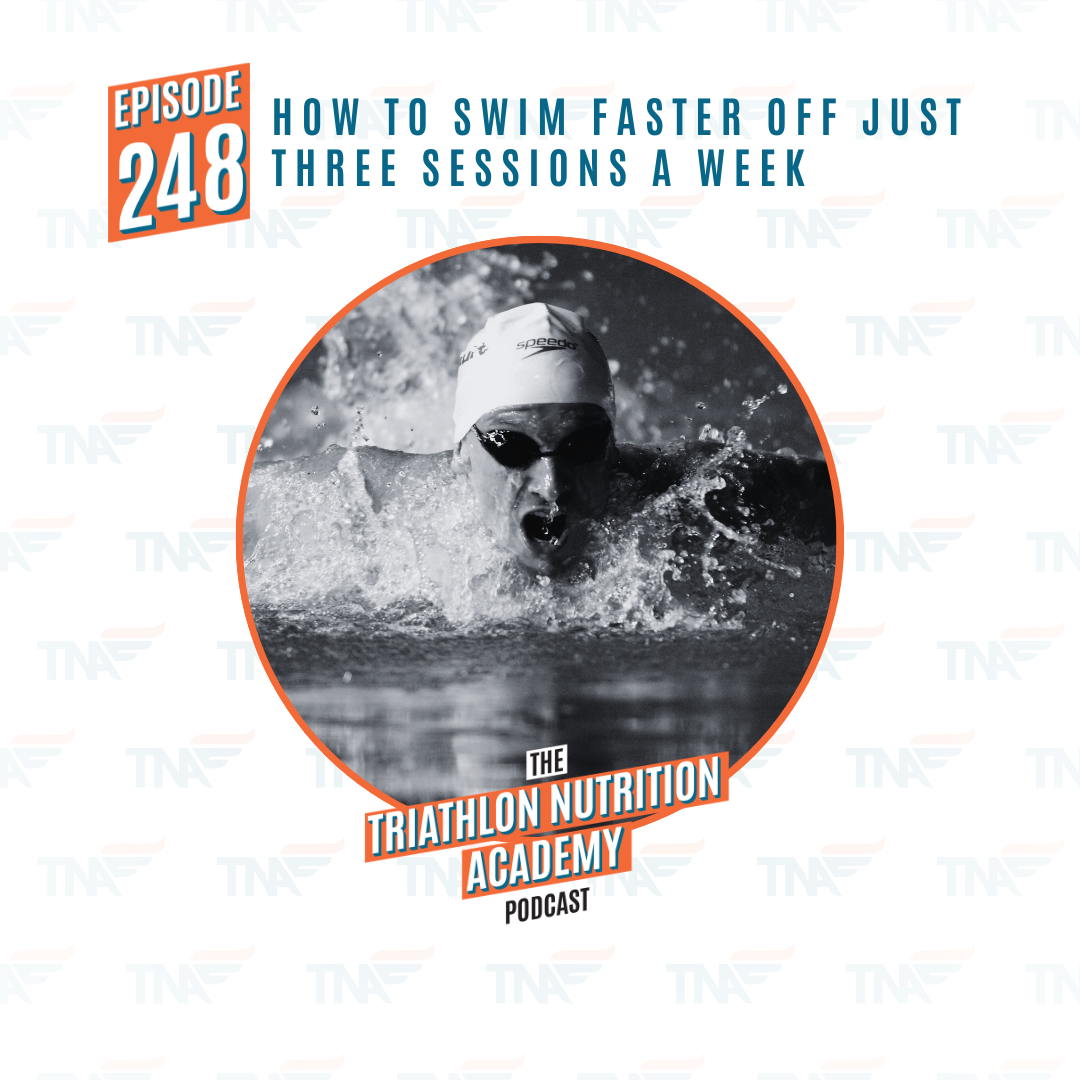
Episode 248 - How to Swim Faster Off Just Three Sessions a Week

Swimming more laps won't make you a faster triathlete. A three-time Olympian who used to swim 80 kilometres a week is here to tell you why.
Brian Johns is a three-time Olympian, former short-course 400-metre individual medley world record holder and now Head of Coaching Science at FORM. He's spent the back half of his career figuring out why some swimmers keep improving and others stay stuck in the same lane (sometimes literally), and in this episode he brings that to the time-poor triathlete who swims two or three times a week.
In this episode you'll learn:
- Why more kilometres in the pool almost never equals a faster triathlon swim
- The exact plan for getting faster off just three sessions a week, no coach required
- How to tell the difference between working hard and actually improving
- The recovery trick Brian used between a late session and an early morning swim
- Why open water fear is really about exposure rather than fitness, and the simple fix that builds confidence fast
- How to practise sighting in the pool long before race day
- A one-word cue to keep you calm and swimming smooth when the start line gets choppy
Links:
Check how well you’re doing when it comes to your nutrition with our 50 Step Checklist to Triathlon Nutrition Mastery
Start working on your nutrition now with my Triathlon Nutrition Kickstart course
It’s for you if you’re a triathlete and you feel like you’ve got your training under control and you’re ready to layer in your nutrition. It's your warmup on the path to becoming a SUPERCHARGED triathlete – woohoo!
Connect with me:
To learn more about the Triathlon Nutrition Academy, head HERE | dietitianapproved.com/academy
See behind-the-scenes action on Instagram: @dietitian.approved
Follow along on Facebook: @DietitianApproved
Join our FREE Dietitian Approved Crew Facebook group
Enjoying the podcast?
Let me know what you loved about it and what you learnt by tagging me @dietitian.approved on Instagram!
Subscribe & Review in Apple Podcast!
Are you subscribed to the podcast?
If not, today's the day! I'm sharing practical, evidence-based nutrition advice to help you nail your nutrition and I don't want you to miss an episode. Click here to subscribe to iTunes!
Now if you’re feeling extra warm and fuzzy, I would be so grateful if you left me a review over on iTunes, too. Those reviews help other people find my podcast and quality nutrition advice. Plus they add a little sparkle to my day.
CLICK HERE to review, select “Ratings and Reviews” and “Write a Review” and let me know what your favourite part of the podcast is.
You're awesome! Thank you!
Episode Transcription
Episode 248: How to Swim Faster Off Just Three Sessions a Week
Welcome to the Triathlon Nutrition Academy podcast. The show designed to serve you up evidence-based sports nutrition advice from the experts. Hi, I'm your host Taryn, Accredited Practicing Dietitian, Advanced Sports Dietitian and founder of Dietitian Approved. Listen as I break down the latest evidence to give you practical, easy-to-digest strategies to train hard, recover faster and perform at your best. You have so much potential, and I want to help you unlock that with the power of nutrition. Let's get into it.
[00:00:00] Brian: One of my coaching mentors is Greg Troy. He often talked about do the absolute least amount possible as long as they're improving. I think that mentality carries over into triathlon as well, where it's like if they're still improving swimming once a week, four times a week, five times a week, and they're still seeing improvement in the water, why bother adding more?
[00:00:19] They're still improving on the base training that they're doing now. And you might see that improvement in ways that's not just the swim time, but also in how you finish your run because you have more energy. Once you see a stall or a plateau at a certain level, then consider adding a little bit more
[00:00:36] Taryn: My guest today has spent pretty much his entire life in the water, and the back half of his career working out why swimmers improve and why some others stay stuck in the same lane.
[00:00:48] Brian Johns is a Canadian three-time Olympian, former world record holder in the short course 400 meters individual medley relay, who transitioned into coaching and then sports technology for form. He's the most decorated swimmer in Canadian university history, winning 33 of 34 races at UBC and taking the CIS Male Swimmer of the Year three times.
[00:01:10] Like, this man basically does not lose. He's been the athlete, he's been the coach, and the data scientist, so he understands what metrics actually matter and how to turn them into systems. Welcome to the podcast, Brian.
[00:01:25] Brian: Well, thank you very much for having me.
[00:01:27] Taryn: You're so welcome. I've got so many questions for you, but today's episode is all about swimming smarter, not harder, and helping the time-poor triathlete who swims maybe two or three times a week actually get faster without having to add a single extra session.
[00:01:47] Now, you used to be the king of volume, clocking 50Ks in the water in a week. For the Northern Hemisphere, that's 31 miles of swimming in a week. Like, swimming is crazy. I think it's the only sport where you train way more than the actual race. I can't think of any other sport that does that.
[00:02:08] Brian: Yeah, swimming's funny like that, where, um, so much time is spent on the preparation aspect for races that are 21 seconds long, four minutes long.
[00:02:20] Um, so there's a very big disparity in terms of how much we prepare compared to the amount of racing. Um, and may- the 50K might even be underselling it. When I was at my peak training, I was closer to, like, 80K. That's crazy. So like 50 miles.
[00:02:36] Taryn: Um- Do you ever get out of the pool?
[00:02:39] Brian: Rarely. Um, shockingly, I had shoulder injuries and over-training and burnout issues, so,
[00:02:45] Taryn: um- Gee, I don't know why
[00:02:46] Brian: yeah, no kidding. So over time, especially in my time, um, as a competitive swimmer, I think during that time we had a big transition going from, like, all volume is good volume, you build it up as much as possible, [00:03:00] and then t- transitioning into being more purposeful, making sure that from a competitive swimming standpoint, that we're doing more race pace that's high intensity- Yeah
[00:03:09] giving yourself the appropriate rest, not just within the workout but between days so that you can really hit those high intensities in a, an effective way, and not just, like- Beating your head against the wall, and you're trying to go race pace but you're not reaching it, but you just keep on trying harder and harder, and you're really just pushing the boulder up the hill.
[00:03:27] Rather than putting your swimmers, as a coach, in a position where they can hit that race pace, and that might mean, okay, we won't do this set in the morning session, we'll do it in the afternoon session. We won't do it today, we'll do it tomorrow. And making smarter decisions so that the swimmer can actually hit those intensities effectively and over a long period of time.
[00:03:49] And so for me, a key piece was having a multi-sport background, which is great for triathletes where they're already doing that now. But even as a kid, I had a lot of sports that I had played and participated in. And so when I got injured and I wasn't able to swim in the water anymore, I had something to fall back on, where a lot of swimmers are just swimmers and maybe not great athletes.
[00:04:13] And so it's a lot harder to kind of learn those sports and learn those movement patterns later in life to be able to support that injury rehab process. For me, I was able to fall back onto running, other sports, to be able to stay fit, and then slowly build in the more purposeful training for my swimming.
[00:04:33] So when I broke the world record in 2003, I was doing, like, 50, 60K weeks would be normal. And then when I went to the 2008 Olympics, made the finals, and that was my highest placing at the Olympics, I was swimming more like 40K weeks. So significant drop in overall volume, much higher in purpose, more sessions away from the pool that helped me stay healthy and keeping my body healthy, and understanding that having a better, like, isolated purpose per session rather than just pushing the work to the highest possible level every single time, having that purpose went a long way to, uh, swimming smarter and extending my career to longer than most.
[00:05:15] Taryn: Yeah, so what, what did that injury teach you about the volume that you used to do versus swimming with efficiency, or just training with efficiency?
[00:05:22] Brian: Mm-hmm. Yeah, so for me it was a big- factor of like how when I got tired, the technique changes. And this is the case- Yeah ... for triathletes as well where-
[00:05:32] Taryn: Yeah, everyone, surely.
[00:05:33] Yeah,
[00:05:34] Brian: exactly. So when it's one thing where it's like, "Oh, I'm getting a little tired. My strokes are getting shorter," or whatever, it's another thing to be like, "Okay, I'm getting tired. Now I'm gonna like really push myself." And that's where I would get myself into trouble where it's like my technique is changing without me realising it.
[00:05:50] I'm pushing harder in a state that I'm more fatigued. Now I have a lot of risk factors. And then when you're doing thousands and thousands of repetitions in with that high risk, that's where you're just ripe for injury. And for me, it, it resulted in a torn rotator cuff. And so then it's like, okay, I can't like do any over arm or over shoulder movements.
[00:06:14] I'm kicking, I'm running, and really getting an appreciation for how to balance that training better so that I can recognise those r- red flags earlier in the like... Now it's like, okay, that's a yellow flag. If I keep going, I'll become a red flag, rather than seeing the red flag and going right through it.
[00:06:34] And so being able to, to, uh, listen to my own body and, uh, be able to communicate that with my coach as well.
[00:06:42] Taryn: Smart. Way smarter. So looking back now, would you have trained your younger self differently, or do you think you had the benefit of youth on your side and you can just smash it when you're young and nothing-
[00:06:55] really happens?
[00:06:57] Brian: I think that my coach would definitely have treated me a little bit differently when I was younger. For me, like I had the drive to like, "I'm going to do the work to the hardest level possible." And the main thing that I would've wanted to tell my young self would've been like, "Your, your best is good enough," rather than trying to like overdo it all the time, and being like satisfied with what you accomplished that day and not trying to like make all of the improvement in a single workout.
[00:07:26] You have to have the incremental gains over time. From a coaching perspective, I think this transition from volume to, for me it was race pace, but really it's a transition from just a volume of work to purposeful work. And I think that has been the biggest transition for me as an athlete and for me when I got onto the pool deck was I'm not just gonna ask my athletes to swim six, seven, eight K sessions and once they finish the session, check mark, they did it.
[00:07:58] It's like, okay, we're gonna do an aerobic piece. They have to have their stroke count the same at the end. If their stroke is falling apart, I'm changing the workout. The workout's written in pencil not in pen. I can change it on the pool deck based off of what I see. And knowing where I need them to go in the long term, finding incremental gains to get there, rather than like, you have to do it like this today or else we won't get there.
[00:08:22] It's, okay, what little piece can we do today to get 1% better and add those one percents over a long period of time?
[00:08:30] Taryn: Yeah, that flexibility and working with the person in front of you is, is so valuable.
[00:08:34] Brian: Mm-hmm.
[00:08:35] Taryn: For a lot of triathletes, I think that they think that more meters or yards is gonna equal better swimming and, and faster swimming.
[00:08:43] But now that you've got all this data in front of you, is that actually true?
[00:08:48] Brian: Well, I wouldn't say it's true in the sense of like just more is better. I do think that there's a high level of specificity for what you're training for. So if you're gonna be training for an Ironman, like there's going to be some sort of minimal level of training that you'll need to do to not just be able to do the swim distance, but to be able to do everything after it, and be able to do the swim distance in a way that you are fast enough for yourself but also comfortable where you have the bike and the run afterwards.
[00:09:17] Taryn: If you're- Yeah, it's a
[00:09:18] Brian: warm-up. Yeah, exactly. If you're more focused on the, like sprint or standards, then like maybe high degrees of volume isn't completely necessary, but you do have to be comfortable in like a red line scenario where you are, like right at that threshold. You're feeling pretty uncomfortable maybe most of the race, in- including some parts of the swimming, especially on the shorter side.
[00:09:44] So gearing the training towards whatever you're training for, that specificity is super important. So- To say more volume is better across the way, I don't think that's true. But what we do see is that if your work is specific to what you are training towards, there's a layer of some of that training will be a good baseline, and you can move from standard to half Ironman to wherever you are if you have a good base.
[00:10:13] But if you're going to succeed or excel at any given distance, you gotta be more specific towards what you're gonna be training for.
[00:10:21] Taryn: Yeah. And is there a way that you can figure out or pinpoint where there's a point of diminishing returns for a swimmer or an athlete?
[00:10:29] Brian: Yeah. It's tough to say, like, with a, with a high degree of accuracy, but I think back to one of my coaching mentors was Gregg Troy, who was the head coach of the University of Florida, Ryan Lochte's old coach.
[00:10:44] And when he was developing swimmers, and we're talking about, like, 10-year-olds moving up through an age group program, um, he often talked about do the absolute least amount possible as long as they're improving. Yep. So for a lot of people, at 12 years old, it's like, "Okay, you're 12. You're doing doubles now.
[00:11:01] You're doing morning practices. Let's start getting to the work." And he was pretty set against that, but he was much more about how is this individual athlete doing? And if they're still improving swimming once a week, four times a week, five times a week, and they're still seeing improvement in the water, why bother adding more?
[00:11:20] They're still improving on the base training that they're doing now. I think that mentality carries over into triathlon as well, where it's like, okay, if you're doing just two workouts a week and each of them are an hour, and you do your races through the season and your swimming's improving, you know what?
[00:11:36] Stay there. That's okay for right now. You're still seeing the improvement, and you might see that improvement in ways that's not just the swim time but also in how you finish your run because you have more energy. Once you see a stall or a plateau at a certain level, then consider adding a little bit more.
[00:11:54] Say, "Okay, I am at, whatever, my 25-minute mile at the start of my standard, and I'm getting kind of stuck there. Now I'll add the third workout. Now I'll add 15 minutes," or however you want to purposefully and progressively increase that, rather than just like, "I'm doing an Ironman, therefore I do four or five w- swim workouts a week."
[00:12:16] That's not necessarily true. How we progressively increase our load over time, as long as you're still improving, you can still keep doing what you're doing. You might even be able to do the exact same workouts, but better, and improve. But once you s- start to recognise the plateau, now you have room to actually add to your training program, rather than just like defaulting to the highest level wherever it takes you.
[00:12:41] If you actually like hold back and hang on to that improvement, then you have room to say, "Okay, now I'll do one more workout," and then you'll start seeing improvement again.
[00:12:50] Taryn: And I need to layer in there the nutrition side of things, I think, because you could be plateauing because you're not fuelling sessions properly.
[00:12:56] And so rather than just adding more, more, more, more, take a step back for a second and, and look at what you're doing before swimming, during swimming, after swimming, before adding extra volume, 'cause that might be the thing that's holding you back, not necessarily needing to do more volume.
[00:13:11] Brian: Absolutely, and for, at least from the competitive swim side, I'm sure this is true on the triathlete side, is the after-swim aspect being a key part of that, where for competitive swimmers, I know this is the same for triathlon, where you have one training session late at night one day, and then you might have a early bike ride or an early swim session the next morning.
[00:13:29] Like, you have to protect how you're going to be training that morning, so how you recover based on that night workout becomes super key.
[00:13:38] Taryn: Yes. Yes. What, what was your favourite recovery after like a late swim and to got to get up and swim again in the morning?
[00:13:45] Brian: Uh, our, our old classic was chocolate milk.
[00:13:48] Having some chocolate milk. For, uh, for me it was also making sure that I get some form of protein, and it is usually like in the, like, laziest bar-formed way possible of just like- Typical
[00:14:01] Taryn: dude ...
[00:14:01] Brian: yeah, exactly. Well, it's, it was also like the sponsors that we have for our national team and stuff- Yeah ... like that that supply it for us, but it was like, look- Get your, get your grams in, you know that you're gonna be recovered, and it's like, okay, over time maybe that gets a little bit stale, but it's also, like, you're meeting the minimum requirements and be able to keep that training consistent from day to day.
[00:14:22] Taryn: You remind me of my brother. He was an Olympic level swimmer, and he just used to eat cereal after cereal- ... bowl. You know, just get whatever he could in, and- Yeah ... I look back now and I'm like, "Ah, dude, I wish you had've seen a dietician, or I could've helped you." So let's help the triathletes listening be as efficient as they can.
[00:14:41] Can you name maybe one or two or three things that are gonna make the biggest difference in an average triathlete's swim for the least amount of effort?
[00:14:53] Brian: Yeah, making the big difference for triathletes with kind of that least amount of effort. I think that for a lot of triathletes, and we know this generally, where how important technique is for swimming, but what becomes really important is how we sequence our training over the course of a season, and how technique flows into that.
[00:15:13] So I'm very mindful when I teach technique to new adult swimmers, or even with, like, experienced, um, Olympic level swimmers, of where am I going to teach something new versus how am I going to teach something that they know but become more reliable at it? And when we talk about technique, we often have to frame it in a way where we are teaching the athlete first.
[00:15:40] And w- when you think about any skill that you've learned, what, like, think about just, like, kicking a soccer ball, basketball shot, whatever it happens to be, you often put it into the simplest environment first to teach it, and then you add complexity over time. So for swimming, we might a- like, teach technique, and we'll go super long rest, easy, one length at a time, and teaching some aspect of it.
[00:16:07] Keeping your head still, one goggle in, one goggle out breathing, keeping your armpit open as you pull. Any number of factors that the coach might think is important for that swimmer to improve their technique. And then you're just kind of creating a common language between the coach and the athlete about what the expectation is of holding that technique or teaching that technique at that time so that when you go down the road, you can reflect on that and m- make it simple in a one or two-word cue later on.
[00:16:37] So when you think about the sequencing of adding your technique, at the start of the season, you're building up your, your volume, great time to make a significant technique change. Maybe you're gonna do some of that, like, really short, really easy technique swimming as you pair it with long, smooth swimming to start building up your aerobic base.
[00:16:58] Then as you transition into the middle of the season, now y- you wanna have more of that easy swimming translate into the aerobic swimming. You're naturally building up more volume. And then the technique changes of I might not be putting you in a space where you're, where I'm teaching you technique.
[00:17:13] You're gonna be too tired for that now. Now I'm just going to remind you about the technique that work that we've done before. Oh, you're getting to the end of the 400, remember to keep your head still, keep your armpit open, keep your feet at the surface, and just simple two or three word, um, cues that are most impactful when the athlete is challenged, at the end of an interval, when they're trying their hardest, when they're trying to go race pace.
[00:17:40] And you're just saving those cues for that moment rather than trying to over teach on the technique. And then as you go towards taper, your preparation, that technique bec- can be brought back in. Now you're in a fresher state again. You're easier to, to think about the technique in [00:18:00] that state, and then you're starting to translate of, like, okay, you've relied on the coach to give you feedback.
[00:18:05] What's gonna be your internal voice telling you when you're in the race moment? You can't have the coach telling you what you're doing. What cues are you gonna remind yourself, uh, right at the start? For me, it was really simple, smooth and strong. That's all I'm gonna tell myself before the race, and that's going to lay into the technique that I know how to do because I practiced it all before.
[00:18:28] And so understanding how that sequence happens is such a huge place to make a gain from technique perspective for a triathlon.
[00:18:37] Taryn: Okay. Lots of good tips there, and I like some of your cues that maybe people can borrow some of those in their own swimming.
[00:18:42] Brian: Mm-hmm.
[00:18:43] Taryn: So you developed the form score to figure out a way to put swimming efficiency into a single number for an athlete.
[00:18:52] I don't know how you did that. But what are the things that actually make a swimmer efficient? What are the ingredients versus somebody that's, [00:19:00] you know, working really hard, but they're swimming like a washing machine?
[00:19:04] Brian: Yeah. For form score or any measure of swimming efficiency, it's a key factor of, like, are you keeping the length of your stroke, which is usually as a result of your technique And are you being reliable at it?
[00:19:18] So going back to kind of reflecting on teaching technique, oftentimes even triathletes can have beautiful technique for a single length. And- or if they're really focused hard on it, I could do it once. Yeah. But swimming's not that type of sport. You have to be able to connect it length to length, and when you're in open water, you're going nonstop, and be able to be reliable at the technique.
[00:19:40] So what I often see for form score is that, like, a lot of people think that their score is gonna be really high, and they'll be able to keep it there. They're shocked at how much it changes over the course of their swimming, even within a s- within a single interval. You swim a 400, you're super fresh at the start.
[00:19:59] First length feels good, great score, great efficiency, great time. You get to the last length, uh, struggling a bit. Stroke gets shorter, maybe getting more scrambly, slowing down, and the s- and the score dives. So what we actually see from a swimming efficiency standpoint is that it's not just about doing it once, but being reliable at it o- from start to finish, and that's what I direct most of my coaching through our goggles and through our app is teaching, um, swimmers to use the goggles and using the form score in a way where you're not just trying to improve it once or do it for a single length, but how are you maintaining your efficiency the longer you go?
[00:20:43] Taryn: Yeah, and then you're gonna be a better, faster swimmer if you can do that and maintain that
[00:20:47] Brian: The way that you train is gonna be the way that you race, and if you train in a way that your stroke efficiency and technique falls off at the end, there'll be no surprise when that happens in a race as well.
[00:20:57] Taryn: I'd love to dig into some of that open water stuff with you in a [00:21:00] second, but before we do that, you've got data from tens of thousands of swimmers. Can you drill down into some of those specifics around what is the thing that keeps swimmers improving versus ones that are plateauing or hitting the wall?
[00:21:15] Can you differentiate that from all of the data and metrics that you've got?
[00:21:18] Brian: Yeah, we have a little bit of data on that. Um, and also, like, just on my background coaching from what I've seen, what often comes up, and it's like this sounds s- so, so simple, but showing up consistently. And I mean, it's like- Tick
[00:21:34] it, like, mind-blowing, I know, but wh- especially when we're dealing with, like, adults that have family responsibilities or work responsibilities, and, um, triathletes where you're trying to balance out your swimming and your running and your cycle training, just getting to a base level of consistency can be really difficult.
[00:21:55] And if you're structuring your week in a way where you can [00:22:00] reliably, whether it's with a squad or on your own, swimming on the same days, swimming at the same time of day on those days, being able to do that not just, like, for a month, but month on month over a long period of time, you see those incremental gains being made.
[00:22:19] And where we see the biggest improvement often is, like, not in the first few weeks, but you get into this, like- You start to train, you feel pretty good. You keep training, you get a little bit down, a little bit, like you're compensating on the training, and then you get into the, the back half of it, or you taper, or you start to rest a little bit, and you get into the super compensation and see this big performance.
[00:22:44] What we really see is that, like, the longer that you can maintain that consistency, even in a, like a long stretch of preparation work prior to that race moment, the better that kind of super compensation moment happens. And when you are [00:23:00] just putting money into the bank $1 at a time, it adds up a lot towards the end.
[00:23:06] If you're trying to get all that money in in a month, and then you miss out, you're starting to take money out of the bank because you're doing two workouts, or you have to miss a week because you're traveling or whatever it happens to be, and life gets in the way, that makes it really difficult to see that moment at the end of your training.
[00:23:24] So trying to form your schedule so that you are consistent week on week, month on month, so that you can see that in the end, that becomes the biggest factor for what we see for long-term performance.
[00:23:39] Taryn: I really love that analogy. It's like compound interest. You just- Yeah ... you know, compounds over time, and I, I guess I talk about that with nutrition a lot.
[00:23:46] It's that consistency day to day. It's not the thing that you cram in right before race week that's gonna have the impact. It's, it's everything that you've done in the lead up. And something that's so technical, I feel Like, you, you have to maintain it, [00:24:00] otherwise, oh, you just go backwards so quickly. And a lot of triathletes are adult onset swimmers.
[00:24:04] Mm-hmm,
[00:24:05] Brian: yeah.
[00:24:06] Taryn: So the step backwards is, like, five steps backwards compared to somebody that's swum their whole life and just has that technique ingrained in the way that their body moves in the water.
[00:24:14] Brian: Yeah, and that's where, like, having th- those skills at a young age can really help. A lot of, uh, triathletes obviously coming to swimming at a later age, but if you're, you're a parent and, like, you're thinking about, like, long-term life skills, just being able to swim comfortably is, like, so huge, where your child is gonna be safe in the water, but also have this variety of movement skills so that, oh, maybe they wanna do triathlon eventually.
[00:24:40] It's gonna be so much easier for them to pick up different sports in the water if they just have that baseline level of skill young.
[00:24:47] Taryn: Yeah. Here in Australia, we throw our kids in the water- Mm-hmm ... very early, like eight weeks old. And you guys over there and the Americans are like, "What the hell?" Mm-hmm. But it's just part of our culture and, and our lifestyle [00:25:00] here.
[00:25:00] We have a lot of... a big swimming culture, and yeah, we do start swimming from a very young age. Like, my daughter does club night, and son, and they're, like, five and seven.
[00:25:09] Brian: Yeah. Where I'm in in Canada as well, in Vancouver, swimming's a big part of our culture as well, where it's like we're right on the coast, and, uh, beaches all around us as well, where having that exposure to just water in general, lakes are all over the place, and just being comfortable in and around water on a boat or wherever it happens to be, where it's like, yeah, if you get, like, thrown off the boat, or if you get, like...
[00:25:35] Y- you can paddle your way out a little bit on the beach, and just having that layer of comfortability is so huge.
[00:25:41] Taryn: Yeah, it's so important. So l- let's talk open water for a second, because this is where a lot of triathletes do get stuck. They swim in a pool, they follow the black line, and then all of our races, not all, but they're all in some form of open water, whether that's the ocean or a lake.
[00:25:57] There are some races that are in a pool, um, [00:26:00] generally in the beginner kind of enticer space. So why does open water rattle people so much, and what can they do to- maintain their technique and stroke and swim better in open water? 'Cause the technique is actually different when you switch to open water, particularly in the ocean.
[00:26:19] Brian: Yeah, definitely. For making that transition from the pool to open water can... I, I don't wanna, like, overemphasize it, because some people, like, go into it and it's like, "Yep, no problem," and they go right into it. Others obviously have different layers of how comfortable they are. And for me, it comes back to, like, I often think of fear as a lack of knowledge, and when you are in open water, you...
[00:26:43] And, like, "Oh, I can't see the bottom of the, of the..." It, it could be rational or irrational, where it's like- ... "Okay, I'm in this, like, still, warm lake. I know there's no sharks here, but I can't see the bottom of the pool. I don't know what's there. I don't know what I'm gonna do." And it's like it may, may not be, like, [00:27:00] the most rational thing, but that person is feeling that fear in that moment, and that, and that fear can be really real, and it can really prevent them from having an experience that's truly enjoyable and then having a performance that will follow through on that.
[00:27:14] And so it's really up to the coach or with that person to try and do it in some sort of group. Oftentimes, I know in Vancouver, I'm sure that this is probably the fa- this is in Australia as well, where it's not that hard to find, like, an open water group swim. If you're connected to, like, master swimming, triathlon swimming, I'm sure that there's groups in your neighborhood that will go down to the beach, will go to your local lake or whatever it happens to be, to do this in a group setting so that they feel really safe.
[00:27:44] Really important from a coach's perspective that if you are doing this in a group setting, that somebody has some sort of lifeguarding background. Often that's gonna be the coach by default. But understanding the space that you have around so that you can create that safe environment so that [00:28:00] people can be comfortable extending what they might be used to.
[00:28:04] And the first time they go down, and they go knee-deep in the water, and that's gonna be it today, okay. Next time let's try and get them to the waist, and, like, just meet the athlete where they're at, and be able to just go one little bit at a time. If they get a little bit more progress, that's great. And then at some point they swim or get their whole body submerged, and then you find that you can be flying pretty quickly.
[00:28:28] Then once you get over that fear of, like, you're comfortable in the water, it becomes, like, a completely different training and racing environment as well, where you really have to rely on the rhythm of your swimming. In a pool, you can push off the wall, you can keep your length, and that's pretty easy to do in a pool setting.
[00:28:47] But when you're in open water on your own, now you have to rely more on, like, that same type of rhythm that you might have on your bike, having that f- that flowing, comfortable rhythm in your swimming so that you [00:29:00] are constantly moving. If you're dealing with waves, having that rhythm helps you overcome those, that choppiness.
[00:29:06] If you're in a big group and you're swimming side by side and you're whacking arms with people, having that rhythm's gonna f- um, help you maintain your speed, not go stop and start because you're always hitting somebody because you're moving your body too slowly. So getting that, like, over that first layer of fear and then understanding, like, how do we take that and then get to a racing environment where you're comfortable in this group setting, all of that can be coached.
[00:29:34] And so it's being mindful of how you expose that swimmer one step at a time so that they can get there.
[00:29:41] Taryn: Yeah. Find somebody that can help you, and get amongst it. Yeah. Start somewhere.
[00:29:45] Brian: Exactly. And it doesn't-- You don't have to go out to the break and back. It's like, just get in there, swim a couple strokes to start, or find a f- spot that you feel particularly comfortable in, and, um- That's a better start than [00:30:00] any.
[00:30:00] Taryn: I love it. Now, sighting is the other thing that triathletes are not taught generally. Like, you don't really learn how to sight if you swim in a pool. Give us your best tips. Like, how do you find the buoy when you can't see it and your stroke falls apart? How do you keep your hips up? What tips have you got to help triathletes sight better?
[00:30:20] Brian: Yeah, it's, uh, th- this is a piece like any other where it's like it is a skill. There's nothing that prevents you from practicing it in the pool, and understanding, like, what are you actually gonna try and do when you're in the open water. And so I always introduce sighting in a pool setting first, and you can fi- and, like, learn how to landmark anything that might be around the pool deck.
[00:30:43] At our pool deck, we ha- like, have those little signs of, like, your slow, medium, fast lanes or whatever it is might be at the b- at the end of your lane. Like, how far away can you see that sign? How far away can you read that sign? And being able to lift your head up, being able to find that in a single moment and be able [00:31:00] to just get comfortable in that change of technique, not being too concerned about what that change of technique is.
[00:31:08] And I think that's where a lot get caught, where it's like, "Oh, I gotta, like, time my sight with this part of my stroke, that part," or whatever. Just go for it first. What is your body gonna naturally wanna do? And then a coach can help shape that in a way where you're maintaining your efficiency or maintaining your technique overall, or a training partner if you ha- if you don't have a coach on deck watching you.
[00:31:30] From a general technique standpoint, sighting, I generally like to see sighting that's timed the same way that you're breathing. So it might be like, okay, I'm breathing to the side, breathe to the side, and a sight. And you're just ke- maintaining that rhythm. And re- I find that in the best swimming triathletes, um, they are sighting in a way where you can't always tell that they're sighting.
[00:31:54] They're just popping that head up for a moment and being able to maintain that rhythm of their stroke, [00:32:00] whether it's a sighting stroke or not. And learning how to just have a continuous swim, whether you're breathing, you're not breathing, you're sighting or not, um, that continuous connection becomes really important Translating that into actual training, like there's nothing that stops you from doing that in the pool.
[00:32:18] And it might be like, okay, we're just gonna learn how to sight first, same as I was saying before. One length at a time, really low effort, really lots of rest, and just learn how to do it m- for the first time. But then over time, you're gonna do more training, build up more volume. You need to build up the aerobic endurance on sighting as much as you need to do it on your swimming in general.
[00:32:42] And so interspersing some training sets where it's like, okay maybe you won't do like your 10 300s all sighting, but maybe you can introduce one of those 300s with sighting to start, and then train the rest of it normally. Then slowly build up how much volume you might be doing on your sighting [00:33:00] within that training context so they become more and more comfortable with it, and your body can adapt to it once you get to the race moment.
[00:33:07] Taryn: It's so important 'cause triathletes have the beautiful zigzag often.
[00:33:11] Brian: Mm.
[00:33:12] Taryn: And you can swim extra like hundreds of meters and add so much time to your distance over a 70.3 or on an Ironman distance just by not swimming straight So that sighting piece is so important, even if you can't really see the buoy, like follow somebody that y- you think is going in the right direction.
[00:33:31] Brian: Oh, yeah, you end up in like group tactics as well with s- with swimming in open water, where, okay, like I find myself as, as a good swimmer in this position a lot, of like, "Oh, I think I'm going straight. I'm pretty sure I'm the one going straight," but the group has gone over here, and now... And they can use group dynamics to like drag off of each other and maybe be in more of an advantage when you're in a group of three or four, even if they're offside, versus being by yourself, but going straight.[00:34:00]
[00:34:00] So there's like a, a very, um, important push and pull to understand like those tactics over a long period of time. But ultimately, like especially for most adults, late onset swimmers who are coming to triathlon, like relying on that group dynamic can be really important, where that can give you a layer of safety, where it's like, "Okay, I'm not the one leading the way.
[00:34:22] I don't need to know where the buoys are. I'm gonna go, go into the group." But I also wanna make sure that I'm not gonna be like crushed between people when we turn at the buoy. I'm not gonna get slammed into the buoy. And being safe, using those sighting more to, for safety rather than like true performance dynamics, so that you can be comfortable in your swimming, and then be in a position where you're not overly stressed, you're getting to the bike comfortable, and then you can move on to the rest of your race.
[00:34:51] Taryn: Mm-hmm. Good one. My favorite tip for open water is to not actually sight the buoy, but to sight a landmark- Mm-hmm ... that you can see in the distance. So [00:35:00] some good sort of race recce the day before, and have a look where the buoys are. You call them buoys, don't you? I guess so. So weird. We call them buoys. Mm.
[00:35:09] Cans, if you're American. Yeah. Any of those things. Like actually sight a landmark if it's a bit of a washing machine out there, 'cause then y- you can see that with a very quick look up. So it's race morning, Brian, and, you know, the gun's gone off, and thank God it's not a mass start anymore, 'cause those things were effing dangerous.
[00:35:27] Oof. But it's a washing machine, right? The waves... Like Cairns recently, we went up there for the IRONMAN for our TNA annual event, and the ocean looked gnarly. Even I was like, "Oh, I'm actually glad I'm not swimming this year." But- ... people got pulled out of the water, it was so rough. Wow. Like people were just vomiting their guts out coming back in.
[00:35:46] What are some tips that you've got for a nervous swimmer that's getting into this ocean that is m- maybe beyond what they have thought they were capable of, or they, they really worried about how rough it is out there?
[00:35:57] Brian: Yeah, like I think it's always important from a triathlon perspective that you can't win the race on the swim, but you can lose it- And it's okay to kind of take away the pressure of like, "I've gotta go my fa- my best swim time," or, "I've gotta be in a certain part of the group," or, "I've gotta po- position myself."
[00:36:14] Like, it's okay to kinda pull back from that, especially in, in a scenario where it's like the water's extra choppy. The, the goal might just be, like, we're just finishing the swim. And if you can just pull back and say like, "Okay, calm myself down," and you're in that, like, pre-race mode where maybe you're already in the water and you're getting comfortable of just like, okay, and like take that moment.
[00:36:42] I think that a big factor that really helps is if it's available to be able to take that race course swim. Oftentimes there's like the day before swim where it's like, here's your opportunity to swim open water on the course. If you're in an, an opportunity to do that, like do take it, because if you are showing up on race day, every- the course is new to you, the...
[00:37:06] Then you see the water and it's choppy, and then you see the hundreds of people that are around you. Like, it can be pretty overwhelming. So if you can take one aspect of that stress out and just be comfortable with, like, go to the beach and see what the course looks like if you can't get in the water.
[00:37:23] If you can get in the water, and oftentimes they might have some buoys set up, go out to the first one, be- take part in whatever group aspect there might be. If they don't even have that, go to your race early enough, dip your toe in the water, have a look at it, then go back into your transition stage and get yourself set up.
[00:37:43] A lot of these things can really bring that stress level down. If you can add just one little bit of comfortability into that moment, and then you get into the race of like, okay, it's gonna be stressful enough as it is. If you can just take one load off, that can [00:38:00] be a, make a world of difference. When the water is completely choppy, then it's like, okay, we're gonna m- like focus on just what you need to do.
[00:38:09] A lot of people are going to be worried about it or stressed out, and they might be wearing that stress on their sleeve. Like trying to internalize, like, what do I need to do to get there? I know there's the first one. I'm going to do it like this. Here's the one cue in my mind, technique or effort or whatever it happens to be.
[00:38:28] For me, it's smooth and strong, and it's like, just gonna stay smooth and strong to that first buoy. And like, and then you just take it one piece at a time.
[00:38:36] Taryn: I feel like a lot of people are gonna take that away with them, the smooth and strong. Like, I'm gonna, I'm gonna swim like Brian in the water. I'm gonna be smooth and strong.
[00:38:44] It's a nice little cue. I mean,
[00:38:44] Brian: that's, that's a great place to start. It's, uh- Yeah ... it's hard to go wrong with that. But I do encourage where it's like- I think everybody has a great race in their mind, what great swimming feels like, what you feel like at the end of your triathlon, and you can reflect back on it of, like, can you describe that great performance in three words, in two words?
[00:39:07] And you can replicate that to the next one. For me, because, like, I was pretty amped up, I needed to, like, bring my, like, bring the temperature down. So it's like I gotta be smooth because if I over try, I'll overdo it. Other people need to wake themselves up, and it's like when I was sw- when I performed my best was, like, I was amped and ready, or, like, it- whatever it happens to be.
[00:39:29] It can be so individual, but I think anybody can reflect upon what it felt like to do their best performance and tell yourself, like, try and describe that feeling in two or three words, and then tell those two or three words to yourself before your next race, and then you can start to replicate it.
[00:39:46] Taryn: Yeah.
[00:39:47] Nice. Okay, so let's get practical. You are a triathlete, and you have got three swims a week, and you have no coach. How are you gonna spend those three sessions wisely to actually get faster?
[00:40:00] Brian: Yeah. Classic scenario. I try to encourage triathletes to at least do, try and build your way up to doing three workouts.
[00:40:08] It doesn't have to be three workouts at a super high level. It might be, like, three one-kilometre workouts and then three 1,200-meter workouts and slowly progress from there. Within that, you have your three workouts. I like to be more purposeful within each workout rather than trying to do a mixed bag in each one.
[00:40:27] So I often designate one of them, like, this one's focused on building my aerobic capacity or zone two training or however you wanna describe it to yourself, and the main goal is going to be, over time, how far am I gonna swim? Maybe that volume is going to increase more than the other workouts. When you are increasing your volume, always be checking in with your heart rate or however you're gonna measure your effort as well as with your technique.
[00:40:54] With form goggles, you can do that with Formscore. If you're by yourself, c- just count your strokes. And if you are counting your strokes and you're doing the first length and your first length is 40 strokes in 50 meters, and then by the end it's 50 strokes, you're probably doing the intervals too long.
[00:41:11] It's okay to make the intervals shorter so that you're holding your technique. Over a long period of time, make those intervals longer. Keep your heart rate in check. Try and progressively do that step by step over the long term. That would be one workout. Mm-hmm. A second workout would be, like, hitting your threshold.
[00:41:29] If you're doing your aerobic capacity and you're trying to raise the floor, threshold, you're trying to raise the ceiling. So however you might wanna measure this, some people use like critical swim speed, zone four training, keeping your heart rate over 160. Again, whatever meaningful metric it is to you to measure that.
[00:41:48] Then it's becomes more about like how are you doing it in a specific time period? Warm up properly for it. You're doing this work at the start. It might be 10 or 15 minutes long, and then you're trying to actually increase the duration that you're doing it. It may not be volume comes along with that, but I always find it important to think about the duration of it because, okay, I'm gonna do eventually 30 minutes of threshold work as 100s to start.
[00:42:14] Taryn: Brutal. I was just gonna ask you, what's your favourite session to do thresholds in? Is it
[00:42:18] Brian: 100s? Oh, I mean, classic is 2100s. 2100s for like a high level swimming- Yeah
[00:42:27] I used to hate those Yeah So boring It's like that, that, that's your classic one Get me. But it's like there's no problem mixing up your intervals either. And like you don't normally train threshold for running and cycling in 60, 90, 100-second intervals. So learning how to push those intervals longer in swimming can be challenging but also extremely rewarding for how that's going to translate over time.
[00:42:53] So it's like, okay, 20 100s is the classic set. Well, there's nothing wrong with doing five rounds of a [00:43:00] 150 and a 100 or even five rounds of like 150 and a 50, and like you're getting a m- a mix of intervals. You're getting to the same volume, but you're starting to learn how to push that effort for a longer period of time, always making sure that you're holding technique for it.
[00:43:14] You do not want to be failing at the end of those intervals. If it is, go back to 100s, go down to 75s, go down to 50s if that's the only distance that you can hold your technique at. But over time, if you get there, you will be able to extend it longer, and the longer your intervals can be, the longer your work can be, the more purposeful that training can be.
[00:43:33] So there's two of them. That's two. One focus on-
[00:43:35] Taryn: Yep ...
[00:43:36] Brian: yeah, there's like aerobic capacity, threshold, pretty classic and can pretty well be drawn across like any triathlon distance that you're trying to work at. Then the third workout can be a little bit more specific towards what you might be training for.
[00:43:51] Typically, at the early season, I usually use this as an opportunity to do speed that's higher, so like I would call it like VO2 training. [00:44:00] Some people might call it speed training, however you might classify it for yourself. It's often faster than threshold, shorter in distance. Yep. 25s even.
[00:44:08] Taryn: 25s, yep.
[00:44:09] Brian: And like Americans are still great at swimming.
[00:44:12] They swim in a 25-yard pool. You can even go shorter. I love doing speed work in like a dive tank, going across the dive tank, and that might be 14 or 16 meters. Right. But you're in a, in a position where you can swim really, really fast. Give yourself lots of rest. You're just trying to teach your body to move quicker.
[00:44:33] You're not necessarily trying to like strain yourself and like overdo it at this pace. For a competitive swimmer, I might live in this zone more to like get more of their race pace of that. For a triathlete, it's more just like be comfortable like moving your body faster so that when you're in the race moment, it feels easy to have a higher rhythm.
[00:44:54] That's great at the start of the season, and then as the season progresses, it becomes more specific to the race that you're [00:45:00] training for. If you're more on the sprint side, that might be a second threshold workout If you're more on, like, the Ironman side, it might be a second endurance workout, and then both of them become more like a tempo zone three race pace, whatever you're trying to hold for your race type session.
[00:45:20] So that b- becomes, like, a pretty safe way to go when you're in, like, the rhythm of training. One to improve your aerobic capacity, one to push your threshold, one that's race specific, and that's a pretty clean way to build your training over a long period of time.
[00:45:35] Taryn: Do you have a favourite drill that you think every swimmer should be doing?
[00:45:38] Brian: Oh, a favourite drill. When I think about triathletes specifically, we always get great runners coming in learning how to swim, and one of the... Like, you'll see very typical running inflexibilities in the water. They can't quite reach their arm over their head. They can't quite, [00:46:00] like, straighten their feet out, stuff like that.
[00:46:02] Pretty classic stuff. Um-
[00:46:04] Taryn: You cramp every time you're trying to freestyle kick.
[00:46:07] Brian: So you're just little knives that are cutting through the water. Um, but I always find that it's, like, great to come back to great body position. That is something that everybody can work on, and over time it's like, "Oh, do this with your arm.
[00:46:23] Don't do an S pull. Pull down." Like, all those things become pretty specific down the road, but where is your head going? Your body's gonna follow your head, and so starting with those two pieces become the most important. I really like to teach new swimmers to swim with a snorkel, where oftentimes they are...
[00:46:45] If they're coming in left to their own devices, they're really thrashy. They're moving their head a lot to try and take their breath. But if you have a snorkel on and you move at all, like, your head's gon- like, you're stopping in the water. So okay, keep the snorkel on, keep your head [00:47:00] straight, and just feel what it's like to have your head motionless in the water first.
[00:47:05] And then it's like, okay, your head is motionless. Keep the snorkel on. Can you keep your back dry? Those two pieces, if you're doing those two pieces to start, everything else can be built out from that. And learning to do that with a snorkel first, then you take away the snorkel, doing it with, like, a breathing pattern, breathing, say, every five strokes.
[00:47:27] You're keeping your head still for those four strokes, then you take your breath. Just keeping, like, that mentality of keeping your head still and your body following your head, that's a great place to start. And then once you're, like, have an idea of what that feels like, then you can start getting more creative with drills that might be more impactful either on your legs or on your arms.
[00:47:49] Taryn: Great tips, Brian. Gosh, thank you so much. I- there's so much in that episode that anybody listening could take and pull apart and go and work on in their next swim, like today, tomorrow. So many good little gold nuggets. If people wanna see what you've built or find you, what's the best place to look you up?
[00:48:06] Brian: Yeah, so I'm the head of coaching science at FORM Goggles, and so by all means, purchase a new pair of goggles. We have a heads-up display inside the- Shameless plug ... Yeah, I know. Reflecting back on open water swimming and being comfortable with it, for a lot of our users, they buy our goggles specifically for open water swimming.
[00:48:23] We have a feature called Swim Straight, lets you swim straight in open water without having to sight, so maybe you're a little bit more comfortable without lifting your head all the time. Having something to focus on in the goggles as a screen, giving you just, like, a little peace to not be so overwhelmed with the open water experience.
[00:48:40] But for my own work, that's where I have all of my coaching instruction inside the app as well, and I have blogs a lot with FORM Swimming as well to help with triathletes become better swimmers in the water.
[00:48:54] Taryn: Excellent. I'll put some of those in the links below this as well if somebody w- does wanna check it out.
[00:48:58] We have so many athletes in the Triathlon Nutrition Academy that have FORM Goggles, love their FORM Goggles, and hope it's making them swim faster and better. But they do have their fuelling dialled in- Mm-hmm ... which is r- just one of the pieces of the puzzle that's really important. Thank you so much for sharing your wisdom, Brian.
[00:49:16] I would love to go for a swim with you one day. When are you in Australia next?
[00:49:20] Brian: Oh, not, not soon enough. I hope to come back there pretty soon, and that would be great.
[00:49:25] Taryn: We'll do a butterfly race, and I'm fairly sure you'll win.
Thanks for joining me for this episode of the Triathlon Nutrition Academy podcast. I would love to hear from you. If you have any questions or want to share with me what you've learned, email me at [email protected]. You can also spread the word by leaving me a review and taking a screenshot of you listening to the show. Don't forget to tag me on social media, @dietitian.approved, so I can give you a shout out, too. If you want to learn more about what we do, head to dietitianapproved.com. And if you want to learn more about the Triathlon Nutrition Academy program, head to dietitianapproved.com/academy. Thanks for joining me and I look forward to helping you smashed in the fourth leg - nutrition!