
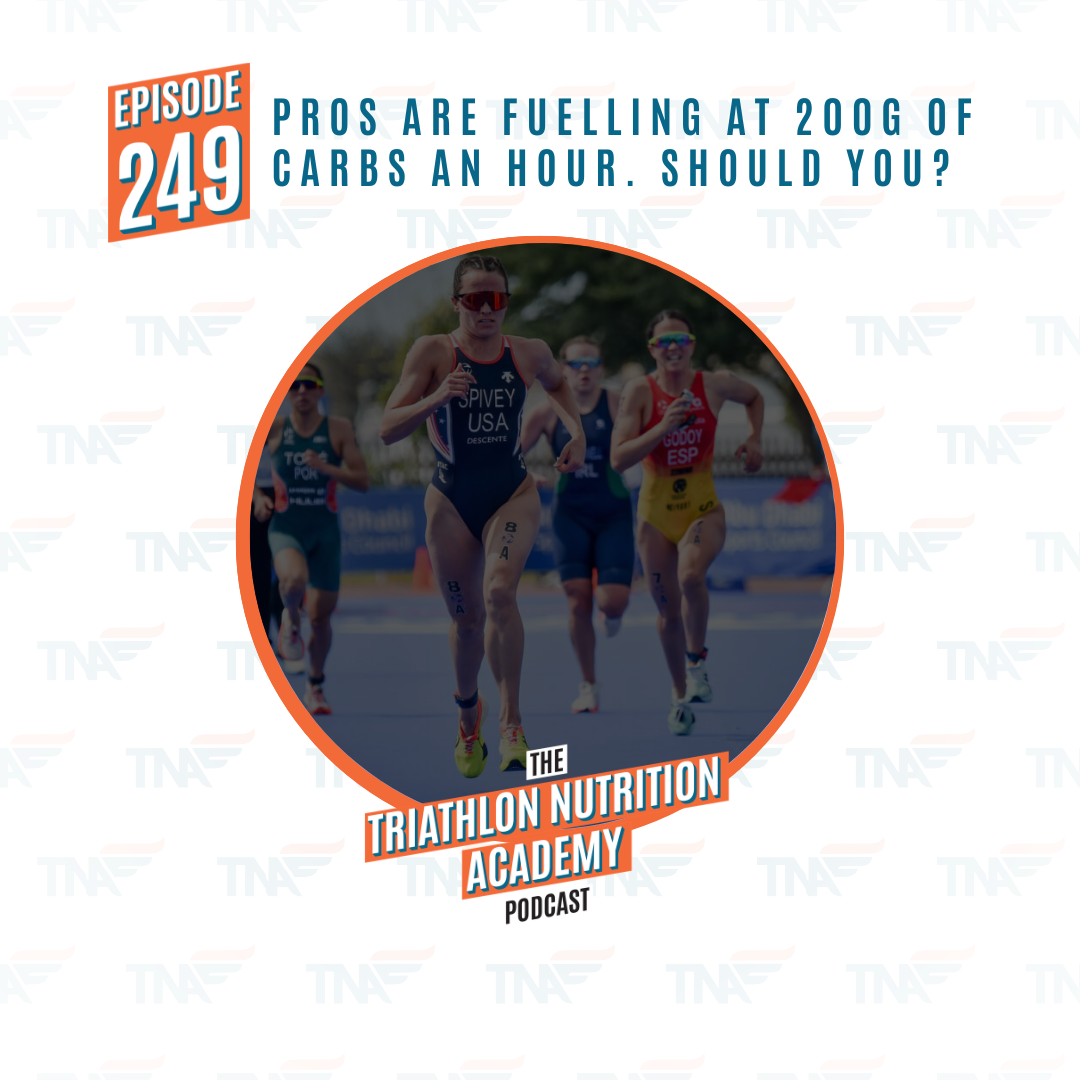
Episode #249 - Pros Are Fuelling at 200g of Carbs an Hour. Should You?

High carb fuelling is the hottest topic in endurance sport right now, and the numbers keep climbing. Ineos Grenadiers are fuelling their riders at up to 150 grams of carbs an hour on big Tour de France stages, and pro triathlete Cameron Wirf recently said he took on 200 grams an hour on the bike in a recent Ironman (yes, 200, in one hour). Every age grouper watching that unfold is tempted to copy it. In this episode Taryn breaks down the real science behind high carb fuelling, why it works for the pros, and the one thing most age group triathletes skip completely before they try to chase that number themselves.
You'll learn:
- Why the pros are pushing carb intake so high, and what the official guidelines actually say
- The genuine recovery benefits of higher carb fuelling, backed by real research
- Why eating past your absorption ceiling can wreck your race instead of fuelling it
- Why your fuelling ceiling is nothing like the pro's ceiling, and why that's completely fine
- A real athlete example of building fuelling tolerance the right way, over time, not overnight
Links:
Check how well you’re doing when it comes to your nutrition with our 50 Step Checklist to Triathlon Nutrition Mastery
Start working on your nutrition now with my Triathlon Nutrition Kickstart course
It’s for you if you’re a triathlete and you feel like you’ve got your training under control and you’re ready to layer in your nutrition. It's your warmup on the path to becoming a SUPERCHARGED triathlete – woohoo!
Connect with me:
To learn more about the Triathlon Nutrition Academy, head HERE | dietitianapproved.com/academy
See behind-the-scenes action on Instagram: @dietitian.approved
Follow along on Facebook: @DietitianApproved
Join our FREE Dietitian Approved Crew Facebook group
Enjoying the podcast?
Let me know what you loved about it and what you learnt by tagging me @dietitian.approved on Instagram!
Subscribe & Review in Apple Podcast!
Are you subscribed to the podcast?
If not, today's the day! I'm sharing practical, evidence-based nutrition advice to help you nail your nutrition and I don't want you to miss an episode. Click here to subscribe to iTunes!
Now if you’re feeling extra warm and fuzzy, I would be so grateful if you left me a review over on iTunes, too. Those reviews help other people find my podcast and quality nutrition advice. Plus they add a little sparkle to my day.
CLICK HERE to review, select “Ratings and Reviews” and “Write a Review” and let me know what your favourite part of the podcast is.
You're awesome! Thank you!
Episode Transcription
Episode 249: Pros Are Fuelling at 200g of Carbs an Hour. Should You?
Welcome to the Triathlon Nutrition Academy podcast. The show designed to serve you up evidence-based sports nutrition advice from the experts. Hi, I'm your host Taryn, Accredited Practicing Dietitian, Advanced Sports Dietitian and founder of Dietitian Approved. Listen as I break down the latest evidence to give you practical, easy-to-digest strategies to train hard, recover faster and perform at your best. You have so much potential, and I want to help you unlock that with the power of nutrition. Let's get into it.
[00:00:00] High carb fuelling is the hottest topic in the endurance sports world at the moment, and the numbers, honestly, they just keep climbing. A few years ago, 90 grams of carbs was the top of the range that most people were doing, and even that was quite a big jump. Then the pros pushed it up to 120 grams of carbs an hour.
[00:00:20] INEOS Grenadiers are now fuelling their riders at somewhere between 140 to 150 grams of carbs an hour in those big Tour de France stages. And one pro triathlete, Cameron Wurf, recently said that he took on 200 grams an hour on the bike in a recent Ironman. 200 grams in one hour. Can you imagine doing that?
[00:00:43] And every age group triathlete is just watching this unfold and probably thinking that, "If the best in the world are chewing through that much, I need to be doing more. I need more gels. I need more carbs. I need more, more, and more." So you cram in some extra gels, have more sports drink when you're out on your next training ride.
[00:01:03] You are bumping your numbers right up for your races. I would hazard a guess that the majority of age groupers are struggling in the back end. On the run leg, you're doubled over, your guts are in a knot, and you are sprinting for the port-a-loo instead of a PB Hi, I'm Taryn. I'm an advanced sports dietitian and triathlon nutrition specialist.
[00:01:24] And today I wanted to give you a clear-eyed view on high-carb fuelling. We're gonna dive into the real science around why the pros are doing this, what it actually gives them, why more carbohydrate does and can mean better performance and better recovery, and the trap that you can fall into the second you try and copy a pro's number without doing the one key thing that makes all of it possible.
[00:01:53] Because there is one thing that separates a pro who can do 200 grams of carbs an hour comfortably and an age group triathlete who just ends up in the portaloo, and this is what most triathletes are skipping completely. If dialling in your race fuel and training your gut to handle it is something that you need to work on, our final cohort of the Triathlon Nutrition Academy for the year is going to open up again soon.
[00:02:19] You can register your interest now at dietitianapproved.com/academy. All right. Let's get into it. Let's start with why the pros are actually doing this in the first place, because they're not just doing it for fun. They're doing it because the science does stack up. The standard guidelines for endurance fuelling from things like ACSM, the AIS, any sort of sports institute in the world, it sits at 60 to 90 grams of carbs an hour for those long, hard efforts.
[00:02:51] That has been the reference range for years. Carbohydrate, as an endurance athlete, is your premium fuel. The more you can take on exogenously, so external to the body, while you're exercising and actually use, that is the most important part, the longer you're gonna spare your muscle glycogen fuel tank for and the longer you can hold your power and your pace without starting to slow down and feel the effects of fatigue.
[00:03:18] And your fatigue effects are gonna turn up to your race and turn up to the party way later in the event than if you didn't have as much fuel on board. And it's not just about that performance in that event, it's also how you recover from that event I've talked about this study before in elite level marathon mountain runners by Virabay and colleagues.
[00:03:42] I'll link it in the show notes if you wanna get nerdy. But they compared 60, 90, and 120 grams of carbs an hour in a marathon in the trails. The 120 grams an hour carbohydrate group did finish with lower markers of stress and muscle damage, like creatine kinase, a lower internal training load from that event, plus neuromuscular function and running capacity 24 hours later.
[00:04:08] They also recovered faster. But if you drill down into that very small sample size of a study, a lot of the people that aimed for 120 grams of carbs an hour absolutely bombed out. They stopped and DNF'd because of horrific gut issues, and this is the problem with trying to aim for numbers so high. So my critical thinking sports dietician brain goes, "Okay, cool."
[00:04:32] Fuelling higher when your body can handle it can absolutely mean a better race, and then you're gonna recover and back up better the next day. So yes, high carb fuelling is a genuine lever. This is not hype. This is not just social media headlines. There is actually science behind it, and I'll talk about some further papers in this episode.
[00:04:52] If you have been underfuelling on the bike for years, there is real performance sitting on the table for you. But, and this is a big but, more is not infinitely better, and I think this is the point where age groupers just get burned. Because you need to be able to tolerate those high levels to actually use them and get the advantage from them.
[00:05:14] Because what the headlines don't tell you is that there is a ceiling, and your ceiling of tolerance and fuelling is not the same as the pros. N- no offense. I say that with love. More carbohydrate is only gonna help you to the point where your gut can actually absorb it and your muscles can actually use that for energy and oxidise the carbohydrate to produce energy.
[00:05:38] If you go past that point where you're not absorbing it, that extra carbohydrate does nothing for you, for your performance, and in fact it's more likely to cause negative effects. There was a feeding study by King and colleagues back in 2018, and what they did was test different rates. What they found was the average power in a time trial was actually highest at 90 grams an hour, about 5% more than the group that did 112 and a half grams an hour.
[00:06:08] So in this study, the bigger dose did not win. It leaned harder on the athlete's own glycogen and more didn't deliver any more usable fuel. So where does that extra carbohydrate go then? It doesn't just magically vanish unless you, you vomit it up and then, well, it's magically gone down the toilet, but it just sits in your gut undigested, sloshing around, absolutely delightful.
[00:06:34] And you will feel bloated, sloshy, cramping, sometimes nausea, and can ultimately leave to that desperate dash to find a portaloo. Now, that is just not a bad luck on the day. This is you eating past your absorption capacity, and the body is just saying, "Please no more. We cannot handle any more." And your absorption capacity is wildly individual.
[00:07:01] There's no one-size-fits-all when it comes to this. In a recent world tour test, some elite riders were oxidising more than 180 grams an hour. But two other really fit riders in the same test were only sitting at 69 grams of carbs an hour and 89 grams of carbs an hour. So it was the same test, but- spread widely across all sorts of different athletes.
[00:07:28] To be able to absorb more carbohydrate, then you need to make sure you are using the right products. That is one of the biggest mistakes I see age-groupers make is they're trying to build these really high carbohydrate levels up with having no sense of what is in their products, what are they made of, and how do we fit your plan to increase your fuelling in the right way?
[00:07:50] And that is something we spend a lot of time talking about in the Academy Power Hour sessions live with me each week. Because N equals one, you are your own experiment. You are your own little special unicorn, and you need to understand your body, your physiology, your nutrition, and what's gonna work for you.
[00:08:07] Because trying to follow numbers of the pros or even the guy in your squad might be the amount that puts you on the toilet. So the pro number, please don't get disheartened that you're so far away. Don't feel like you have to chase them. It is not your target. It is the top of the mountain those athletes have spent months climbing.
[00:08:28] You see that number, you chase that number, and you are skipping every little piece of the puzzle along the way that made that number work for them in the first place. And this can go wrong in two ways. One, you crank your carbohydrate up overnight to an amount that your body has never seen, and you blow up in training or on race day.
[00:08:50] And two, this one is just as common, is that you get scared. You're somebody that suffers from gut issues already, and so you err on the side of caution, and you probably end up under-fuelling a hard race that maybe genuinely warranted a higher rate of fuelling, but you're so scarred from doing that, that you're hesitant to give it a go, and you'll fall apart in the back half of your race, particularly the run.
[00:09:16] And you probably just write it off to it being a fitness thing, or not having a good day, or maybe you didn't sleep very well, or all the lists of reasons that we can come up with to tell ourselves that this is why it's happening, when it was fuelling All along. Because the bits that the highlights and everything you see in the media leaves out is that the pros did not start at 200 grams an hour.
[00:09:39] They probably didn't start at 100 grams an hour. Cameron Wurf did not roll out of bed one day tolerating that. Teams like INEOS and EF spend months in the lead-up of the Tour and big events deliberately training their gut to absorb more under stress. Because your gut is so trainable, it behaves just like your muscles.
[00:09:59] We do our training. We swim, bike and run to train those. We also need to translate that into training our nutrition. The transporters that actually carry the carbohydrate across your gut will upregulate when you progressively train them, and a pro athlete's gut is a highly trained organ, the same as their legs and same as their cardiac engine.
[00:10:21] You would never turn up to your FTP test and try and copy the pros in tomorrow's session and then wonder why you're absolutely effed and cooked and can't make it. The same logic is gonna apply here with your nutrition. Their gut has done the work and yours has not, yet. So that's exactly why I'm not gonna stand here and hand you a step-by-step protocol to train your gut on the podcast, because doing this wrong is precisely how you end up worse off than when you started.
[00:10:51] Push too hard, push too fast, and you spend six weeks miserable, cramping and convinced your gut is just not working and you're the problem. [00:11:00] But it just needs the right progression at the right time built around your physiology, your training and your races And you need to understand the signs and symptoms you need to look for to know if it's actually working or not.
[00:11:14] That is one of the things we can do step by step together in the Triathlon Nutrition Academy program. I can help take you from wherever you are right now and build your gut and your fuelling up to what your body actually needs safely, in the right order, with no gut issues, or even just minimal gut issues, but we'll get through that.
[00:11:34] I've even had to bring athletes down in pow hour. They're trying too hard too fast, and having that critical brain and support to bounce ideas off is how we get to somebody's plan, and they have such success out there on the race course as a result. So let me leave you with what you should be taking and watching from the pros.
[00:11:54] The stuff that you can actually do today without the gut training detail that really needs to be done properly. Work out your event's real demands first, the duration, the intensity, the course, the temperature. Fuel for the work required, not for the work that someone else is doing. A mid-pack age grouper on a long course is not putting out Tour de France stages worth of power, so you do not need a Tour de France stages worth of carbohydrates to fuel that.
[00:12:25] You may need more than you're doing now, but it is unlikely that you should be doing 200 grams an hour. Start from where you are, not from the headlines. If you're sitting at 40 grams of carbs an hour now, your next step is not 120 grams of carbs an hour. It's a bit more than 40. It's maybe 50 or 60 grams of carbs an hour.
[00:12:45] Practice it in training. Never try any new fuelling strategies on race day or even close to race day. Race day is for proven strategies only It is not for being sidetracked by shiny new things that you found in the expo. And fuel your training, not just your races. Race day nutrition starts with your training day nutrition, which is why we don't talk about race day nutrition until phase two of the academy program, because the groundwork is done in your day-to-day fuelling.
[00:13:16] Your gut is gonna adapt to what you feed it consistently, not to what you panic eat on race day morning. I wanna share with you one real example of an athlete who did this properly. When Lynn first joined the TNA program, she was fuelling at around 30 to 40 grams of carbs an hour on the bike. That was it.
[00:13:34] But she was really struggling to increase it from that. So she was significantly under-fuelling, she was basically running on fumes, and she swore she would never do an Ironman again. Now, I did not crank her fuelling up to 100 grams an hour for her and just hope that she was okay. We built her up slowly over time, and we've trained her gut over months to years now.
[00:13:58] And fast-forward to now, Lynn is comfortably sitting at 80 grams of carbs an hour on the bike. She raced Cannes 70.3 and held that easily. Absolutely no dramas, no gut issues. She said she felt great, and she even landed herself on the podium. So the thing that used to wreck her gut, she now does comfortably without even thinking about it, but that has taken us time.
[00:14:21] That doesn't happen overnight or weeks. And the thing I love about Lynn is that it isn't just her racing that's changed. She is training better, she is recovering better, and her overall health has genuinely improved, like, out of sight. 80 grams of carbs an hour might not be, like, a headline number, particularly if we're comparing ourselves to the pros, but it is roughly double what she was doing and what she could handle before, and it is the right number for her.
[00:14:51] And that is the whole game about triathlon nutrition. It is not about the biggest number and the best and how much can you do and let's keep going more, more, and more. Do not compare yourself to others. Focus on your number and get it right and dialled in for your body So high carb fuelling is absolutely real.
[00:15:11] It is here to stay. It is not going anywhere. It's only gonna get higher because it works. Physiologically, it works. More carbs when you can absorb them equals better performance and better recovery. The science is solid, but there is absolutely a ceiling, and of course, it's individual. If you're eating past what your gut can actually absorb, then it just sits there and it wrecks you.
[00:15:35] 90 grams of carbs an hour that you actually absorb and oxidise for energy, hands down, beats 120 grams of carbs an hour that you don't absorb. The pros can hit these massive numbers because they've gut trained themselves for months, in fact, for years to get there, and that is a skill that they've built.
[00:15:54] It's not a number that they've copied. They have figured that out for themselves because they're not all doing the same amount of fuelling per hour. Everyone has their own uniqueness, and I'd also argue that their engines are built differently. If your VO2 max is 101.1 mils per kilo per minute like Blumenfeld's, then we can have a different conversation.
[00:16:15] But until you're at that level, then you need to meet your body where it's at. Your job is not to chase the pros' numbers. It's only gonna get worse, this space. It's never gonna be quiet. Your job is to find your number, build it if you need to for your body and your event one step at a time, and it's not a set and forget number.
[00:16:36] That number might jiggle around up and down depending on what you're racing. Your strategy's gonna be different for a hot versus a cold race. It's gonna be different for a hilly versus a flat race. So do not plan a number and stick with it for the rest of your life. And if this is the work that you know you need to do for yourself, understanding your fuelling, getting your gut to work properly, and actually absorb what you need instead of guessing it, this is exactly what the Triathlon Nutrition Academy was built for.
[00:17:02] Our final cohort of the year is coming up soon, and it is the only way to work with me directly. Register your interest now at dietitianapproved.com/academy because the best time to work on your nutrition was 12 months ago, and the second-best time is gonna be now. Thank you for wrapping me around your ear holes today.
[00:17:21] Make sure you go and smash your training. Fuel a little bit smarter than you did yesterday, and I'll catch you next week.
Thanks for joining me for this episode of the Triathlon Nutrition Academy podcast. I would love to hear from you. If you have any questions or want to share with me what you've learned, email me at [email protected]. You can also spread the word by leaving me a review and taking a screenshot of you listening to the show. Don't forget to tag me on social media, @dietitian.approved, so I can give you a shout out, too. If you want to learn more about what we do, head to dietitianapproved.com. And if you want to learn more about the Triathlon Nutrition Academy program, head to dietitianapproved.com/academy. Thanks for joining me and I look forward to helping you smashed in the fourth leg - nutrition!