
Episode 250 - If Challenge Roth Is On Your Bucket List, Listen to This First

Thinking about putting Challenge Roth on your bucket list? Three TNA athletes just raced it, and they are telling you exactly what to get right before you sign up
Three TNA athletes share what it really takes to race Challenge Roth, from importing race nutrition into Australia to riding through Solar Hill. Real lessons on fuelling, logistics and pacing for anyone with this iconic full distance race on the bucket list.
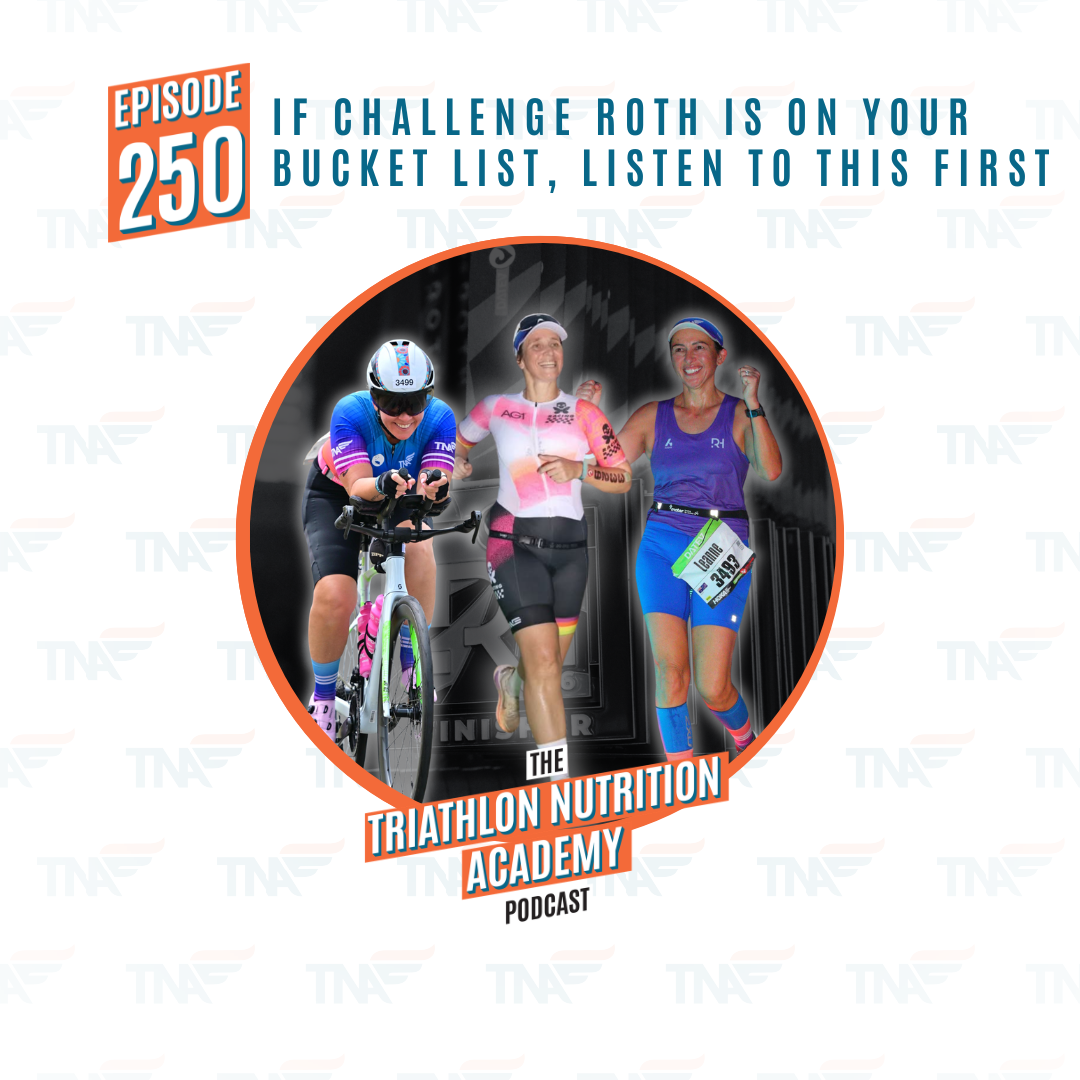
Jo, Lisa and Leanne are all TNA athletes, all from Queensland, and they have just ticked one of triathlon's biggest bucket list events off the list: Challenge Roth in Bavaria, Germany. In this episode they share what training for and racing this iconic full distance event was really like, from importing race nutrition into Australia to talking themselves through a mid-race gut issue on the run.
In this episode you will learn:
- Why Australians book Challenge Roth through a travel company, and how fast the race actually sells out
- What to pack, and import, when the on-course sports nutrition brand is not sold at home
- How to handle a mid-race gut issue without abandoning your fuelling plan
- Why nailing your everyday training nutrition is what actually gets you to the start line healthy
- Why hiring a bike for race day can cost you more than it saves
- What Solar Hill is really like, and why it might make you cry
Links:
Check how well you’re doing when it comes to your nutrition with our 50 Step Checklist to Triathlon Nutrition Mastery
Start working on your nutrition now with my Triathlon Nutrition Kickstart course
It’s for you if you’re a triathlete and you feel like you’ve got your training under control and you’re ready to layer in your nutrition. It's your warmup on the path to becoming a SUPERCHARGED triathlete – woohoo!
Connect with me:
To learn more about the Triathlon Nutrition Academy, head HERE | dietitianapproved.com/academy
See behind-the-scenes action on Instagram: @dietitian.approved
Follow along on Facebook: @DietitianApproved
Join our FREE Dietitian Approved Crew Facebook group
Enjoying the podcast?
Let me know what you loved about it and what you learnt by tagging me @dietitian.approved on Instagram!
Subscribe & Review in Apple Podcast!
Are you subscribed to the podcast?
If not, today's the day! I'm sharing practical, evidence-based nutrition advice to help you nail your nutrition and I don't want you to miss an episode. Click here to subscribe to iTunes!
Now if you’re feeling extra warm and fuzzy, I would be so grateful if you left me a review over on iTunes, too. Those reviews help other people find my podcast and quality nutrition advice. Plus they add a little sparkle to my day.
CLICK HERE to review, select “Ratings and Reviews” and “Write a Review” and let me know what your favourite part of the podcast is.
You're awesome! Thank you!
Episode Transcription
Episode 250: If Challenge Roth Is On Your Bucket List, Listen to This First
Welcome to the Triathlon Nutrition Academy podcast. The show designed to serve you up evidence-based sports nutrition advice from the experts. Hi, I'm your host Taryn, Accredited Practicing Dietitian, Advanced Sports Dietitian and founder of Dietitian Approved. Listen as I break down the latest evidence to give you practical, easy-to-digest strategies to train hard, recover faster and perform at your best. You have so
[0:00] **Jo:** Even when they say, "Oh yeah, this is the fastest full distance triathlon," and kind of set expectations about what the course is like, there were definitely things that made it harder along the way, which there always is. I would definitely never hire a bike again. Bringing my own bike, and I've done it before, it actually would've been super easy. The travel company would've looked after that really well. Definitely bring your own bike, the one that you've practised on and you're comfortable on, and that's set up exactly as you want.
[0:28] **Taryn:** And matches your kit perfectly.
[0:30] **Jo:** Yeah, exactly, way prettier. I think that was the only time that Leanne got a picture of me looking super disappointed, was the moment I picked up the bike.
**Welcome to the Triathlon Nutrition Academy podcast. The show designed to serve you up evidence-based sports nutrition advice from the experts. Hi, I'm your host Taryn, Accredited Practicing Dietitian, Advanced Sports Dietitian and founder of Dietitian Approved. Listen as I break down the latest evidence to give you practical, easy-to-digest strategies to train hard, recover faster and perform at your best. You have so much potential, and I want to help you unlock that with the power of nutrition. Let's get into it.**
[0:41] **Taryn:** Have I got a treat for you today. I have got three very special guests joining me from their holidays in various locations in Europe. They've gotten up early this morning to record this episode, and I think they're quietly regretting saying yes to that right now. Joining me is Jo Hurley, Lisa McDonald and Leanne Cogill. Welcome, ladies.
[1:02] **Leanne:** Hi.
**Jo:** Hi.
**Leanne:** Hello.
[1:04] **Taryn:** All three of these ladies have just raced the iconic Challenge Roth course, and they're here to share some of their insights, their experiences and their top tips for you. So if this is an event that you have on your bucket list, grab yourself a pen and paper now, because I've got so much juicy goodness for you. And if you haven't heard of Roth, it is in the middle of Germany, in Bavaria. It is known for its lightning-fast course, its electric stadium-like fan support that draws over 300,000 people, and it has a really deep triathlon legacy, being around since 1984. So it's more like a festival, I would say, than an actual race, and it includes the famous Solar Hill. If you haven't heard of Solar Hill, it's where thousands of fans line up on this steep incline, creating a really narrow tunnel that you ride through, just like it was the Tour de France. So I'm really excited to hear from these ladies what that experience was like. I was very jealous watching their stories from back home here in Australia. So my first question is, did it actually live up to those expectations that you had going in?
[2:12] **Leanne:** It was amazing. I've been able to spectate at that race 21 years ago, so I kind of knew what it was all about. That one's always been on the bucket list since, but I couldn't get back for 21 years, so being on the actual course was, yeah, it was amazing. It was all I had dreamed of really.
[2:36] **Taryn:** And was it number 20 Ironman distance events for you, this one?
[2:41] **Leanne:** I'm thinking it was 19. I'm not sure, I've kind of lost count, I need a pen and paper. Yeah, I think it was 19, but it was the best one, and I felt the best. I didn't die before the finish line. Well, I didn't actually die at all, so that was good.
[3:02] **Taryn:** Nice, well we'll get into some of the details around why that happened a little bit later, I'm sure, but what about you, Jo? Did it meet your expectations, or even just exceed them?
[3:10] **Jo:** I think from the get-go, the music as we walked in, the whole day was just emotional and meaningful, and they did an amazing job of setting the feelings and the tone of the day as soon as you walked in. I think every moment, I actually cried, not on the start line, but on the swim start, because all of the music and the banks just lined with people, and you see that famous bridge, "Welcome to the home of triathlon," and the bridge is just packed full of people. It didn't feel real to me. I've seen this online so many times, and I can't believe I'm actually here. We had front row, sitting on the banks watching all the pros go out for the swim start as well. I think it was seeing Lucy Charles-Barclay swim in real life that I just turned around, and I was like, "This can't be real." It was just amazing. So I had a lot of these moments of feeling like, "How am I here? How did I get here? This is amazing."
[4:33] **Taryn:** And how early do the Germans start drinking?
**Jo:** Real early, yeah.
**Leanne:** Straight away.
**Jo:** Yeah, the sun comes up pretty early. 5am cracker beer, it was a thing.
**Taryn:** There is beer that you have for breakfast in Germany, it's called morning beer or breakfast beer. It just seems like one big party. What about you, Lisa? I know you had your eyes set on Roth for many years.
[5:02] **Lisa:** A bit like Leanne, I hadn't raced it before, obviously, but we had been there back in 2018, and my husband had raced it, so I knew what it was like. It was pretty surreal to do it myself, and I was pretty terrified the entire lead up, I didn't think I could do it. Actually completing it was, yeah, amazing.
[5:27] **Taryn:** Looked like an amazing experience, one of those full distance events that should definitely be on everyone's bucket list. And it sells out almost instantly every year. How hard was it for you guys to actually register?
[5:38] **Lisa:** There's kind of only one way for Australians to do it, and that's go through a travel company, which is what we all did. Felix, the race director, was telling us at the race briefing that 35,000 people logged in to try and get a ticket, and it sells out in seconds.
[5:55] **Taryn:** Wow, and do you have a guaranteed spot if you go through that travel company as an Australian, or do you still go into some sort of ballot?
[6:05] **Lisa:** No, if you get in early enough, you can get your spot.
[6:08] **Taryn:** Put your credit card on the line and say, "I'm doing it, take my money."
[6:13] **Lisa:** Yep, pretty much.
[6:14] **Jo:** You basically do a deposit sign up with Tri Travel to get in, and then when the tickets come out, they'll give you a link to go in and register for the race. So that was kind of the easiest part of the whole thing, I would say, and it was a huge help through the whole experience to be so close to the race start and be bused in and out and all the other things that they do for you as well.
[6:41] **Taryn:** Yeah, that is a big piece of the puzzle when you're travelling internationally, it takes a long time for any Australian to get to Germany. What are some of those other general preparation things that are really important for you guys, that you look back on now and go, "I'm so glad I did this," to prepare yourself for racing internationally in a completely different time zone, in a completely different climate also?
[7:02] **Leanne:** The sports nutrition that they had on course was the first obstacle, I suppose. The PowerBar brand. They do send you everything that's going to be on the course, the gels, the drinks, the bars, but it was pretty much impossible to get in Australia. None of those products were available, or you could order their starter pack, but the postage on it was about $100. So I just tried a few PowerBar gels, and luckily I'm not really fussy when it comes to gels, but last year my friend did the race, and she just decided to rely on the sports nutrition that was on course, and she got a really upset tummy. I think the carb drink must've just been too concentrated, and quite a few people I heard had sore tummies. So I wasn't going to do that. I just made sure that I had all my own stuff. That was quite difficult to bring because it weighs quite a lot, but now it's all in my tummy and I don't have to carry it home. It was quite hard, I had to click and collect and send it to Lisa in Darwin, because she had more baggage allowance, and I really needed it. I had to factor in the Tim Tams, the Vegemite, the rice crackers and the gummy lollies, and Lisa brought it over for me. There was lots of planning, that's for sure.
[8:42] **Taryn:** What would you have done if Lisa wasn't travelling as well?
[8:45] **Leanne:** I would've just gone nude the whole time, no clothes, no shoes, buy clothes over there.
**Taryn:** You would've backed out.
**Leanne:** Yeah, that's it.
**Taryn:** Yeah, whole bag's taken up with sports nutrition.
**Leanne:** Yeah, pretty much.
[9:01] **Lisa:** And then the poor Tim Tams had to survive the European heatwave.
**Leanne:** They survived though, they were a little bit worse for wear, but they were okay, they taste good. But the Vegemite got confiscated at the final hurdle.
**Taryn:** Oh, goodness.
**Leanne:** Oh well, that's the way it goes.
[9:19] **Taryn:** So frustrating. What about you, Lise? You're travelling with your family, so you have an extra layer of logistics. What did you have to do to prepare to race all the way in Germany?
[9:30] **Lisa:** We didn't have to do too much differently, I guess I'm lucky my girls are older. They're pretty easy, they've been travelling for a long time. I did spend the whole time telling my husband he had it easier this trip, because when he did Roth, I had a five-year-old and a three-year-old in tow with me the entire day. But we did have to buy a different bike bag, mainly because of the airline we chose to fly with, they have very strict size restrictions. Thankfully I travel with my mechanic, and he was able to pull my bike apart way more than I am capable of and put it back together, so that was our only real logistical issue. In hindsight, it's actually been very good travelling around with a small bike bag, especially for the rest of our trip, lugging it on and off trains and up and down the million stairs that consume Europe.
[10:30] **Taryn:** Yes, it's not a particularly accessible part of the world, is it, lots of crazy stairs.
[10:38] **Jo:** I got there a couple of weeks early, and that's something that I've done before racing internationally as well. I think especially, not that I knew beforehand, but coming into the heatwave in Europe, that settling in time was really good for me. So I kind of front-load my trips when I'm going overseas, I have less time at the end to go out and enjoy things, but I do get that nice settling in time where I kind of feel quite at home by the time all the athletes and everything start showing up. So I had been here for a couple of weeks before the tour started. That just kind of gives me time to get my belly used to the food, to get over the jet lag, to ground and settle into the entire environment. And this time it was actually also just acclimatising to a very severe heat level in Europe. I was really glad that I did that, because luckily for the Roth week, the temperature actually cooled down a bit, thank god, because I don't know if I would've started if it was 40 degrees. There'd been a few race cancellations, and I just couldn't imagine getting out there in that kind of heat. That just wouldn't have been enjoyable, and I'm here for joy, so I was very glad that it came good.
[12:13] **Taryn:** So no Kona for you then, if that's the case.
[12:16] **Jo:** I think it's a different kind of heat there. It's like anywhere, it's dependent, it's not always super hot, but it's a different kind of heat. This heat was really just very overwhelming. Obviously Kona out on the Queen K and all the black that's out there, it does get super hot as well, but this just felt really stifling, all the time. There's just no break. From 4am to 10pm, it's just getting hotter and hotter through the whole day, there's no break to it.
[12:53] **Taryn:** Yeah, and their buildings are not designed for that heat either, like they are here in Australia where it's hot all the time, so you know how to cool down inside. So looking back now, in terms of your preparation, is there anything that you would've done differently to set yourself up for success for Roth? Any learnings that you have?
[13:12] **Lisa:** Their course is extremely hilly, but I live in a very flat place, so there's nothing I can do about that. I think I trained really well, and my coach prepared me.
[13:22] **Leanne:** I was actually prepared properly for once. In 19 attempts, I would say this is maybe the third time that I've got it right. I was happy, I felt really good the whole time. It is painful, but I knew that I was going to finish, and I knew that I was going to be strong on the finish, and I knew I could walk home and walk around the next day, so that means I was well prepared. I was pretty grateful for that, no injuries, no illnesses, so yay, hooray.
[14:03] **Taryn:** Awesome, and you guys looked awesome in your TNA tri suit also, by the way, thank you for hauling those over for me, Jo.
[14:12] **Jo:** Yeah, they were awesome. I mean, it's like never try anything new on race day, but we decided that we were going to wear them for the swim practice. So I had a different suit that I was going to wear, and then we put them on for the swim practice, and I was like, "Ooh, this actually feels pretty good." So I ended up wearing it on race day as well, and I loved it, it's a great suit.
[14:32] **Taryn:** Yeah, thank you, I'm glad. It was worth probably three months of stress, of my health going backwards, to sort out our tri suits, but to have them represented all the way in Germany was pretty cool. Okay, so take us to race day. Sounds like from the moment you wake up to the end, it's just an amazing experience. In terms of nutrition, did everything that you rehearsed go to plan, or is there anybody that had to adapt on the fly? Leanne, you said you felt amazing, and surely part of that is training and nutrition. Anybody else have anything go wrong, or did everything go right?
[15:11] **Lisa:** When I was riding my bike, I started to feel a bit sick, and at first I was like, "Oh, it's okay." It kind of went away on the bike. But as I was running, I was like, "Oh no, I think I do feel a bit sick." So I did have to think, "Oh, what can I do?" I originally thought maybe I've just drunk too much Red Bull, maybe I've found my caffeine limit. A few people on the bus back told me the canal had made quite a few people sick, so I don't know if it was that. But anyway, it wasn't debilitating, but it was like, "Ooh, I've never felt this before." So I did have to check out the on-course nutrition and go, "Ooh, what can I take instead?" And in the end I ended up eating dry pretzels and water, and that got me, I felt much better after that, and that got me through to the end.
[16:01] **Taryn:** Yeah, did it go away at all?
[16:03] **Lisa:** Yeah, it did, after I had an emergency bathroom stop. Then I felt fine, and I just kept eating dry pretzels, some salt and some bread and some water, just like your mum tells you when you're sick as a little kid.
[16:19] **Taryn:** Yeah, keep it simple. Did you do carb calculations in your head at that point, or were you just reaching for whatever you could get in and keep in?
[16:28] **Lisa:** At that point I was walking most of the marathon too, so I was like, "Ah, doesn't matter." But I was trying to stay somewhat on track.
[16:39] **Taryn:** Nice work, a lot of people would have a challenge like that and just stop. So it's a good testament to your resilience to be able to have that issue, figure out a solution, and then keep going while you're out there exercising for 13 hours.
[16:55] **Jo:** On the day was absolutely fine, but in the days leading up, as we started thinking about the carb loading plan, and Leanne and I were looking at what we were going to eat, I just suddenly had no appetite at all. I was just excited and nervous, and I just really found it hard, I didn't want to eat. Leanne was just constantly, "You've got to eat, what are we eating, what are we eating?" And I was just not hungry, it was like my appetite just totally shut down. Luckily I had her with me just encouraging me, "No, we've got to go get something," and just to find something to kind of kickstart my appetite again as well, and probably just make me laugh a bit and just relax so that I could actually get something down.
[17:44] **Taryn:** Leanne's good at that, she's a good feeder.
[17:50] **Leanne:** Thanks. I think the actual race day morning logistics was really tricky. We found out before we got there that all three of us were in the last, second to last wave. The pro men went off at 6:30, and we started at 8:15. You have to sort of count back, you want to be done eating about three hours before. The German hotels do a great buffet breakfast, so I got some white rolls and jam, but by the time the race came, three hours before, I just couldn't eat those. At the hotel we had to leave at like 4:30, so they opened the breakfast at 3:30. So I got the coffee, and I had a little pancake, and the sports drink. I was ready to go, but I couldn't do that plan that I'd tried before, it was just too tricky. There was too much going on, lining up for the toilets, trying to work out when do we go into the holding pen, lots of waiting around, but of course there was lots of excitement. Jo and I were just, every time that big cannon went off, we'd just crap ourselves a little bit, I think we got used to it after a couple of cannons before our wave. This huge gun goes off every five minutes, and it shakes your bones. So that was hard to, well, it wasn't hard, I just had to get a piece of paper and write down the times and work backwards from the start, and when we were leaving. It was an extra little thing to work out on the morning, but we all had it under control, didn't we, girls?
[19:48] **Jo:** We did. I mean, we all were in the same starting group, so we were all dealing with the exact same delay, it was nearly two hours after the pros had gone out, so we were in the second-last wave. Cannons are going off, lots of time to think, which can be dangerous, but we did keep each other pretty entertained, and we were able to go into the water together, so that was helpful.
[20:17] **Taryn:** It's so good to have the three of you there, three TNA people chose to do it individually, but you all have each other there to support each other, which is such an amazing experience than doing it by yourself. And Jo, your race looked different, you went in with a plan to do the swim and then half of the bike. You decided that before you even left Australia, instead of finishing it off and doing the marathon. Can you talk us through that decision, and how did you actually feel executing it on the day?
[20:45] **Jo:** I think it helped a lot that I had decided well before the day, so I kind of processed the whole, "This is my plan," and I felt really good about it. It was actually months before, I mean you sign up for this race over a year before you actually do it. Just the timing of signing up, I signed up for Roth, I was super excited and was just about to race Geelong 70.3 a few days later. Unfortunately, in that race I got a stress fracture, and a lot of things changed from that point in time. It was literally days after I signed. Unlike Lisa and Lee, I hadn't done a full before, and I hadn't been to Roth before. I just didn't have enough time, dealing with the injury, doing TNA as well, and getting my food sorted and making that a solid, reliable part of my life as well. I was practising a lot, and just things in my life changed, I went and started a masters, I'm a single mum, and trying to make the shift in my training with all the other things I had going on to the full distance just proved, it was sucking the joy out of things. I wasn't actually enjoying my racing, and I love to race. I was feeling a lot of pressure, how do I feel on this race, how am I going to do it, just started becoming a bit of a, I don't know, it just wasn't helping my preparation. So I ended up sitting down with my coach and a few friends who I was training with, and made the decision that I was going to create my own race, that I was going to go and have this fantastic experience. I wanted to have the holiday, I wanted to enjoy time with the people that I was going to be meeting up with and travelling with. I didn't want to defer or cancel or anything like that, I still wanted to get out there. So I kind of came up with my own plan to be able to do the full swim, which I knew, the swim is my favourite leg, I knew that I would be able to do that. And to do a loop of the bike, it's a two-loop bike course, two 90k loops, and I figured if I could get out there and do a loop, then I would be able to come back, and I would've seen two-thirds of the course. I did have a little secret ambition that potentially I might be able to convince them to let me out on the run course, even though I hadn't done the full 180 on the bike. I really treated it as a course recce, full swim, a loop of the bike, so I know exactly what I'm up for when I come back and give it another go, because that is my plan, and I was hoping to get out on the run if I could. But the logistics of having to, I came in earlier than my entire group, so it kind of stood out that I was finishing early, and it just made it difficult, the logistics of getting me off course was preventing me from getting out on the run. At the end of the day, that was an amazing opportunity to get out on the course and be cheerleader for the girls, and to get out and see everyone on the run course and be able to spectate. So I got a spectator experience as well, which was amazing, all the way up to the finish line and the after party, which was amazing.
[24:10] **Taryn:** Can we talk about Solar Hill?
[24:12] **Jo:** Oh yes, Solar Hill. So for me, because I knew what my outcome was already, that was my finish line. Riding up that hill, there was parts on the ride where even though I knew I was only doing one loop, part of my decision making just to ease the burden as well was I hired a bike, and I hated that bike, absolutely did not like that bike. So there was moments on the ride where I was just like, "Get to Solar Hill, Solar Hill, that's your job." And oh my god, as you round the corner, you just take a huge breath looking up at all those people, knowing that you're about to ride deep through the middle of those people. It's just a wall of people in front of you.
[25:04] **Taryn:** Yeah.
**Jo:** So you go around a corner and you can see them up ahead, and you're going to be riding straight through them. That was an amazing experience, I'm just so grateful that I was able to come and do that part of the race, because I'm now so inspired to come back and experience the whole thing just because that moment was so special.
[25:27] **Taryn:** And you get to do it twice.
**Jo:** Yeah, the girls will be able to say what it was like going the second time.
[25:33] **Taryn:** Yeah, was it absolute mayhem by the second time round?
[25:36] **Lisa:** It becomes a bit less, there's a few less people, but it's still really, really, really exciting, and there's still plenty of people to ride through. It's pretty special. I would say one tip for Solar Hill is to practise riding at a super slow cadence, because it's like being stuck behind your child riding a bike. You can't control the speed, you can't control anything, you just have to ride behind the group in front of you, because you obviously all bunch up. So it's a bit funny to ride up there, but there's heaps of people, it's amazing. I was really worried about people touching me, trying to pat me on the back, but they give you heaps of space. It was really good.
[26:21] **Taryn:** Okay, nobody gave you a sneaky little push?
[26:24] **Leanne:** You don't need it, you don't need a push.
[26:26] **Taryn:** It's like being a Tour de France rider, that little bit, it's what they have to endure so often.
**Lisa:** Yeah.
**Taryn:** And they must hate it, because they've done it so many times, it's not this once-off amazing experience where you're like, "Yeah, this is the best day ever," they're like, "Please get out of my way." So for each of you, if you lined up to do Roth again tomorrow, is there anything that you would do differently?
[26:49] **Leanne:** I'd probably have a few more gears. I was watching other people riding up the hills, and they seemed to be spinning really easy gears, I reckon I needed a couple more, because the cadence got quite slow. I managed, it's okay, but it would've been nice to have a few extra clicks in certain places. I'd like to have the same friends again, that'd be nice. That was one of the best parts of it, having the girls there as well.
[27:20] **Taryn:** So nothing, Lise? Nothing you would do differently, you nailed it?
[27:24] **Lisa:** And sorry to my coach, I didn't listen to him when he told me what to do on the bike. This was my first full distance, and I was so scared about not making it that I didn't listen to him. So I went really easy on the first lap, and I probably shouldn't have, it meant I missed my bike goal, and I probably could've ridden a bit better, especially seeing as my marathon went terribly anyway. But I think maybe I should've ridden a bit harder on the first lap. It was also super windy, so I don't know if I would've blown up if I'd gone too fast on the first lap. But I did go out very easy to begin with, thinking, I've never ridden 180 kilometres before in a race, and I have to run after this. So maybe that's my only thing.
[28:15] **Taryn:** Yeah, it's hard to know though, isn't it, because you've never done that distance before, how do you know how you're going to feel? So every race you do, you learn something. So next time you do Roth, is there going to be a next time, Lise?
[28:27] **Lisa:** Oh, I don't know about Roth, it's a big trip, but maybe a different thing.
[28:33] **Taryn:** A different full distance event, you know how to pace yourself slightly differently, you've got it in the tank. And what about you, Jo?
[28:40] **Jo:** I mean, obviously my intention is to come back, I'd love to finish this race. I wasn't sure if I really wanted a full distance triathlon, I really love the 70.3 distance, and it's such a big step up, and I really wasn't sure. But now having been there, I was constantly the whole time like, "When I come back, this is what I'm going to do differently." I think just knowing that even when they say, "Oh yeah, this is the fastest full distance triathlon," and kind of set expectations about what the course is like, there were definitely things that made it harder along the way, which there always is. There was a bit of a current in the swim, so I kind of watched the pros as they went out, and I could see the lines that they chose, that they must have been dealing with a current, so I tried to do something similar, and I think that was a good idea to do that. I would definitely never hire a bike again. Bringing my own bike, and I've done it before, it actually would've been super easy, the travel company would've looked after that really well, it's just well set up for that. So trying to tackle that course on a hire bike just didn't fit me well, it wasn't set up properly. With my nutrition, the actual nutrition was fine, it was just the logistics on this bike that wasn't my bike that I struggled with, and I had to do a fair bit of thinking around how I fit my nutrition on the bike, and that would've been really hard had I been intending to do the full distance, to try and get all that on this bike that I struggled with a bit. So definitely bring your own bike, and the one that you've practised on and you're comfortable on, and set up exactly as you want.
[30:33] **Taryn:** And matches your kit perfectly.
**Leanne:** Yeah, exactly, way prettier.
[30:40] **Jo:** So I think that was the only time that Leanne got a picture of me looking super disappointed was the moment I picked up the bike. I just had such regret. I think the other thing is that the bike course is hilly. Solar Hill was amazing, but there was quite a big climb before that. Just being able to potentially do that on Rouvy, or just make sure that you've got some climbing in the practice as well is really important. It's not a super fast, flat course, there is work involved as well. I did do the course on Rouvy a couple of times, so I kind of got a sense of it, and in practice it wasn't as hard as it was on the trainer. It's just a good idea to really get a lay of the land on the ride course before the day.
[31:31] **Taryn:** Why do they say it's one of the fastest? Surely it's not, if it's not flat.
[31:35] **Jo:** What they're talking about is I think the way that you ride constantly through towns, so there's lots of spectator engagement on the course, you constantly have a little stretch where you can kind of get down and get some speed. I couldn't on my bike, but you would be able to. There's speedier sections, and then you come into towns where there's a real cheering, all the locals are out, a lot of atmosphere, and that happens very regularly on the course. I think that's what it is, the adrenaline of all the spectators. You just go faster through the towns, and then you're pumped up and ready for the next section where you might get down and give it a crack again. I really think that's what it is.
[32:19] **Lisa:** The roads are also super nice.
[32:24] **Taryn:** Nice, there's no Queensland potholes to contend with.
**Lisa:** Absolutely not, no, it's a beautiful road.
[32:31] **Taryn:** I just realised that all four of us are from Queensland, look at us go. So somebody's just put Roth on their bucket list, and they've bumped it into, "I want to do this thing." What is the best piece of advice that you've got for them?
[32:45] **Leanne:** Well, you've got to go through the travel company. Know the course and work out what you've got, your nutrition, what you've got to take. You've just got to have that in your mind from word go. Once you start training, you've just got to focus on, first of all, getting to the start line, but knowing what's coming and being prepared for it. It is a lot, it's a big commitment, and it does require sacrifices, and that's the same with any race, not just Roth. But there's so much, it's really expensive, it's a long way, so you want to do everything right, it's not just like popping up to Cairns on your $80 flight. There's a lot at stake, and you don't want to muck it up.
[33:37] **Taryn:** Yeah, how long did it take you to prepare, Lee? How many months are we talking?
[33:42] **Leanne:** I sort of started properly training for it in December, so six months, and I pretty much started from scratch too. I was very consistent for once, I trained pretty much every day, I didn't have many rest days, so I think that's why I didn't get injured. It wasn't all in right at the end or all in right in the middle, because I'm thinking, "Oh, it's coming, it's coming." So you've just got to build it up slowly, and the longer you can do that for, the better.
[34:24] **Taryn:** Did it help having your nutrition planned this time? You probably have it much more automated than you ever have before, less winging it. Do you think that's one of the reasons why you could have that good training availability and stay consistent without falling apart
[34:38] **Leanne:** Yeah, well just especially the pre and post-training nutrition was something that I didn't really have to think about anymore, because I know what to do. As always, it can do better on the day to day stuff, because you're so busy, and it's often convenience and what are the kids going to have too. But I think just nailing the pre, during and post-training nutrition just kept me healthy, and my body could handle the strain and the load, and also just the thinking part of it. Once you know what you're doing, it just becomes automatic, you don't have to fluff around before and after, you just get on with your life.
[35:30] **Taryn:** That's surely what it's meant to be like, we just overthink it sometimes, or we don't know what to do, and so it just becomes this big vicious circle. What about you, Lise? What's your best piece of advice?
[35:43] **Lisa:** Oh, same, logistically, make sure you go through the travel company, I think it would be impossible to do without that. Practise running on gravel, 27 kilometres of the marathon is on gravel.
[35:59] **Taryn:** Did you guys practise gravel running?
[36:03] **Lisa:** Yeah, I did. With all of the training, having the knowledge to eat well makes you get through it and feel good and keep going with your actual life. So making sure you're eating well, fuelling well before and after, that's what set me up to be able to train so well. I prepared for this for maybe, I asked my coach to start helping me 18 months out when I first signed up, and I was able to consistently train that entire time, I didn't need to stop, I didn't get sick. Apart from a pretty big life event, I trained fully, consistently the entire time.
[36:48] **Taryn:** Well done, and you did a sneaky marathon in there, you did some 70.3s. So you had a big block of all these roads, all these decisions and races lead to Roth, which is pretty cool. Okay, so prepare long term would be maybe Lisa's advice. What about you, Jo?
[37:06] **Jo:** Yeah, that consistency in training over a long block is really important, and having the right coach that's fully dialled into the expectations of Roth and what you're going to be dealing with on the day is really important. So just having confidence in that coach and that plan is vital, I think. Just from my observations of others on the course, there was a lot of nerves around the fact that it wasn't a wetsuit swim, I was stoked about that, I don't love swimming in a wetsuit, I much prefer the swim skin. The water was actually really warm, on our practice swim I think it was like 25, 26 degrees in the water, it was wonderful, I loved it. What is sad is when you see people who've done so much preparation and work and who end up super disappointed on the day because they haven't really done much practice of open water swimming without a wetsuit, for example. There was a lot of disappointed people with that news, which we only got an hour before the race, so it was kind of like bring both and we'll let you know. So just getting ready for those things I think is really important, open water swimming, the more of that you can do, the better. And as well, just staying safe on the bike, being on a bike that you're really comfortable with, there was a lot of accidents out there. I think if you look at the DNFs that I saw, it was either being unable to complete a non-wetsuit swim, or coming undone with a crash on the bike essentially. So just staying safe and riding within your limits on the bike just to make sure that you're getting yourself safely to the finish is really important as well, just to save the disappointment. But for me, the nutrition, yeah, I agree with the girls, that was just the part I didn't have to worry about at all. It was just easy, dialled in. The place that we were staying had great options of food as well, all around us we had great food options. There was a little place next door to our hotel that had chicken and rice bowls and things, and Cat Matthews and a few other pros were sitting in there every day. So it was like a good sign to be like, "Yeah, that's safe to eat, we should go there." We had good food options, and I think that was the easiest part of the whole endeavour for us, which is fantastic.
[39:42] **Taryn:** Yeah, amazing, so what's next for you guys? Jo, are you going to do Roth again? Not next year, but...
[39:49] **Jo:** Not next year, yeah. I think I'd like to do a full distance on home turf first, because I'd like to come into this with a greater level of confidence that I am able to complete the full distance, and that when I come, I'm ready, I've got the confidence to know that I can do it. So hopefully I'll be back in 2028. I've also just got other goals and other things as usual that I'd like to do, so fitting it in and making sure I've got a good lead time without any races kind of impacting my preparation either, because it is hard when you've got different race goals that you want to do, how do you fit it in and get the timing right as well. I didn't nail that this time, but I definitely have a lot of experience now to come back and nail it next time.
[40:41] **Taryn:** Well, it took Leanne 20 years to come back, so you don't have to do it in 2028, you've got time, you're only new to triathlon, don't forget, you've only been doing it for a few short years.
[40:52] **Jo:** It's two and a half years. I still consider myself a rookie, and I'm here to learn, and that's the attitude that I brought into this experience, and it's been amazing. I'm so glad that I did that and didn't bite off way more than I could chew, I came and did what I said that I was going to do, and I'm excited for what's next.
[41:14] **Taryn:** And to have a good experience too, like, if you had gone in and pushed yourself and DNF'd and been disappointed, that's not the outcome that you want, you went and had a good time, I think you got the best of both worlds.
[41:27] **Jo:** Yeah, I feel like that as well. Being able to get out and be cheering for everyone, I was jumping up and down on the Red Bull station, I got to have beers with Mark Allen, that was epic. So many moments where you're like, "Oh my god, I'm sitting here drinking beers in Germany with Mark Allen, watching Roth." We were talking about sharks and, oh my god, all kinds of things. It was just, I couldn't believe it. And then the laser show, and seeing the finish line, and I was so happy for the girls, seeing them cross the finish line, just to be able to be there and call out their name, "Hey, I made it here, I'm in one piece." It was just nice to be there for them as well. It was just so worthwhile making the trip, and having the inspiration for what am I going to do next, and I think that's going to get me through a lot of hard training days back at home in the garage.
[42:35] **Taryn:** What about you, Lise?
[42:36] **Lisa:** I've always said Roth was the only full distance I would ever do. I've already signed up for some local stuff, but no plans.
[42:47] **Taryn:** Well, this has been a long 18 month journey just to get to this point, so I think you deserve a little rest for a little while, Leice. And what about you, Leanne, what's Ironman number 20?
[42:56] **Leanne:** I've always wanted to do a race called the Norseman, which is an Ironman distance, but it's very iconic. You jump off a ferry into a fjord and swim in this freezing cold water, and the bike course is very hard, and the run, the last 5k you've got to go up this mountain, and I'm actually going to that mountain today, and I'm going to do the 5k to the finish, I'm not going to run, but I'm just going to go and check it out and maybe, like Jo, get inspired to try and get in. It's impossible to get in, like Roth, there's no Tri Travel to help you, you can try and qualify for it, but I'm not in that zone, so I'll just keep entering the lottery every year. Whenever that happens, I just have to hopefully keep going. I do want to keep going, I've done a full distance in every age group, so I want to try and find some old people around that might battle me to the death in the iron distance, getting it done in every age group. But I've got, I think the next goal is I want to get under four hours in the marathon, I reckon I can do it, so I'm going to put that on the list next, hopefully within the next six months I can knock that one over.
[44:29] **Taryn:** I reckon you could do it. I think we need to get a shirt printed for you, Leanne, that has all of your full distance races on it and the year, so that you can remember, because you've done so many over a long triathlon career.
[44:42] **Leanne:** I do actually have that T-shirt, because when I went to Kona, I went with three girlfriends, and they made a T-shirt with me on it, and it was a little bit embarrassing, but it was nice, and on the back it had all my races. But I've done three more since then, so I'll have to get the shirt out and count it up.
[45:10] **Taryn:** Ladies, thank you so much for sharing your Roth journey with us today. I know that you guys are still on holidays, and you are regretfully up early to talk to me because I'm still stuck here in Australia. But I think a lot of athletes listening will have potentially added Roth to their bucket list now after today, it's just such an iconic race, and if you know these guys, you would have seen their stories and the behind the scenes, it just looks so cool, so much fun.
[45:38] **Lisa:** They said it really well at that briefing, just enjoy the race, it's an amazing experience, just take your time, enjoy it, you're not qualifying for anything, it's just pure enjoyment, the whole purpose of the race is just to have a great time.
[45:53] **Taryn:** Yeah, and fitness is half of that equation, you've got to get nutrition and your fuelling right if you want to tackle a big goal like that, so that you're not leaving anything to chance on the start line in Bavaria with the drunk Germans, and you can cross that finish line with a smile on your face instead of maybe regretting it, or DNFing it, or not meeting cutoff or anything like that. All right, ladies, enjoy the rest of your holidays. I'll see you when you get back to Australia.
Thanks for joining me for this episode of the Triathlon Nutrition Academy podcast. I would love to hear from you. If you have any questions or want to share with me what you've learned, email me at [email protected]. You can also spread the word by leaving me a review and taking a screenshot of you listening to the show. Don't forget to tag me on social media, @dietitian.approved, so I can give you a shout out, too. If you want to learn more about what we do, head to dietitianapproved.com. And if you want to learn more about the Triathlon Nutrition Academy program, head to dietitianapproved.com/academy. Thanks for joining me and I look forward to helping you smashed in the fourth leg - nutrition!