
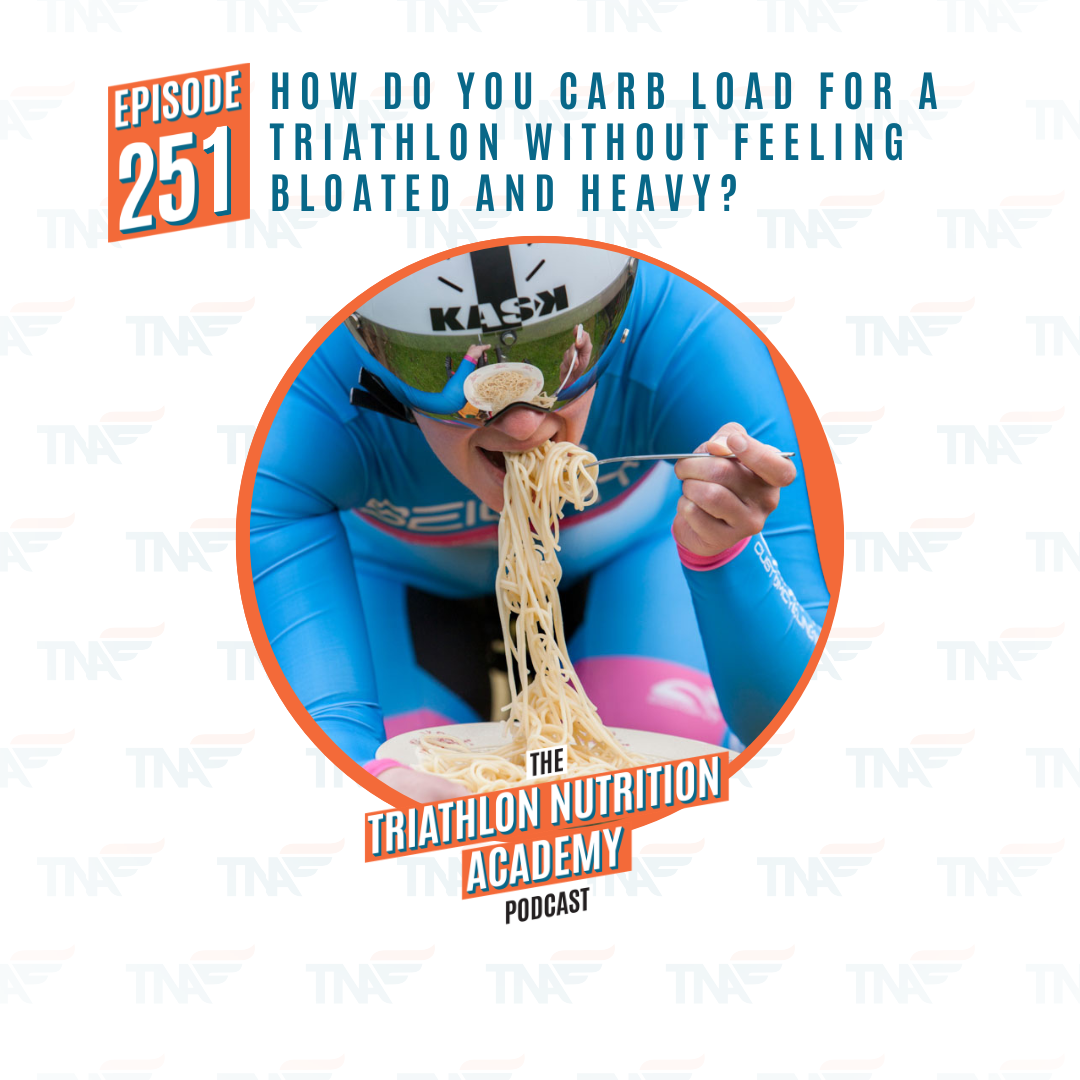
Episode 251 - How Do You Carb Load for a Triathlon Without Feeling Bloated and Heavy?

A giant bowl of pasta the night before your race is not carbohydrate loading. Not even close.
In two decades of working with age group triathletes, Taryn has never met one who carb loads properly. This episode fixes that once and for all. It breaks down the science of carbohydrate loading, why it is genuinely free speed out on the course, and the handful of mistakes that leave you feeling bloated, heavy and fading in the back half of your race.
WHAT YOU WILL LEARN
- What carbohydrate loading actually is, and why it is not the same as demolishing a pasta dinner
- Why carb loading delays fatigue rather than making you faster, and how it is worth 1 to 3% performance out on course
- The five common mistakes that leave you bloated and heavy (you are almost certainly doing at least one)
- Why the number on the scales going up is a sign you have done it right, not a reason to panic
- Whether women really do carb load worse than men, and what the research actually says
For the complete guide to Carbohydrate Loading for Endurance Athletes, CLICK HERE 🔗
Links:
Check how well you’re doing when it comes to your nutrition with our 50 Step Checklist to Triathlon Nutrition Mastery
Start working on your nutrition now with my Triathlon Nutrition Kickstart course
It’s for you if you’re a triathlete and you feel like you’ve got your training under control and you’re ready to layer in your nutrition. It's your warmup on the path to becoming a SUPERCHARGED triathlete – woohoo!
Connect with me:
To learn more about the Triathlon Nutrition Academy, head HERE | dietitianapproved.com/academy
See behind-the-scenes action on Instagram: @dietitian.approved
Follow along on Facebook: @DietitianApproved
Join our FREE Dietitian Approved Crew Facebook group
Enjoying the podcast?
Let me know what you loved about it and what you learnt by tagging me @dietitian.approved on Instagram!
Subscribe & Review in Apple Podcast!
Are you subscribed to the podcast?
If not, today's the day! I'm sharing practical, evidence-based nutrition advice to help you nail your nutrition and I don't want you to miss an episode. Click here to subscribe to iTunes!
Now if you’re feeling extra warm and fuzzy, I would be so grateful if you left me a review over on iTunes, too. Those reviews help other people find my podcast and quality nutrition advice. Plus they add a little sparkle to my day.
CLICK HERE to review, select “Ratings and Reviews” and “Write a Review” and let me know what your favourite part of the podcast is.
You're awesome! Thank you!
Episode Transcription
Episode 251: How Do You Carb Load for a Triathlon Without Feeling Bloated and Heavy?
Welcome to the Triathlon Nutrition Academy podcast. The show designed to serve you up evidence-based sports nutrition advice from the experts. Hi, I'm your host Taryn, Accredited Practicing Dietitian, Advanced Sports Dietitian and founder of Dietitian Approved. Listen as I break down the latest evidence to give you practical, easy-to-digest strategies to train hard, recover faster and perform at your best. You have so much potential, and I want to help you unlock that with the power of nutrition. Let's get into it.
[00:00:00] You've done the training. In fact, you've done months of it. You're at the start line of your very first 70.3, and last night you did exactly what everyone has told you to do. You demolished a giant bowl of pasta, and maybe you even added some garlic bread just for good measure. And at the time, you felt really good about it.
[00:00:18] But now it's 7:00 AM and you're feeling really heavy, you're feeling bloated, and a bit like you've swallowed a brick that just won't digest. And then halfway through your bike leg of the race, your legs start feeling heavy and you're wondering where that pasta all went. I'll tell you where it went: nowhere particularly useful, because a big bowl of spag bol the night before your race is not carbohydrate loading.
[00:00:40] In fact, it's not even close Hi, I'm Taryn. I'm an advanced sports dietician and triathlon nutrition expert, and I've got to be straight with you. In my two decades of experience working with age group triathletes, I've never met one athlete that knows how to carbohydrate load properly. Not one. So today, I'm gonna help you fix it once and for all.
[00:01:00] We're gonna dive into the science of carbohydrate loading, what it is, why it's genuinely free speed out on the race course if you are an endurance athlete, some of the common mistakes that absolutely leave you feeling bloated and heavy, and I can help you with exactly how to do it properly with my complete guide to carbohydrate loading.
[00:01:19] The practical step-by-step evidence-based protocol and building out your individualised carbohydrate loading plan is the exact tool that I use inside the Triathlon Nutrition Academy. We use it to work out an athlete's unique numbers and then build their specific custom plan. It's available at dietitianapproved.com/carb-loading.
[00:01:44] I'll link it in the show notes for you. So let's dive into what carbohydrate loading actually is. If you've been listening for a while or you know me, you know that I love to teach first because there is so much value in understanding why something works. That way you can follow the exact protocol with the knowledge and confidence that it's going to work because you understand it.
[00:02:04] My entire philosophy when it comes to triathlon nutrition is give a triathlete a fish and they eat for a day, or if you teach a triathlete to fish then they know how to eat for life. And because you can't carbohydrate load properly if you don't understand the mechanisms, I'm gonna explain exactly what's happening in the muscles.
[00:02:24] So you know that when you eat carbohydrate, it gets broken down into glucose, and glycogen is our storage form of glucose. We store it in our liver and we store it in our muscles. So think of your muscle glycogen as basically the fuel tank or the gas tank of your car. It is your stored form of fuel that you can use during exercise and racing.
[00:02:44] We package up glycogen with water in a ratio of one molecule of glycogen to three molecules of water, and the fuller your tank, the further you can go. Just like petrol in your car, the fuller it is, the longer you can drive for. And as an endurance athlete, the goal is to start your races with a full tank, but with carb loading, we can fill it up even further.
[00:03:07] It's called super compensation. So think about when you put petrol in your car or gas in your car- And the little bowser clicks off to say it's full, and you're like, "Nah, it's not really full. I reckon I can shove a bit extra in." So you click it again and put more fuel in the tank. Carb loading is a similar sort of premise.
[00:03:26] We want to fill our muscle glycogen fuel tank up above normal or as full as we can possibly get it before we toe the start line. Now, this is a really important principle that a lot of people get wrong, and that is carbohydrate loading doesn't make you faster. So per minute of running or per kilometre on the bike, you're not going faster.
[00:03:47] What carbohydrate loading does is it delays the onset of fatigue, so it pushes back further in the race or even not happen at all that point where you run out of fuel and your pace just falls off a cliff or you start walking. So it's definitely pace protection. It is the difference between you continuing on and maybe negative splitting the run, crossing the finish line with a smile, versus your competitors who have hit the wall and are starting to walk, or their pace slows right down in that back half.
[00:04:18] Now, carb loading is one of those things that's been researched for a long time, like since the '60s, and we know that it's beneficial for events lasting longer than about 90 minutes. So if you race Olympic distance, 70.3, 140.6, or anything even longer than that, you will benefit from carbohydrate loading, and it needs to become a part of your entire race nutrition strategy.
[00:04:41] You are leaving performance on the table if you're not doing it properly. It is worth about a 1 to 3% performance enhancement. Like, that is literally free speed that you are leaving on the table if you're not doing it properly. That is some of the basic science of carbohydrate loading without going into the last 60 years of research.
[00:05:01] It is not a nice-to-have. You need a custom carbohydrate loading plan for yourself. But so many triathletes just suck at it, no offense Meanwhile, there are a handful of mistakes that I see over and over again, and I'd put money on the fact that you're doing at least one of them. So let's go through them.
[00:05:20] Mistake number one is that big race dinner plan. The night before you race, you go nuts at the pasta party, or you have this giant bowl of spag bol and think that you've carbohydrate loaded. This is one of the key things that is going to leave you feeling bloated and heavy in your race and in the morning as you toe the start line.
[00:05:37] Carbohydrate loading does take time. It also requires you to hit your specific numbers, and a big bowl of spag bol the night before your event comes nowhere close to effectively carbohydrate loading. Mistake number two is doing it the hard, outdated way. The original 1960s method required you to deplete your glycogen stores first.
[00:06:00] So you do a really hard training session to run them down in combination with a very low carbohydrate diet, so stripping out all of your fuel tank. And then you would carbohydrate load after that for three days. It is miserable, and it is not what we need when you're trying to taper heading into a race.
[00:06:20] And now we know it is completely unnecessary, but a lot of triathletes never got that memo. We don't need to suffer through that old-school archaic protocol anymore. Mistake number three is loading with the wrong foods. Big bowls of salad, burgers, egg and fry ups, those sorts of foods are just going to wreak havoc on your gut, and they're also not effective at loading up your muscle glycogen stores.
[00:06:46] Really high fat and high fibre foods are a recipe for you spending most of your race in the portaloo. Carb loading is genuinely the one time where I'm going to steer you towards not particularly dietitian-approved food choices. I'm always going to say that white bread beats brown bread in this instance.
[00:07:05] So you enjoy that, 'cause you're not gonna hear it from me very often. Mistake number four is panicking when you stand on the scales. Now, to carb load glycogen effectively, we need to package it up and store it with water. Your weight on the scales is going up, but people absolutely freak out when they see that, and then they start backtracking and under fuelling themselves.
[00:07:28] But remember when I said right in the beginning that glycogen is stored with water in a ratio of one is to three. So we want our weight to increase when we're carb loading. It's actually a sign that you've done it correctly. It's not a problem, it is the entire point of filling up our fuel tank. We want to get heavier, but not too heavy, so that we can turn up to our race feeling fast, not sluggish.
[00:07:51] Mistake number five, and I think this is the biggest one, is just guessing. Using the internet, trying to figure it out yourself online, but there is not a one-size-fits-all number. You want to find the sweet spot of the evidence-based protocol that is for you, and most people have no idea what that is for them.
[00:08:08] Plus, you also need the ability to adapt and tweak it over time, depending on what you're doing, and as you get better at carb loading over time as well. As your racing changes, so too should your entire race nutrition strategy, including your carbohydrate loading plan. You want a custom plan for Olympic distance.
[00:08:28] You want your own strategy for a 70.3 race, and again, you want a different strategy for your full distance Ironman event We don't have this one carb loading plan that is set and forget for everything that we do forevermore. You need to be able to pull the right levers and adjust it to get the most out of it for every individual race.
[00:08:48] Now, if you're a female athlete, carb loading was historically done in men until more recent years. If you've ever been told that females can't carb load or can't do it as well as men, or that a particular stage of a menstrual cycle means that you can't carb load effectively either, then this is for you.
[00:09:09] There is so much noise online when it comes to females and just carbohydrate in general. Most of it is unhelpful, and some of the influencer rubbish is just flat out incorrect. Makes my blood boil. So it's important to keep your wits about you when you're looking at this stuff on the internet. Let me start with the uncomfortable truth, particularly as a female athlete myself.
[00:09:31] For decades, almost all of the carbohydrate loading research was done in men. Women were just not represented at all, because we have a menstrual cycle and that makes us more complicated. So they took the easy route and just left us out. So a lot of the advice we were handed maybe 20 years ago wasn't actually designed for the female body.
[00:09:51] It got copied across from the blokes, and everyone just hoped for the best. Thankfully, the last decade, that is changing, and changing in a big way. When you look back at the studies, and I'm gonna link some of those below this in the show notes for you, the times that women didn't carb load as well compared to men really came down to them not eating the right amount of carbohydrate.
[00:10:14] It's not some female's inability to store it or to glycogen load. When you give a woman the right amount in the right way, she will absolutely glycogen load just as well as men. On top of all of that, the female physiology is far more nuanced. Hormones shift across the menstrual cycle, and that can change how your body uses and also stores carbohydrate.
[00:10:38] So it's not the science And, you know, the research working against us, it's that the picture is a bit more complex and the internet is just terrible at that nuance, particularly at an individual level. And I think that is the real issue. The online space is an absolute minefield at the moment. It's only getting worse.
[00:11:00] Contradictory hot takes, fear around carbohydrates, people who have never met you telling you exactly what to eat. There is so much misinformation, and it's confusing, and it's leaving a lot of women carb-phobic and under-fuelled, which is the exact opposite of what we're trying to achieve with carb loading.
[00:11:18] So no, females are not worse than men at carb loading. You've just been handed advice that wasn't built for you, and the answer is not another one-size-fits-all rule. It's a method that actually accounts for you and your body and your physiology. So here is where I want to point you to the exact fix to build your carbohydrate-loading plan.
[00:11:39] I cannot give you a carbohydrate-loading plan on a podcast. Heck, if you emailed me, I still can't give you a carbohydrate-loading plan because it is so individual, and honestly, I will never do that because a generic plan is the exact problem that I'm trying to talk about in this whole episode, in fact, the entire podcast, and I'd be doing you a massive disservice if I was pretending otherwise.
[00:12:04] But I can give you the exact tool to work it out. The exact method and the exact tool that I use with my athletes inside the Triathlon Nutrition Academy program without doing the Triathlon Nutrition Academy program. I have taken everything that I teach my athletes inside and put it into a complete carb loading masterclass for you available to the public.
[00:12:26] It is three video lessons just over an hour all up, and it comes with the exact tool that I use with my athletes, which I have never shared outside the program until now. The lessons walk you through the science, the modern evidence-based protocol, the female-specific stuff that I just talked about. I get specific on the types of foods and, in fact, exact foods and exact brands that you can use to build out your plan, as well as what to avoid so that you can understand exactly why you're doing it, what to do, and how to do it.
[00:13:01] And the tool that I'm sharing with you is absolute magic. I actually can't believe that I'm giving this away outside of TNA. You pop in your details, the things that make you uniquely you, and it calculates your specific targets for you. No Googling at 11:00 P.M. at night trying to figure it out for yourself, asking ChatGPT to write you a generic plan.
[00:13:22] It's all laid out there ready for you. Then as you're building your plan with the specific foods, it tallies everything as you go, tells you live whether you're in range or not. It does all of the maths and it takes all of the guesswork away, but you stay completely in control about the foods that you're eating and when.
[00:13:41] And don't worry, I share exactly what you need to do to make this easy because that is the whole point. I'm not handing a done-for-you meal plan you don't understand and you can't repeat or you can't tweak and change if you don't like particular things or things don't work. I'm gonna teach you everything I teach my athletes to help you build your own so that you can do it for every single race for the rest of your life.
[00:14:05] Because remember, if I give a triathlete a fish, they eat for a meal, but if I teach a triathlete how to fish, then they eat forever. So if you're racing longer than 90 minutes, this is for you. Go and grab it at dietitianapproved.com/carb-loading. Build it once, use it forever. So let's bring it home. Number one, carb loading tops up your muscle glycogen fuel tank so that you delay your fatigue point later into your race, and it is genuinely giving you free speed, a one to 3% performance enhancement.
[00:14:41] It's way cheaper than a new bike or carbon sole shoes, and it's gonna help you perform better and consistently better. Two, it is a non-negotiable for anything longer than 90 minutes. It's not a nice to have. It's not an elite only thing. It is for every age group triathlete racing Olympic distance up.
[00:15:01] That includes marathon runners, cyclists, multi-day events. Three, most triathletes, in fact, the majority of triathletes get it wrong. They cram one big giant pasta dinner the night before they race. They load the wrong foods. They're just guessing numbers. They're not even keeping track of things, and they have no idea how to do it properly.
[00:15:22] They've pulled something off the internet, and they're still winging it. Number four, if you are a female athlete, in the past you've been handed advice that wasn't built for you. It's not your fault, but we know how to fix it. And five, doing this properly is highly individual. You cannot copy your carb loading plan from your training buddy or your coach or someone's given you a generic plan on the internet, which is exactly why you want the exact method and the tool to make it so easy, not just a generic rule of thumb.
[00:15:55] So if you wanna stop guessing and actually own this for every single race that you do from here on, go and take the carb loading masterclass. Build it once using my tool and use it forever, no matter what the distance is that you're racing. Go on, do it now.
Thanks for joining me for this episode of the Triathlon Nutrition Academy podcast. I would love to hear from you. If you have any questions or want to share with me what you've learned, email me at [email protected]. You can also spread the word by leaving me a review and taking a screenshot of you listening to the show. Don't forget to tag me on social media, @dietitian.approved, so I can give you a shout out, too. If you want to learn more about what we do, head to dietitianapproved.com. And if you want to learn more about the Triathlon Nutrition Academy program, head to dietitianapproved.com/academy. Thanks for joining me and I look forward to helping you smashed in the fourth leg - nutrition!