
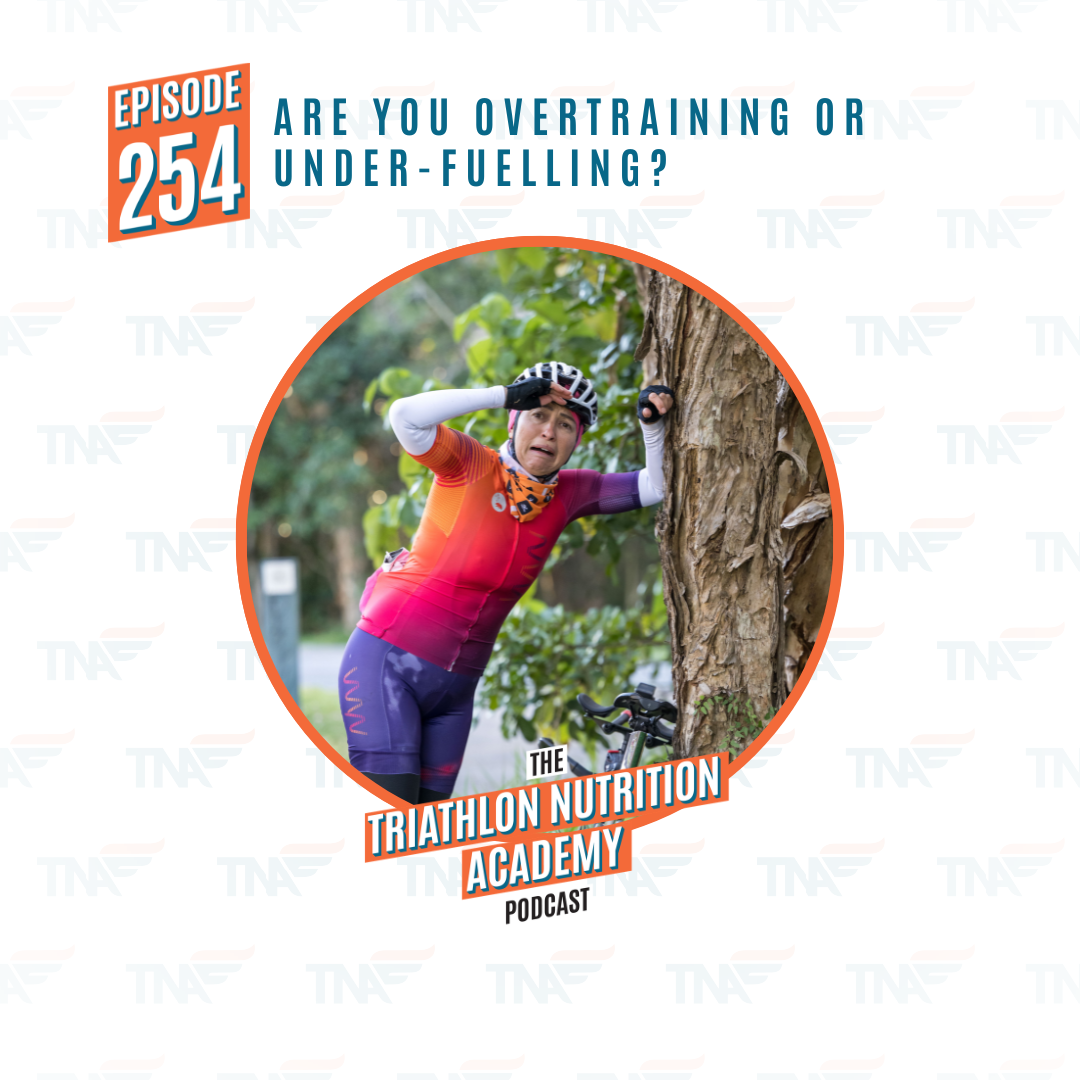
Episode 254 - Are you Overtraining or Under-Fuelling?

Your legs are heavy, your easy sessions feel hard, and you are not improving despite training consistently. If you immediately thought overtraining, you are right. That is also the exact symptom list for under-fuelling.
Researchers went looking for every training overload study that also measured what athletes were eating. 21 studies made the cut, and in 18 of them, 86%, the athletes were under-fuelled. So the majority of athletes diagnosed as overtrained in the research were in fact not eating enough. Which raises a fairly uncomfortable question about that extra session you are thinking of adding to your training schedule right now.
In this episode I show you how to tell whether you are overtrained or under-fuelled, why adding volume to an under-fuelled athlete makes everything worse, and the 3 signals plus 3 fixes to run through before you touch your training program.
WHAT YOU WILL TAKE AWAY
- Why overtraining and under-fuelling start in exactly the same place in your brain, and why that changes the fix
- What energy availability actually is, and why it is not the same thing as calories in versus calories out
- The maths run on a 75 kg age-grouper training 12 hours a week, and what his number actually comes out at
- Why overtraining is a diagnosis of exclusion, and what the professionals rule out first
- The 3 signals that tell you under-fuelling is on the table at all
- The 3 things to fix today, before you add another hour of training
Links:
Check how well you’re doing when it comes to your nutrition with our 50 Step Checklist to Triathlon Nutrition Mastery
Start working on your nutrition now with my Triathlon Nutrition Kickstart course
It’s for you if you’re a triathlete and you feel like you’ve got your training under control and you’re ready to layer in your nutrition. It's your warmup on the path to becoming a SUPERCHARGED triathlete – woohoo!
Connect with me:
To learn more about the Triathlon Nutrition Academy, head HERE | dietitianapproved.com/academy
See behind-the-scenes action on Instagram: @dietitian.approved
Follow along on Facebook: @DietitianApproved
Join our FREE Dietitian Approved Crew Facebook group
Enjoying the podcast?
Let me know what you loved about it and what you learnt by tagging me @dietitian.approved on Instagram!
Subscribe & Review in Apple Podcast!
Are you subscribed to the podcast?
If not, today's the day! I'm sharing practical, evidence-based nutrition advice to help you nail your nutrition and I don't want you to miss an episode. Click here to subscribe to iTunes!
Now if you’re feeling extra warm and fuzzy, I would be so grateful if you left me a review over on iTunes, too. Those reviews help other people find my podcast and quality nutrition advice. Plus they add a little sparkle to my day.
CLICK HERE to review, select “Ratings and Reviews” and “Write a Review” and let me know what your favourite part of the podcast is.
You're awesome! Thank you!
Episode Transcription
Episode 254: Are you Overtraining or Under-Fuelling?
Welcome to the Triathlon Nutrition Academy podcast. The show designed to serve you up evidence-based sports nutrition advice from the experts. Hi, I'm your host Taryn, Accredited Practicing Dietitian, Advanced Sports Dietitian and founder of Dietitian Approved. Listen as I break down the latest evidence to give you practical, easy-to-digest strategies to train hard, recover faster and perform at your best. You have so much potential, and I want to help you unlock that with the power of nutrition. Let's get into it.
[00:00:00] Taryn: Do your legs feel tired and fatigued and sometimes it just doesn't seem to go away? Do you have training sessions that on paper look relatively easy but end up feeling really hard? Do you feel like you're not really improving despite training consistently? You might also be sleeping badly, your mood is up and down, and you're getting sick way more often than you should be, and any little niggle is hanging around for weeks.
[00:00:25] Now, what did I just describe? If you immediately thought overtraining- You are right. But this is also a symptom list for under-fuelling. Researchers went digging and went looking for every study they could find on training overload, where they also measured what athletes were eating. 21 studies made the cut, and in 18 of them, so 86%, the athletes were under-fuelled.
[00:00:54] 86%. So the majority of athletes who got diagnosed as over-trained in the research were, in fact, not eating enough, which raises a fairly uncomfortable question about that extra session that you're thinking about adding to your training schedule at the moment. Hi, I'm Taryn. I'm an advanced sports dietician and triathlon nutrition specialist, and today I'm gonna show you how to tell whether you are over-trained or under-fuelled, why adding volume onto an already under-fuelled athlete just makes everything worse, and the three signals plus the three fixes to run through before you go and touch your training program.
[00:01:33] Race day is won in training, and your day-to-day nutrition is genuinely the single most valuable thing that I help my athletes with inside my program, The Triathlon Nutrition Academy, which by the way is opening again soon, if you're interested. So let's dive into why those two lists are the same, because once you understand this, everything else is gonna make sense.
[00:01:57] Both of them do start in the same place. They both trace back to the hypothalamus and the pituitary, which is your control center in your brain. It decides how much energy your body is allowed to spend on things that aren't just immediate survival, so things like your hormones, your bones, your immune system, your ability to build fitness.
[00:02:20] And that control panel doesn't care why the energy is short. It doesn't ask the question, "Did you train too much or did you eat too little?" It just registers that there is not enough to go down, and so it starts turning dials down. Same origin, same dials, same symptoms, but completely different fixes. Now let me correct something that I know a lot of triathletes have never really stopped to think about properly, and that's you don't get fitter during your training sessions.
[00:02:52] The session is the stimulus, it's the signal, it's the switch, it's putting a hand up and saying to your body, "Hey, I want to get better at this thing that I'm training." The actual adaptation that happens, the mitochondria, the muscle repair, the enzymes, the getting faster, all of that happens after and outside of your training in recovery.
[00:03:14] And recovery is expensive. It costs energy to run. But we only adapt from the sessions that we recover from. So if the energy just isn't there, you send the signal But nothing actually gets built. You did the work, you paid for it in time, in legs, in DOMS, in family credits, in getting up at 4:30 to squeeze it in before the workday starts.
[00:03:37] But you never actually cashed in on it. It's like paying a deposit and then the builder just not turning up to do the work. But the money has left your account regardless of the outcome. So let's go back to that 86% for a second because that is a huge number. Thanks to Trent Stellingworth and his team for putting this together.
[00:03:55] But they pulled training overload and over-training studies that had also measured energy intake, carbohydrate Exercise energy expenditure or energy availability. 18 out of 21 studies showed a decrease or a between cohort difference in energy availability or carbohydrate availability during that overload period.
[00:04:17] Their stated conclusion on the paper is that many negative outcomes of training overload may be primarily due to misdiagnosed under-fuelling. And that matters because in a clinical setting, there is a proper order of operations for this, and nobody in age group triathlon follows it. Overtraining syndrome is what we call a diagnosis of exclusion.
[00:04:42] That means that before anybody is able to write it down as an answer, they also must rule out everything else that could explain the same picture, and low energy availability sits right at the top of that ruling list. In a joint consensus statement from the European [00:05:00] College of Sport Science and the American College of Sports Medicine, it is very clear on that point.
[00:05:05] So the professionals check the fuelling first, then they consider the training. And the average age group triathlete out on their long ride, feeling tired, feeling fatigued, and a bit flat, does it in the exact opposite order. You probably think, "Hey, I need to get fitter, I need to get faster, so I need to train more."
[00:05:26] So let me get a little bit nerdy and a little bit sports dietitian-y on you just for a minute because I love to translate the science into practical, easy-to-digest strategies that you can actually do. So promise it's gonna be worth it. We have this concept in sports nutrition called energy availability.
[00:05:41] You've probably heard me talk about it before. We have quite a number of episodes back in the archive around energy availability. It is not the same thing as calories in, calories out, and that is where a lot of people get tripped up. Energy availability is what is left over in your body to [00:06:00] actually run after you've paid for your training.
[00:06:03] So the maths looks like this. You take everything you eat in a day, you subtract what your training cost was for the day, and whatever is left over is what your body has to fund every single other process that it needs to do. So beating of your heart, making hormones, literally breathing, fighting off that cold that's going around, keeping your bones dense, and building the adaptations From the training session that you've just done.
[00:06:31] Then we express that number in calories per kilo fat-free mass. Apologies if you're imperial, science is in the metric system, you'll get used to it. Your fat-free mass is basically your body minus your fat stores, so it's your lean muscle mass and your bone, your metabolically active tissue. And below about 30 kilocals per kilo of fat-free mass is where things are going wrong.
[00:06:55] Around 45 kilograms per kilo fat-free mass is where things run properly. It's optimal. Now, it's not a hard and fast black and white, it is a scale, but it's some really important numbers to consider. And I'm gonna do a couple of examples with you so that we can apply this to a real person. 'Cause for me, that's how I remember things.
[00:07:15] If it's not practical, I'm not gonna remember it. So let's do these numbers on a male triathlete, 75 kilos, which is 165 pounds, with a fat-free mass of 66 kilos. Let's say this guy is training 12 hours a week. I'm being conservative. He's not elite, he's not professional, he's just a committed age group athlete with a 70.3 coming up on the calendar.
[00:07:37] He's got a job, he's got a family, and he is trying to lean up to get to race weight for this event. Now, 12 hours a week spread across swim, bike, and run, at a rough average of 600 kilocals per hour, is 7,200 kilocals across the week. If we spread that out across seven days, just for easy maths, we'll divide it by seven, his [00:08:00] training is costing him a bit over 1,000 calories a day.
[00:08:03] 1,028. Now, there is far more nuance and differentiation to what I just did then, but I'm really trying to keep it simple so that you can understand the concept. Let's just say this guy eats 2,800 calories a day, like fairly average, I would say. I've definitely met males of that size that eat less than that.
[00:08:21] I've definitely met males of that size that eat way more than that. But for a lot of people, 2,800 calories might actually feel like a lot. It's a lot if you put it on a plate. And he would absolutely tell you that he's eating plenty. He might even tell you that he's eating too much because he's trying to drive some fat loss, remember?
[00:08:38] So 2,800 calories minus his 1,028 a day from training. That leaves us 770 kilocals per day. If we divide that number by his fat-free mass, divided by 66, and we're left with 26.8 kilocals per kilo fat-free mass. Now, remember I just told you below [00:09:00] 30 is problematic. Anything below 45, we're starting to get in this sub-optimal range.
[00:09:05] So that number is far too low, and he's under that every day for months on end, and he has no idea whatsoever because from where he's seeing it, he's eating a lot, he's feeling all right, and he's still trying to lose some weight For that same athlete to sit comfortably at 45 kilocals per kilo fat-free mass or above where things are actually working properly and optimal, he needs to be eating around 4,000 calories a day.
[00:09:35] That's a big shift. Now, let's do a quick example with a female athlete. Because the numbers are different and I don't wanna leave half the population out, let's do an example with a 69-kilo female who has a fat-free mass of around 50 kilos. Let's pretend she's doing the same 12-hour training week. She needs to be somewhere in the region of 3,200 kilocals per day, but she's only [00:10:00] eating just over 2,000 because she's also trying to lose some body fat.
[00:10:03] So if you take the calories that she's eating, 2,100, minus her training calories of 1,030, you are left with 1,070 kilocals. Divide that by her fat-free mass of 50, and she is only sitting at 21 kilocals per kilo fat-free mass Now, don't come at me about all of the details and the nuance of that. I've overly simplified what is quite a complicated process and some complicated details there.
[00:10:31] So I'm not about being highly specific here. I'm-- This is purely numbers as an example to help you understand the point. Because your actual numbers, you can't just base them on the ones I gave you. Also, I made those up. They depend on your body composition, your sessions, the intensities, your metabolism, your medical history, your training history, and about 10 other things, which is exactly why I bang on about N equals one all the time.
[00:10:59]You are your own experiment. You have your own unique physiology, lifestyle factors, medical factors, and nobody should be handing you a number off the internet or AI and calling it personalised. Fuelling for three sports and trying to drive body fat loss can be a very delicate balance, and I love to help my athletes in the academy program understand when is actually an appropriate time to be doing that, because it's not all the time, and how to do it safely without feeling like your throat's been cut and you're not affecting your overall energy availability status.
[00:11:37] There's a body of research summarised really nicely by Anna Mellon and colleagues that I'll link below for you to have a read if you're interested. Looking at what happens when you increase an athlete's training volume by 20 to 50% and then just leave them to eat whatever they feel like eating. And what happens is their intake of food doesn't keep up with that increase in training.
[00:12:00] They add the training hours, they follow their appetite and hunger cues like a reasonable human would, and their energy availability quietly falls off a cliff without a single conscious decision ever made. Because nobody decides to underfuel that badly. And I'd love you to think about that for a second because nobody sits down at the beginning of the year and it's New Year resolution time, and you write down or you think, "All right, you know what would be great this year?"
[00:12:29] My goal is going to spend the year under-fuling. That sounds great. It just happens because your appetite is a rubbish indicator of what your body actually needs, particularly when you are training a lot. And it doesn't take long to start to get into the red zone either. In just a few short days, you can under-fuel enough to affect your hormones negatively and, for a female, drop out your menstrual cycle for that month.
[00:12:57] Men, you don't have that clear signal, but your testosterone can be affected just as quickly. So let me deal with the thing that you might still be thinking because I know you're probably still thinking it. You're like, "Whatever, Taren, I know I just need to train more." And I get it, I really do, because I've had those exact same thoughts myself.
[00:13:15] I wanna get fitter, I wanna get faster, I wanna get leaner, I'm gonna increase my training. Because you've probably had that positive feedback loop before. Your entire model of I want to get better at something because it's not working is to do more of it. If you're trying to improve your swim, you add extra swim sessions into your week to try and get better, and generally it's served you.
[00:13:35] It's the reason that you can swim, bike, and run all together. But you've aimed it at the wrong system because if you're under-fueling and you've added another session, you've not added training, you've actually added cost. You made the energy sum that we just did before worse, not better. There is now more work to recover from and no more extra energy available to recover with, so you feel worse, which looks like more evidence that you're unfit at or you suck at swimming, which makes adding another session just feel more justified.
[00:14:10] And round and round it goes. You feel like sh*t, the internet tells you to harden up, go and get the work done, and every single lap of that just digs a hole a little bit deeper. And that is why athletes often turn up to work with me having done everything right for the last 18 months and not actually progressed the entire time.
[00:14:29] Triathletes certainly don't lack discipline, but They end up stuck in the same loop, and you're probably just doing things the hard way. So how do you tell if you are over-training or under-fuelling? Let's get practical. I've got three signals that will tell you whether under-fuelling is on the table at all, because the order of operations is you have to rule that out first before even blaming your training.
[00:14:55] So signal one, your appetite has gone the wrong way. Your training volume's gone up and your appetite signals have gone down or just stayed exactly where it was. And now that is backwards, and it's the one that I know catches a lot of triathletes out because you think you're being disciplined, you think, "You know, I'm not hungry, so I don't need it," and you feel like you've finally cracked the code.
[00:15:18] But what is actually happening is hard training and also chronic under-fuelling suppresses your appetite. Your body turns the hunger signal down because it is trying to make that energy last longer. So the athlete who most desperately needs to be eating more through that phase is the athlete that just feels like eating less.
[00:15:40] It is a cruel design flaw of our body, and I know it's incredibly common. So if you've finished a long training session, say a three-hour ride, and you genuinely weren't hungry afterwards, that's not discipline. That's not your body telling you that you don't need it. It is the feather warning sign. If you've listened to me for a while, you know that I talk about the three warning signs, and they get louder as we go.
[00:16:05] We've got the feather, the brick, and the truck. Your body starts to give you these little messages if you tune into them, and they are like little feathery taps on the shoulder to say, "Hang on a minute. Something's not right here. Listen." If you ignore the feather, it will throw a brick at you. And if you ignore the brick as well, the truck's gonna turn up eventually, and that truck looks like a stress fracture.
[00:16:30] It looks like a season written off. It looks like a set of blood results that you really don't want and is going to take months to rectify. Signal two is the scales not behaving, and there is two versions of this. Version one, your weight has been dead flat through a big training block. You've added an extra five hours a week, and the number on the scales hasn't moved a gram or a pound.
[00:16:56] That is not a plateau. That can sometimes be a sign that it's your body just defending itself. It has down-regulated everything to protect you, and one of the first things to go is your resting metabolic rate. Version two, your weight is drifting down and your performance is drifting down alongside it. If those two lines are moving together, you are very likely losing muscle mass, plus or minus some fat, which is the exact opposite of what you need, and it's a very expensive and unhealthy way to lose weight, to get lighter, to get leaner and faster.
[00:17:36] Because the weight on the scale's gonna go down, but it's not the body fat that's driving that change. Signal three is easy training is all right, it's fine, it's doable, but your hard training, top-end gear, has gone or it's tanked. I think this is one of the most nutrition-specific of the three, so pay attention and ask yourself honestly, can you still, you know, tick along at endurance pace, zone two efforts, and it feels more or less normal?
[00:18:02] But the second you go to hold some threshold, do some efforts, and push yourself into the hurt hole, it just isn't there, and a number that you could hit maybe three months ago is now just pure fantasy. This is called low carbohydrate availability. Your aerobic system runs quite efficiently and well on fat at that lower intensity, but the moment you go hard and you crank the intensity, your body wants carbohydrate.
[00:18:31] And if the tank is empty, then there is just simply nothing for it to give you. So easy stays okay, but the hard stuff falls apart. Now, there's a fourth sign that does go alongside these three that I do want you to keep an eye on, that I can't leave out, and that is the illness thing and the niggle pattern.
[00:18:51] Something I often talk about, those colds that you just keep picking up or won't go away for ages, and sore spots and little [00:19:00] niggles that just outstay their welcome for far longer than they should. Little annoying injuries, often soft tissue things that just keep stacking on top of each other and you're like, "Man, I cannot get a break."
[00:19:11] Your immune system is quite expensive to run, and it is one of the first departments your body starts making cuts to when the energy budget is tight. Now, if you went tick, tick, and tick to those first three- And maybe even another tick for the fourth, I would be genuinely surprised if the thing holding you back right now was your training program.
[00:19:35] So what do you actually do about it? I mean, I think you should join the academy program and fix your fuelling forever, but here are three things. Number one, your during training nutrition. This is so important. Are you fuelling inside your sessions or only around it? Now, it depends how long you're going for and the intensity and a bunch of other factors, but are you putting some carbohydrate in while your body is doing the work?
[00:19:59] A lot of age groupers I meet will eat before a session, not do much during, and then suck at recovery after. Like we're talking heading out for a three-hour ride on a bottle of water and a banana and then wondering why they're absolutely wrecked for the rest of the day. If your long rides are under-fuelled or just poorly fuelled, you're not just performing worse in that session and on that day, you're actually borrowing energy that you have to pay back later, and the interest rate on that loan is brutal, particularly the hit on your immune system.
[00:20:31] If you're doing long rides, the bike is your rolling buffet. It is the easiest place in our entire sport to get fuel in for yourself because your tummy is not jiggling up and down like it is when you're running, so you need to use that as your advantage. The second thing you can do to fix it is prioritize what you do after training.
[00:20:50] Have you got a strategic plan for your recovery nutrition, or does your debt just keep rolling on over to tomorrow? This is the four Rs of recovery. [00:21:00] Refuel with carbohydrate, repair with protein, rehydrate with fluids, and revitalise with some colour on your plate. And if your honest answer is, "I get home and I have a shower, then I chuck the kids in the car and do the school run, and then I sort myself out once I've got home," then no offense, but your recovery nutrition sucks.
[00:21:19] Every session that you don't recover from properly is a session you paid for and you're not collecting on. The third thing is does your food intake move when your training moves, or do you roughly eat the same thing every day regardless of whether it's a rest day or a five-hour day? Because this is the set and forget approach, this stable no matter what's going on, and that set and forget Not periodise your training is a thing not to do with your nutrition as a triathlete ever.
[00:21:47] Like, full stop, period. A periodised training week needs a periodised eating plan. Big day, big food. Light day, light food. And a whole heap of other strategy that goes into that. But if your training is a rollercoaster and your food is a flat line, then you are guaranteed to be over-fuelled on some days and then badly under-fuelled on others.
[00:22:08] And those under-fuelled ones are almost always the days that matter the most. You need to fuel for the work required. This is the whole philosophy of triathlon in five words. Now, just a quick note before I wrap up, and I need to say this every time I come close to this topic. If something in this episode has touched a nerve, and by that I mean, you know, food feels like a fight, you're restricting or you're punishing yourself, or you realize that there's a pattern going on that is bigger than, you know, just knowing your numbers, please go and talk to somebody that specialises in that.
[00:22:41] I'm not an eating disorder dietician. That is a genuine specialty, and it is not mine, so I will always refer you on to somebody that can help. You need to get the right person in your corner, because getting the right person in your corner is the smartest thing you can do, and the fastest. Okay, so to wrap us up, whoo.
[00:23:01] One, the symptoms of over-training and also under-fuelling chronically are effectively the same list, and 86% of the studies that looked at over-training and energy availability found that athletes were under-fuelled. That is crazy. Number two, over-training is a diagnosis of exclusion, which means that fuelling needs to get ruled out first.
[00:23:27] The professionals check the food before they blame the training, whereas most age groupers do it the other way around. Number three, the maths is brutal, and nobody runs it. 12 hours of training a week and eating 2,800 calories a day puts a 75-kilo male under the energy availability line, even though it probably feels fine for him and he feels like he's eating enough.
[00:23:51] Number four, your three signals to check. Number one, your appetite's gone backwards or it hasn't scaled with your training. Number two, the scales are [00:24:00] not behaving. And number three, easy training's okay, but that top-end gear, the high-performance stuff, is really hard. Number five, those three immediate fixes that I want you to do today, what you're doing before training, what you're doing during training, and what you're doing after training, prioritise those things, the bookends, because that is what I would do with you if you were my athlete.
[00:24:21] These are non-negotiables. And if I can leave you with one final thought, it's that adding volume to an under-fuelled athlete does not make them any fitter. It just makes them more tired, more grumpy, slower, and a more expensive in time and money fix. I would argue that your nutrition is what is capping your performance right now, if that is you.
[00:24:44] It is not your training program. So before you go and add that extra session that you are maybe considering, go and run some sums instead. It's only gonna take you a couple of minutes, and it might save your entire season. And if you listened to any of that and thought, "Right, I have absolutely no [00:25:00] idea, Taryn, what my number is, and I definitely don't know how to fix it," don't stress.
[00:25:04] This is exactly what I help y athletes do inside the Triathlon Nutrition Academy. I teach you how to eat for training, racing, and life so you're not asking the internet at 9:00 at night Random questions every time you see something shiny or your training program changes. Because my entire philosophy is that if I give a triathlete a meal plan that they have no idea about, then they eat for a week.
[00:25:29] But if I can teach a triathlete how to fuel for training and racing, then they never need me again, which is terrible business, but it is brilliant for you because it does set you up for life. You do the work once, and it lasts forever. So if that's something you're interested in, get your name on the list for our next cohort at dietitianapproved.com/academy.
[00:25:49] Thank you so much for joining me today. If you do have any questions or you wanna share anything with me, send me a DM on Instagram @dietitian.approved. [00:26:00] Happy training, and I'll see you next week
Thanks for joining me for this episode of the Triathlon Nutrition Academy podcast. I would love to hear from you. If you have any questions or want to share with me what you've learned, email me at [email protected]. You can also spread the word by leaving me a review and taking a screenshot of you listening to the show. Don't forget to tag me on social media, @dietitian.approved, so I can give you a shout out, too. If you want to learn more about what we do, head to dietitianapproved.com. And if you want to learn more about the Triathlon Nutrition Academy program, head to dietitianapproved.com/academy. Thanks for joining me and I look forward to helping you smashed in the fourth leg - nutrition!