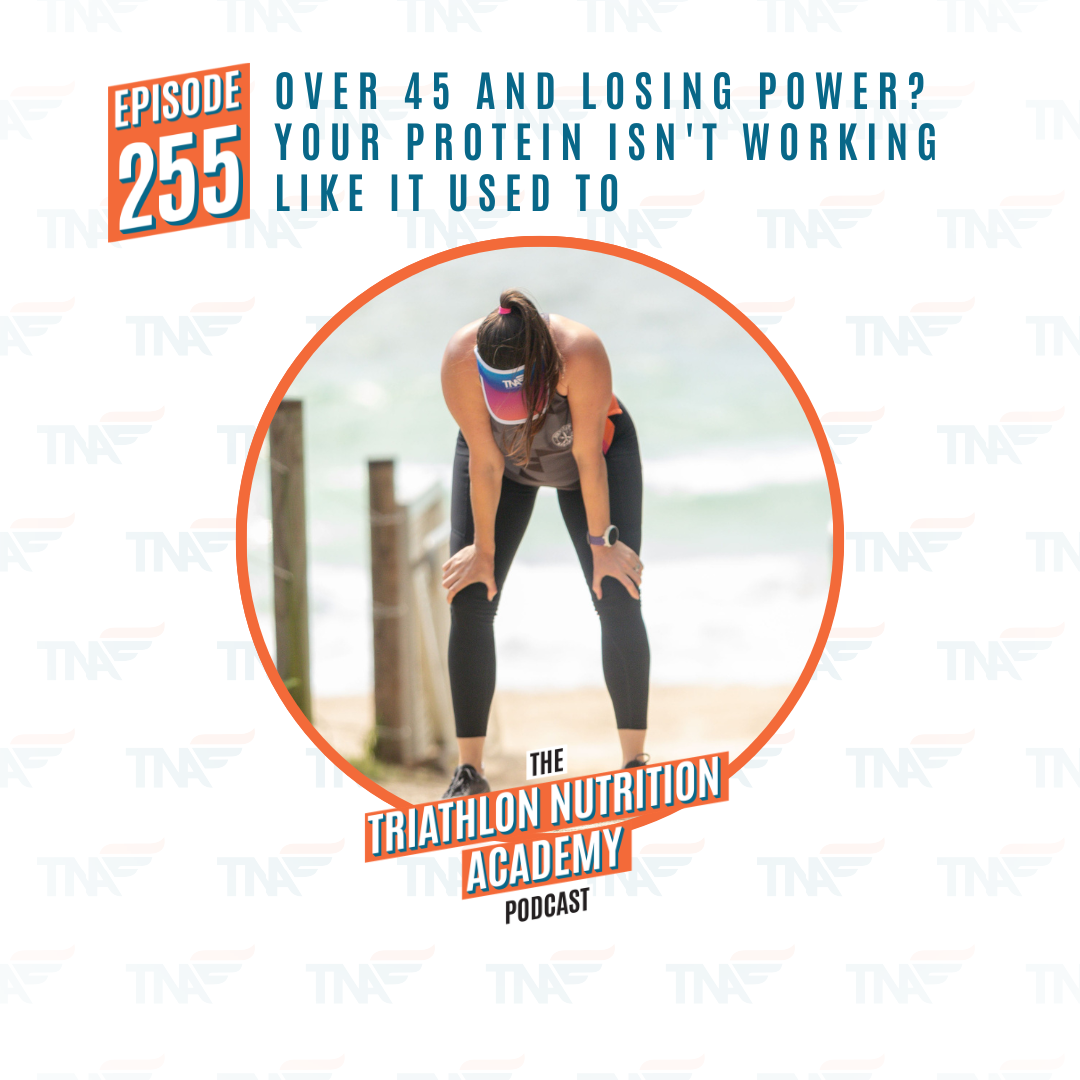
Episode 255 - Over 45 and Losing Power? Your Protein Isn't Working Like It Used To

Everywhere you look, someone is telling you to eat more protein. If you are over 45 and your power is going backwards, more protein is not the fix you have been promised.
Back in January the US dietary guidelines roughly doubled their protein recommendation, and that was overdue. But guidelines written for a sedentary population are a very different thing to guidelines for an athlete training 10 to 15 hours a week. Something real does change in your muscles as you get older, and the research on masters triathletes makes for uncomfortable reading. What it does not show is that eating more protein fixes it.
In this episode I take you through what is actually happening in ageing muscle, what happened when researchers doubled the protein after a muscle damaging session, and the 5 protein levers to pull instead of just reaching for more.
WHAT YOU WILL TAKE AWAY
- What anabolic resistance is in plain English, and why the rules changed at about 35 without anybody sending you the memo
- Inside the Australian study that compared masters triathletes with younger ones, and what happened to their muscle repair and their cycling time trials
- What doubling the post exercise protein dose actually bought masters triathletes, and what it did not
- Why your total protein intake stops paying you back once you are in a reasonable range
- The 5 protein levers, and why most triathletes only ever pull number 5
- Why your breakfast is almost certainly the weak link in your day
- Why the same mistake is happening right now with carbohydrate
Links:
Check how well you’re doing when it comes to your nutrition with our 50 Step Checklist to Triathlon Nutrition Mastery
Start working on your nutrition now with my Triathlon Nutrition Kickstart course
It’s for you if you’re a triathlete and you feel like you’ve got your training under control and you’re ready to layer in your nutrition. It's your warmup on the path to becoming a SUPERCHARGED triathlete – woohoo!
Connect with me:
To learn more about the Triathlon Nutrition Academy, head HERE | dietitianapproved.com/academy
See behind-the-scenes action on Instagram: @dietitian.approved
Follow along on Facebook: @DietitianApproved
Join our FREE Dietitian Approved Crew Facebook group
Enjoying the podcast?
Let me know what you loved about it and what you learnt by tagging me @dietitian.approved on Instagram!
Subscribe & Review in Apple Podcast!
Are you subscribed to the podcast?
If not, today's the day! I'm sharing practical, evidence-based nutrition advice to help you nail your nutrition and I don't want you to miss an episode. Click here to subscribe to iTunes!
Now if you’re feeling extra warm and fuzzy, I would be so grateful if you left me a review over on iTunes, too. Those reviews help other people find my podcast and quality nutrition advice. Plus they add a little sparkle to my day.
CLICK HERE to review, select “Ratings and Reviews” and “Write a Review” and let me know what your favourite part of the podcast is.
You're awesome! Thank you!
Episode Transcription
Episode 255: Over 45 and Losing Power? Your Protein Isn't Working Like It Used To
Welcome to the Triathlon Nutrition Academy podcast. The show designed to serve you up evidence-based sports nutrition advice from the experts. Hi, I'm your host Taryn, Accredited Practicing Dietitian, Advanced Sports Dietitian and founder of Dietitian Approved. Listen as I break down the latest evidence to give you practical, easy-to-digest strategies to train hard, recover faster and perform at your best. You have so much potential, and I want to help you unlock that with the power of nutrition. Let's get into it.
Everywhere you look right now, someone is telling you to eat more protein. Everywhere you look, food is being marketed as extra protein, from things like cereal, yogurt, bars, coffee, and even your bloody water is protein-fortified these days. Back in January, the US dietary guidelines pretty much doubled their protein recommendation, and thank goodness.
It was about time that they did that. But guidelines for the general sedentary population are very different to those for active people, and in particular, triathletes. If you are over 45 and you're noticing that your power is dropping or not getting better as you get older, then chances are you've almost certainly been told that you need to eat more protein.
That's gonna fix the problem. And I'm definitely not here to tell you that that is wrong, because it's definitely not wrong. As you get older, you genuinely need protein to work harder for you, and I'm gonna show you what some of the research says about that today. But what I'm here to talk about is that that total number Is the easy part.
Actually eating it week after week around your training program, a real appetite, and a real job, that is the hard part. And that's the part that nobody is helping you with, that practical application of the theory that we're seeing all over the internet at the moment, unless you're a Triathlon Nutrition Academy athlete, and that's exactly what we do inside my program.
So welcome to the Triathlon Nutrition Academy podcast. I'm your host, Taryn. I'm an advanced sports dietitian and triathlon nutrition specialist. I'm also an age group triathlete who has stood on the podium many times across sprint, Olympic, and 70.3 distances. My favourite leg is the swim, and I'm not a very good runner, hence the swimming.
So thank goodness for Aquabikes these days. So let's start with what is actually happening in your body as you get older, 'cause that part is real, I'm sorry, and you're probably not gonna like it. As we get older, your body and your muscles do respond differently to the protein in your diet, and training actually.
The building blocks of amino acids get delivered just like they always did when you were younger, but your muscles just don't do as much with them compared to what they used to. And technically it's a term called anabolic resistance. In a really simplified way, more protein or the same protein in doesn't have the same result.
Less muscle stimulus and muscle building. And it is very much backed by research. In an Australian study by some of the greats in this space, so Peter Raeburn, who's the masters athlete guru guy who's now retired, Stu Phillips, he's very much the protein and muscle mass man. They published a paper back in 2016, and I'll link it below if you do wanna dive into the details.
And they took five masters triathletes, like a very small sample size, their average age was 53, comparing them to six younger triathletes with an average age of 27. And what they did was they matched their training. They did three days of hard endurance training, including a muscle-damaging 30-minute downhill run, plus three by 20-minute cycling time trials at 10, 24, and 48 hours after that muscle-damaging downhill run.
Now this is a small study. Like I said, it's only 11 athletes, but- Perfectly, it's in triathletes, and it is the only one of its kind. Everyone was fed the same controlled diet, before you have a go at me about that. They had a certain amount of protein per kilo per day that was matched spread across meals, plus they had 20 grams of whey protein straight after that downhill run for recovery.
Now, side note, recovery's more than just protein, and if you want to dial in your recovery nutrition, then you could get my recovery accelerator to do that. So over the three days, masters athletes showed a significantly lower myofibular fractional synthetic rate compared to the younger triathletes.
There was also a trend for the masters triathletes to produce a slower cycling time trial compared with the younger athletes. So the masters athletes with the same amount of protein had poorer muscle protein repair and remodelling, and their acute recovery was worse. And also, their cycling time trial was worse.
This is a really clear example that your nutrition from when you were younger just doesn't work the same as you get older. And it's not your fault, you didn't get it wrong, but maybe you just didn't evolve your nutrition through different stages of life. The rules changed. They changed at about 35 years old, and nobody sent you the memo.
If you want to dive into some of the training principles, Joe Friel was a guest of mine on the podcast a while back and covered how masters athletes can get fast and stay fit after 50. So go back and listen to Episode 179 if you're interested. Keep listening for the nutrition side of things, 'cause that is my area of expertise.
So if this is real, and it is, this anabolic resistance that we get as we get older, you would think that the logical next move would be to eat more protein, yeah? Which is exactly what everyone's telling you to do right now. Protein is sexy again. It kind of comes in this wave every couple of decades.
Something gets a resurgence. But Does more protein actually fix this? That is what we need to know. The same research group, they did a follow-up study. They took eight masters triathletes who completed two trials separated by seven days in a randomised, double-blind, crossover study design. Their trials consisted of a morning knee extensor peak isometric torque repeat test, and a cycling time trial following that 30-minute downhill run.
That is brutal. It's really designed to elicit exercise-induced muscle damage, that's why it's in these studies. Followed by an eight-hour recovery period. And during their recovery period, they had either a moderate or a high dose of protein based on grams per kilo, and the high was double what the moderate level of protein was, and it was consumed in three bolus feedings at two-hour intervals commencing immediately post-exercise.
And what they found is the high-protein group that had double the amount of protein after exercise did not significantly improve their recovery compared to the regular amount of protein, the moderate dose. Their cycling performance in the time trials was also unchanged, but they lost less strength through the afternoon into that knee extensor test, and had a reduced perception of their fatigue over the eight-hour window.
So they felt significantly less wrecked compared to the group that had less protein than them. The author's conclusion was that doubling the recommended post-exercise protein did not significantly improve recovery in masters triathletes. So if you're expecting more And doubling your protein is gonna be the thing that gets your legs back.
That is not what happened in the research. And that, unfortunately, is one of my issues with the way that more protein is being sold at the moment. More, more, and more, as if the total amount is the only lever that you've got to pull to try and improve things. This study is a great example in triathletes that just simply more is not the fix.
Because really it's so much more nuanced than that. We can't take this one thing and go blanketly, "This is the answer." In my mind, it's being far more strategic around what we do with our nutrition rather than simply doing more. The other thing to consider in an age group triathlete population where you're not, like, literally being handed food to eat in a study, is it can be genuinely hard to try and hit some of these high-protein recommendations.
And this is my happy place as a practitioner. It's translating the science into something you can understand, and then translating that into what you actually eat. What do you put in your mouth? And this is something that I troubleshoot with my athletes in the academy every single week in our Power Hour calls.
The Triathlon Nutrition Academy is my education program where I teach triathletes how to fuel properly for racing, training, and life. It is the education plus the application so you know exactly what to eat and when to get the most out of your body. And here's what happens in the real world when an athlete decides to increase their protein.
Week one, you're probably doing great. You add some extra high-protein foods, like some cottage cheese, some high-protein yogurt, extra chicken breast, maybe a protein shake. And you probably still get to dinner, and you're a fair way behind the target. So you have to cram a heap in at dinner and after dinner, and you feel really full, and you don't sleep very well.
And it just seems so hard to fit it all into a day. Week two, you are still going. But by week three and four, you are so bloody sick of cottage cheese and yogurt, and you cannot even look at another tub. Then you stop, and it just becomes all too hard to maintain, and you conclude that, "Hey, protein just isn't gonna work for me."
The protein probably worked fine, but the practical reality is that hitting a protein target that's high as a triathlete can be legitimately difficult because you're probably eating already a fair amount of carbohydrate and other foods around training, your appetite is potentially blunted after hard sessions, you've got a job , you've got family, and you've got all of your life.
You're not just sitting around with all the time in the world with unlimited stomach space waiting for someone to hand you your next feed. Although that'd be, uh, pretty amazing, wouldn't it? The internet is gonna give you a number, and then it's gonna walk away. That number for you is not the hard part.
The hard part is knowing what to eat and when, the timing and the strategy behind it so you can maximise the benefit in the easiest way possible. So let's get practical because there is a version of this that works, and it's not always about eating more. Your total protein intake does matter. But once you're in a reasonable range, pushing it higher stops buying you much.
Like a lot of things with triathlon nutrition, to be honest, more is not always better. What matters more is what happens across your day, and this is the main piece that I want you to take away from today. I recorded an episode a while back about large protein doses in one sitting. It was affectionately dubbed the barbecue study, where they had to eat 100 grams of protein in a meal, just like you would do at a barbecue when you're trying to try a little bit of everything.
That was Episode 141, and I covered the protein research shift in more detail. So that's definitely worth a listen if you haven't done that. But the take-home message is you're a human, you are not a snake. You can't eat once a day and expect it to hold you all day. You also wanna maximise your nutrition around your training sessions.
And for a lot of triathletes, we're doing multiple sessions in a day, so that's obviously not gonna work if you're only eating once or all of your protein sits at one place. Because every time you eat protein, you increase your muscle protein synthesis rates, and every time you train, you increase your muscle protein synthesis rates.
So to maximally stimulate muscle protein synthesis, it makes sense to do both simultaneously across the day, multiple times a day if you can. There is some good research in masters swimmers that shows this beautifully, and I'll link that below if you wanna go and have a look. Their total protein intake was excellent.
It's comfortably where it could be or should be, but almost all of it was stacked into lunch and then dinner. The total was fine, but the pattern really wasn't working, and I bet you good money that if I audited your food right now, your breakfast would probably be the weak link because it often is. So what can you do to combat this anabolic resistance that we get as we get older and improve or maintain your power?
There are five protein levers. Number one- How much you're getting in one sitting. Number two, how many times a day you hit that. Number three, where those hits sit relative to the sessions that damage your muscle tissue. Number four, the type of protein that it is and how biologically available it is to your body.
And number five, your total daily protein intake. Most athletes start with lever number five and never really strategise about the first four. If you're getting older and you want to maintain or increase your power, more is not the only piece of the puzzle, and I've just shown you that. This is the exact same mistake that's happening with carbohydrate at the moment.
Triathlon's answer to everything is just more. Like, we're seeing that with people having more and more carbohydrate during exercise and during racing. But eating more is not a strategy. Eating more strategically is. Knowing what to eat and when so you can get the most out of your training program is the whole game.
And as we get older, it becomes even more important. You need to start when you're about 35. It's important to understand why you're eating a particular way at a particular time so you can align it with your training. Now, if you're retired and you can train pro hours, it is even more important for you to have structure in that day So in summary, the blunted response is real.
As you get older, your muscles do less with the same protein, and that is just physiology. It's not how much effort you're putting in. But [00:13:00] more protein has its own ceiling. It has been tested in the research, and it can't buy back better performance. What moves the needle is the dose, the frequency, the timing around your training sessions that damage muscles.
So it's structure and it's strategy. It's not necessarily overall volume. So if you're sitting there thinking, "Okay, Taryn, I get it. Structure matters. Now what do I actually do about it?" Well, I have the perfect solution for you. Join the Triathlon Nutrition Academy in our upcoming cohort, and I will teach you everything you need to know forevermore.
Because it is the difference between free information off the internet or a podcast and something that actually works for you. The internet's gonna give you a number. We are not devoid of information. But it can't tell you how to fix that number into your Tuesday when you've got a swim in the morning and a full day of work, and then a run off the bike in the evening.
It doesn't know your training program, and it doesn't know your physiology, and it doesn't know your lifestyle. It might also not know that you just cannot face another tub of cottage cheese 'cause, oh my God, you're over it. The academy is not a meal plan that I hand you and walk away. It's not generic one-size-fits-all.
It is me teaching you how your body works, how to build your plan around your own training program, and then troubleshooting it and dialling it in with you each week in Power Hour. There are plenty of ways to skin this cat, and my job is to find the ones that work for you so that you are still doing it in 12 months' time.
If you are over 35 and maybe you're feeling things starting to change, maybe you're not there quite yet, this is the moment to stop and get it sorted, not in two seasons' time when you've already lost more ground. Head to dietitianapproved.com/academy and register your interest for our next cohort. Thank you so much for joining me, and I'll see you next week
Thanks for joining me for this episode of the Triathlon Nutrition Academy podcast. I would love to hear from you. If you have any questions or want to share with me what you've learned, email me at [email protected]. You can also spread the word by leaving me a review and taking a screenshot of you listening to the show. Don't forget to tag me on social media, @dietitian.approved, so I can give you a shout out, too. If you want to learn more about what we do, head to dietitianapproved.com. And if you want to learn more about the Triathlon Nutrition Academy program, head to dietitianapproved.com/academy. Thanks for joining me and I look forward to helping you smashed in the fourth leg - nutrition!