
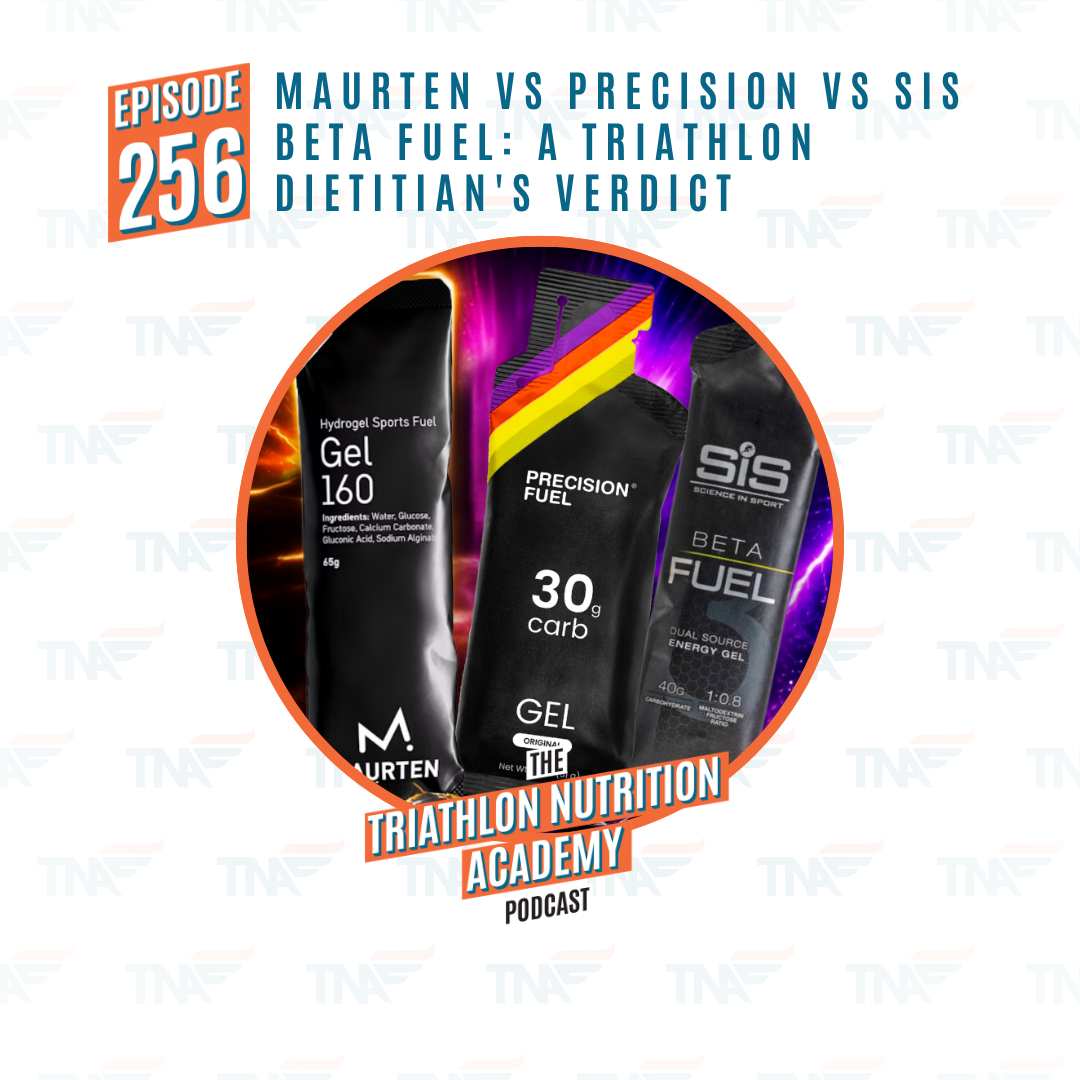
Episode 256 - Maurten vs Precision vs SIS Beta Fuel: A Triathlon Dietitian's Verdict

Are you paying up to $5.20 a gel because that is what they hand out on course?
Maurten, Precision Fuel and Hydration and SIS Beta Fuel are the three gels I get asked about more than any others. So I put them side by side and worked out what is actually in the packet, what each one costs you per 100 grams of carbohydrate, and whether that price gap buys you anything at all. No brand has paid me a cent to talk about them. I am Switzerland when it comes to sports nutrition products.
One of these gels costs roughly two thirds more than another for the exact same gram of carbohydrate. Whether that is money well spent comes down to three things most triathletes have never been taught to look for.
WHAT YOU WILL TAKE AWAY
- What is actually inside each gel: carbohydrate, sodium, calories, caffeine and the main ingredients
- What it costs to fuel at 90 grams of carbohydrate an hour on each brand, in both Aussie and US dollars
- What the glucose to fructose ratio means in plain English, and the carbohydrate rate you need to be hitting before it matters to you
- Whether the hydrogel does what the marketing implies it does
- Which gel makes sense for Sprint, Olympic, 70.3 and full distance racing
- How to read a sports nutrition label so you are not at the mercy of whoever has the biggest marketing budget
Links:
Check how well you’re doing when it comes to your nutrition with our 50 Step Checklist to Triathlon Nutrition Mastery
Start working on your nutrition now with my Triathlon Nutrition Kickstart course
It’s for you if you’re a triathlete and you feel like you’ve got your training under control and you’re ready to layer in your nutrition. It's your warmup on the path to becoming a SUPERCHARGED triathlete – woohoo!
Connect with me:
To learn more about the Triathlon Nutrition Academy, head HERE | dietitianapproved.com/academy
See behind-the-scenes action on Instagram: @dietitian.approved
Follow along on Facebook: @DietitianApproved
Join our FREE Dietitian Approved Crew Facebook group
Enjoying the podcast?
Let me know what you loved about it and what you learnt by tagging me @dietitian.approved on Instagram!
Subscribe & Review in Apple Podcast!
Are you subscribed to the podcast?
If not, today's the day! I'm sharing practical, evidence-based nutrition advice to help you nail your nutrition and I don't want you to miss an episode. Click here to subscribe to iTunes!
Now if you’re feeling extra warm and fuzzy, I would be so grateful if you left me a review over on iTunes, too. Those reviews help other people find my podcast and quality nutrition advice. Plus they add a little sparkle to my day.
CLICK HERE to review, select “Ratings and Reviews” and “Write a Review” and let me know what your favourite part of the podcast is.
You're awesome! Thank you!
Episode Transcription
Episode 256: Maurten vs Precision vs SIS Beta Fuel: A Triathlon Dietitian's Verdict
Welcome to the Triathlon Nutrition Academy podcast. The show designed to serve you up evidence-based sports nutrition advice from the experts. Hi, I'm your host Taryn, Accredited Practicing Dietitian, Advanced Sports Dietitian and founder of Dietitian Approved. Listen as I break down the latest evidence to give you practical, easy-to-digest strategies to train hard, recover faster and perform at your best. You have so much potential, and I want to help you unlock that with the power of nutrition. Let's get into it.
[00:00:00] Hands up if you picked your gels purely because they are the on-course race nutrition. And if you did, that's totally okay, but you probably chose them and bought them before you actually had a fuelling strategy, and that's the part that I want to fix for you today. Today, I'm putting three of the most popular gels side by side, and we're going to compare them.
[00:00:19] Maurten, Precision Fuel and Hydration, and SiS Beta-Fuel. I'm gonna walk through what's actually inside the packets, the carbohydrate, the sodium, the calories, whether their glucose to fructose ratio actually matters, which one is the easiest on your gut, and whether more expensive means better. If you're new here, hi, I'm Taryn.
[00:00:39] I'm an advanced sports dietitian and triathlon nutrition specialist, and I am not being paid by any of these brands to talk about them today. I want to be really transparent about that I am Switzerland when it comes to sports nutrition products because if I talk about something or I suggest it or recommend it, I want you to have confidence that I'm doing that because it's actually a good product, not because I'm getting paid to do so.
[00:01:02] All right, let's get into it. Let's start with the nutrition breakdown. What is actually in these three gels? Let's start with the Maurten Gel 100. This is the caffeinated version, or there's also a non-caffeinated version. It is a little 40 gram sachet. Inside is 25 grams of carbs, 100 calories, and 20 milligrams of sodium.
[00:01:21] It has a glucose to fructose ratio of one is to .8. And this version here, which is a caffeinated version, has 100 milligrams of caffeine in it. The main ingredients are water, glucose, and fructose. In Australia, as of today, at the time of recording, they're about $5.20 a gel. You can get a box of 12 for $62.40.
[00:01:43] And in the US, I had a look at the feed and they're about $4 a gel, or 45 US dollars for a box of 12. So that's about $3.75 per gel. The caffeinated version is slightly more expensive. It's $52 for a box of 12. Next is a Precision Fuel and Hydration Gel30. This is a 51 gram sachet, and inside is 30 grams of carbs, no sodium, and they do have a caffeinated version that has 100 milligrams of caffeine inside.
[00:02:11] It has a glucose fructose ratio of two is to one, and the main ingredients are maltodextrin, water, and fructose. In Australia, a gel is about $4.75. In the US, it's about $3.12 for a single, $12.49 for a four-pack, or 46 US dollars for a 15-pack. So it's around $3.10 a gel, depending on how many you're buying. And our final gel for comparison is the SiS Beta-Fuel.
[00:02:36] It is a 60 gram sachet, and inside is 40 grams of carbs, 160 calories, and 30 milligrams of sodium. It is a one is to .8 ratio, and there are caffeine and nootropic versions available. The main ingredients are water, maltodextrin, and fructose. And a single gel in Australia is $4.95. In the US, it's $4.50 or 23 US dollars for a six-pack, so about $3.85 a gel in the US.
[00:03:02] So that's the three different brands I'm gonna look at today. Three very different price tags, and all three of them essentially doing the same job. You're getting a mixture of glucose and fructose in all three products in a relatively rapid way to help your working muscles. The only really genuinely different number I would say is the amount of carbohydrate per gel.
[00:03:22] So we've got Maurten at 25, the PFH at 30, and the SiS Beta-Fuel at 40. And the other differentiator is that glucose to fructose ratio, which I'll dive into in a little bit as well. So at the most expensive Maurten, is it worth the money? And what one should you actually buy? Because they are so similar- What I did was I calculated the cost per 100 grams of carbs.
[00:03:43] In Australian dollars, the Maurten is $20.80 for 100 grams of carbs. Precision Fuel and Hydration is $15.80, and the SiS Beta Fuel is about $12.40, so cheaper by a fair bit. In US dollars, Maurten is 15, Precision Fuel and Hydration is $10.40, and the SiS Beta Fuel is about $9.15. So that gap is the same across both currencies.
[00:04:06] Maurten is roughly two-thirds more expensive than the SiS Beta Fuel for the same grams of carbohydrate, 68% in Australia and 64% in the US. Now, obviously, the price is gonna move around with sales and different retailers, and if you're buying in bulk, it's gonna be cheaper per gel. So treat those numbers as some ballpark to help us compare, but the pattern still holds.
[00:04:29] Per gram for gram of carbohydrate, SiS is the cheapest. Precision Fuel and Hydration sits in the middle, and Maurten is the most expensive option. So let's get practical and apply that to something that actually makes sense for you as a triathlete. To hit, say, 90 grams of carbs an hour as an example, you're going to need a bit over two SiS Beta Fuel gels.
[00:04:50] So that's gonna cost you around $11.14 an hour. To hit 90 grams of carbohydrate with the Precision Fuel and Hydration gels, you're gonna need three, so the cost is around [00:05:00] $14.25 an hour. And to fuel on Maurten, you're going to need nearly four Which is going to cost you just under $19 an hour for the exact same 90 grams of carbs.
[00:05:11] So let me make that number even more real and practical for you. Let's look at the cost of fuelling a 70.3 bike leg, and say conservatively it's gonna take you three hours to do that. If you were to fuel on Maurten gels alone, in Aussie dollars it would cost you $57. Comparing that to fuelling three hours with the SIS Beta Fuel, it's gonna cost you about $33.
[00:05:34] In the US that's about $40 versus about $25 US. Now, that is one example for one bike ride. You think about how many training rides you need to do to prepare for that 70.3, and those costs are going to add up considerably over your training block heading in. Triathlon is an expensive sport as it is, so I think those details really matter.
[00:05:56] Is Maurten worth it? My honest answer is probably not. Only use it if your gut genuinely cannot tolerate other gel products. Like, that is a real reason, and it's gonna be worth every cent if it's a thing that separates you from finishing a race and not finishing a race. But if you're only buying it because it's on the Ironman branded courses, the pros use it, or somebody that is an affiliate has got you onto it, then I really think you're wasting your money.
[00:06:26] You have to think about the funding of your training nutrition to get to race day, where if it's on course then it might be free on the day, but there's a huge investment that goes into fuelling your training heading into that. The next thing to consider is does that glucose to fructose ratio actually matter?
[00:06:43] So firstly, let me try and explain what that number means, because I know a lot of triathletes have no idea. The one is to 0.8 ratio means that for every one gram of glucose there is 0.8 grams of fructose, and the two is to one ratio means for every two grams of glucose there is one gram of fructose.
[00:07:02] That's it. That's the whole mystery. Now, does that matter and why are we even talking about this? We know that when you use two different types of carbohydrates or sugars, they do absorb differently from the gut lining into the bloodstream If you use both simultaneously, then you can absorb more carbohydrate per hour than if you just use glucose alone.
[00:07:23] And that is why this has just exploded in the sports nutrition product market over the last few years. The study that everyone quotes is from Curele and Asker Jeukendrup from 2008. I will link it below if you wanna dive into those details, but they compared cyclists on one type of sugar versus two type of sugars, and the two sugar group improved their time trial performance by 8%.
[00:07:46] But the study compared one type of sugar with two different types of sugars. It didn't compare Maurten versus SiS Beta Fuel. All three of these products that we're talking about today sit on that side of having multiple different carbohydrates or sugars in their gel product. The one is to 0.8[00:08:00]
[00:08:02] versus the two is to one argument comes from a different study altogether, O'Brien and Rowlands in 2011, and they found that the one is to 0.8 ratio came out best on absorption efficiency and gut comfort. But that edge is only really important and it's only gonna show up when you're fuelling really hard, northwards of 90 grams of carbs an hour.
[00:08:23] If you are on anything less, or 60 grams an hour or less, then it doesn't really matter. The details of multiple transportable carbohydrates, which is the technical term for what I'm talking about here with these different types of sugars, is something that I dive into in detail With my athletes in the Triathlon Nutrition Academy program.
[00:08:42] It is my education program for age group triathletes who are done winging their nutrition and want the step-by-step strategy that sets them up for life. Because once you understand this concept, you stop needing to watch YouTube or have somebody like me tell you which product to buy. You can just pick up the packet, look at it yourself, and go, "Oh, this is rubbish, I don't need it," or, "This is actually gonna work for me."
[00:09:05] The bit I actually want you to take away from this section is that the on-course nutrition is always going to change. You are better off picking gels based on your personalised race nutrition strategy rather than picking what's on course and having it change every year. I would also like you to start looking at the ingredients list of your products.
[00:09:25] Go and have a look at the carb ratio, and then do some quick maths to figure out the cost of 100 grams of carbs. And that way, you're doing a better job of making informed gel decisions. Supplement companies don't always make it really easy to find that carb ratio. Some, like the SiS Beta-Fuel, have it printed right on the front of the gel packet.
[00:09:46] Others don't, and you have to go digging through websites, and sometimes you even have to email them to understand what's going on. So you need to do your research, know what you're looking for, know where to find the answer, and also what it means when you do find it out. [00:10:00] That is three components that most triathletes have never been taught.
[00:10:04] And honestly, this is only going to get worse. There are more and more gels and other sports nutrition brands launching every single year. The claims on the front are getting bigger. The numbers printed on the pack are chosen because they sound like science, not necessarily because they mean anything useful for you.
[00:10:22] If you don't know how to read a label, you are just at the mercy of whoever has the best marketing budget. Last week, one of my TNA athletes shared a new product that she bought. We were talking about tart cherry juice and the benefits on sleep and recovery, and the front of the carton had in big, bold letters, "cherry juice."
[00:10:40] So in Power Hour, we turned it around, we had a look at the ingredient list, and there was 0% Actual cherry juice. None. There was a cherry juice extract in the product, and then that was it. It is honestly the Wild West out there. Being able to pick up a product, turn it over, work out what is in there and if it's going to serve you or whether it is a whole heap of marketing BS is a skill that you need as a triathlete.
[00:11:06] Without it, you're gonna waste an enormous amount of money on products that aren't even what they say they are, are not the right fit for you, and are not gonna help you get anywhere near your goals. Now, the part that decides it for most people is which one is easiest on your gut, because the best gel in the world is absolutely useless if it puts you on the portaloo.
[00:11:26] This is the question that actually wins or loses races, and it's actually not one that any brand can answer for you. You are your own experiment, and it's about figuring out what products work well for you and what ones don't. Now, Maurten's whole pitch is the hydrogel. So what does that mean in plain English?
[00:11:44] Maurten encapsulate or wrap up the carbohydrate into a gel structure. They use alginate, which is a seaweed extract, to do that. And what it's meant to do is hold that carbohydrate together as it moves through your gastrointestinal tract, carrying the carbohydrate more gently and could help lower or prevent upper GI issues.
[00:12:04] It is clever, and the marketing is very good, but the evidence in the research that it reduces gut distress and improves performance compared to a normal gel is very thin. If you want the full nerd version, go back to my interview with Andy King, where we pull apart the hydrogel research and whether or not it does actually improve performance or not.
[00:12:24] And the short answer is it doesn't And what I find triathletes actually report to me is sort of split two ways. Some people like it, find it goes down easy. Other people just cannot even swallow it. It has been affectionately termed snot rockets because of the very interesting texture that it does have thanks to the hydrogel.
[00:12:43] And if you're a texture eater, then you're either going to love it or you're going to hate it. Precision Fuel and Hydration is deliberately mild. It doesn't have a lot of flavour to it, so it's mildly sweet rather than being really overly sweet. And the SiS Beta Fuel is a 40 gram of carbohydrate sachet.
[00:12:58] It's definitely bigger than the other products, so you're getting more carbohydrate in one hit, and for some triathletes that can be a lot if you're not used to having that in one go. So the real variable is your taste preferences, your tolerances, and obviously your gut training as well, and your gut is very trainable.
[00:13:16] Your gut is going to adapt to what you repeatably ask it to do. Practice 90 grams of carbs an hour in training, and your gut gets better at absorbing 90 grams of carbs an hour while you're exercising. But if you take a gel once a fortnight and then you try four in a race in an hour, you're gonna find out the hard way what happens when you do that.
[00:13:35] So my practical takeaway for you is pick one. Pick a product that you like the sound of, that you like the taste of, you like the texture of it, and train on it for a couple of months. But if you're racing in the next fortnight, do not change anything. Don't do anything weird this close to race day. You're better off c- doing your race as is and then trialing something afterwards once it's done.
[00:13:56] Now, which of these gels would you have depending on the type of race distance that you do? So sprint to Olympic distance, it's under, say, two and a half to three hours. I would be buying gels based on the price, the taste, the texture And honestly, what you like and what your gut likes. So I think cost and convenience wins at these shorter course events.
[00:14:18] As you step to more 70.3 distance, you are now fuelling for, you know, five, six, seven, up to eight hours, and your carbohydrate sources and the ratio does start to matter. Plus, you're also training out there for a lot more hours, and so you might want to consider the cost of your training nutrition when we're talking about what you want to do on race day.
[00:14:39] If you're training for full distance events like an Ironman, then the total cost and the total volume is gonna add up really fast. If you're doing an Ironman distance event on gels alone, which I probably wouldn't recommend, I've had one athlete in my time that have done that, and it didn't end so well, which is why he ended up coming to see me in the first place.
[00:14:57] But if you were to do that just for the purpose of this, SIS Beta Fuel would obviously give you the most carbohydrate for the least amount of money, and it's also the least amount of sachets that you would have to carry on your bike or when running as well. But I would recommend that you do mix gels with some sports drink and maybe even some real food so that you're not just relying on one item because if you did that, if you did an Ironman on just one gel, none of these products here have enough sodium in them for anyone to survive on.
[00:15:28] They're all very, very low. So a quick summary of where we're at. All three gels are really at the end of the day doing a similar job, and the gap between the components in the gels is smaller than that price gap suggests. The one is to 0.8 ratio has a slight edge on the two is to one ratio, but only if you're fuelling upwards of 100 grams of carbs an hour.
[00:15:51] HydroGel While it's sexy, although maybe a bit more like snot rockets, does not improve performance. If you're using gels, they do not include a lot of sodium, so you're going to need a plan for that. The SiS Beta-Fuel wins on cost per gram of carbohydrate across both Aussie and US dollars. Precision Fuel and Hydration is in the middle, and Maurten is, sits at the top as the most expensive.
[00:16:15] Whatever you pick, train your gut and don't change it really close to a race. The exact gel that you use is probably the last 5% of your race nutrition strategy. It is almost like the sprinkles on the icing on your cake. If you haven't baked the cake underneath, there is nothing for those sprinkles to stick to.
[00:16:34] If you're under fuelling all week, if you're skipping your recovery nutrition, if you're rocking up to your long rides on a coffee and a banana, then it doesn't matter which of these three gels is in your back pocket, 'cause it is completely irrelevant if you don't have all of those other components dialled in.
[00:16:49] Nutrition really is the fourth leg of triathlon. You've trained for swim, the bike, and the run for probably years, but if you've never really trained your nutrition and you're still wondering why you're not performing at the best on race day, then that is what the Triathlon Nutrition Academy can help you with.
[00:17:05] It is a nine-month education program where I teach you in a very systematic order how to fuel your training week, what to eat before and after each session, the key nutrients to help you stay healthy as an endurance athlete, how to train your gut, and how to build a race plan for every single distance that is uniquely yours.
[00:17:23] Plus, you get access to me live each week in our power hours to troubleshoot your specific situation and utilise my two decades of experience in triathlon so you're not up Googling or ChatGPT-ing at 9:00 PM at night for an answer to something, and then you're still not really sure if it's right for you.
[00:17:39] Doors open again soon, so register your interest at dietitianapproved.com/academy. Now, if this episode has just saved you a couple of hundred bucks, do me a favour and send it to your training buddy who's still paying $6 a gel and thinking more expensive is better.
Thanks for joining me for this episode of the Triathlon Nutrition Academy podcast. I would love to hear from you. If you have any questions or want to share with me what you've learned, email me at [email protected]. You can also spread the word by leaving me a review and taking a screenshot of you listening to the show. Don't forget to tag me on social media, @dietitian.approved, so I can give you a shout out, too. If you want to learn more about what we do, head to dietitianapproved.com. And if you want to learn more about the Triathlon Nutrition Academy program, head to dietitianapproved.com/academy. Thanks for joining me and I look forward to helping you smashed in the fourth leg - nutrition!