
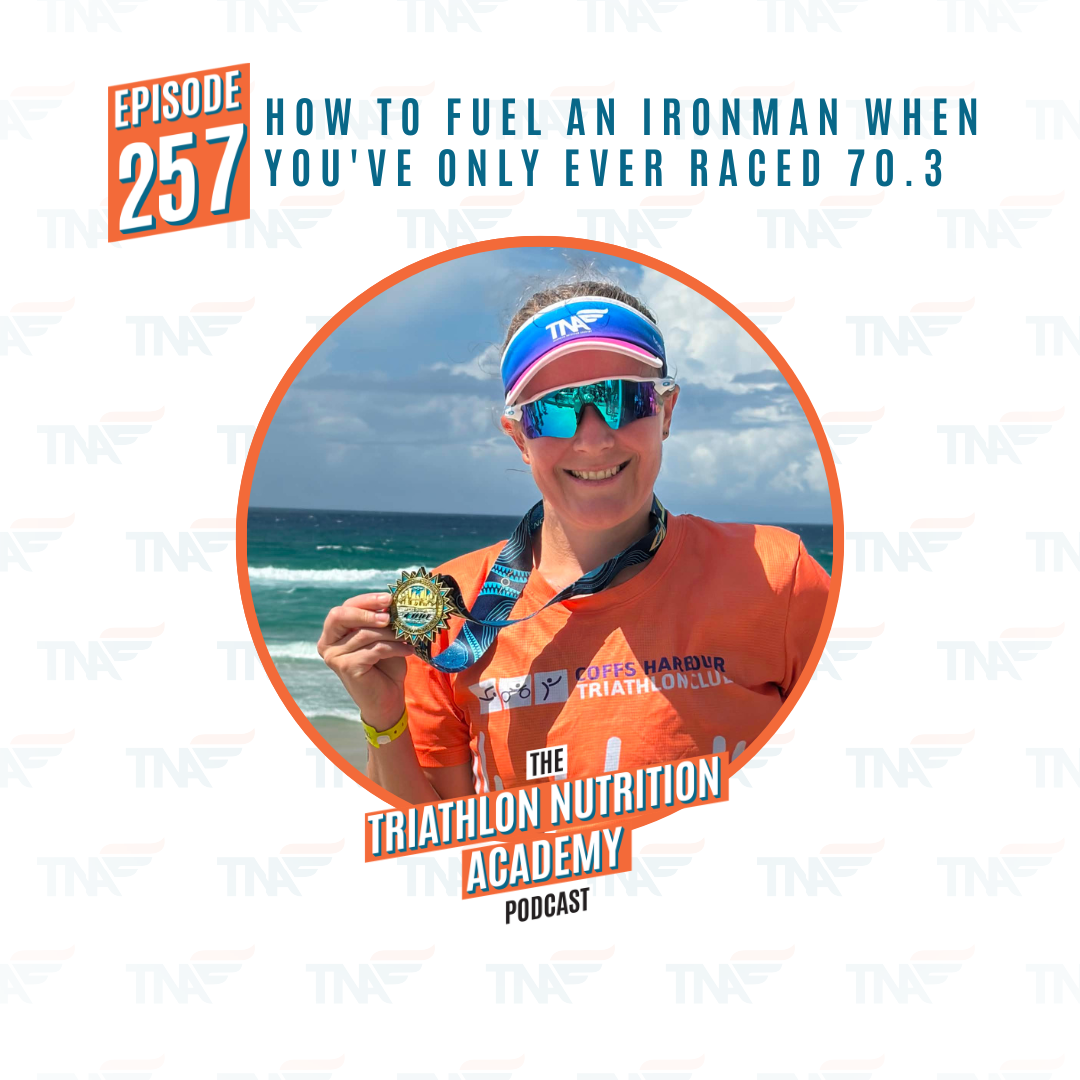
Episode 257 - How to Fuel an Ironman When You've Only Ever Raced 70.3

You can get away with a fuelling gap over five hours. You cannot get away with it over 13.
Stepping up from 70.3 to Ironman is the exact moment most triathletes work out that their fuelling needs attention. Julie Whitton is 13 weeks out from Ironman Western Australia, her first full distance race after a decade of racing halves. She is a paramedic with New South Wales Ambulance, she has been a shift worker for 21 years, and she trains off a nine day roster that changes constantly. In this episode she takes Taryn through exactly what she has had to upgrade to get to that start line, and where the gaps showed up once the hours went up.
This is not a first Ironman story. This is the step up story, for the triathlete who already races 70.3 well and assumes that skill carries over.
IN THIS EPISODE
- What changes in your bike and run fuelling numbers when a race goes from five hours to 13 hours
- Why a small hourly shortfall you got away with at 70.3 compounds into a walk at full distance
- The shift from liquid fuel to solid food on long rides, and the trap of swapping over too fast
- How to gut train on gels without hitting flavour fatigue weeks before race day
- What Julie was doing at 70.3 that stopped working the moment the volume climbed
- Why she moved her recovery from 90 percent to 100 percent, and what that changed in her week
- Fuelling your body for what you want it to do rather than for how you want it to look
Links:
Check how well you’re doing when it comes to your nutrition with our 50 Step Checklist to Triathlon Nutrition Mastery
Start working on your nutrition now with my Triathlon Nutrition Kickstart course
It’s for you if you’re a triathlete and you feel like you’ve got your training under control and you’re ready to layer in your nutrition. It's your warmup on the path to becoming a SUPERCHARGED triathlete – woohoo!
Connect with me:
To learn more about the Triathlon Nutrition Academy, head HERE | dietitianapproved.com/academy
See behind-the-scenes action on Instagram: @dietitian.approved
Follow along on Facebook: @DietitianApproved
Join our FREE Dietitian Approved Crew Facebook group
Enjoying the podcast?
Let me know what you loved about it and what you learnt by tagging me @dietitian.approved on Instagram!
Subscribe & Review in Apple Podcast!
Are you subscribed to the podcast?
If not, today's the day! I'm sharing practical, evidence-based nutrition advice to help you nail your nutrition and I don't want you to miss an episode. Click here to subscribe to iTunes!
Now if you’re feeling extra warm and fuzzy, I would be so grateful if you left me a review over on iTunes, too. Those reviews help other people find my podcast and quality nutrition advice. Plus they add a little sparkle to my day.
CLICK HERE to review, select “Ratings and Reviews” and “Write a Review” and let me know what your favourite part of the podcast is.
You're awesome! Thank you!
Episode Transcription
Episode 257: How to Fuel an Ironman When You've Only Ever Raced 70.3
Welcome to the Triathlon Nutrition Academy podcast. The show designed to serve you up evidence-based sports nutrition advice from the experts. Hi, I'm your host Taryn, Accredited Practicing Dietitian, Advanced Sports Dietitian and founder of Dietitian Approved. Listen as I break down the latest evidence to give you practical, easy-to-digest strategies to train hard, recover faster and perform at your best. You have so much potential, and I want to help you unlock that with the power of nutrition. Let's get into it.
[00:00:00] Taryn: How do you feel about full distance Ironman?
[00:00:02] Jules: I have never done one. I will do one in the future, but at the moment it's not the right time for me. I want to be out there, but there's a few other things in life now that take priority over the training required to do that distance.
[00:00:19] Taryn: Yep.
[00:00:19] Jules: So it's on the table, but not in the plan yet.
[00:00:23] Taryn: That was Jules Whitton on this podcast three years ago, and on the sixth of December she is racing Ironman Western Australia. Jules is a paramedic with New South Wales Ambulance and has been a shift worker for, what, 21 years, Jules? Yes. That's a long time. So she- It is ... she races on a nine-day roster that changes constantly, and for a decade, 70.3s were her happy place, until now, and she's gonna step up to do the full distance.
[00:00:51] And I know that a lot of listeners are in that exact same position, where they're considering stepping into a full distance race from comfortably sitting at 70.3 distance, and it's where you start to go, "Okay-" Hang on a minute, I really need to work on my nutrition if I'm gonna survive this race. And you're absolutely right to think that.
[00:01:11] You can get away with a lot in a 17.3, I would say. A fuelling gap over five to six hours is very different compared to a fuelling gap over 10, 13, 16 hours. Those extra hours are where any tiny little shortfall is just kind of built up and compound over time and turn into a death walk through the red carpet.
[00:01:34] Jules has been a TNA athlete since January 2023, so she's spent the last three years building the base that she's standing on now, after taking some pretty quality time off. She's 13 weeks away from the biggest race of her life, and she's gonna tell you what she's had to do to upgrade her training and nutrition to get to where she is now.
[00:01:55] Jules, welcome back to the podcast.
[00:01:57] Jules: Thanks for having me again. It's been a long time.
[00:01:59] Taryn: Yeah, it has been a long time. I didn't realise it was three years until I went to look back for that past episode. So if you haven't listened to that with Jules, maybe it's worth listening to now before we get into today's episode.
[00:02:10] So when we chatted three years ago, that wasn't the right time for you to do a full distance event, but now you've signed up for one. What made you do that? What's changed?
[00:02:19] Jules: Primarily timing and the age of my daughter. Both fair. She is now 15. She's able to look after herself, um, get herself ready in the morning so I can get out and do my long training without having that, uh, timeframe, time restriction for getting her off to school, and making sure that she stays alive on the weekends.
[00:02:42] She's able to do that herself, so it's really good timing for her schooling, for what year she's in at school, uh, to be able to take a little bit of time off so she can travel with us and enjoy that moment, um, with me. She's been watching me do triathlons ever since she's been alive, so I think it's really important for her to be able to see that end goal for me as well.
[00:03:07] Taryn: Yeah. And was it one defining moment where you're like, "Right, this is gonna be the year," because it just, the stars align? Or has it quietly crept up on you in the background?
[00:03:16] Jules: It's been quietly creeping up, and I've just been waiting for that time. Um, 2024 I did the long course world championships in Townsville, uh, which gave me a little bit of a taste of what it was like to step up in distance from the 70.3s.
[00:03:34] And then so after that, that's when we started to set sights on which event to do, when would that event take place, what time of year. Uh, there's a lot of planning with my work to make sure I've got the time off to be able to do a particular event, so I had to plan that, um, 18 months in advance. And Busso just kind of fitted in with everything.
[00:03:56] Taryn: And is that the reason why you've chosen Ironman Western Australia, just timing? Or is there anything about that race that you really want to do?
[00:04:03] Jules: Primarily the course, actually. Um, I think the course suits me, uh, because it's flat, um, which is not always the easiest. I think the location, it's away from home, but there's still a good group of my training partners heading over as well.
[00:04:20] But yeah, it was primarily the course that was the draw card for it.
[00:04:23] Taryn: Yeah. Flat and fast, but can be hot.
[00:04:25] Jules: Yes. Or freezing cold, depending on what the year it is. At least we know it's gonna be windy.
[00:04:30] Taryn: Yes, I reckon it'll be hot this year because if any- the weather at the moment is any indicator, it's not gonna be cold.
[00:04:37] Jules: Yeah.
[00:04:37] Taryn: So you, as a shift worker, work this nine-day roster. What do you have to do to increase your training hours to do an Ironman build and juggle all of that in what you do?
[00:04:49] Jules: Need to be more prepared with meal planning, um, which for me isn't cooking 10 meals on a Sunday. Uh, it's making sure I've got the right ingredients to be able to cook the right meals, uh, to set myself up for recovery food, lunches, dinners when I'm at work.
[00:05:11] Having meals that are easy to microwave that are gonna give me the right nutrition to support that training that I've done before work or that I've gotta do the following day. Very rarely train after work when I'm on shift, but it's usually in the mornings beforehand.
[00:05:28] Taryn: You do really have to be organized, otherwise you'll get home from a long training session or a long work shift and there's nothing in the fridge and you're like, "Oh, damn it."
[00:05:36] Jules: Yeah.
[00:05:37] Taryn: And I'm sure the energy levels are not particularly high or well motivated to, you know, go to the shops and, and cook something elaborate then. So it's almost- Yeah ... looking after future you.
[00:05:46] Jules: And we work long shifts, so we need to make sure that I can have dinner, get to bed, recover- Get up the next morning for the next shift.
[00:05:56] Um, there's no time to muck around going to the shops after work or planning a full meal. Um, just need to get it in.
[00:06:05] Taryn: How many hours has your training program increased from 70.3 training to this full distance build?
[00:06:11] Jules: So we're right at the s- start of my build in terms of Ironman build, I guess. Uh, we've been probably four to five weeks now of, dedicated Ironman training, and I'm now up to 12 hours.
[00:06:26] Most of my 70.3 training was around that 9 to 10-hour mark, which comparison, which, you know, we shouldn't be doing, but comparatively I know that's a low volume, but it's what works with my life and, and the restrictions of shift work and long hours. Obviously, that number's gonna increase. This is my first Ironman build.
[00:06:49] I have no idea what's in store or how much that's going to increase.
[00:06:54] Taryn: Do you want to know?
[00:06:55] Jules: I'm just gonna trust my coach and go one week at a time, um, with this little mantra that I've got of, you know, one session, one day, one week, one month, one finish line. Like, that's what I'm focusing on.
[00:07:11] Taryn: I love that mantra.
[00:07:12] That's a good one. So talk me through some of the numbers to help with your transition from 70.3 up. Uh, like I know what you've been working on with nutrition and what you did before, and I feel like your 70.3 race nutrition and what you're doing day to day, you had that pretty well organised, right? There wasn't anything major that you needed to do to improve that.
[00:07:34] But full distance racing and training is a different beast. So what are you working on and what are you trying to achieve? Let's start with bike nutrition maybe from 70.3 to full distance.
[00:07:46] Jules: So my main goal is to actually make sure that I get the calories and the carbohydrates in. 70.3, I had this target, but towards the end of the race or once I'd finished the race and I did my [00:08:00] calc, so I was usually about 10 grams short per hour, um, over the whole event.
[00:08:04] So I made it through, but I was on the very bottom limit of doing it, and I could certainly do more. Recognizing that, knowing that, the task now is to actually get it in rather than just thinking about having it. So- Good strategy ... I'm now... Yeah. Uh, whereas before I was usually getting 70 grams in on the bike, uh, now I'm boosting that up to 80.
[00:08:28] So and that's just practicing every single ride to make sure I'm hitting those numbers. Uh, that allows me to drop off the numbers in the run just for gut tolerance and bit of safety there, which I'm also training to be better at, which is working, but obviously that takes time. Getting those numbers in and really focusing on the recovery 70.3 is I was getting away with probably only doing my recovery about 90%, but I really know that Ironman, completely different kettle of fish.
[00:09:10] You need to be 100% focused on the training and the nutrition. Um, it's not just in training nutrition, it's recovery nutrition as well. So a podcast that you did a little while ago on recovery and how your adaptations in training are s- linked to recovery, and having that little bit of knowledge really reinforces how much we do need to get that recovery, um, in straight away.
[00:09:42] Taryn: Yeah. It's so important when you're training multiple times a day or, you know, backing up and training again the next day and having to train hard or, or training long. One of the things that really stuck with me from the last episode that we did together was that back then your training hadn't changed, but your ability to recover from that training had just been blown exponentially out of the water.
[00:10:03] Is, is that still true now, or did you relax for a bit and you're trying to bring it back in again?
[00:10:08] Jules: Oh, no, that's definitely still true now. Last season I just concentrated on a few local Olympic distance races and, you know, I could get away with it. Um, if my recovery ch- nutrition wasn't right and I missed a session, it wasn't too much of an issue.
[00:10:23] But now, getting all that nutrition in, focusing on the recovery, I'm able to get up. I'm not missing sessions. I'm actually achieving those sessions, hitting my numbers, um, whether that's power or pace, time. It's kind of just focused on what the goal for that nut- for that session is. But to be able to get up and do it, that's a big-ticket item.
[00:10:47] Taryn: Yeah.
[00:10:47] Jules: Uh, that consistency- Yeah ... is so important.
[00:10:49] Taryn: Yeah, particularly as you get closer to. So you're trying to focus on your recovery 100% instead of 90%. I like that. 10% marginal gains. Increase your bike fuelling. How are you doing that and how's that going?
[00:11:02] Jules: It's going reasonably well. I'm switching more to solid foods on the bike, at least for the first, uh, portion of the ride will be the intention, and just trialing different things.
[00:11:13] Um, like today I used a Clif Bar. Um, trialing Chews, lollies, um, sandwiches. that's all I've trialed so far, but I've got a, a few other options up my sleeve to try next week and in the coming weeks. Uh, but definitely the solid food will be the plan, and then- Maybe adapting depending on the weather
[00:11:37] Taryn: And that's different to your 70.3 race nutrition?
[00:11:40] Jules: Yeah, 70.3s I'm just on gels and liquid carbs.
[00:11:44] Taryn: And how are you going trying to have more solid foods on the bike?
[00:11:48] Jules: I'm not enjoying them. They're hard work. But, uh, obviously they'll be beneficial, otherwise it wouldn't be recommended.
[00:11:58] Taryn: What are the things that you're liking to have that's solid so far?
[00:12:02] Jules: Really enjoying snakes and the sandwiches.
[00:12:05] Yeah.
[00:12:05] Taryn: Um- Are you having the good old Vegemite snacks? Vegemite stacks?
[00:12:08] Jules: Yeah, I've tried them. Yeah? Yeah. Yeah, they're a, they're definitely a winner.
[00:12:11] Taryn: Okay, so a bit more solid food 'cause you're out there for longer, but that is a huge shift for you, isn't it, if you've gone from liquids to having all of these solids?
[00:12:20] What I'd probably suggest is try a bunch of stuff right now, see what you like, particularly when you're out on your long, long rides as, as they start to build, 'cause y- I don't know what your coach is doing, but you might end up riding 100Ks, 150Ks, maybe 180Ks once before you do your race. Not to scare you, but six hours or so.
[00:12:43] And you definitely feel like different things when you're out riding for six hours versus three hours. So lean into that a little and see how your body feels in, what you're feeling like when you're out there. And having a few options as, like, a bit of a rolling buffet can be beneficial in the early days until you land on something that feels right or feels good.
[00:13:04] But you certainly need to, don't need to go from all liquids to all solids. We're gonna need to find some sort of middle ground in there that is comfortable for your tummy, you can carry it on your bike, 'cause otherwise you're gonna be, like, baguettes out the back pocket, but still provides the amount of fuel you need to survive a long day in the office.
[00:13:24] Jules: Yep.
[00:13:25] Taryn: And then what about your run nutrition? So what, what do you aim for in the 70.3 run versus what are you trying to aim for in an Ironman, in a marathon?
[00:13:34] Jules: I aim for about 40 grams, um, in the seven point, 70.3 run. Uh, usually one gel and then Coke, um, at the aid stations. sometimes if there's a carb electrolyte type fluid, I might grab it, but primarily it's just getting the carbs from my gels.
[00:13:55] Sometimes I do have trouble- Keeping that down just because I'm so dehydrated to that point, so that's another one that I'm working on, keeping the, um, water and hydration levels up so I can actually take the gels properly.
[00:14:09] Taryn: Yep.
[00:14:10] Jules: I would like to increase that number a little bit, just simply because I'm gonna be out there for longer.
[00:14:16] So as that number starts to fade, I'd normally be getting to the finish line. But now I've got that distance again. So I really can't let that fade happen in the first, um, 30 K's, 35 K's.
[00:14:33] Taryn: What's in your mind? Like, what do you think your goals are around the run fuel?
[00:14:38] Jules: Think I'm still gonna be sticking with the gels, because I know they suit well.
[00:14:41] Taryn: Just gonna need more of them.
[00:14:42] Jules: Yeah. And I'm gonna have to be really careful with training on them. There's obviously the knowledge that we need to gut train what we're using, but previously I've used too many gels in training and I've got sick of them by the time I've got to race. So I really need to train appropriately, but not get that flavour fatigue before the event.
[00:15:07] Taryn: What gels are you planning on using?
[00:15:09] Jules: Precision.
[00:15:11] Taryn: Okay. You could try different variety of flavours and brands in training, and still race on that on race day so that you're not getting flavor fatigue. You got 13 weeks to go, and you're already like, "I'm gonna get over these gels." If you're in that position now with three months to go, you need to probably inject some of that variety now.
[00:15:30] My goal for you, Jules, is 60 grams of carbs an hour on the run based on everything I know about you.
[00:15:35] Jules: Okay.
[00:15:37] Taryn: Reckon you could do it?
[00:15:38] Jules: That's always been the aim. I've always aimed for 60 over the whole race. That's why I sort of front load on the bike, knowing that I'm gonna decrease on the run. So yeah, I can definitely work on it.
[00:15:50] Taryn: So depending on what gels you use, it'll be probably more like two gels an hour for the first bit and see how that goes, plus topping up with some Coke and... Oh, there's no sports drink on course anymore.
[00:16:01] Jules: No.
[00:16:02] Taryn: By Ironman. What about things like textural things, like your snakes or blocks or chews or something, just to give you some variety?
[00:16:10] Jules: Yeah, I'll have to, um, probably go back to the Clif Chews or some form of other chew. I'll definitely try some different flavor chews just to break it up a bit. But yeah, really happy with the snakes.
[00:16:21] Taryn: Chuck those in there then if you like those, and just gotta figure out a way to carry them.
[00:16:25] Jules: I got a back pocket.
[00:16:28] Taryn: Okay, so if you can, your mission, if you choose to accept it, is to try and crank up some of that run fuel, and you've got the time to do it, but giving it a nudge in every long run that you do from here on in. Same as the bike, if you can try and get the bike up a little bit higher, I think that'll set your run up better.
[00:16:46] Jules: Okay. Mission accepted.
[00:16:47] Taryn: Mission accepted. You are a very stubborn, quiet achiever, so I know that if I give you this mission, you will quietly chip away at it until it's done.
[00:16:56] Jules: Yeah. Well, that's the ultimate thing, right? There's no point going into a race without getting all your ducks in a row, and often those ducks are coming from the experts.
[00:17:06] So, you know, I've got the coach, got the dietician, I've got the, the friends for support who have been there before, and that all comes together to make the race a really tough but enjoyable experience.
[00:17:19] Taryn: We spend so much money on triathlon, don't we? It doesn't make sense to try and put all those ducks in a row, and that step from 70.3 to 140.6 is a big one, and I know a lot of athletes go, "Okay, now I'm gonna invest on, in all of these things that I should've invested in earlier."
[00:17:34] Jules: Mm.
[00:17:35] Taryn: Have you found anything so far that was working for 70.3 that has stopped working for full distance?
[00:17:42] Jules: Having one banana before a training session is not enough. I got away with it before, but it's, it's just not enough carbs before I head out on those longer sessions. So yeah, that's the, the pre-training nutrition.
[00:18:01] The nutrition the night before, like the amount of carbs the night before or the day before, that's probably the biggest one, fuelling those sessions appropriately and preparing appropriately for them, um, is a big change.
[00:18:15] Taryn: Yep. And carb loading, have you practiced that recently at all, or not quite there yet?
[00:18:21] Jules: So I did like a three-quarters of a carb load yesterday, um, in preparation for today's ride. Uh, it wasn't as hard or as difficult as a full load. Obviously we're only three-quarters of the way there, so didn't quite achieve it, but definitely better than just having a normal day and having some pre... Like having breakfast before I head out.
[00:18:45] Um, so those little things, again, are working on to dial them in properly and make sure I get a full load rather than three-quarters.
[00:18:54] Taryn: Yeah. If that's the first time you've tried it in this block, we've got plenty of time to give that another crack.
[00:18:59] Jules: Yeah. I feel like the weeks are gonna go pretty quick. Yeah.
[00:19:02] So you- we've got 13 weeks now, so we've got plenty of time for everything, but- Like, it's gonna go really quick.
[00:19:12] Taryn: Can you get any insight from your coach around when those big peak weeks are? Just so that you can plan for them and they don't align with, like, a crazy shift or something like that.
[00:19:23] Jules: Yeah. I'll be sitting down with him within a c- within the next couple of weeks, uh, probably after Sunny Coast 70.3.
[00:19:30] Taryn: Yep.
[00:19:30] Jules: And really go over those final couple of months worth of training.
[00:19:35] Taryn: Yeah, it'd be really good to align your, all your carb loading and your gut training and, like, building the right nutrition up, building the right nutrition up, and align that with your training program. Even though you wanna, you know, horse blinker it and not know what's coming, in a, in a way.
[00:19:52] Jules: Oh, no, I like to be prepared. I- I've got a pretty good idea what my shifts are gonna be up until race day. So once they all get confirmed, I'll be able to put them into TrainingPeaks, and then my coach will see it and come up with a plan. Obviously, things change, but that'll be the general idea. But once I sit down with him, we'll be able to know when those big ones are and what numbers I'm gonna be hitting.
[00:20:14] Taryn: And then align all of your nutrition principles that you've learnt inside the academy to those so that you can turn up to race day giving it a red-hot go.
[00:20:22] Jules: Yep, and not changing things the night before.
[00:20:24] Taryn: No, don't do that.
[00:20:25] Jules: That's
[00:20:25] Taryn: a silly idea.
[00:20:28] Jules: Work it out in the car on the way.
[00:20:30] Taryn: No, please don't do that.
[00:20:31] Hopefully I've taught you more than, uh, winging it.
[00:20:34] Jules: Yes. Yes, definitely. And I think the other thing that we have learnt is how to adapt when things change. So a race I did at the start of the year, instead of swim, ride, run, it got changed to run, ride, run. So everything changed with 12 hours to go. Um, obviously having that knowledge and ability, I was able to quickly adapt and change a few things so I could run straight away rather than having a couple of hours ready beforehand.
[00:21:09] Taryn: How has your gut handled the jump in training volume so far? Has it been okay, or are you starting to notice it do weird things?
[00:21:17] Jules: If we'd have recorded last week, I would have said yeah, it's- it's going well. Um, this week it's been a little bit off. Um, no known reason, but we'll see what happens.
[00:21:32] Taryn: C- is it more training do you think, or more intensity?
[00:21:35] Or is there something that you're eating that's not sitting well?
[00:21:38] Jules: Honestly, it could be something I'm eating. It could just be too many Red Bulls.
[00:21:42] Taryn: That'll do it.
[00:21:43] Jules: Yeah. So I was having a lot of them before long course world champs, um, and I recognised that was the change. So I cut them out. Yeah, I think that might be starting to happen again.
[00:21:56] Taryn: Maybe it's-
[00:21:57] Jules: So that's about the only thing that's changed.
[00:21:58] Taryn: Sometimes when you have more training though, or more hard training, there's just more mechanical load on the gut, and if you already have a sensitive gut, it can be, you know, just a little bit can tip it over.
[00:22:08] Jules: So I might still be able to have my Red Bulls?
[00:22:11] Taryn: Well, it could also be the Red Bulls. Depends how many you're having, Jules.
[00:22:14] Jules: Only one every couple of days.
[00:22:16] Taryn: That's not too bad though. So we've talked about carb loading. You know what you're doing there, just need to practice. We've talked about bike fuel. Again, you know what you're doing there, it's just about dialling that in as you head closer.
[00:22:27] Same as the run fuel. Is there anything that you're still working out with 13 weeks to go?
[00:22:31] Jules: Yeah, definitely there's obviously still a lot of unknowns. Um, but I think one of those biggest unknowns is how much fuel do I actually need to make sure that I can run those last two kilometers of the marathon. I know what I need for a half, but stepping up to the full, it's not just two halves put together.
[00:22:53] It's completely different. So a lot of that is, is gonna come as a surprise on race day, I guess. Uh, but mostly training. if I can finish a training set with still energy left, um, still fuelled, still feeling good, then I think that's the key. So replicating those numbers in race day accurately and not close to the mark, but definitely hitting that mark, I think that's gonna be the key to having the confidence to know that I've got enough on board so I can finish that, um, run down that finish chute, ring that bell, and, and be smiling and have energy to cross the line.
[00:23:35] Taryn: That's a key KPI, I think, that you're not hitting the bollards 'cause you can't stand up straight anymore. If you could go back to 2023 Jules from three years ago, and, you know, you could tell her one thing about what you're going to embark on, what would it be?
[00:23:51] Jules: Concentrate on fuelling your body for what you want it to do, not for how you want it to look.
[00:23:58] Ooh, that's a good one. As a female, this is prob- like, I know I'm not the only one that feels like this. I've spent so many years putting food into my body in the hope that it's gonna look a certain way. Someone said to me once, "What's more important, how you look or how you perform?" And I didn't have to think about the answer.
[00:24:20] I knew performance was my answer. And you can't do that if you've got different goals. If you're fuelling your body for performance, you're going to achieve it. If you're fuelling your body for how it looks, those don't go together. Obviously genetics plays a big role in that, but for me It's not the same thing. no one's looking at me when I cross the line. No one cares what I look like. They care that I'm ringing that bell. 2023, Jules, 2026, I'm fuelling for, for performance, not for how I look.
[00:24:54] Taryn: That's a big one, Jules, and I know you are not alone in having those thoughts, particularly for women, like you said.
[00:24:59]Triathlon is a very aesthetic sport, despite it not being an aesthetic sport, 'cause we're spending our whole lives in togs or swimwear, tight tri suits. We look to the pros for what we should be doing, you know, in inverted commas, and they're all, like, fairly lean, light machines. But as an age group triathlete, there's a delicate balance between being healthy and performance, and when you work full-time and you're, you know, you're a shift worker and you're a mum, and you have all these other competing things in life, it's a really delicate balance to get that right, when we're constantly trying to scale back to be lighter and leaner and faster.
[00:25:39] Doesn't make much sense.
[00:25:41] Jules: Yeah. Yeah. I lost a lot of power years ago when I got too lean. Um, recognised it straightaway. I haven't done it again.
[00:25:49] Taryn: Well, you've been working really hard to build your fuelling up. People don't really realise how far you've come. So to then step up from 70.3, where you were comfortable, to an Ironman is a big stretch, and part of that is getting your head around fuelling more to get that distance.
[00:26:08] Jules: Yeah. If I don't fuel properly, I can't do the training sessions. If I don't do the training, I can't do the race. It's a no-brainer.
[00:26:15] Taryn: Yeah. You've come so far, Jules. So proud of you. So if someone else is listening and they, they are in that same position as you, they're, they've been comfortable at 70.3s for a while, and they want to step up to a full, or they have registered and they're freaking out, do you have any advice for them?
[00:26:33] Jules: Educate yourself. Um, talk to people who've done it. Talk to your coach. Um, make sure that you get really solid, knowledgeable people in your team. Make sure you've got your nutrition down pat, um, not just some AI off the internet. Just join the Academy. Like, the Academy goes through everything. Uh, starts with recovery, which is your key point, and something that you can make changes to straightaway.
[00:26:59]Within the Academy, we then work through all the different programs. Some of them take time to build. other parts you can start making those changes straightaway. So for anyone who's going to step up, um, it's really that key part that can't be overlooked. You can swim, ride, run all you want, but if you're not fuelling, if you don't have that nutrition, um, knowledge or principles down pat- With evidence-based knowledge, you're not gonna achieve it.
[00:27:30] Taryn: Yeah, couldn't have said that better myself.
[00:27:32] Jules: I've been listening to you.
[00:27:35] Taryn: Last time I asked you about your big goals, and as the ever-quiet achiever that you are, you said that you would tell people about it once you've achieved it. Obviously, Ironman's one of those things on your bucket list. Is there anything else that you can tell us about that you wanna do after this race?
[00:27:52] Do you wanna do another one? Do you wanna go even longer? What's on the, what's on the goal plan for Jules Wharton?
[00:27:57] Jules: So after this one, I'm going to take a year away from long distance stuff. We've got a couple of family holidays booked. Nice. So come 2028, um, then we'll start to look at it again. I've never intended to be a one-and-done Ironman athlete.
[00:28:16] I've always intended to do more than one, and that's just going to work in with life. Um, it's not something that is, is a set date and that'll be it. I intend to do this sport for a very long time, and then whenever Ironman comes along, I'll do it, whenever it suits life and work, um, relationship, family balances.
[00:28:41] It's a lifestyle, right? Yeah. So whenever it fits with that lifestyle, then I'll do it.
[00:28:45] Taryn: Any plans to go to Kona one day?
[00:28:48] Jules: No No, and that's simply a financial decision. Um, you know, Hawaii's always been there. I just don't think it's financially achievable for me at the moment.
[00:29:03] Taryn: Yeah, it's become really expensive, hasn't it?
[00:29:06] It's just gotten worse and worse over the years.
[00:29:07] Jules: Yeah, and triathlon's quite a selfish sport that takes a big team behind you, and I think I can use my money elsewhere to support my team who supports me.
[00:29:19] Taryn: Yeah. Nice. Well, Jules, thank you so much for sharing your story again. I know that podcasting is probably your least favourite thing to do in the world.
[00:29:27] Jules: Oh. Maybe, maybe long swims.
[00:29:33] Taryn: Wow, we got one up. But I think it's an important message to share, and I know a lot of athletes are in that same boat of stepping into something big, and there's lots of tips in what we talked about today for how to do that in, you know, a real life, a real age grouper that works, that has family, not just some elite athlete on a pedestal that has, you know, their amazing support team and they train for a living.
[00:29:56] They have all the time in the world to do all the little bits and pieces. And if you take just one thing from Jules today, it's not that she waited until she signed up for the Ironman to sort of her nutrition out. She spent the last three years building a really solid foundation so that when she's ready and her life is ready, she knows exactly how to step up her nutrition so that it can align perfectly with training rather than start to step up, keep doing the same shit that she's doing, and then really struggle.
[00:30:26] And I know a lot of athletes get unstuck- In doing that, moving to, uh, something harder and longer, and having a big delay in working out the nutrition components that go with that. So as her hours increases, she has a strategy for how she adjusts her bike nutrition. She has a strategy for how she adjusts her run nutrition.
[00:30:48] She's 100% on recovery rather than 90%, and those sorts of things compounded over time are gonna have a huge impact on her outcome on race day. So it's not the one thing she does in the event, it's the months and years that have gone into preparing for this. So if you are sitting there and you've done a couple of halves and you're thinking about a full, then maybe this is your gentle nudge to get the fourth leg sorted before you are deep in a 15-hour training build and have no capacity to learn anything or change anything 'cause you're just so tired.
[00:31:21] And that is exactly what the Triathlon Nutrition Academy is for. It is my online program where I teach triathletes how to fuel properly for training, for recovery, for racing, and for life. And it's not just a meal plan that I hand you and say, "See you later." It's me teaching you all of the science behind endurance fueling and how to work out what you need for you so that you can do it for the rest of your life without me handing you a plan, whatever distance you decide to take on.
[00:31:48] So get your name on the list for our upcoming cohort at dietitianapproved.com/academy and you'll be the first to know when we open doors. And on the 6th of December, go and track Jules Whitton at Busselton Ironman, our quiet achiever with a big fire in her belly. Thank you, Jules.
[00:32:06] Jules: Thank you.
Thanks for joining me for this episode of the Triathlon Nutrition Academy podcast. I would love to hear from you. If you have any questions or want to share with me what you've learned, email me at [email protected]. You can also spread the word by leaving me a review and taking a screenshot of you listening to the show. Don't forget to tag me on social media, @dietitian.approved, so I can give you a shout out, too. If you want to learn more about what we do, head to dietitianapproved.com. And if you want to learn more about the Triathlon Nutrition Academy program, head to dietitianapproved.com/academy. Thanks for joining me and I look forward to helping you smashed in the fourth leg - nutrition!