
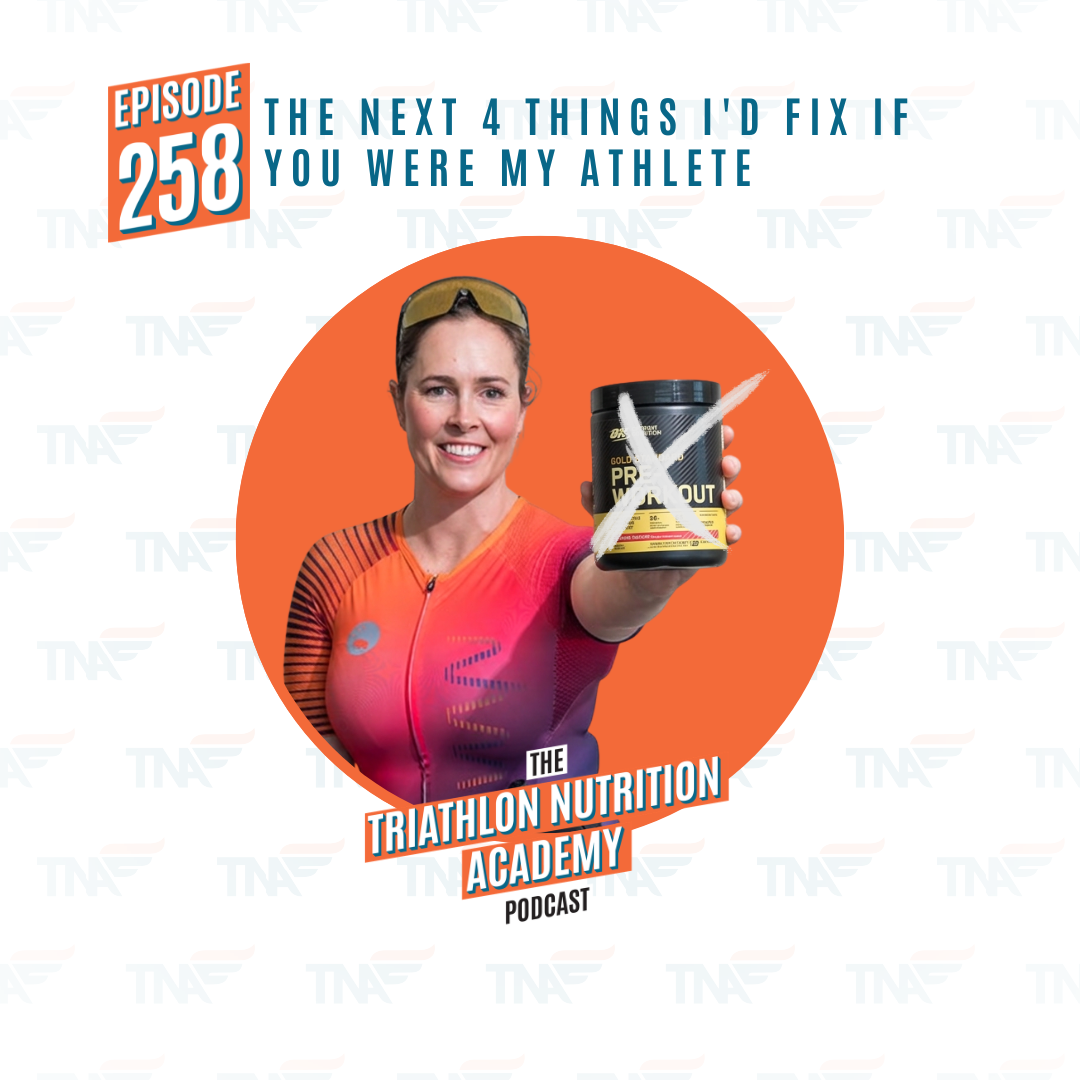
Episode 258 - The Next 4 Things I'd Fix If You Were My Athlete

Most triathletes are working their nutrition list backwards. They start at number eight and skip one through seven entirely.
In Episode 229 I walked you through the first four things I fix with every triathlete I work with. The big rocks. This is Part 2, and it picks up at number five. If you have not heard 229 yet, go and listen to that one first, because these next four do not work without the foundations underneath them.
Number five is your hydration and electrolytes, which most athletes think they have sorted and almost never do. Number six is the three micronutrients that quietly put a ceiling on everything else. Number seven is your race nutrition strategy, which is a lot more than deciding which gel you are taking. And number eight is the fun stuff, the sprinkles on the icing on your cake, which is exactly where nearly everybody wants to start.
WHAT YOU WILL TAKE AWAY
- Why one standalone sweat test is not a number you can set and forget for life
- The three micronutrients that determine whether you can train and race well, and why supplementing blindly is the wrong first move
- What a race nutrition strategy actually involves, and why practising your fuel is not the same as practising it at race intensity
- The full roll call of supplements and gadgets triathletes ask me about, and where they genuinely belong in the order
- Why your recovery nutrition does not finish when you cross the finish line
- The order I would work through all eight in, so you get the best bang for your buck
Links:
Check how well you’re doing when it comes to your nutrition with our 50 Step Checklist to Triathlon Nutrition Mastery
Start working on your nutrition now with my Triathlon Nutrition Kickstart course
It’s for you if you’re a triathlete and you feel like you’ve got your training under control and you’re ready to layer in your nutrition. It's your warmup on the path to becoming a SUPERCHARGED triathlete – woohoo!
Connect with me:
To learn more about the Triathlon Nutrition Academy, head HERE | dietitianapproved.com/academy
See behind-the-scenes action on Instagram: @dietitian.approved
Follow along on Facebook: @DietitianApproved
Join our FREE Dietitian Approved Crew Facebook group
Enjoying the podcast?
Let me know what you loved about it and what you learnt by tagging me @dietitian.approved on Instagram!
Subscribe & Review in Apple Podcast!
Are you subscribed to the podcast?
If not, today's the day! I'm sharing practical, evidence-based nutrition advice to help you nail your nutrition and I don't want you to miss an episode. Click here to subscribe to iTunes!
Now if you’re feeling extra warm and fuzzy, I would be so grateful if you left me a review over on iTunes, too. Those reviews help other people find my podcast and quality nutrition advice. Plus they add a little sparkle to my day.
CLICK HERE to review, select “Ratings and Reviews” and “Write a Review” and let me know what your favourite part of the podcast is.
You're awesome! Thank you!
Episode Transcription
Episode 258: The Next 4 Things I'd Fix If You Were My Athlete
Welcome to the Triathlon Nutrition Academy podcast. The show designed to serve you up evidence-based sports nutrition advice from the experts. Hi, I'm your host Taryn, Accredited Practicing Dietitian, Advanced Sports Dietitian and founder of Dietitian Approved. Listen as I break down the latest evidence to give you practical, easy-to-digest strategies to train hard, recover faster and perform at your best. You have so much potential, and I want to help you unlock that with the power of nutrition. Let's get into it.
There are eight key things that I fix with every triathlete I work with, and after two decades of doing this, I can tell you with absolute confidence that most triathletes are working this list backwards. They start at number eight The sprinkles on the icing on the cake. A new supplement, a new electrolyte product that everyone is talking about, bicarb, some broccoli extract, and they have skipped one through seven entirely.
Back in episode 229, I walked you through the first four things that I fix with every triathlete that I work with. These are the big rock foundations, and if you've not heard episode 229 yet, stop this now and go back and listen to that episode first because this is part two. This is the next four things that I want you to work on, and they're not gonna work unless you've done those first four.
So today we're gonna pick up at number five. These are the things that I see triathletes get wrong over and over again, and they make a really big difference to how you train, how you back up and recover, and absolutely how you race. If you're new here, hi, I'm Taryn. I'm an advanced sports dietitian and I used to be the sports dietitian for Triathlon Australia.
Over the last two decades, I've worked with thousands of age group triathletes just like you to help them understand how to eat for three sports. And what I've learnt in my time is that you don't build performance on top of chaos. So let's get into it. Number five. The fifth thing that I would fix with you if you were my athlete is your hydration and electrolytes, and this is a big one that so many triathletes are walking around having no idea how to do this properly for them.
We're almost in the same trap as we are with carbohydrate. If a little bit is good, then surely more is gonna be better, and hydration is the perfect example of that mentality going wrong in either direction. I see athletes who are not drinking enough. I also see athletes who are drinking far too much because they're just terrified of being dehydrated, and they end up with a tummy that is sloshing around all over the place.
They have to stop and wee constantly, but yet they're still scared and they're still convinced that they need to drink more. Then there's also the electrolyte, and in particular, the sodium piece. The messaging with this at the moment is also more, more, and more. Products are carrying significantly more sodium in them than they did five to 10 years ago, and athletes are layering product upon product and adding sodium on top of that because they're told that sodium is really important, and sodium is really important.
It's the main electrolyte that we lose in our sweat. But that doesn't mean take on as much as you possibly can. The real question that you need to be able to answer is how much do you specifically need for the situation? Because this is where a lot of athletes are flying completely blind. They don't know how much they're drinking, they don't know how much they're sweating, and they don't know what their sweat sodium concentration is across a variety of situations.
They've picked a number because they've done some free online calculator that has told them what to do, or they've done one standalone sweat test, which is also pretty useless because it's only one data point That one data point, that one test has given you information about what has happened under those conditions.
It does not give you your number that's set and forget for life because your sweat sodium concentration and your sweat rate actually shifts constantly. It shifts with the conditions, so the environmental conditions, the intensity, the modality, the duration, your fitness, your acclimatisation levels, your body size, and it's gonna be different on the bike and on the run.
So you can't do one sweat test and go, "Cool, got it sorted, Taryn," 'cause that is not gonna end well for you. One of my Triathlon Nutrition Academy athletes, which is my online group education program for age group triathletes who are done winging it with the fourth leg, we're starting a new cohort soon, by the way, she is deep in Ironman prep, and at the moment she's taking on 750 mils, which is about 25 fluid ounces, with four scoops of powdered sports drink, and she's having some sips of plain water on top of that as well.
She is stopping for a wee five times in three hours on the bike and has never done a sweat test before or even just a hydration test to understand what her sweat rate is. So she has no idea about how much she's losing to know how much to drink. She's just following this set and forget plan, and my issue is this exact problem happened last season.
She's carried the same issue for two seasons in a row and not done anything to fix it. She's noticed this problem twice, and it's because nobody taught her how to actually go and figure out what's going on. So her homework that I gave her was to go and do some testing using our TNA strategy and fix the issue once and for all, not take it into a third season because doing the same thing and expecting a different result is the definition of insanity.
Okay. So once you've got your hydration and your sodium sorted, number six is the one piece I think a lot of triathletes really underestimate, and that is your key micronutrients. It is all about macros at the moment. Getting enough carbs, protein, and fat at the right time. But what about the key micronutrients that are really important for you as an endurance athlete?
They are iron, calcium, and vitamin D, and you cannot train and race well if any of these three are not optimized. Now, I did not just say, "Go to the chemist and blindly supplement all three of those things." In fact, it's quite the opposite. This is about getting data and information first, and then we can figure out a plan of attack.
Iron does a lot of jobs around the body, but one of the key things it does for you as an endurance athlete is transports oxygen, particularly to your working muscles when you're doing that aerobic training. If your iron status is not where it needs to be, which side note, is actually higher and different to the general population, you have just put a ceiling on your ability to train and race.
And you can be genuinely fit, swimming, riding, and running in a week, looking healthy and eating what you think is a great, healthy diet, and still not meeting your needs and/or absorbing what you need from your food. I once had an athlete that was so iron deficient that she was napping every single day.
She was getting an iron infusion every three months, and she just thought that level of fatigue was part of being a triathlete and being a really active person. And frustratingly, she was just being Band-Aided every three months. So what we did was we fixed the root cause, and since then she hasn't had an iron infusion, not one.
She doesn't need a nap every day, and she ended up qualifying for Worlds because she could train and race so much better than before. I have another example of an athlete who was told by their coach to quit dairy because dairy causes inflammation. So she did what her coach asked her to do, and she stopped having dairy altogether.
At the same time, she was going through that stage of life where our hormones shift and training for an Ironman, doing about 15 hours a week, including strength training. Now, she clawed her way To the start line of that race, got to the finish line, and also vowed to never do a full distance race ever again.
But a few months after that race, she had a stress fracture. She got a bone mineral density scan and was in the bottom of the lowest quartile, a T-score of minus 2. She showed her coach that, and he said it was still okay. Like, ugh, makes me so angry. Thankfully, he's not her coach anymore. And thankfully, this same athlete has recently had their bone mineral density done again two years later, and it has improved significantly.
It is proof that you can do it. You can turn your bone mineral density around with the right guidance and consistency in your approach. I really shudder to think what would've happened if she didn't invest in getting some proper advice from a qualified sports dietitian. Your bones work like a calcium bank.
If you're not getting enough calcium from your food, it's just gonna borrow from that bank, take a withdrawal, to maintain your serum calcium levels. And it's not like your body prints you a statement like the bank does so you can see those withdrawals. They're just happening silently underneath, and often you don't find out that that's happening until something breaks, or you get your routine bone mineral density scan after 50 and find out that you are osteopenic or worse.
So when you are a high-achieving, high-performing triathlete Your nutrition is more than just getting you through your training session. It is about keeping you healthy enough so that you can still do this sport in 10 years' time, or 20 years' time. So we need to stop waiting till there's a problem, and please don't start throwing supplements down your throat now.
Get in the information, know what you are working with first, and then fix what actually needs fixing from the ground up. So that is why it's one of the key things that you need to work on with your nutrition before doing anything else. Okay, number seven, your race nutrition strategy. And when I say race nutrition strategy, I don't just mean what types of gels are you gonna use in your race?
But yay, we're finally here. Notice that it took us six elements to get here first, because your race day is built in your daily training environment. There is no point having the perfectly formulated race nutrition plan if you're not actually recovering and adapting from training first. Your race nutrition starts months before.
The longer you race, the longer you need to prepare for it, because it's all about the practice and the rehearsal and the refinement over time. So the goal is, by the time you toe the start line, your nutrition is, like, almost boring. You've done it so many times that you just don't even need to think about it anymore, and there are a lot of pieces that go into your entire race nutrition strategy.
You've got your carbohydrate loading strategy, including whether you need to do that or not, and how you carb load for an Olympic versus a 70.3 versus a full distance race is different. Your pre-race meal, so what you're doing from the moment you wake up on race morning to the moment you start swimming.
What it is, when it is, how much it is, and can you actually tolerate it when you are so nervous that you've already been to the portaloo 15 times? What are you doing during your race? So that includes on the bike and on the run, how much carbohydrate, how much fluid, how much sodium, how are you gonna get that in?
Have you got the right ratios? What do you do if the conditions change? What if it's way hotter than predicted? What if it's way cooler than predicted? What if the swim is a washing machine and you can't keep your bike nutrition down? What do you do when your race nutrition doesn't go to plan? What do you do when your race doesn't go to plan?
How do you troubleshoot things that can happen so that you don't end up DNFing? I have 50 million examples of athletes where something happened. I once had an Ironman athlete who had the perfectly formulated plan, but he got his teeth kicked out in the swim Front two teeth. Horrible. Can't believe he kept racing, but that threw all of his bike nutrition out the window because a lot of it he needed to chew.
But because he understood his plan, he knew how to adapt it, and he knew what was on course because he'd practiced with it, so that he could do the maths and rewrote his entire race nutrition plan while he was out there. I had another athlete do her first full distance. Her plan was immaculate, but on race day, getting onto the bike, her stomach turned on her and she couldn't keep any of it down.
She managed to wrangle a few things, but just couldn't hold onto nutrition, and then she got to the run, and the only thing she could hold down was some Coke, a bit of the broth, and a couple of grapes. And we got to the bottom of what was actually going on here, and it wasn't that she hadn't practiced the plan before, because she had, but the problem was she hadn't ever practiced at race intensity in the specific order that she had planned, in the heat, and with her heart rate as high as it is on race day.
So it's not that she got it wrong, she just didn't have the knowledge and the experience to do all of those things in training first. So it's so important to practice it in race conditions, at race pace, and replicate as much as you can. And the other thing you need to think about with your race nutrition is it also needs to include recovery, my friend, and not just in that 30 minutes after you cross the finish line and you're grabbing some fruit as you're going through the chute.
I teach my athletes what to eat for the entire week after the race, because once you cross the finish line, your nutrition hasn't stopped. It hasn't finished; it needs to continue. Racing is the biggest physiological stress that you've put yourself through all season. It's way more stress than training can ever elicit, and I see triathletes make this mistake all the time.
You train so hard for this event, and then you have this massive brain fart once you cross the finish line. I don't understand what happens, but all things go out the window, and everything you know about eating properly and recovering and rehydrating, you're like, "Pff, screw it." Now, I'm not saying don't celebrate.
Like, please celebrate. You've absolutely earned it. But you can celebrate and look after your recovery at the same time. If you wanna eat a burger and chips, go for it. Don't care. I'm not that type of dietitian, but I'm gonna make sure you hit your right targets in your recovery window with whatever food you choose.
So race nutrition, practice it, rehearse it, refine it, and make race day, from a nutrition perspective, almost boring so that all you have to concentrate on is negative splitting the run. Okay, and finally, number eight, performance enhancers. These are the sprinkles on your icing on the cake. The fun stuff.
Let's call it that. And this is where almost every triathlete wants to start. I'm gonna list a bunch of things, and every one of these is something a Triathlon Nutrition Academy athlete has asked me about in Power Hour. You ready? Ketones, Prepped Prime, Urolithin A, sodium bicarb, broccoli juice extract, tart cherry juice, collagen, coenzyme Q10, beetroot juice, chia seeds, yerba mate, guarana, glucosamine and chondroitin, triple magnesium, Vespa wasp extract, trace mineral drops, a hydration patch, protein shots, one of which turned out to be 60 grams of sugar, celery juice, creatine, and organic beef spleen and liver.
Then we also have the gadget layer, which I don't have time to get into that 'cause it is massive. Things like body scanners, WHOOP bands, Oura Rings, a race day calculator telling an athlete to only replace 25% of what they're gonna burn, ChatGPT calorie recommendations. It is honestly exhausting. There will always be something new you'll feel like you need to have and you need to try, otherwise you're gonna get left behind.
Some of these things are actually legitimate. Some of them are pure marketing. But that's not actually my point. My point is that not a single one of these things is in the list of the first eight things I would fix with your nutrition, because you cannot put sprinkles on your cake that you haven't baked yet.
There is nothing for them to stick to. They're just gonna run all over the counter and fall on the floor. And if your bike fueling is a mess, you are under-recovering, you're dehydrated, and your daily nutrition is all over the place and reactive rather than proactive, adding some genuine sprinkles that can be beneficial for you, things like caffeine and nitrate, is not gonna fix any of that.
It's like putting race tires on a 2002 Ford Fiesta. You've got the fancy bit, but the foundations are still F, so it's not gonna make you any faster. Now, I'm not anti-supplement. Personally, I'm taking a couple of selective things for my health and performance, so that is not my message. I'm anti wasting money on passive shiny objects without the foundations for them to stick to, because it's so much easier to just pop a pill than it is to actually figure out what your recovery nutrition should be.
But once you've baked your cake and you've iced it, the eighth thing that I would layer into your whole nutrition plan is some performance-enhancing supplements. Caffeine works, and it works really well for endurance athletes if you dial it in. Nitrate can also be a really useful tool But it's not gonna work if you haven't got everything else right.
They are done last, not first. Using our TNA protocols that are built specifically for triathletes and are science-backed. So that is all of the eight things I would fix with your nutrition, and I want you to take from these two episodes the order that I would do it in to get the best bang for your buck.
One to four is your foundations, and then five to eight are the next layer on top of that once the first four are dialled in. Once you've got all of those eight working consistently, then we can take it up a notch and look at some of those sprinkles, those one percenters, and continue to dial it all in.
But most triathletes do this backwards. They start at eight, they want the latest gadget, they want the latest pill, the latest hack, and they've completely skipped one through seven, which is exactly why you can spend a fortune on sports nutrition products and still not have your nutrition working for you.
Now, I wanna be straight with you for a second because the order that you do things is the free part. I can give you the order right here on the podcast, and I have. We are more than 250 episodes deep. Free content is genuinely good at teaching you some surface level stuff. It will tell you that iron's really important and it matters, that you need to rehearse your race nutrition, which is true.
But what it can't do is run your specific numbers, watch you execute them, help you tweak it and revise it, look at your blood results, and tell you what to do to fix it. If you have all the time in the world to read the research and you genuinely enjoy the process of doing that, and you're prepared to spend probably a couple of seasons testing this on yourself, you could probably get there eventually.
But if you have been at this for a while and you're still guessing at your hydration, your sodium, you don't really know where your iron is sitting or if it's a problem or if you need to fix it, or your last race fell apart and you don't really know what happened, then the missing piece of the puzzle is not more free podcast episodes.
It is somebody looking at your numbers and telling you what to do to get to the root cause of the problem so you can fix it forever. Information is free now, but knowing what bits apply specifically to you and your situation is the hard part, and the price of trying to figure that out alone is not necessarily paid in dollars.
It's paid in time It's paid in unsuccessful race seasons. It's paid in DNFs. It's paid in injuries. All things that take us a step back from doing the thing that we love. If you want all of these eight things built out for you properly in the right order, plus so much more, then that is exactly what the Triathlon Nutrition Academy is.
It is not a meal plan that I'm like, "Here you go. Off you go. See you later. Have fun with that." It's not one size fits all. It's not generic where everyone gets the same numbers. It is me teaching you how to build your own personalised race nutrition strategy around your training, your race schedule, and your actual life.
My advice for a 45-year-old mum that works full time is gonna be different to a retired 70-year-old male. I'm gonna help you build your specific recovery targets and then apply that to four specific recovery nutrition meals that you can chop and change, but are locked in so that I know you're recovering well after every session.
Your pre-training fuelling strategy for every session in your program Not just fasting across the board or eating half a banana as you run out the door. Your fuelling numbers during a session, depending on what that session actually is, depending on your goals, depending on where you are in your race season.
Your hydration and sodium worked out from your specific data, not somebody else's. Where your iron, calcium, and vitamin D levels are actually sitting for an athletic population, not the general pop, and what to do about it if they're not right, if they're not optimal. Your race nutrition strategy for every distance, practiced and refined until race day is boring.
And then once all of that is working for you, we're gonna put the sprinkles on your cake. The whole point of the TNA program is that you walk out of it knowing how to do nutrition for triathlon for yourself for the rest of your racing life. I am doing myself out of a job teaching triathletes everything that I've learnt in my six-year degree to qualify as a sports dietitian, qualifications that cost me more than $50,000, not to mention the thousands of dollars it costs me annually to maintain my accreditation as an advanced sports dietitian.
And look, I'm completely fine with that because I want to help you. I became a sports dietitian to help athletes to fuel for health and performance. We open doors to the Triathlon Nutrition Academy a few times a year, and if you want to know the moment they are going to open again, go and get your name on the list at dietitianapproved.com/academy.
And if it sounds like a lot of money to spend on yourself and your nutrition and it's not a pill that you can passively take, I want you to add up what it's costing you to keep getting your nutrition wrong. It's the entry fees, it's the flights, it's the accommodation, it's months of hard training, all of it riding on a race that falls apart in the back half for a reason that you could have fixed.
So go back to episode 229, get those four foundational rocks sorted first, and then come back to these four. Because when all eight are working harmoniously together, that is when your nutrition stops being one more thing you are trying to keep on top of and starts being a performance-enhancing tool.
Thanks for joining me for this episode of the Triathlon Nutrition Academy podcast. I would love to hear from you. If you have any questions or want to share with me what you've learned, email me at [email protected]. You can also spread the word by leaving me a review and taking a screenshot of you listening to the show. Don't forget to tag me on social media, @dietitian.approved, so I can give you a shout out, too. If you want to learn more about what we do, head to dietitianapproved.com. And if you want to learn more about the Triathlon Nutrition Academy program, head to dietitianapproved.com/academy. Thanks for joining me and I look forward to helping you smashed in the fourth leg - nutrition!