
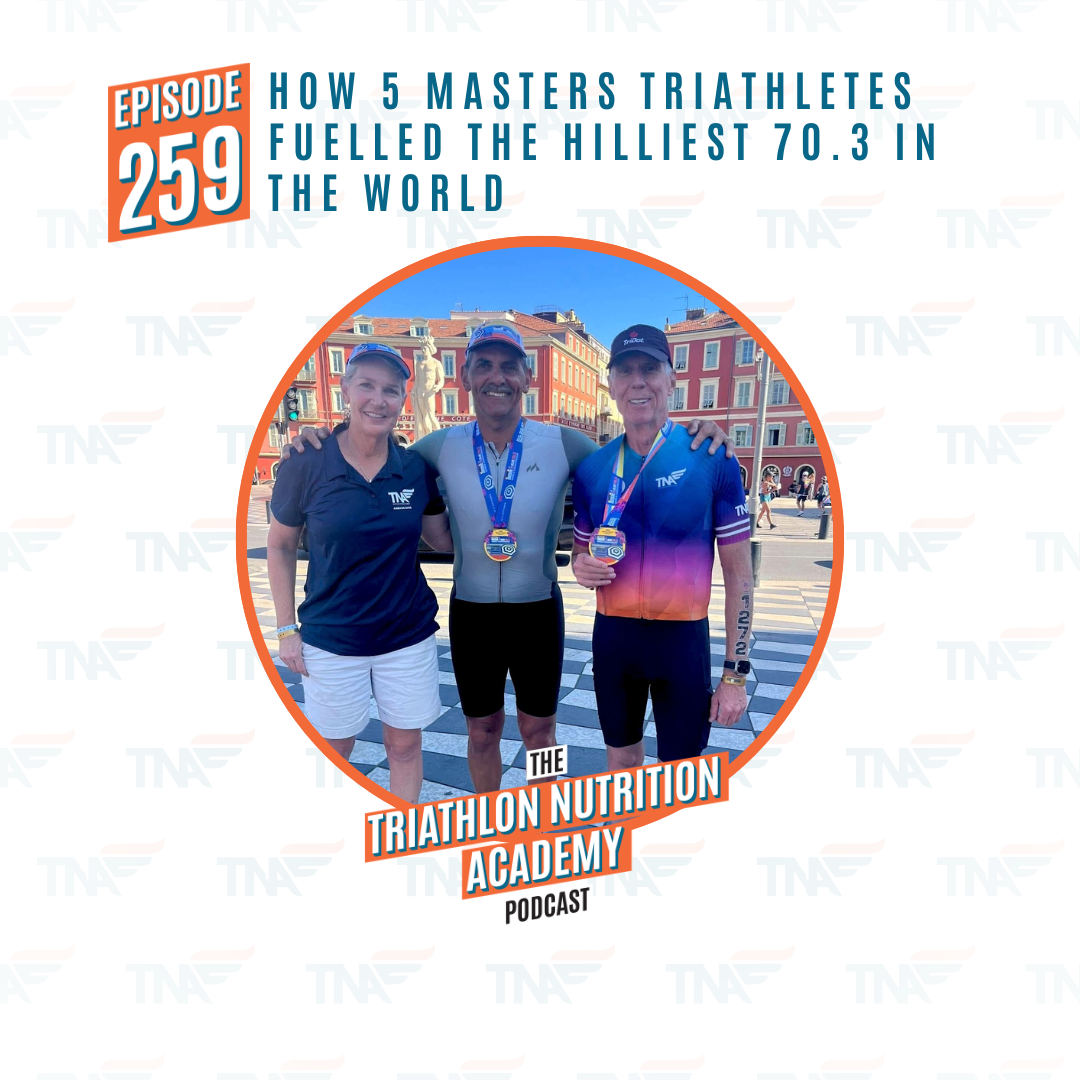
Episode 259 - How 5 Masters Triathletes Fuelled the Hilliest 70.3 in the World

What does it take to fuel the hilliest 70.3 in the world?
Six Triathlon Nutrition Academy athletes lined up at the IRONMAN 70.3 World Championship in Nice, France on 12 and 13 September 2026. A 1.9km swim in the Mediterranean, 90km on the bike with around 1190m of climbing, a long grind up the Col de Vence, an 11km technical descent with both hands on the brakes, then a flat half marathon in the baking French sun along the Promenade des Anglais.
One day after the race, five of them sat down with me to talk through what they did, what they would change and what they would tell you if Nice is on your bucket list. Most of them are masters athletes racing in the 60 to 69 age groups. Not one of them raced on the same nutrition plan.
Joining me are Kathleen Gilton, Kelly Estes, Stephen Duquette, Stanford Skelton and Daniel Walker.
WHAT YOU WILL TAKE AWAY
- Why the athlete who was most afraid of the bike had the best ride of her life
- How bike choice and gearing change what you can carry, and when you can actually drink it
- How to ride light on a long climb without under-fuelling the back half of your race
- What it takes to run a hot half marathon with no cramping, four years after cramping nearly ended a triathlon career
- The race week mistake that cost a well-prepared athlete 20 minutes on the run, and it had nothing to do with training
- Why six athletes on the same course, in the same heat, all fuelled differently and all got it right
Links:
Check how well you’re doing when it comes to your nutrition with our 50 Step Checklist to Triathlon Nutrition Mastery
Start working on your nutrition now with my Triathlon Nutrition Kickstart course
It’s for you if you’re a triathlete and you feel like you’ve got your training under control and you’re ready to layer in your nutrition. It's your warmup on the path to becoming a SUPERCHARGED triathlete – woohoo!
Connect with me:
To learn more about the Triathlon Nutrition Academy, head HERE | dietitianapproved.com/academy
See behind-the-scenes action on Instagram: @dietitian.approved
Follow along on Facebook: @DietitianApproved
Join our FREE Dietitian Approved Crew Facebook group
Enjoying the podcast?
Let me know what you loved about it and what you learnt by tagging me @dietitian.approved on Instagram!
Subscribe & Review in Apple Podcast!
Are you subscribed to the podcast?
If not, today's the day! I'm sharing practical, evidence-based nutrition advice to help you nail your nutrition and I don't want you to miss an episode. Click here to subscribe to iTunes!
Now if you’re feeling extra warm and fuzzy, I would be so grateful if you left me a review over on iTunes, too. Those reviews help other people find my podcast and quality nutrition advice. Plus they add a little sparkle to my day.
CLICK HERE to review, select “Ratings and Reviews” and “Write a Review” and let me know what your favourite part of the podcast is.
You're awesome! Thank you!
Episode Transcription
Episode 259: How 5 Masters Triathletes Fuelled the Hilliest 70.3 in the World
Welcome to the Triathlon Nutrition Academy podcast. The show designed to serve you up evidence-based sports nutrition advice from the experts. Hi, I'm your host Taryn, Accredited Practicing Dietitian, Advanced Sports Dietitian and founder of Dietitian Approved. Listen as I break down the latest evidence to give you practical, easy-to-digest strategies to train hard, recover faster and perform at your best. You have so much potential, and I want to help you unlock that with the power of nutrition. Let's get into it.
Taryn: Do you think you would've made it to world champs or had the day in the office that you did without working on your nutrition for a year?
[00:00:09] Kathleen: When I joined TNA in 2023, I didn't fuel for any of my just runs. So I went from someone who had to go to find bathrooms all the time, to signing up for my first triathlon in 15 years, to the world championship race, and in my opinion, for me, I crushed it, four years later. And so I don't know what else you need to say, but I think that's it.
[00:00:37] Taryn: You start the day with a beautiful, warm ocean swim in the Mediterranean, a pebbly beach exit, then a picturesque 90K bike ride with, I think, 1,248 metres of elevation. And the climb starts at about 10 kilometres in, runs for nearly 35 kilometres, with an average gradient of 6.6% with pinches of 12%. Then you get this crazy technical descent where both hands are hanging on for dear life on the brakes right back to the beach, and then you run a casual half-marathon, two laps along the Promenade des Anglais in the baking hot sun in the south of France. That is the 70.3 World Championship course in Nice, and I had six Triathlon Nutrition Academy athletes on the starting line, which is my online education program designed to help you turn nutrition into your secret weapon. It's personalised to your training, your goals, your lifestyle, and your race calendar. And today we're going to take you behind the scenes to what it's like. Joining me to share their experiences firsthand the day after the race, so it's nice and fresh, is the Spuds, Kathleen Gilton and Kelly Estes from Idaho Falls and Boise in the USA.
[00:01:46] Kathleen: Hi there.
[00:01:47] Kelly: Hi, Taryn.
[00:01:48] Taryn: Flying the flag for Canada was Marie Stevenson, who's not joining us today, but Steve Duquette all the way from tiny Ontario, Canada. Welcome, Steve.
[00:01:58] Steve: Good morning, Taryn.
[00:01:59] Taryn: Stan Skelton, who is a pilot from Ely, Minnesota, USA.
[00:02:04] Stan: Hello.
[00:02:05] Taryn: And fellow Aussie, Daniel Walker from Victoria, Australia.
[00:02:09] Daniel: Hey, Taryn. Thanks for having me.
[00:02:11] Taryn: All right. Thank you, legends, for joining me. I'm sure I'm probably the last person you want to talk to today. You want to kick back and relax and enjoy what France has to offer. But let's go around the room. I want from each of you one word, if you can, that describes world champs in Nice.
[00:02:28] Steve: Epic.
[00:02:29] Kelly: Challenging.
[00:02:30] Daniel: Steve has stolen mine, so I'm going to have to have another think to think. Actually, mine is effing epic, so I technically had two words.
[00:02:37] Taryn: Overachiever Stan, you're next.
[00:02:41] Stan: Challenging, for sure.
[00:02:42] Taryn: Okay, we got two epics and two challenging. Kathleen, what you got?
[00:02:46] Kathleen: Transformative.
[00:02:47] Taryn: Oh, that's a good one. Now, Kathleen, the bike leg was what you were most worried about, and you've trained so hard over the last 12 months to build your strength on the bike. Tell me, I haven't asked you yet, I've been saving it for this. What was it like?
[00:03:06] Kathleen: For the first time in my life, it was the most unbelievable biking experience I have ever had.
[00:03:12] Taryn: Wow.
[00:03:13] Kathleen: And I can't even explain how coming down that descent looking around, I looked around, I don't go as fast as these guys do, the views were amazing the people out there cheering for us were amazing, the women going by were amazing, the women around me were amazing, and it just made me realise it was a once in a lifetime experience to be riding up the Col de Vence, getting to the top, I didn't walk. So the whole bike leg was my favourite, and I have never, ever said that in my life.
[00:03:54] Taryn: What? Who are you and what have you done with Kathleen?
[00:03:57] Kathleen: Exactly.
[00:03:59] Taryn: You were like so nervous about the bike leg, and you were going to quit triathlon and never do 70.3 again last time I spoke to you because you were so worried about it. What were some of the things that you did to prepare for it?
[00:04:11] Kathleen: So when I signed up last September in Sunny Coast to do this race, I knew it was going to be the race that was going to force me to improve my bike handling skills. Biking doesn't come naturally to me. I don't really understand innately, like, how to turn, any of those things that many people could just go out and kind of ride the bike, and for me it always seemed really difficult. So what I did was I worked with a coach who was a former professional cyclist based out of Boise who also had won her age group in Kona. So I had a woman who understood exactly what it was like to be in my shoes, where I was training. we started with the fundamentals. I learned pedal stroke, I learned cadence we did sessions in parking lots, and built into my training routine was go ride around the parking lot, go around all the obstacles, find trees. So pretty much every ride I did, no matter what was prescribed, at the end I found a way just to build those basic skills in so that over time just handling a bike became a little more natural for me. so hiring her was really super important. We decided early on I was going to ride my road bike. We took the aero bars off to make the descent as safe as possible for me, no extra weight on the front. Strength work and then- We also just had a philosophy of spending as much time riding outside and finding routes in my local area that mimicked the terrain a little bit, and luckily for me, I happen to live in Boise, Idaho, where we have Bogus Basin a ski resort, local ski resort, and it is the stomping ground for Kristin Armstrong, gold medallist female cyclist. It's also the stomping ground for Matteo Jorgenson, who's a professional cyclist now. So I had, I think I rode up that mountain five times and came back down, and that was where I learned to be patient going up the hill. It was going to just take a long time, settle in, do it. Most of the time coming down was still quite scary for me, but I learned that the goal of this race for me was to finish that bike, get up the hill, get down the hill, and so when I was done and came out of transition, I really didn't even care what happened on the run. I had won before I got there with all the training I had done.
[00:06:50] Taryn: Yeah.
[00:06:51] Kathleen: And I had won when I got to the end of the bike. It was pretty monumental for me.
[00:06:57] Taryn: Yeah. Aw. And you didn't walk. We were talking about what's the worst that can happen? You get off and you walk for a pinch. Like, that's really the worst.
[00:07:07] Kathleen: Yes, I didn't walk, and I saw people walking on the first, those steep first inclines, and I thought, "I'm not walking," and then one of my favourite moments of the whole ride was when you make the corner and you start up the Col, there was this chorus of women saying, "We're here. Let's go," and like we all were in it together, like, "We're going to get to the top of this fucker."
[00:07:35] Taryn: I can't believe you're the one that swore first. Jeez, it's normally me. And how was the descent? Because that was something you were really worried about as well. Like, not only getting up to the top of the thing, but the descending down, and that was a skill that you really had to learn too in the lead up.
[00:07:50] Kathleen: Yeah. The descent scared me tremendously, but the day before we took a shuttle bus where we actually saw what the course was, and we had a professional on the bus giving us advice about specific areas to look for. And because I was prepared to go at my own pace and had really trained myself not to pay attention to what other people were doing, other than to stay safe, I went down it and felt super confident. I looked around. I remember what I saw, and I'll never forget.
[00:08:27] Taryn: Amazing. The roads over there, though, are so beautiful because the camber follows the road and it hugs it, and if you just stick with the road. I've done a lot of climbing and descending in France, and the road surface is schmick. They build roads way different than they do in Australia. Hey, Dan. They just slap them together in Australia. In France they actually think about the camber and where they position things.
[00:08:52] Daniel: Definitely.
[00:08:53] Taryn: So Dan, for you, like for all of the athletes racing Nice, the decision to ride on a road bike or a TT is something you have to think through because of the bike course. What did you decide to ride on and why? And did you do anything differently with your gearing?
[00:09:13] Daniel: Yeah, so I decided to ride on the TT bike. I'm more comfortable on the TT bike. It's really well set up for me, and it gets my hip angle into a really good position and allows me to then run off the bike really well. So I did extensive testing over Christmas before I'd even qualified. I took my TT bike, full disc wheel, aero helmet, and actually climbed Mount Hotham and then Falls Creek two days later, so both six-hour rides back to back. And I normally run a 58 front chain ring, and I dropped back to a 52 front chain ring to get me that extra range, and I'm so glad I did. The gearing was perfect. I thought I might run out of gears going downhill because I love descending. At 89 kilos it's one of my fortes. But due to how technical and tight it was, I never ran out of gears which was fantastic. and that was really my choice of bike. I'm happy with the choice of bike. There were times going up the hill I wouldn't have minded having a road bike, but I think I more than made up for it when I got to the flat sections and could really let it fly.
[00:10:20] Taryn: There were some descent sections for you that clocked over 50Ks an hour. I was looking at some segments. I think one of them said 56. Is that right?
[00:10:28] Daniel: Yes, it was a really fun section, pretty quick, and riders everywhere. That was one of the challenges, getting around. Like, there was meant to be no riding over the centre line. I'm not sure how many people didn't listen to that because everyone was on the centre line. And to get around people, I had to go on the other side of the road around corners to do it. There was no other way to get past. In triathlon it's common that for some reason people don't keep to the hard side of the road, but it was even worse in this.
[00:10:58] Taryn: Okay. That's not good, 'cause that wasn't a shut road, was it? There was private driveways and people could get in and out of their houses if they had to.
[00:11:07] Daniel: Yeah, there was, but they were smart in the way they did it. They made sure that they made the direction of traffic all go the same way as the bikes.
[00:11:14] Taryn: Yeah.
[00:11:14] Daniel: And And when we actually got to the descent, I think there was only one car on the descent, and that was actually slowing people down, so I had to overtake this car, then it overtook me back, and then I overtook it again. And I'm just going, "What are you doing? We're going faster than you." So yeah, that was a bit frustrating, but yeah, then we went past and didn't see them again.
[00:11:33] Taryn: Just draft off them a little bit, like at the tour.
[00:11:36] Daniel: Yeah, exactly. And the other key thing for my bike as well, being a heavier rider, the course selection really wasn't one that suited me, but I came for the experience. The good thing it did was take me outside of my comfort zone and allowed me to work on something that I initially joined TNA for, and that was I wanted to improve my body composition. I think the first thing you said to me was, "Whoa, we're going to pump the brakes on that. You're training for Ironman and we can't do that." So I think I waited nearly a full year, and after Christmas I pulled the trigger on that and managed to lose eight kilos while still improving my bike power, which is the key sign you need to look for that you're not overdoing things.
[00:12:16] Taryn: So how did you do that? Because I did make you stop. If you haven't met Dan before, he's a guns blazing, all or nothing, very high-achieving, high-performing triathlete, and so for him to join a program to want to lose weight and for me to say, "No, now's not the right time," I'm sure that was quite challenging mentally for him. But thankfully you were patient, and you learnt stuff first before you did that. So how did you then go about driving some body fat loss without affecting your power and your wattage and what you can push on the bike?
[00:12:53] Daniel: Yeah, so you put together in your program a really easy system to follow where you've got medium plates and hard plates depending on the workload you've got. And I tried to make sure I assessed the session I had, not for the day, I was always looking a day ahead. So do I have a hard bike tomorrow? Because I made the mistake the first time where I was looking at having a small deficit, and I chose to go into a deficit the day before I was doing 60 60s in the morning, which is, it's really hard. That's where glycogen depletion comes in. I was riding along fine, all of a sudden, bang, just shut down. So that happened the first two sessions and I very quickly adjusted. And I was able to make that adjustment quickly 'cause I had Taryn in my head basically telling me what I needed to do to make sure that was fuelled. So it was a bit of a game, but I was able to troubleshoot and get that all sorted myself within about a week or two. And that's due to what I learnt in the academy and how to manipulate things like that.
[00:13:54] Taryn: And were you happy with your body composition on the start line of this race, or do you still want to lose another eight kilos?
[00:13:59] Daniel: I've had my DEXA scan, so there is still another seven or eight to go, but to drop that much in that frame of time is not sustainable. The body doesn't like doing it. So we'll have a consolidation phase, and then probably the start of next year, in the off-season, we'll look to do the same again and improve it further. But it's about enjoying myself at the same time, and it does make everything more difficult when you're doing that, so I was welcoming a break. Even fuelling my rides, I fuel pretty aggressively on the bike, and having to not fuel as aggressively meant when I came into my other races such as Cannes, I had to fuel at a less aggressive rate and then adjust my power targets on the bike in line with that. So there was a bit of a balancing act on the things I needed to do to be able to do it. So it's a conscious decision that you need to make, and target a specific time of the year.
[00:14:50] Taryn: Yeah. Really good lessons there because if you fuel for performance and you're stoking the fire, you can race harder and push more, versus if you're trying to drive a deficit to drive fat loss, you can't get as much out of your body. So you've got to be really smart around when you pull the trigger like Dan did, how you do it in a way that is balanced and still going to reach your goals without just shooting yourself in the foot in the process. Yeah, 100%. So two different bike choices there from both of you. We've got a roadie and a TT, and, like, different gearing to try and get up the hill, 'cause half of the bike course is uphill. Stan, one of the things that we talked about was how you ensure your ride, your rolling buffet is light and you're still fuelling. So what were some of the changes that you made to your nutrition for this course in particular to make sure your bike was light and fast?
[00:15:40] Stan: Well, I did start off with three bottles, but I heavily loaded with 150 grams of carb on the first bottle, and I had finished that before we came to the first aid station, so I could drop that. And then I had 200 grams still of tailwind in two bottles. I just took water during the aid station and doused myself and took what I could, and then dropped that for the climb. And then I finished the bottle on the climb, so when I got to the next aid station, I was just carrying one bottle instead of how I normally would.
[00:16:17] Taryn: And how did it go?
[00:16:18] Stan: It did work. Probably my biggest miscalculation was the bike ride took a half an hour longer than I thought it would take. Yep. It was just so slow. So I had with Clif Bloks, and the gel, and my three bottles, I think I had planned like 340 grams, which was supposed to be over 100 grams an hour. But it actually ended up being a little bit less than 100 grams an hour. And I did not take any nutrition from the aid stations on the bike. I just took water for cooling and for to help wash down the Clif Bloks and the one gel I brought. So but otherwise, yeah, I felt fine about it. And I did lose a bottle on the way down. The descent had a couple of spots that were very rough. I had a bottle pop out on that, but I was almost done with it, so it really didn't affect me.
[00:17:10] Taryn: Okay, that's good. And was the run okay with slightly less fuel than you felt like you were going to have?
[00:17:17] Stan: Yes, the run was fine. I had another set of Clif Bloks, you know, 50 grams. And then I did take some Precision on the run for the electrolytes. And all that was fine. The electrolytes before the swim, as you recommended, I had 2,500 milligrams. That worked out really well. And for the caffeine, the gel I had on the bike was a Precision 30 with 100 milligrams of caffeine, so that worked too. So no, I was pretty pleased with it all. It was just trying to stay cool on the run as much as anything.
[00:17:53] Taryn: Yeah, and the run was hot. Like, at that time of year in France, baking on the bitumen, like, it's flat, it's a hot French sun. Steve, I want to hear from you about how that went because for you, out of all of you guys, the run for you is probably the bit that was going to hurt the most because it was so hot. And when you first came to see me, when you first joined the Triathlon Nutrition Academy, you were basically at the point of giving up triathlon, you were cramping so bad. So did you cramp at World Champs in a hot run course?
[00:18:28] Steve: Short answer, no. Did not cramp. Did not have any whisper of a cramp the entire day.
[00:18:37] Taryn: Yay.
[00:18:38] Steve: Yeah. I was actually worried about that. I was worried about it with the bike ride because of that long, sustained climb, and it was hot. I biked that course last Sunday, and it was stinking hot, and I actually was close to cramping at the top of that climb. So I was kind of worried. but in any case, there was no cramping. I felt good. Like, honest to goodness, like, again, like, no gut issues. It was hot. They had these cooling sort of showers as you ran through it. You guys all went through those probably. So I took advantage of every opportunity to cool off, take some ice, and so on and so forth. I didn't run a fast half-marathon. I certainly was hoping for a faster run, but at the same time, because of the heat, I knew that was going to be a challenge for me. So I, you know, I walked the aid stations. I took every opportunity to use the water, the ice, some cola sometimes, the electrolytes, and I just tried to stay on top of it, the gels and so on. And yeah, it felt great. Like, it was hot. We suffered or I suffered. But my other friends that were here told me, and people that were tracking me were commenting on their own little chat group saying that I'm having a really good run. So that was encouraging to hear that after, of course, after I was done, I heard all about it. So yeah, was very pleased. I mean, that course is tough. That whole course is tough.
[00:20:15] Taryn: It's World Champs. Like, it's not going to be easy.
[00:20:19] Steve: Yeah, exactly. So yeah, I did some acute sodium loading leading into the race, a lot of carb loading. And even, and race morning, I had a bottle of carbs and electrolytes that I sipped on before the swim. So I felt that I did a pretty good job of sort of front-end loading some of that stuff, and I do think it made a difference. Yeah.
[00:20:44] Taryn: Yeah. Is that what you've been working on over the last little bit of time to try and prevent your cramps?
[00:20:49] Taryn: Stop them happening altogether?
[00:20:50] Steve: I'm constantly working on it. Like, I have to, I have to, I have to do that all the time because I just know the other side of the coin is, if I don't, I'm going to have some cramps, and I don't want to go back to that because that was really awful a couple years ago. So I was quite pleased, because I'd got done the big climb, Col de Vence. we kept going, and then we got to do the descents, which was super fun. So I got to do it twice because I did it last Sunday. It was good. but when I finished that climb, it actually felt way better than when I did it the week before. So that was encouraging, 'cause I'm in the race, and there's more sort of on the line. Like, I got to get through this thing.
[00:21:33] Taryn: When you did your training ride of the course, did you do all of your race nutrition principles leading in? Like, your carb loading, what you do pre-race morning, and that whole strategy, and then your race nutrition fuelling, or did you just go and do a 90K training ride without it?
[00:21:47] Steve: I didn't do any carb loading for that training ride. but certainly the race nutrition and hydration part was definitely a focus on that training ride.
[00:21:56] Taryn: Okay. I was just wondering if you were cramped because you didn't do any of that, all of that beautiful race nutrition strategy that we package up around it to prevent it.
[00:22:05] Steve: I mean, yeah, and like I say, it was at the top of that climb on the training ride. There was just this little semblance of, yeah, I know when my quads and hammies are going to kind of go, and it was just that little feeling. But it never happened, but I could feel it coming. And maybe it was the fact that we didn't carb load or I didn't carb load for that ride. And also it was significantly hotter a week ago. Like, I think it was 30 something degrees on that Sunday versus what, did it hit 27 on race day? So that.
[00:22:40] Taryn: Big difference.
[00:22:41] Steve: Yeah, when I was doing that climb on the training ride, going up Col de Vence, the sun on my back, like I was cooking. I mean, honest to goodness, it was so stinking hot. We were just frying out there, and it wasn't as hot on race day. So that may be part of the environmental factors.
[00:22:58] Taryn: Yeah. Sweat less, cramps less.
[00:23:01] Steve: Yeah.
[00:23:02] Taryn: Now I'd like to hear from the main man, and the internet is always just full of like sunshine and rainbows sometimes, and you see all of the good parts and you never hear about the bad parts or any sort of adversity. So Kelly, you didn't have the best day in the office. Can you talk us through what happened and some of the things that you did to troubleshoot your day? Because you still crossed the finish line, you still did a pretty bloody good time. And if, I know it's still fresh maybe, but is there anything that you've thought of that you might want to do differently for next time?
[00:23:36] Kelly: Yeah, my race didn't go as I was hoping. It started out really well. I had trained a lot for this race, and I trained in hot climates, lots of hills and climbing, and I felt as prepared as I thought I could be. I really put a lot of effort into it. I've been training since last year. I knew I was coming, so put a lot of effort into this. And the race started out really well. I carb loaded well, and I did the hot weather sodium loading protocols. And then the race started out really well. I had a really good swim. I was a little nervous about the swim because I had to drop out of Cannes last June because I had some issues in the swim. And so as the swim started this time, it went really well. I had a good swim, and I actually completed the swim about two minutes faster than I was forecasted to perform, so that was a plus. So the race was going really good so far. Then I get on the bike. The bike starts out really well, and I'm, I'm forecast to complete the bike in four hours. And so I knew that it was probably going to take me around two hours and 20 minutes to get to the top. Well, the race starts out really well, and you go a little faster on race day. There's a few more watts you just feel good. So going up the hill, it actually turned out to be really pretty good. I got to the top of the hill about 20 minutes faster than the forecast, so it was really a very successful race so far. I'm really feeling pretty good. I started going down the hill, and I started getting cramps in my quads, which has never happened before, ever. So this was completely new. And so the first thoughts were, "Oh, is this going to cause me to have to pull over, to stop? What's going to happen?" Fortunately, it didn't really slow me down that much, that even though those cramps were there, my quads were kind of pulsing and cramping a little bit, I was able to keep riding. And so it didn't slow me down a lot, but I didn't know if it was going to get worse or go away. But the cramps did go away after, I don't know, probably five to 10 miles, that 10 to 15 kilometre distance, and it finally went away. I got down to the bottom and it really worked out pretty well. It didn't give me any more problems. I did have a bike mechanical problem along the way. I had to pull over. I lost about five minutes to pull over and tighten and do, make an adjustment. But the bike turned out to be really good. So my overall bike forecast of four hours, I actually finished it in 3:45, three hours and 45, which was good. So there's another highlight. Things are going really pretty good. And if I hadn't had the bike mechanical, I would have finished it almost 20 minutes early. So it, so it's really pretty successful so far. I followed all of my nutrition planning. some modifications I did was, and it's based on feedback I'd gotten from Steve and his practice ride, was I front-loaded my nutrition on the bike so that by the time I got to the top, I had front-loaded quite a bit of it. So I knew coming down the hill, I was going to be holding on and going fast and it was crazy coming down because we're talking about people using both lanes of the road. The road really, from my perspective, wasn't in that good a condition. There's a lot of rough spots, there's a lot of hazards, and there's a lot of people out there going really fast. And so coming down, I was holding on tight, trying to go fast, and so there wasn't a lot of focus on nutrition until I got down to the bottom. And then I tried to make up for nutrition in the last the last 15 K of the ride. And so overall, it really went pretty well. I get into transition, I come out. As soon as I get off the bike, I'm expecting to have really good run performance because in training, when I get off the bike, I've never felt better running. I feel strong. I don't feel like I'd really ridden that much. My bike setup has just really got it to where I come off the bike and I'm really feeling good. Well, it wasn't that way on race day. My legs were heavy, and I averaged about a minute and a half slower per mile than what I normally get. and in some places what I ended up doing was walking through aid stations, which I haven't walked through aid stations, I don't know how many races. So really was becoming disappointing.
[00:27:58] Taryn: Nothing wrong with that, though, as a strategy.
[00:27:59] Kelly: Yeah. And so also at the beginning of the run, my quad started cramping again like they had on the bike, which is really unusual. So I was, again, uncertain how was that going to impact my performance. Well, it was probably only two or three miles, and the cramping went away, fortunately. But I still felt heav- heavy and slow. So overall, I was really kind of disappointed with the run because I was so much slower. I am, was probably 25, 20 to 25 minutes slower doing the run than I should have been. So, and so that was overall between the bike and the run of losing the time in the mechanical and the slow run. You know, I think I could have done the race 30 minutes faster than I did. But the lesson here is, for me is, when I look back and say, "Well, what probably contributed to this?" The days leading up to the race, I was walking around quite a bit, especially for the women's race the day before, I was out being a spectator. And on that spectator day, I put in 26,000 steps walking around. That's a lot. Most people have to make a deliberate effort to try to get 10,000 steps a day.
[00:29:12] Daniel: Mm.
[00:29:12] Kelly: I had 26,000 steps just doing the basics, spectating stuff, and staging my gear for race day and all the stuff that goes along with it. But being outside, doing all those steps, which actually we'd been walking for two or three days before the race, doing a lot of spectating and walking around, doing a lot of stuff, 'cause Nice is beautiful and you just like to walk around and see stuff. what I noticed was I was dehydrated on the days leading up because the colour of my urine was telling me I was dehydrated. And so I was drinking more and more over time, but it wasn't clearing up. And so I went into race day, I believe I went into race day probably more dehydrated than I realised, and it probably affected me. So likely all the walking around I did and the dehydration contributed to poor run performance. That's what I think happened. So if I was to do something different, what's my advice? Try to rest if you can. Sometimes you can't, but try to rest after you've eaten as much as you can on the days leading up to the race, and stay hydrated. So here in Nice the temperatures weren't really hot. I had trained in hotter temperatures, but I think combined with humidity, it impacted me, impacted my hydration levels, and it was just harder on me than I thought, and it showed up in my run. I'm not really quite sure what else it, what it was, but the dehydration and rest was something I would focus and do different next time.
[00:30:42] Taryn: Yeah, not to mention how hard the bike course is. I know you've got your predictions, but does it take into consideration just how tough the bike is? It takes a lot out of your legs when you spend half of it climbing. It's hard to then run off the bike the same as you normally would on a flat bike course.
[00:31:00] Kelly: Yeah, you're right. I trained for that, though, so I felt confident that I shouldn't have that issue. I've trained in hills of comparable steep grade and elevation, and then after the ride I've run 40-minute intervals, which isn't the full distance, but certainly the first 40 minutes would've showed cramps and things like that. So I really believe that there was just something different about being here. Maybe it's the humidity also, maybe the elevation change. I train at high elevation. So I'll continue to think about it and try to understand what to do different, but I had trained, and there really was no reason for it. There's no reason for the cramps or the slow running. I mean, it just shouldn't have been there.
[00:31:44] Taryn: I think Steve said you needed a new bike.
[00:31:48] Kelly: Yeah, it does help even with swim performance. If you get a new bike, it'll help you swim faster too.
[00:31:54] Taryn: Ten plus one. So a question to you all then, the Saturday women's race, Sunday men's race split, do you think that's a good idea? Do you think it's a bad idea? Like, I know Kathleen, you expressed just how awesome it was to be out there with all the women, but then you've got the men spectating and on their feet all day, and then the same as you, like the day after your race, you're probably shattered, and you're spending the whole day kind of spectating on your feet as well. What do, what do we think? What's our opinion?
[00:32:24] Stan: Yep, I really enjoyed the ability to watch the women race. I'm sure it possibly took out a little bit of your physical training to be on your feet all day, but I think a bigger issue was that we couldn't use the same transition. So transition two and transition one were quite a bit apart, maybe two kilometres. So to check in, you had to drop your bike and then walk another two kilometres, and we were a mile further east, or actually further west from the bike start. So I ended up walking probably 10,000 steps just checking in. But overall, I had a blast watching the women, and I'm happy they did it that way. I just wish the transitions could've been closer.
[00:33:11] Daniel: For me, I absolutely loved the split day. The only thing is I would've loved to have watched the men's race as well. That was the number one thing. I'm riding along, I'm like, "I'd love to watch the men's pro race as well," 'cause I knew it would be good, but watching the female race was great. I prioritised making sure I was trying to do the shortest amount possible, and as soon as the women's pro race was over, I went home, got off my feet, and did what I needed to do to prepare for the day after, which is also one of those things then you don't get to support other people you know on there. But the amount of time and effort that goes into the preparation for that, it was all about me from that point on. And I went home and did what I needed to do to make sure I carb loaded efficiently and kept my hydration up. But I agree with Stan on the split transition. I was actually using my AI agent that I uploaded the race guide into it. It told me to go to T2 first with my bike, and drop off my run gear, and then ride back down to T1. I didn't listen to it, and I went to T1, and ""as I'm walking that 2K, I'm thinking, "I should have listened to my AI agent and had it nailed to start with.
[00:34:17] Kathleen: I loved having the two different days. I mean, as a woman being out there in a 70.3, typically there's only 25% of the whole field is female, and the rest are men. And so for me to be out there with just women, there were some fast women, but I felt like it was managed. I felt very safe. I felt supported, and for me it was wonderful the next day getting to go and cheer these guys on. And so I felt like I had the best of both worlds with that setup. I do think that like these guys said, I was unprepared for how far the transitions were apart, and I was also a little unprepared with the crowds that come with the world championship race. So even just walking, say you're walking half a mile, I might walk a half a mile on the sidewalk in Boise. Here you're zigging, you're zagging, you're going around people, you're trying not to step on the dog, there are kerbs, there's fencing, and so everything just sort of was up a notch in terms of the mental and the physical fatigue doing basic things like going to T1. And we did a walkthrough of T2 where you left your bike, but when I went back to drop off my bag, I mean, I knew where I was going to put the bag. I had to go through the whole thing because they required that you walk through the entire transition, and I thought, "I don't need to be doing this," but you don't always find out until you're in the thick of it.
[00:35:52] Taryn: Mm-hmm.
[00:35:53] Kathleen: And so I do agree. The amount of walking, the amount of mental energy that it takes being in a world championship can kind of be exhausting. But I loved the way it all rolled out and really enjoyed getting to see these guys out on the course was very special.
[00:36:13] Kelly: I like to have had the race where we did it all on one day so that when the race is over, you can kind of sit around and talk about it a little differently than when you do it on split days, where the conversations are a little different. However, the split days are really nice because you have fewer bikes and fewer people out on course, and so it's easier, especially on the bike course when you're trying to do passing and things like that if you have half as many bikes, it just makes it easier logistically for running, for all of it, and swimming. I mean, it's just, it's just nicer to have a split that it makes it for a more enjoyable experience for me.
[00:36:52] Steve: I wish the men would've raced on Saturday because I watched one of my friends, and Kathleen as well, like several people that I knew racing the women. But that whole time I'm watching them, I'm still stressing about being ready for the next day. Whereas if I could've raced on Saturday, it would've been a lot more enjoyable watching Kathleen and my other friends race without thinking that I have to still prep and try to get to sleep early and all that stuff. I slept longer on Saturday morning, so I actually didn't see the swim start at all. but I got down to see people coming in on the bike and transitioning to the run, and then at the finish line afterwards. And then it was back to business as far as get back to my air-conditioned room, chill, relax, and just not think about it too much. I got my bottles and stuff ready late afternoon and so on and so forth. So yeah, I was very nervous the day before. Like, I don't know why, but I did the practice swim several days early, did the whole course and it went well, and I was excited at that point. But then a couple days later, I was getting really nervous about that swim. But it was weird because when I got up on Sunday morning and I choked down some food, and that was hard too, had some pancakes and some other stuff. But when I actually got down to the swim into the chutes, it sort of all went away and it was like, "Okay, you know what? Just go out there and have fun." Like, I've got to enjoy this. And so that sort of nervousness went away, which was good, I guess.
[00:38:35] Taryn: Just start going into the rhythm, right? You're like, "You know how to do this. Just clock in. Start swimming, and it'll, you'll get comfortable as you keep going."
[00:38:44] Steve: Yeah. Took a few hundred metres settling in, but I echo the same comments about the transitions. Now, I did Ironman Ottawa last year, and the transitions were very far apart, so we did a lot of that same sort of thing. So that wasn't as big a factor for me this time. But I certainly appreciate what people are saying about going, and like Dan was talking about, because I rode my bike to T2 and dropped off my run bag.
[00:39:15] Taryn: Oh, you followed the AI agent advice?
[00:39:17] Steve: And then I rode my bike back to T1 and racked my bike, yes. I didn't even have an AI agent. What happened was my friend Julie, who we're all staying here together, she raced the day before, just like Kathleen did. So Julie didn't listen to her AI agent either. But I'm like, "Okay, I'm not doing that. I am not walking, like racking my bike and then walking all the way back there." So that was the nice part about having the women race the day before me, because all of that preparation and running around, it's like, "Okay, well, that didn't work very well, so I'm not going to do that. I'm going to do it this way instead." So that was very helpful, actually. So yeah, thanks. Thanks to all the women. Show the way.
[00:40:05] Taryn: Show us the way. Thank you. Guys, I'm so proud of you. Like, this is the first time I've spoken to you, and I've specifically not asked you questions ahead of this so that I could hear firsthand what was going on. But what is the thing you're most proud of from Nice?
[00:40:22] Daniel: For me, I'm extremely proud of what happened. I got sick. I got here on Monday, and on the Tuesday I woke up and I was horrible. Body aches and basically in bed. On the Thursday I was not going to race, and luckily I improved on the Friday and improved again on the Saturday. I definitely wasn't 100%, and still am not now. But to be able to find a way to overcome that, adjust my plan, and how I executed on the bike and then the run, to just hold back a little bit, I'm proud of that, to be able to get over the finish line and have just a great day. It was a, it was a really fun day, and the good thing about that on the run when it started to get a little bit tough, I would just sit back and just go, "Oh, how lucky am I to actually be out here? First, to get here, and then to actually get the opportunity to run along here" when it had all been taken away from me. Like, it was a thing where I was in the cafe breaking down, and I had to have my wife console me on the Thursday. And so yes, I'm just grateful that I made the start line and then got to finish, and the finish line experience was one of the best ever.
[00:41:33] Taryn: You also did a cracking time. Like, you flew up that mountain, and then you flew on the run course despite being sick.
[00:41:39] Daniel: Yeah, I was really happy with the run. It was a five-minute 70.3 run PB for me, so I was really happy with that. Yeah, and there's, there's definitely more in the tank, and me and my coach Matt have been working so hard on my run and getting that consistency happening. And the good thing is that was a reserved run for me, and I know that I've got like substantially more to go. So I'm looking forward to Melbourne, where I'm going to enter that healthy. The bike course suits me, and I'm going to send it. So I'm looking forward to that.
[00:42:10] Steve: You know what? I'm proud of the fact that I've spent a lot of time training for this, putting in the hard work and focusing on the nutrition and the hydration, as we talked about, with the previous Steve cramping and so on.
[00:42:27] Taryn: Old Steve.
[00:42:28] Steve: Yeah.
[00:42:28] Taryn: He's gone.
[00:42:30] Steve: Old Steve is dead. So yeah, I'm grateful. I was on that bike course and that run course and constantly thinking, "This is surreal." Like, I'm in Nice, France doing this world championship course. And as I got to that 20th kilometre, because there was a sign for 20K on the run where you go to the right to finish or you do the lap around, I'm like, "I'm getting this thing done." It was just a really cool feeling to think that I actually made it here. But at the same time, it's like, you know what? I put in a massive amount of effort and consistency, all the training, the nutrition, and doing, trying to do things the right way. Still got a long way to go, but I'm very proud of the fact that I've had a massive change in the last couple of years of doing this and working with you on the nutrition and so on. And don't get me wrong, you have got to put in the work. You got to go do the training rides and the runs and stuff. But to think, three or four years ago, what? You're going to go to a world championship in four years? No, that would've never, ever crossed my mind, ever.
[00:43:44] Taryn: You were going to quit the sport altogether.
[00:43:46] Steve: I was definitely very close. Not going to lie.
[00:43:51] Taryn: I'm glad you didn't.
[00:43:52] Steve: Same here. We got this today, right? Look at that baby.
[00:43:56] Taryn: That is one sexy-looking medal.
[00:43:59] Steve: Yep. Wear it proudly, everyone.
[00:44:02] Kelly: I'm proud that I did put all the effort in. I did everything that I thought I could do to be ready. I've had a very successful trip. I worry a lot about getting sick, like Daniel was talking about, you worry about getting sick, so I do all the protective measures. I've been very successful in terms of everything has gone well. Didn't get sick. All the equipment's worked. Been a successful trip, and now I have some vacation days to enjoy it afterwards, and it is a tremendous amount of work to get ready for this. You spend a year or more training, and all that stuff culminates on one day of performance. Everything has got to work just right. Your flights have got to get you here on time. The equipment has got to work. You have got to not forget something at home, and you have got to stay healthy. And then on race day, you do your best, and when it's all said and done, then you look back and you go, "Wow," you know, "what a ride. This has just been an amazing adventure to get here, and now we do it in a beautiful place with all these people." And I'm collecting moments all along the way. I've got pictures and video and memories that's just going to last me a lifetime. That's what I'm most proud of is that this is going to be part of my experience, my memories for years to come, and I will be so glad that I put all the effort into doing this.
[00:45:26] Taryn: I'm so proud of you for finishing. I know you're still probably wallowing in self-pity a little bit 'cause you didn't have the day that you wanted, but the difference between having a bad day and, you know, DNFing and being really devastated versus, like, overcoming those issues and still finishing is awesome, Kelly, so I'm very proud of you.
[00:45:48] Kelly: Yeah, thank you. Thank you.
[00:45:49] Kathleen: To be honest, I was super proud of myself when I raised my hand back at Sunny Coast and they said, "Who would like to go to Worlds?" 'Cause they had roll down spots, and I watched a bunch of women jump up and I thought, "Do I do this?" And because of the confidence that I built through TNA and the relationships I've made, just saying yes was a huge, big step, and then I spent the last year working on the things that I was the absolute worst at. Looking under the hood, looking at mobility, looking at strength, doing the things I didn't really like to do, but I knew would prepare me. Before I even got on the aeroplane in Boise, which was delayed and had me completely stressed that I was not going to have a bike show up, I wasn't going to make it, all that kind of stuff, you know, I knew I had already won at that point. And then when my sister showed up to cheer me on, and, you know, I'm standing at the start line thinking We focus so much on the bike in this race, because it's daunting and it is challenging, and they use those words in the description for it. But you're swimming in the Mediterranean Sea, which is this beautiful blue colour. You can see people. You can't see buoys all that well, but you can see people. We're swimming into the sun. And just standing there, recognising you are in a beautiful place doing an iconic race, and all those things that at every step you wondered, "Can I do this? Should I do this? Am I doing this right? Am I doing it wrong?" And you build a group of people around you who help you prepare as best you can, and then you show up and, like I said, you swim in a beautiful blue ocean. You ride up some crazy beautiful mountains, come down, see people in their driveways cheering you on, realise that every little town in France seems to have a different style of speed bump, and you better be prepared for whatever that is. And then you get on the run, and it was hard and it was hot, and I had a very hard run as well, and there's just people at every corner cheering you on. And once I got off that bike, I knew I was going to get across that finish line one way or the other. And all in all, the whole experience has just been amazing. So I would encourage people, when you're looking at races, don't just choose the race that you think you're going to excel at. Find some races that you know are going to be the hardest for you to pull off, because that's where you're going to learn the most about yourself.
[00:48:33] Taryn: Yeah. Diamonds are made under pressure. I'm so proud of you for finishing. Well, you were going to quit the sport as well 'cause you were so stressed and so anxious about this race that you were like, "That's it, I'm done. Never doing a 70.3 again." But look how good you feel now afterwards, having finished, and you did it.
[00:48:53] Kathleen: I did. Thank you.
[00:48:54] Taryn: I loved it. Please don't sign up for anything for the next couple of weeks while you're in this, like, euphoria high, okay? Don't make any big decisions.
[00:49:03] Kathleen: I will follow that advice to a T.
[00:49:07] Taryn: No new bikes just yet. Give it a couple of weeks, and then new bike. All right, lucky last, Stan. What are you most proud of?
[00:49:15] Stan: I'm most proud that I qualified just to be here, and then secondly, that I was able to enjoy some of the bike scenery and just felt gratitude, like other people have mentioned, that we're in beautiful parts of the world and doing what we love, and there's so many that aren't able to do that. And yeah, it's pretty overwhelming. It's very emotional when you cross the finish line.
[00:49:40] Taryn: Thanks, Stan. Okay, one last bonus question for you all. Do you think you would have made it to world champs or had the day in the office that you did without working on your nutrition for a year or more? Some of you have worked on your nutrition for more than a year.
[00:50:00] Daniel: So the answer to that is, yes, I do think I would have qualified. However, I don't think I would have had the day I would have had. And I think I might have texted you last night, Taryn, and just said, "I don't need to worry about the fourth leg of triathlon anymore, so I can just focus on the other three." It's that dialled in now. I know what I need to do when a situation occurs, and then I know how to troubleshoot. So I don't think I would have had the day I had, especially given what happened in the lead-up. So I had to do some extra things with my carb load and my hydration and stay off my feet as well. So yeah, the short answer to that is, yes, I would have qualified. No, I wouldn't have had the day I had yesterday.
[00:50:37] Taryn: Good answer. I didn't get that message. Where did you send me that message?
[00:50:43] Daniel: I think I sent it, or maybe I was just thinking it.
[00:50:45] Taryn: I'll go and hunt, but at least it's on air. Yeah.
[00:50:51] Daniel: It was on Instagram. It's on Instagram.
[00:50:53] Taryn: Okay, thanks. A comment to you. I'll go find it.
[00:50:55] Stan: Yeah, I'll echo what Daniel said. I was only with the TNA for probably two months before I qualified in June, because I just started in April, but I would not have had the day I had yesterday if I hadn't worked with you for the past four or five months, so.
[00:51:11] Steve: It's hard to say if I would have qualified or not, because I certainly struggled with all of this stuff with the cramping. So I kind of feel like if I had never joined your TNA program, there is probably a good chance that I wouldn't have, because I'm not sure how long it would have taken me to figure out what the issues were with the cramping. Maybe we would've figured it out somewhere along the way. I don't know. I think we figured it out pretty quick once I got into the program, that changed very fast. So, and then as far as actually racing yesterday, definitely it would have been a lot worse, I think, because I think about how I used to use the nutrition and so on compared to what I do now. It's very dialled in. It's very structured and methodical. So I think it definitely wouldn't have been as good a day for sure without that.
[00:52:09] Kathleen: So I'll just put it this way. When I joined TNA in 2023, I didn't fuel for any of my just runs because I always had to stop and find a bathroom, and I actually hadn't even done a triathlon in 15 years. So I went from someone who had to go to find bathrooms all the time to signing up for my first triathlon in 15 years to the world championship race, and in my opinion, for me, I crushed it, four years later. And so I don't know what else you need to say, but I think that's it.
[00:52:54] Taryn: Drop mic. That's pretty big. That is pretty big. So would you have done, do you think you would've done World Champs without TNA?
[00:53:02] Kathleen: I don't think I even knew what World Champs was. So no. But I'm so inspired by the TNA community and the big audacious goals that everyone in this group, not just here today, but everyone has goals of their own regardless of what distance they race, how fast they race, how hard they race, and just seeing that commitment and the excitement for the love of triathlon has helped me be inspired to do more than I ever imagined. And I have the nutrition knowledge to actually be able to execute on race day, and I will note there was not a single port-a-loo stop for me yesterday.
[00:53:53] Taryn: Yay.
[00:53:53] Kathleen: There you go.
[00:53:56] Taryn: That is big. It is honestly big because you've had to step so far out of your comfort zone, Kathleen, just to even travel to do this race on the other side of the world, without your bike mechanic, AKA husband.
[00:54:10] Kathleen: Yes.
[00:54:10] Taryn: At the 70.3 distance, on a hilly AF course, when bike skills was your weakness. Like, it's huge. I don't know if it's really even sunk in for you yet.
[00:54:21] Kathleen: It sunk in when I parked the bike. It did, to be honest. I knew. I was like, "That that's pretty cool." I will say, I had the worst time actually racking my bike, because my seat is so high, as I'm tall, and like Daniel said, I'm not made for this kind of race. I'm 5'11" and dragging myself up that hill took a long time. But once I got my bike racked, I was just incredibly relieved and, like, the party starts here.
[00:54:50] Taryn: Yep.
[00:54:51] Kathleen: Amazing. Then I saw Kelly and I saw my sister, and I'm like, "Now it's really starting."
[00:54:55] Kelly: I wouldn't have qualified. The nutrition was so important and, you know, I discovered the nutrition early on when I started triathlon in 2022, and started implementing it, and that's really helped me improve. My performance times have just improved year on year, and this year I've had my challenges, but the nutrition education you provide to us, Taryn, has helped me get faster and faster. And so when I qualified for Worlds, when I qualified last September, I was really peaking in my performance and this, the nutrition's what's made the difference. You know? It helps me focus on swim, bike, and run because I know my nutrition is dialled in and I just need to go out and do the training and eat properly to support that. And maybe I would have eventually qualified for Worlds, but it probably would take years longer of training and trying to figure out how to achieve the fitness that I currently have. I think it would just take a lot longer, or maybe I'd never have got fast enough. If I never got the nutrition figured out, I may never get fast enough.
[00:56:07] Taryn: Well, your 70.3 time has incrementally come down by an hour and a half over the last few years.
[00:56:14] Kelly: Yes, I did.
[00:56:16] Taryn: Like, that's a lot.
[00:56:17] Kelly: And I was expecting that. I was expecting that here at Worlds. I was expecting to go about half an hour faster than what I did. I mean, I think for me, I'm 66 years old. That kind of performance is impressive in terms of, like, when I look at how do I compare to other athletes, I'm an average swimmer for my age. But on the bike and on the run, I'm elite level. My performance wasn't there yesterday.
[00:56:45] Steve: Yeah.
[00:56:45] Kelly: Which is disappointing, but that's why it's disappointing, is I am ranked as elite level on the bike and the run, and my performance in these races show it. Yesterday it didn't work out that well and that's why I'm disappointed is I know my performance is a lot better, but yet it wasn't there. And some races are that way. It's okay. And the nutrition is a big part of that, right? It's not just swim, bike, run training and strength training. It's eating properly to fuel that performance while also living your everyday life, doing everything else you need to do. Mow the lawn, clean the house, family responsibilities, and do your training. Oh, and a job, if you have a job. I don't have a job, so I don't have to worry about that.
[00:57:31] Taryn: Pro hours.
[00:57:33] Kelly: Yeah.
[00:57:33] Taryn: It sounds almost like your expectations were so high for this race, Kelly, and I think you did amazing. I think we need to regroup here 'cause, like, you crossed that finish line in a great time on a really challenging course. Maybe your expectations were beyond what they maybe should've been, and that's what's making you feel disappointed, which happens to us as triathletes 'cause we're such high achievers.
[00:58:00] Kelly: Well, I've spent a lot of time achieving those expectations in training. The performance has been there. The previous races, my performance has been there. So it's just, yeah, I'm disappointed. Maybe I shouldn't be. But everything has been in place, including the nutrition. Everything's been in place. I've been practising it. I'm confident in my nutrition as much as I'm confident that I could have ran faster. and that's why when you ask about nutrition, would it have gotten me here to world champs, I'm as confident as any other aspect of triathlon with my nutrition. When it comes to nutrition, I'm confident that I know I'm doing the right things to optimise my performance. You taught us that. I've practised it. I know it works. And and so maybe I shouldn't be disappointed, but at the same time, if I know everything's dialled in and it just didn't work out that way, I should be disappointed that I don't understand something. Something didn't go right.
[00:59:05] Taryn: Well, carb load up again and go out tomorrow. Lay it all out there.
[00:59:10] Kelly: No, fantastic. Fantastic.
[00:59:10] Taryn: Anyone want to join him?
[00:59:12] Kelly: I'm on holidays now.
[00:59:15] Taryn: Tapping out. Guys, Dan, Kathleen, Steve, Stan, Kelly, you guys are awesome. I'm so proud of you, and thank you so much for sharing your Nice journey with us. I know a lot of people will have got some great little nuggets and tips out of there if they want to do it in the future. And that first-hand knowledge, so fresh also, one day post-race, is what's going to help people not make some of those mistakes or do some of those transition logistics that you guys have just shared with them. So, thank you. What I want you to take away from this episode also is that all of them had different race nutrition plans. They didn't have the same cookie cutter thing that we shove into everyone's hand and everyone does the same thing. Like, they figure out what works for their body, their bike setup, their race strategy, and dial that in and tweak that over time. And they have been working on this for a long period of time. So Kelly's at four years. Steve's at four years. Kathleen's at about three. Dan's at, what are you at now, Dan, two?
[01:00:13] Daniel: Yeah, close. A year and a half.
[01:00:14] Taryn: Yeah. Yeah, and Stan's, Stan's fresh meat. He has only been in our ecosystem for a few months. But this is not something that they went out and thought about and executed on the day. They just figured they'd use whatever was at aid stations and see how they went. They've been cashing in cheques that they have been banking all year. So if you're sitting there listening and you want to be the athlete that gets off the plane in a foreign country and knows exactly what they're doing, then come and join us inside the Triathlon Nutrition Academy. Doors open soon, and you can get your name on the list at dietitianapproved.com/academy. It's about knowing what to do, why you're doing it, and how to adjust it when training or life or the course throws some of your goals off course, and Nice is the perfect example of that. Thank you guys again for joining me. Enjoy your holidays, and I'll see you soon. Bye.
[01:01:06] Kathleen: Bye. Thank you, Taryn.
Thanks for joining me for this episode of the Triathlon Nutrition Academy podcast. I would love to hear from you. If you have any questions or want to share with me what you've learned, email me at [email protected]. You can also spread the word by leaving me a review and taking a screenshot of you listening to the show. Don't forget to tag me on social media, @dietitian.approved, so I can give you a shout out, too. If you want to learn more about what we do, head to dietitianapproved.com. And if you want to learn more about the Triathlon Nutrition Academy program, head to dietitianapproved.com/academy. Thanks for joining me and I look forward to helping you smashed in the fourth leg - nutrition!