
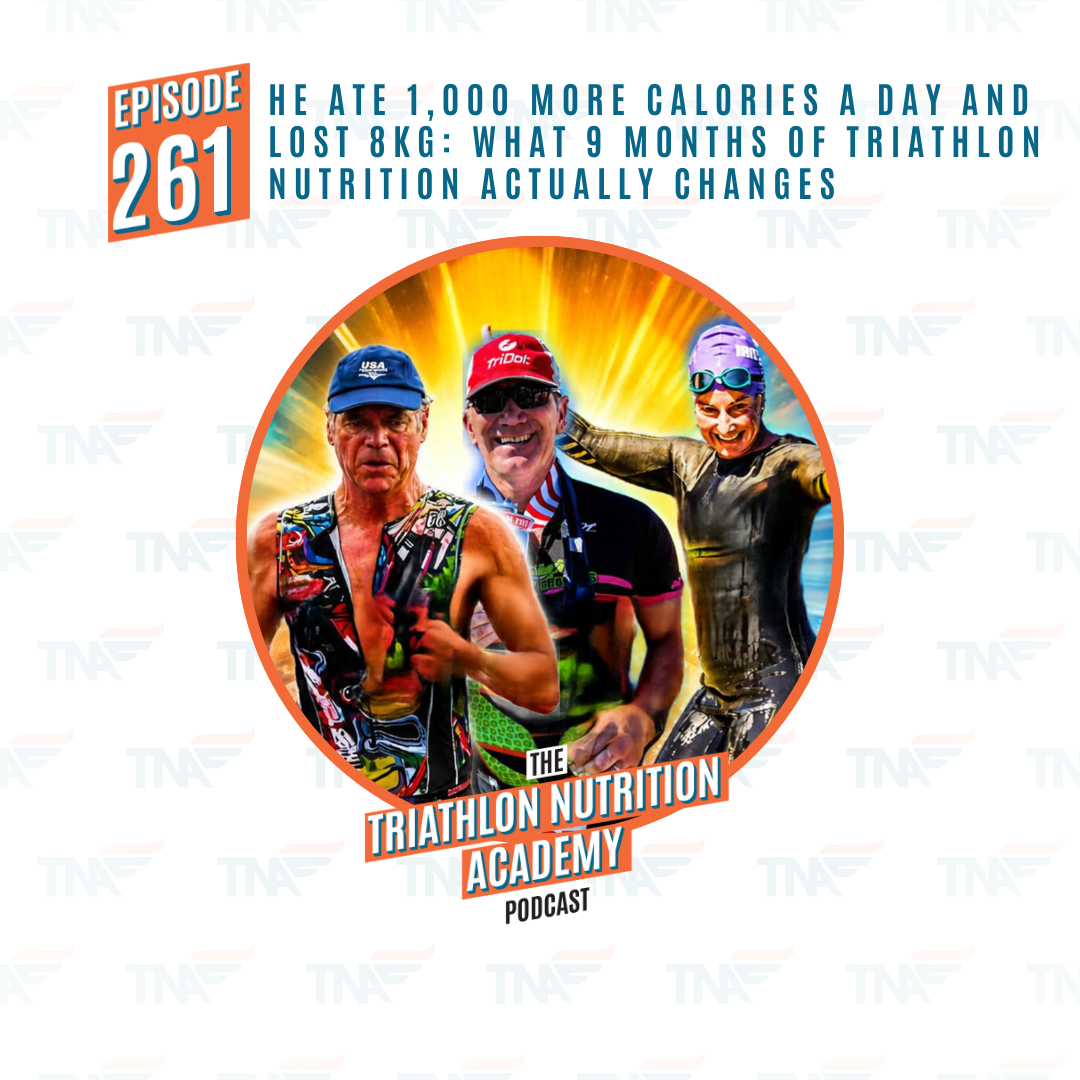
Episode 261 - He Ate 1,000 More Calories a Day and Lost 8kg: What 9 Months of Triathlon Nutrition Actually Changes

What happens when you eat 1,000 more calories a day? For Curt, a 54 year old triathlete from Texas, it meant losing 8kg, ditching the daily nap and finally making it through a training day without bonking. That is not a typo, and it is not a fluke.
Nine months ago, three brand new Triathlon Nutrition Academy athletes came on the show a few weeks into the program to share what it is really like on the inside. Now Curt, Jade and Steve have finished all three phases and they are back. Three different athletes, three different decades of life and three very different starting points: a 39 year old mum of three from WA in her second Ironman build, a scientist from Texas who watched from the sidelines for 4 years while his mate got faster and a 71 year old from San Diego with more than 300 races behind him and no formal nutrition education until now.
WHAT YOU WILL TAKE AWAY
- Why Curt lost 8kg while going from around 2,000 to closer to 3,000 calories a day, and why underfuelling was the thing keeping the body fat on
- How Jade went from years of fasted sessions to fuelling every session, and what changed when she hit 90g of carbs an hour on the bike
- Why Steve calls nutrition free speed after 30 years of hand waving it, and how a race week plan changed 5 national championship races in 3 days
- The benefits nobody expected outside triathlon, from a happier marriage to more beach days and a kid who packs his mum's long run fuel
- What all three would say to the version of themselves sitting on the fence 9 months ago
Links:
Check how well you’re doing when it comes to your nutrition with our 50 Step Checklist to Triathlon Nutrition Mastery
Start working on your nutrition now with my Triathlon Nutrition Kickstart course
It’s for you if you’re a triathlete and you feel like you’ve got your training under control and you’re ready to layer in your nutrition. It's your warmup on the path to becoming a SUPERCHARGED triathlete – woohoo!
Connect with me:
To learn more about the Triathlon Nutrition Academy, head HERE | dietitianapproved.com/academy
See behind-the-scenes action on Instagram: @dietitian.approved
Follow along on Facebook: @DietitianApproved
Join our FREE Dietitian Approved Crew Facebook group
Enjoying the podcast?
Let me know what you loved about it and what you learnt by tagging me @dietitian.approved on Instagram!
Subscribe & Review in Apple Podcast!
Are you subscribed to the podcast?
If not, today's the day! I'm sharing practical, evidence-based nutrition advice to help you nail your nutrition and I don't want you to miss an episode. Click here to subscribe to iTunes!
Now if you’re feeling extra warm and fuzzy, I would be so grateful if you left me a review over on iTunes, too. Those reviews help other people find my podcast and quality nutrition advice. Plus they add a little sparkle to my day.
CLICK HERE to review, select “Ratings and Reviews” and “Write a Review” and let me know what your favourite part of the podcast is.
You're awesome! Thank you!
Episode Transcription
Episode 261: He Ate 1,000 More Calories a Day and Lost 8kg: What 9 Months of Triathlon Nutrition Actually Changes
Welcome to the Triathlon Nutrition Academy podcast. The show designed to serve you up evidence-based sports nutrition advice from the experts. Hi, I'm your host Taryn, Accredited Practicing Dietitian, Advanced Sports Dietitian and founder of Dietitian Approved. Listen as I break down the latest evidence to give you practical, easy-to-digest strategies to train hard, recover faster and perform at your best. You have so much potential, and I want to help you unlock that with the power of nutrition. Let's get into it.
[00:00:00] Curt: I went from eating around 2,000 calories or less trying to diet, and now I'm eating closer to 3,000 calories and losing a pound a week practically. And I'm stronger in my training, I'm stronger in my races, I recover faster. So yeah, it's pretty amazing that you can eat more and lose weight.
Taryn: It's just about understanding what's right nutrition for you in that moment. Six months ago, I introduced you to three brand new Triathlon Nutrition Academy athletes, and they at that point were only a few weeks into the program. And they shared what it's really like on the inside having just joined.
Well, these three have now finished all three phases and they're back to tell you what's changed. Jade is a 39-year-old mum of three from Western Australia, a health and PE teacher, and she is preparing for her second Ironman at Ironman Western Australia in Busselton in a few weeks time. She saved up for an entire year and had a secret bank account just to join TNA when she did.
Curt is 54 from Laguna Vista, Texas, and he watched from the sidelines for four years while his mate Kelly, who was inside the program, just got faster, and he used to constantly bonk and get really, really hangry. And Steve is 71 years young from San Diego and raced more than 300 times over a 30-year triathlon career.
And TNA is the first time he's ever really had proper nutrition education. These are three different athletes in three different decades of life and three very different starting points. Last time I asked them what nobody tells you when you join TNA, and today I want to see what they've achieved over the last nine months.
So welcome back, guys.
Curt: Hello.
Taryn: Hi.
Curt: Hello.
Taryn: All right, let's kick it off. What is one word that describes how you feel about your nutrition now compared to then?
Curt: For me, it's adaptable. I am way more adaptable. I can overcome hiccups as they arise. My day-to-day is adaptable. One of the first questions I asked you was, "Do we eat for today or tomorrow?"
And you said, "It depends." And, yes, it does depend. And that adaptability allows me to adjust from day to day, whether it's a hard training day today or a hard training day tomorrow.
Taryn: Adaptability. I love that.
Jade: For me, I am confident, more confident with what I am doing day to day and going into different training as well.
So that's been a huge one for me, something that I definitely didn't have at the start of the year.
Taryn: You've come in leaps and bounds in that. I feel like we've got still lots of room to go there, Jade.
Jade: Oh, yeah. Absolutely.
Steve: I also feel very confident. The uncertainty and vague areas in my nutrition approach in the past have been answered.
I have a very clear picture of what I need to do. We've done some race week nutrition plans that I've executed, and they've turned out very well, and I've seen an improvement in my training and my recovery.
Taryn: Nice. And so after 30 years of doing triathlon with no nutrition education, do you think you should have done this 30 years ago?
Steve: Oh, yeah, yeah. I should have quit reading Slowtwitch or whatever my mates were doing and just taken some really good advice, and you have given me some really excellent advice and excellent education on what I need to do.
Taryn: Awesome. Thank you. All right, Curt, when you first started, when you were last on the podcast, you told us that your wife is just so sick and tired of you bonking every couple of hours and getting hangry.
How is that going for you now?
Curt: Well, it's much better. I'm still married. I can make it through the day without bonking now, and when I do, I can look back and see where I messed up. I understand how my nutrition throughout the day affects me better than I did before, and it's not a mystery why I'm bonking.
Now I know why I was bonking, and now I can see when I do bonk, "Hey, you missed a meal. You got distracted. You didn't eat properly in the morning. You didn't eat properly after a training, and that's why you're in this situation," and now I understand it. So I feel pretty confident moving forward that there will be far less of those times.
Taryn: Tick, tick and tick. And what else has changed for you, Curt, over the last nine months?
Curt: Well, Kelly told me that I wouldn't need a nap after every training. And I thought he was full of it, but I don't hardly ever nap, and I kind of miss it.
Taryn: You can still take a nap if you want to. It's just as long as it's not a "I need this or I'm going to, like, fall into a massive hole."
Curt: Yeah. Especially the recovery meals, that eliminates all that fatigue you feel after a hard workout, and it's pretty amazing to go from needing a nap after every major workout to, you know, I hardly ever take a nap now.
Taryn: Think how much time you've just gained.
Curt: Yeah, at least an hour a day.
Taryn: Yeah, that's a lot. And you're being humble too, because you've also lost eight kilos while eating more, and all you did was really eat well for triathlon and added a daily dog walk.
Curt: That's amazing. I went from eating, you know, and we don't measure our food in calories, but I went from eating around 2,000 calories or less trying to diet, and now I'm eating closer to 3,000 calories and losing a pound a week practically, and I'm stronger in my training.
I'm stronger in my races. I recover faster. So yeah, it's pretty amazing that you can eat more and lose weight.
Taryn: Yeah. It's just about understanding what's right nutrition for you in that moment. For you, you were significantly under-fuelled, hence the bonking and getting hangry all the time, but trying to drive some body fat loss.
And so mentally, we think that's what we have to do, but sometimes you just need to eat a little bit more and let your body relax so it can let go of that body fat tissue, because it's no longer just in this heightened stress state all the time. But it's really hard to get your head around.
Curt: Yeah. I didn't believe it at first when you laid out what I should be eating.
Taryn: Now look at you go.
Curt: Yes.
Taryn: So what does a normal training day of nutrition look like for you now compared to what it did before? Other than no longer needing that nap, what are you doing differently with food?
Curt: Well, the pre-workout meal, I don't train fasted, so I always have a pre-workout meal.
The post-workout meal. Each meal has a goal of what to, you know, or targets to hit for protein and carbohydrates. I don't follow the fat as much as I probably should, but the two things that I look for is the protein and carbohydrates, and hit those numbers. You know, if it was a hard workout today, eat a little more carbohydrates to top up my glycogen.
If it's a hard workout tomorrow, there again, you eat a little bit more to top up for that. And then you have your normal days, which, you know, now it's pre-workout, post-workout, lunch, a healthy snack and dinner, and that's it. I'm ready for the next day.
Taryn: Amazing. How long do you think it took you to get there mentally, to have that laid out and organised to the point where it's just habitual now?
You don't have to think about it or overthink it, second-guess things. You now just know that this is what I'm doing and it's going to be enough.
Curt: It's funny because, you know, you go through the class and we forget where we were before because it's become natural for us. And we've come so far. And working out with other triathletes that haven't been in this class, that reminds me of, you know, where I was before.
But it's easy. It's easy to follow. We don't have to feel bad if we don't hit our targets that day, because there's nothing punitive. We learn from our mistakes every day and we move on, and so it's not judgemental. It's fantastic that way.
Taryn: I think that's really good advice for a triathlete, because we are such high-achieving beings that everything needs to be perfect always, and otherwise we spiral.
Curt: Yes.
Taryn: Now Jade, you were really worried about how you would fit it all in around, you know, working four days a week, having three young kids with all of their sporting commitments, and all while doing Ironman training. How did the time commitment for you actually play out across all those three phases?
Jade: Yeah, it was definitely a juggle, but it was something I enjoyed doing because I could see the benefits that it had with my training, and not just the training but how I was able to show up in life outside of training. Some weeks and some months were easier than others, but it's always there for me to come back to.
I'm still catching up on a few little things, but I sort of picked up where we were at, or I went back to something that felt important at the time. Yeah, so it was definitely achievable and manageable, and I'm so glad that I did it and I didn't hold back.
Taryn: Me too. Now can we talk about the secret bank account a little bit?
Because, you know, looking back, investing in yourself as a mum is really hard. Like, we look after everyone else first, and I know a lot of people will resonate with that. Was it worth the investment in yourself to do this, both in time and financially?
Jade: Showing up for me by doing this and giving myself the knowledge not only gave me back energy to be with my family and to do all my training, but it's empowered myself that I can have all this extra knowledge, and I have something for me that I really enjoy doing and getting out of.
And, you know, sometimes I think as mums we can kind of get stuck in the everyday routine of things. We limit ourselves by not going for something that we're really excited about or really want to get on. It definitely was a great investment into not only giving myself energy and being able to fuel training, but also to feel like, you know, I'm achieving something for myself that I'm really interested and invested in.
Taryn: I think it's so important that we do things for ourself. You just got to get over that hurdle of not looking after somebody else first. It's time to focus on you. Because you're the bus driver, right? If you go down, the whole bus goes down.
Jade: That's it.
Taryn: You used to go and do training sessions on nothing at all, a lot of fasted training because you were so worried about getting sick and how that was going to feel in your tummy when you were doing a session.
How's that going for you now?
Jade: I actually can't believe that I'd spent so many years training in that way. It's so different for me now. Every session is pre-fuelled, and then fuelled during training, and the difference is huge. And then it's also a recovery fuel straight after, not two hours or three hours or just something here and something there, which I know that I was doing just over 12 months ago.
I just wonder how I was ever getting through without having all that fuel and energy in the bank. So yeah, hopefully results will show.
Taryn: Is your son still helping you with your recovery meals?
Jade: Yes, he is. He's always sort of coming out and asking if I'm on the bike, "Oh Mum, what can I do? How can I help?
I'll make you breakfast. What do you need?" So yeah, it's a journey for the whole family, and they're very active too, so we talk about when they have to go to sports, like what we need to do and how we can make sure they've got energy in the bank for what they do. So yeah, it's a whole family affair.
Taryn: I love it.
I've even seen him carrying your nutrition out on long runs recently.
Jade: The whole family is on board. They now want to come along. And yeah, so I stack the backpack full and then off we go.
Taryn: So good. Steve, you said you'd always just kind of hand-waved the nutrition part of things. You've been doing triathlon for 30 years, and you've probably made every mistake under the book.
What do you think has been the biggest mistake that you've now stopped making?
Steve: Being really inconsistent in how I fuelled workouts and recoveries. Like Curt said, I know what to do to fuel every workout. I know what to do for recovery for the workouts. Because of that, I've noticed I'm getting a lot more consistent high quality out of my workouts.
And during the race weeks that I've had, I'm very confident that I'm eating the right things so that whatever hurdles there are on race day, nutrition is not going to be one of them.
Taryn: And are you still crashing out on the couch after long rides like Curt was?
Steve: No. No, no.
Taryn: Not at all?
Steve: No. No. No.
I mean, sometimes later in the evening maybe. But, you know, during the workouts, no, or right after the workouts, not at all.
Taryn: That's so good. You used to call nutrition free speed, and that was right in the beginning when we'd only just started. Do you still call it that and still refer to it as free speed, or have you got a different term for it?
Steve: No, I still think of it as free speed. I was talking to Mark Allen about an article he wrote where he said that triathlon is a report card on your swim, bike and run, how well you train for all of them. And we talked about how maybe nutrition and recovery, which is very closely tied to nutrition, are two other parts of the report card.
So yeah, I think it is free speed. I think if, for a multitude of reasons, you're fuelled correctly on race day, you've had better quality workouts, you've been able to be more consistent. You've taken one more level of stress off your race because you've got 1,000 things you're worried about on race day, but if you have your nutrition plan nailed, that's one thing you're not stressing out about.
Taryn: Yes. One of our athletes just raced Nice at Worlds, and he said, "I've got my fourth leg so dialled that I don't even have to worry about it anymore. All I have to do is worry about swim, bike and run, and that's it." So one of the things you raced over the last nine months, Steve, was Multisport Nationals.
It was the five national championship races in three days, and it's something you've done before and never had a nutrition plan for before. Last time you said it was just a suffer fest and it usually is a suffer fest, and then you go to the pub afterwards to celebrate and, you know, drown your sorrows.
We built a plan specifically for that event this year in Power Hours. How did it go?
Steve: Actually, you spent a fair chunk of one of the Power Hours going over that race week nutrition plan with me and helping me really dial it in. I followed it real carefully. Yeah, I've done these many times in the past, and by the time I get around to that fifth race on the third day of the days I'm doing races, I'm usually just kind of dragging my butt through the race.
This year I felt really good all the way through, nutrition-wise. Yeah, I didn't feel like there was any lag in my energy levels. I felt really good, and I did really well, so I'm very pleased with those results.
Taryn: What did you learn from that, that you're going to take into next year's event?
Steve: So next year I'm actually going to do some longer course events, but what I'm taking is knowing through my experience that following the guidelines, the advice, the tools that you provide with this as part of the course, that I'm really confident that I'll be able to nail the nutrition both for the training and for the race weeks.
Taryn: What about you, Curt? Last time you were watching other athletes race with no plan and just hated it. What does race day look like for you now?
Curt: Well, for me, there's definitely a plan which starts one to two days before the race now, instead of one meal before the race. And then, like Steve said, there's a plan for the whole day, and I don't have to worry about it on race day because I've taken care of it weeks in advance.
I made the plan. The only thing I do on race day is fill the bottles with the recommended amount of stuff, and I've got that planned. And then it's also broken into an adaptable plan, which was really rigid for me before. I had to drink so much an hour so I got my fluids and my nutrition.
[00:17:00] Now that's separated. I know how much fluids I need. I know how much fuel I need. Those are two separate things that I take in at two different times so that if it's a cold day, I don't have to take in a bunch of fluid that I don't need to get my carbohydrates in. So that's been fantastic. It's still such a struggle to watch other athletes on race day fumbling around, mixing, you know, "Maybe I'll put two of these in my bottle today instead of one."
I'm like, "Never try anything new on race day." That's the mantra of all triathlon, I believe. But there's no plan most of the time, and it's really hard and I hope that we can talk more people into joining TNA so that I see less of that on race days.
Taryn: Yeah. It doesn't make any sense, does it?
Like, we put so much time and effort into all of our training and spend so much money on the event, to not have a nutrition plan just blows my mind, but it is still happening at every distance, and it's crazy. So Jade, you're heading to Ironman Western Australia again at the end of the year for the second time.
The big, hairy, audacious goal is sub-13 hours.
Jade: Yeah.
Taryn: Yep. How are you feeling about that, and how has this build been different to last year's build?
Jade: It's still a scary goal, but they're not big goals if they're not scary. So at this time last year, I had listened to lots of your podcast.
I had listened to one about fuelling and being like, "You need to be on it, like, now." I was like, "Right." So I just was ordering different gels and was just gambling everything and not having a plan at all. So yes, I was trying to increase some carbs and actually just get some fuelling in, but there was no method to what I was doing.
So this year is completely different. Every trained fuelling session has a plan and has a reason. Yeah, that, for me, has been difficult because I'm really cautious with the nutrition side of things because I'm always super worried, and I like to stick in a comfort zone. But yeah, this build-up to Ironman, I've definitely smashed out the comfort zone, sitting well above what I thought I was capable of, and that feels awesome.
Last week, I went well above, which I probably was meant to go a bit slower, but I went well above and proved to myself more than anything that I was capable of doing a lot more than I give myself credit for, and that felt awesome. And it not only felt awesome being able to still have lots of energy on the ride and the run, it felt awesome mentally knowing that, yeah, I'm capable of a lot more than I give myself credit for.
Taryn: Yeah, girl, you are. Sometimes you just have to be given a gentle nudge.
[00:20:00] Jade: Yes.
Taryn: Well, Busso's, what, two months away-ish. We won't talk in weeks. We might freak you out. But you already have your race nutrition plan written out.
Jade: Yeah.
Taryn: So completely different stage compared to last year's event. You know exactly what it'll be with some tweaks that might happen over the next couple of months.
Like, how does that feel to have that already done in terms of taking away that mental load?
Jade: Yeah, it feels amazing. Last night, I actually, I was going to send you a picture, I came across my scribbled bit of paper that I was sitting down the day before Ironman. Like, I'd had a very rough, but I was sitting down, and I was planning out hour by hour, you know, handwritten, finding out sodium, finding out carbs per hour, figuring out...
And I kind of just laughed last night to think, "Oh my God, what would Taryn think if she saw this compared to what we're doing now?" So yeah, this is a huge, huge difference. Like, we're months out. I'm now getting comfortable with what I want. I'm trying new products so that, you know, they're suiting what we need so we can push above and beyond what I thought was possible.
I now don't look at foods and think, "Oh, no, my body doesn't like that." It's probably because I was overdoing something or underdoing something, which is why my body responded like that. So it's been awesome to understand and gain confidence with the science around why things happen or why our bodies react and don't react the way that they do.
Taryn: I think knowledge is power. When you actually understand stuff, it's just so much easier, because one of the things that you struggle with is paralysis by analysis, and I know a lot of triathletes are the same. There's just so much going on and it's so overwhelming and it's so confusing because we're not devoid of information, it's just filtering that down into what do I actually need for my body and my race.
So much so that you were, like, skipping strength sessions because you were just overthinking the macro timing and what do I do for pre, what do I do for recovery, and this is all just too hard.
Jade: Yeah, the information overload sometimes, you know, from all the outside sources can just be a lot, but the Power Hours are just invaluable being able to ask those questions, run products by you, and then understand how they...
Like, it's not that they won't work, but how they can work, or how they can fit, or is there a better option? And I have swapped a few things over and, yeah, I've loved that I've made the changes for that.
Taryn: So what's the difference between a year of Ironman prep just by listening to this podcast versus a year of Ironman prep where you're actually inside the TNA program and you have access to me most weeks in Power Hour?
Jade: The year just listening to the podcast was great, but there was still a lot of guessing. This year has been amazing because we get to individualise our plans. We get the knowledge.
You do the podcast so well, where you leave these little crumbs, and it just leaves you wanting more. So we really get to dive deep into all that information and personalise it to ourselves, to our, you know, age specific, body mass, lean body mass specific, race specific. Like, it's not guessing anymore.
It's not a gamble, and like you said, you spend so much money on all the equipment, on all the race day, it's crazy to just leave it up to a gamble with what you're putting in your body, which is what you ultimately have most control over on the day in all the variables that can happen. So yeah, it's been invaluable.
Taryn: I, like you, am a high achiever, and I don't like doing things in halves, and so it's against my whole ethos to give somebody really specific information on the podcast when I don't know anything about you. But once we spend some time together and I know what your life is like and, you know, that you have three kids and mornings are chaos and you go to school sport in the afternoon, I know you, then I can be so much more prescriptive because otherwise it's an "it depends" situation, which is, you know, helpful but not helpful.
For everyone, we cover race nutrition in phase two and phase three of the program. We dive deep in the academy on all things race nutrition, from carb loading, to pre-race meal, to caffeine, to what you're doing on the bike, what you're doing on the run, your sodium hydration. Like, all the elements that go into your race nutrition plan, we tackle each one specifically and figure it out for you and your event.
For all of you, what do you think is the thing that changed the most now with how you fuel and race after you've had all of that education?
Steve: The confidence of knowing that you've got this part of the race and the training nailed. And, you know, doubt can be a horrible anchor that drags you down and slows you down in racing. Removing that doubt lets you focus a lot more on the race, on your physical performance and your mental performance.
And it's great to have that weight lifted off of you in terms of nutrition and hydration.
Curt: You know, listening to podcasts and getting snippets of what you need and general rules of thumb, that's all great. It got me to my first few finish lines. But now understanding what it all really means, like, you know, I'm a scientist by trade and when we get to geek out with you about how carbohydrates move across into our bloodstream and only so much of this carbohydrate can make it across in an hour, so you've got to use other carbohydrates.
And I had been using a starch that needs to be broken down once before it can even start crossing those paths. And understanding all that, it just makes it so much easier to plan our day on race day and then be effective instead of, like, I was filling up with starches and then by the time I was on the run, I was so full of undigested starch that I could barely walk, let alone run, and I had no idea why. And now I've planned it out for each type of starch that can move across from my gut into my blood, and that makes everything available, you know, on time and on purpose.
Taryn: Do you want to add anything to that, Jade?
Jade: I just think that having, again, the confidence to know that what you put into your body isn't going to have a negative effect because you've thought about it, it's not just a gamble. And yeah, you're not left feeling gross during the race or during training or after training because you know what you're putting in.
It's not just whatever. And once you've got the knowledge, you just can't not do it. So it becomes habitual, which is so good.
Taryn: No excuses. So I'd love you guys to share some of the things that have happened or what's changed for you outside of triathlon and racing, because we spend so much time talking about training nutrition and racing nutrition, but I'm very much a dietitian and holistically like to improve people's lives.
I can't help it. So what has changed for you that's got nothing to do with triathlon?
Jade: So, yeah, busy household. It's been a bit of a whirlwind, and it's been trial and error, but things that we've done or that I've done to benefit everyone is smoothie bags. So just chopping everything up or having it ready to go in the freezer so it's always there has made mornings and those recovery meals super easy, on the go, get everything done.
I've been using the pressure cooker a lot, the slow cooker, and double batching meals so that there's either leftovers the next night for busy nights or the next week. So tonight, I double cooked my carb-loading meal last week, so it's out, thawing out, ready to go for tonight.
Taryn: Yes. Those things make a huge impact when we don't have much time. Like, I don't believe in spending six hours meal prepping on a Sunday. It's just little habits and behaviour changes that can happen in the week to look after future you and getting it all working seamlessly without having to slave away for hours trying to prepare it all.
Curt: So I've noticed that, you know, even my relationship outside of triathlon with my wife has improved because I'm not bonking and I'm not hangry all the time. And she, you know, walks into the kitchen while I'm making breakfast and she's like, "What are you putting on your eggs?" I'm like, "Well, it's spinach.
Taryn says we need to put vegetables in every meal." She's like, "Who is this and where's my husband?" So yeah, outside of triathlon, I think, you know, by being not hangry all the time, it's actually improved my relationship with my wife.
Taryn: Oh yeah, side benefit, decreased risk of divorce. I like that one.
Steve: I think because I've been able to train better and because I don't bonk after training, because I know how to recover, I've been able to go to the beach more often. When I started really diving into triathlon a lot, I gave up the other sport I did most of my adult life, which was surfing, and it seems like the number of days I would get to the beach, just even going to the beach and sitting on a beach, dwindled down from six days a week down to a couple days a month.
So now I have the energy to go to the beach more. And that might not sound like much, but, you know, when you're 71 years old like I am, it is a big deal to have the energy to go do all that. So I like that. I like that doing this not only has helped with the triathlon, but triathlon's just a small part of my life.
It has not impacted the other parts of my life. In fact, it has helped the other parts of my life. You know, we've got another grandchild now, so we've got seven of them now. It takes a lot of energy when all those little critters are running around the house, playing and yelling, and you've got to try to keep up with them.
So I really appreciate that aspect of the training as well.
Taryn: Yeah, you want to have energy to swing your grandkids around for plenty of years to come. Because you want to be racing in your 90s, don't you? Is that the goal?
Steve: Yeah, yeah. My parents both lived well into their 90s, and they didn't take care of themselves, exercising or caring about nutrition or anything.
So there are no guarantees, but I think that the path is there for me to get to my 90s in good health and good fitness.
Taryn: Yeah, you've got all the right foundations in place. One of the things you do do is strength training, and we've talked about, you know, protein timing and getting your food right around that to maximally support the benefits of strength training, particularly as we get older.
What has that done for you now as a 71-year-old athlete?
Steve: A couple of the local races that I showed up to here early in the summer and up through August, some of the guys I race against every year came up to me, and they kind of looked funny at me, and they're like, "What have you been doing? You just look bigger now."
Taryn: In a good way.
Steve: Yeah, in a good way. And other people said the same thing. But, you know, my weight hasn't changed, but when I'm doing my strength training, I have lots of energy for it. I'm taking the protein when I'm supposed to. Depending upon the weight session or the strength or yoga session or whatever, recovery is appropriate.
And I'm seeing good results from it. And other people obviously are seeing the same result if they come up to me and they say something like, "Damn, boy, what have you been doing?"
Taryn: That's hilarious.
So what have you guys learnt about yourself over the last nine months that you maybe didn't expect? Something that you go into a nutrition program and you think, "Okay, I'm going to learn how to eat for this sport," but what is something else that you've taken away that you just didn't expect to happen?
Steve: At my age, I can still put my ego aside and learn to think about something differently, and it's not always easy to do that because I can be really stubborn. But I think that's a really important component to getting something out of it. You know, if you go in and you're unwilling to examine your beliefs and learn new things, you're probably not going to get as much out of it as if you have an open mind and, you know, okay, let's measure the results, and that's what it really comes down to.
What can you measure? Not just what do I feel is better. Gosh, I feel like I should just eat this or that. Instead, measuring what I'm doing, having a plan, seeing it executed, and seeing the results.
Taryn: So you can teach an old dog new tricks, Steve.
Steve: Sure can.
Taryn: What would you say then to experienced triathletes who are in a similar boat to you, have been doing triathlon for a really long time and think, you know, "There's nothing new that I'm going to learn here"?
Steve: Any time somebody in any endeavour in life says, "There's nothing more for me to learn here," those assumptions need to be challenged. I would say to those athletes, "You should give it a try." You know, whether it's just dipping your toe in the water for a few days at a camp perhaps, or listening to the podcast.
But why not, once you get a little taste of it, why not just go ahead and sign up for the course and learn what you're going to learn?
Taryn: As long as they're not in your age group.
Steve: Yeah, yeah. Well, of course it doesn't work if you're 71 years old, but yeah.
Taryn: 70 to 75, stay away.
Steve: Yeah. It was still pretty competitive, I've got to say.
There are a lot of guys, I'm like, "When are you going to retire?" He just won't quit, but I won't either, so there we go.
Taryn: Yeah, exactly. They're probably the same mentality as you. They want to be doing this for a long time, so they ain't going anywhere. You just got to figure out how to beat them.
[00:34:00] Steve: That's part of it. The social aspect is a big part of it, too. And so in terms of nutrition, keeping yourself healthy, keeping yourself in the sport also means you get to spend more time socialising with friends, people you've known for many years, and that's a dimension of endurance sports, triathlon, other sports, that I think is often overlooked.
For me, there's a really important socialisation aspect to it, and I don't think that should be overlooked.
Taryn: Mm. Yeah, community, so important.
Curt: Well, I've learned that I can't grit my way through training, that nutrition is a huge part of getting through training and then reaping the benefits of that training.
I feel so much better during my training sessions now than I did before, and I recover faster. And the results may not be there quite yet, but I really have... I think I can take this a long way.
Jade: Yeah, I think for me, I just learnt that I'm a lot more capable than what I give myself credit for, that I limit myself with the fear of things that could or might happen, and I've done that for a really, really long time, for many years, and not just training-wise.
Like, even just drinking milk, I remember I didn't like milk when I was a kid, and I've really avoided that until now, and you've shown me and given me ways to introduce that, and now I'm fine. So yeah, it's been a long time where I've, you know, limited myself to, "I can't have all that because I'll feel sick," and worry and stress about what might happen.
And this past nine months I've really stepped outside of those feelings and fears and, yeah, doing things that I honestly didn't think. Even last week when we were talking about getting to 90 grams of carbs per hour on the bike, I was like, "Mm, no way." That was Friday. Well, by Saturday I was doing that.
So yeah, just breaking those limitations has felt awesome and showed me that I am way more capable than I think I am.
Taryn: Yeah, than you give yourself credit for. Absolutely.
Jade: Yeah.
Taryn: Just shove you out of your comfort zone a little bit and you're going to fly. So given everything that you've learnt and how you're performing in training and racing, if you could go back now and tell yourself nine months ago when you were sitting on the fence thinking about it, or, you know, Curt, you've been thinking about this for four years now, what would you say to that person?
Curt: Well, I would definitely say do this class before you attempt your first Ironman, and you'll have way more fun.
Taryn: Good advice.
Jade: I sat on the fence for a whole year. I did the little pre-thing in January, and I still was umming and ahing, and that was going into the year of my first Ironman. And now I sort of sit back and reflect and, like, sort of wish I had of had all of this information last year so I could've been in this position this year.
And then going into my second one, I'm really just dialling everything in, and it's just to really fine-tune the last little bits. But maybe that just means another one down the track. Just not next year. I promise, not next year.
Steve: I went into this with high expectations, and I have to say the course exceeded those expectations, so I'm very pleasantly pleased.
For me, it's been worth it, absolutely worth it, and if I had to go back and tell myself at some point to do this, I wouldn't hesitate at all. I'd say, "Look dummy, sign up for it. Do it. Just do it. You're going to be so surprised at what you learn," and very pleased with the results.
Taryn: So is it worth the investment?
Steve: For me, it was absolutely worth the investment.
Jade: Absolutely.
Curt: Most definitely.
Jade: It's definitely worth the investment. I mean, you're investing hours and hours a week doing the training of triathlon. It takes up so much time in your life. It's really a lifestyle, so if you're going to invest your time and energy into that, then invest into making sure you're performing at the best you can, and giving yourself all that you need to get through everything.
I think it really seems like a no-brainer, and, yeah, I just wish I had of, A, jumped on board quicker, and B, discovered it way earlier, because I think, yeah, the knowledge I've learnt has just been amazing. And coming from a dietitian, it's so trustworthy. I don't question anything, but lots of people just rely on that social media, and it...
Who does it come from? Where does it come from? So yeah, definitely worth the investment because all the information you get is the right information and the knowledge that you can continue to use going forward. It's not just the 12 months that you're in the academy. You take it with you beyond that.
Taryn: Yeah, for life. We're lifers.
Steve: I thought of something else I'd like to add. There was no gatekeeping during this course. There were no, I think, assumptions on your part, on Taryn's part, and there was a lot of acceptance of everybody doing what they can and trying to coach people to do better. And for me, that's extremely positive, and it's a real reflection on Taryn and the way she teaches the class.
Taryn: Aw, thanks Steve. Yeah, once you're inside, there's no gatekeeping. You get access to 20 years of experience and six years of university-level study, and we will find a way to get to the bottom of whatever's going on, one way or the other.
Jade: Yeah, I second what you say, Steve. I think, you know, last week I had my plan ready, and it wasn't perfect, and I was...
I literally sat there the night before, and I was so stressed over do I put it in or it's not right, it's not finished. But Taryn's created an environment where I felt, you know what? Just put it in, and we'll just talk through what we can. And then we had the discussion, and I was like, "Oh, thank God I did this," because otherwise I would've just been holding onto it, and I wouldn't have got anywhere near what I needed to, and I wouldn't have tried it all the next day.
So the environment that you create inside Power Hour and the Academy is really safe, and there aren't any silly questions. And, yeah, it's a really enjoyable space to be part of.
Taryn: Oh, I miss you guys.
Curt: I can't back up what Jade and Steve said any more or any better than they did. You know, I learned so much last week when Jade was asking her questions.
I took, you know, a whole page of notes. And, you know, some days I felt like I was taking up too much time in Power Hour, and then somebody like Louis says, "Oh, hey man, you covered everything I was going to ask." And it's such a, we all grow together for the nine months that we are in TNA together, and I actually look forward to seeing everybody somewhere down the line at some race.
So I think I'll hopefully see everybody sooner or later.
Taryn: Santa Cruz 2027, Curt.
Curt: I'm going to try and make it there. I don't know in what capacity, but I will try and make it.
Taryn: We're getting together lots of teams, so there's no pressure, or you could just come for the fun.
Curt: That might be what I do.
Taryn: Okay, so team, so what is the next big, hairy, audacious goal? Like Jade, you've got an Ironman in a couple of months. Goal is sub 13 hours. Curt, you want to be doing an Ironman on your 60th and 70th birthday. And Steve, like Team USA and Worlds. What have you guys got in the pipeline now that you've got a really solid foundation with your nutrition?
Steve: Next year I'm going to do Rock 'n' Roll Marathon. I'm going to do a 70.3 at some point during the year, and I have the world championship race in Edmonton in July, and I'm looking forward to all those events.
Taryn: Nice.
Curt: I'm looking forward to doing a 70.3 next summer, probably Coeur d'Alene. Some of my local sprint and Olympic tris.
And building a better foundation physically. You know, building it with the nutrition that'll back up the training.
Jade: At the moment for me, it's just all focused on December. But yeah, for next year, I'm not sure. I'm turning 40 at the beginning of the year, so I've kind of gone with a rest, reset and re-strengthen motto for the next year.
But knowing me, that will also involve some races. Probably more short course, but I look forward to actually putting the short course nutrition into practice because, again, I've done many sprint distance and not at all fuelled during them with anything but water. So yeah. Looking forward to doing some of the short course and putting those strategies into practice.
Taryn: And has anybody got in the back of their mind something extra crazy that they want to do and tackle now that you've got the nutrition on board?
Curt: Well, I, you know, I don't want to commit to an Ironman anytime soon because I don't think I can put in the actual training time because I'm going to do some travelling.
But man, I could trip up and sign up for a full distance pretty easy.
Taryn: Okay. That's pretty good now that you're no longer bonking and your wife's happy with you. Happy wife, happy life, Curt.
Steve: My coach has been saying, "Let's pick some races next year," like I mentioned a marathon and a 70.3. "Let's pick some races that suit you the best from a course perspective, and let's see if you can't qualify for the world championship."
Taryn: Nice.
Steve: So that's the bar that she wants me to get above.
Taryn: Okay, I'm here for it.
Jade: I haven't dared to think, because once I get something in my head, I kind of don't let it go, and, yeah, we need to keep this family together at this stage.
Taryn: Yep.
Jade: No, it's a busy time with the build and all the training that's going on, so I think for me it's keeping those thoughts to the side and maybe letting hubby slip into some training space, but I'm sure down the track there'll be something.
Taryn: Sounds good. I won't pressure you to do an Ultraman or anything like that, Jade. Oh, you guys are legends. Curt, Jade, Steve, thank you so much for coming back and sharing so openly about what you've done over the last nine months.
Like, I've given you the education and the tools, but you guys have absolutely just run with it, and it's been so awesome to watch what you've achieved in such a short space of time, and also watch you in the future. What I love about these three is that nine months ago, before they joined, they all had excuses around, you know, why they should wait to do it.
Like, whether it's time or money and needing to start a secret bank account, or, you know, maybe thinking that I don't need to do this at this stage of my career, I've already got enough, it's not really going to benefit me that much. And today not one of them is talking about the cost of that, they're talking about what's changed both in triathlon and also outside of triathlon.
You know, their races, their energy at work, their ability to recover fast, Steve's ability to get big, in a good way. As well as the side benefit to the household and, you know, the kitchen and the food prep and the other benefits to your entire family. Nutrition isn't something that you can fix in a week.
It's also not something that you can fix properly for yourself for life by picking up little free nuggets and tidbits from, you know, AI or podcasts or YouTube. It's something that you learn, and then you practise it, and then you make it your own, and that is what the Triathlon Nutrition Academy is built for.
It's not a macro tracking app that you don't understand, and it's definitely not a one size fits all quick fix. It's nine months learning how to fuel your body for your own training with me and a group of other legends like these triathletes, just like Curt, Jade and Steve, all beside you. Making the same mistakes, we're all failing forwards, and we're learning and doing this together.
So if you want to join us, head to dietitianapproved.com/academy. Thank you, team. I'll see you soon, and good luck at Busso, Jade.
Jade: Thank you.
Steve: Good luck, Jade. Thank you. Goodbye.
[00:47:00] Curt: Thanks.
Thanks for joining me for this episode of the Triathlon Nutrition Academy podcast. I would love to hear from you. If you have any questions or want to share with me what you've learned, email me at [email protected]. You can also spread the word by leaving me a review and taking a screenshot of you listening to the show. Don't forget to tag me on social media, @dietitian.approved, so I can give you a shout out, too. If you want to learn more about what we do, head to dietitianapproved.com. And if you want to learn more about the Triathlon Nutrition Academy program, head to dietitianapproved.com/academy. Thanks for joining me and I look forward to helping you smashed in the fourth leg - nutrition!