
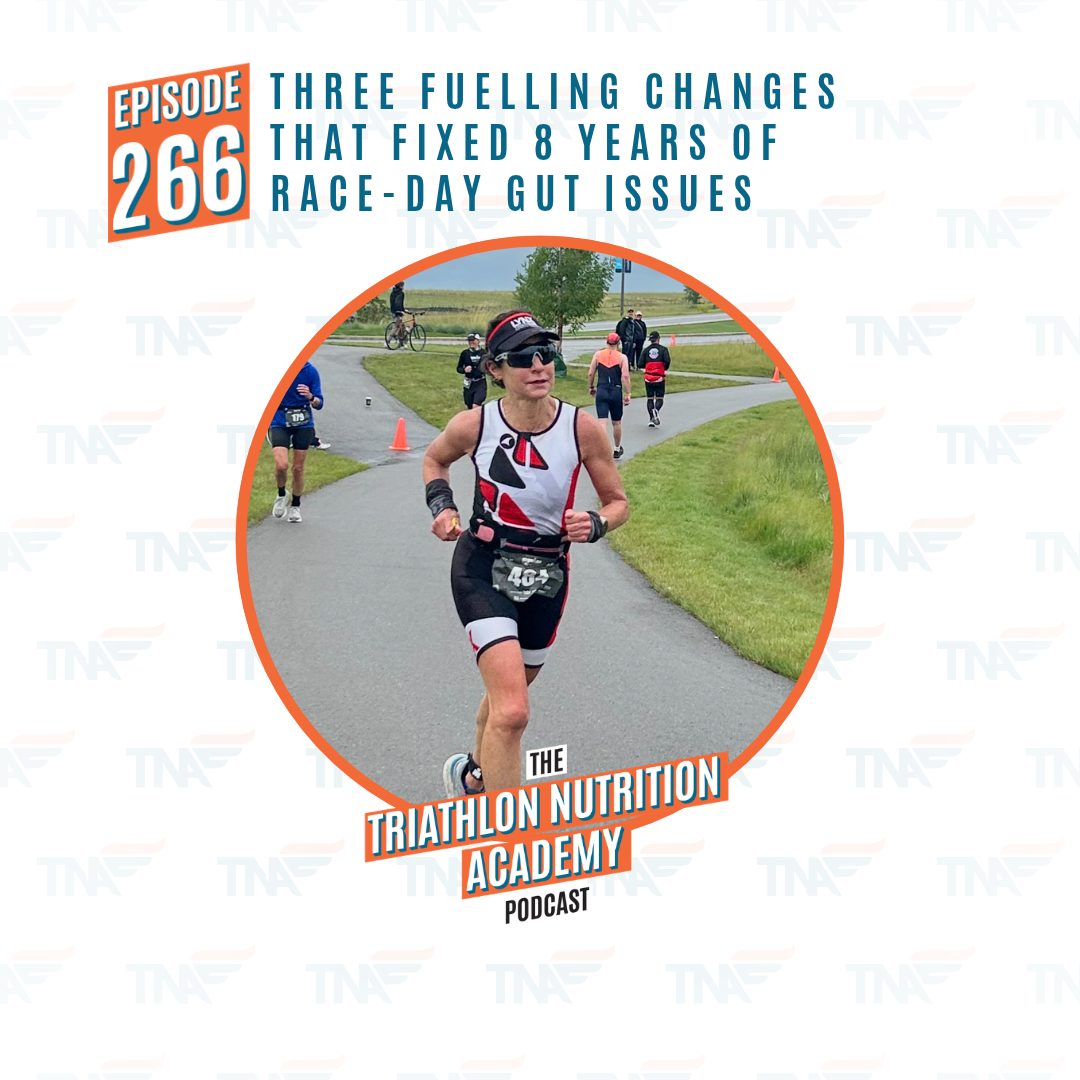
Episode 266 - Three Fuelling Changes That Fixed 8 Years of Race-Day Gut Issues

Race-day gut issues followed Marie Stevenson through 8 years of triathlon, and she’s a family doctor. So how did she race the IRONMAN 70.3 World Championship in Nice without them?
Marie is a family doctor from Calgary, Canada, who has been racing triathlon for 17 years. She thought her nutrition was great, yet for 8 of those years she planned every run around where the portaloos were. She shares what she used to eat on race day, the everyday fuelling gap she had no idea she was carrying and the 3 changes she credits for her first race without gut issues in 8 years. She also explains how she rebuilt her carb load in a foreign country when the bag holding her race food was stuck in Amsterdam during race week.
WHAT YOU’LL LEARN
- What Marie ate on race day for years, and why it kept letting her down
- What 8 years of trial and error did and didn’t fix
- The daily fuelling gap hiding behind a diet she believed was great
- How she rebuilt her carb load when her race bag went missing before 70.3 Worlds
- The 3 changes she credits for racing Nice with no gut issues
- Why it’s never too late for a masters athlete to change how they fuel
Links:
Check how well you’re doing when it comes to your nutrition with our 50 Step Checklist to Triathlon Nutrition Mastery
Start working on your nutrition now with my Triathlon Nutrition Kickstart course
It’s for you if you’re a triathlete and you feel like you’ve got your training under control and you’re ready to layer in your nutrition. It's your warmup on the path to becoming a SUPERCHARGED triathlete – woohoo!
Connect with me:
To learn more about the Triathlon Nutrition Academy, head HERE | dietitianapproved.com/academy
See behind-the-scenes action on Instagram: @dietitian.approved
Follow along on Facebook: @DietitianApproved
Join our FREE Dietitian Approved Crew Facebook group
Enjoying the podcast?
Let me know what you loved about it and what you learnt by tagging me @dietitian.approved on Instagram!
Subscribe & Review in Apple Podcast!
Are you subscribed to the podcast?
If not, today's the day! I'm sharing practical, evidence-based nutrition advice to help you nail your nutrition and I don't want you to miss an episode. Click here to subscribe to iTunes!
Now if you’re feeling extra warm and fuzzy, I would be so grateful if you left me a review over on iTunes, too. Those reviews help other people find my podcast and quality nutrition advice. Plus they add a little sparkle to my day.
CLICK HERE to review, select “Ratings and Reviews” and “Write a Review” and let me know what your favourite part of the podcast is.
You're awesome! Thank you!
Episode Transcription
Episode 266: Three Fuelling Changes That Fixed 8 Years of Race-Day Gut Issues
Welcome to the Triathlon Nutrition Academy podcast. The show designed to serve you up evidence-based sports nutrition advice from the experts. Hi, I'm your host Taryn, Accredited Practicing Dietitian, Advanced Sports Dietitian and founder of Dietitian Approved. Listen as I break down the latest evidence to give you practical, easy-to-digest strategies to train hard, recover faster and perform at your best. You have so much potential, and I want to help you unlock that with the power of nutrition. Let's get into it.
Marie: I thought my nutrition was great, but it wasn’t. When I was doing my marathons, I literally did a marathon on two protein bars and maybe 10 Honey Stingers. And that was it. Every one of them.
[00:00:18] Taryn: Okay. I mean, I love that you thought that was good or great, and I guess we don’t know what we don’t know really.
[00:00:27] Do you start the run with your stomach sloshing? Do you know where every portaloo is out on the run course before you’ve even racked your bike? And have you been racing for years and just accepted that your gut is the weak link? If you just went tick, tick and tick, you need to hear from Marie. She’s a family doctor from Calgary and has been doing triathlon for 17 years now, and the last eight she’s been struggling with gut issues.
[00:00:51] This year at 70.3 Worlds in Nice, her stomach was completely fine. So what changed? Let’s get into it. Marie, welcome to the podcast.
[00:01:01] Marie: Thank you for having me, Taryn.
[00:01:03] Taryn: I’m so excited to talk to you, because you missed our Nice group episode because of all the drama that you had at Nice, plus you’d already packed up the bike and headed to Italy, which I definitely don’t blame you for. I wish I was joining you, but stoked to finally have you on the podcast so that you can share your story.
[00:01:19] Marie: Thanks for having me, very belatedly.
[00:01:22] Taryn: That’s okay. You’re here now. So before we get into that, let’s take us right back to 17 years ago and share how you actually fell in love with this crazy sport of triathlon.
[00:01:32] Marie: Well, I didn’t exactly fall in love with triathlon. In fact, I really did not like it when I first started. I started running when I was 47. I ran two marathons and then decided that I was going to have a coach set up my program, and the first thing he said to me is, “Marie, you’re old. You need to cross-train. You should start biking and swimming.” And I said, “Well, that would be great, but I’ve never swam, and I’ve tootled with my kids on a bike, and that’s my experience.” And he was, “No problem. We’ll get you into it.” So I started swimming and found it one of the most frustrating things I’ve ever done because of the technique part of it.
[00:02:26] And I started cycling indoor. I had a real fear on the bike. When I got outside, I was always falling, clipped in, and I would wear out my brakes going down a hill. So my first triathlon, I had done one open swim and one outdoor bike, and that was my introduction to triathlon. So in the swim, the kayakers picked me out as the weakest link in the lake, and I had two kayakers escort me for the race. I was the last one out.
[00:03:07] Taryn: Nice.
[00:03:07] Marie: And on the bike, I had never turned on a bike clipped in, so I had to go to a wider part to turn on the bike, and the volunteers were running after me, “Lady, lady, you’re supposed to turn. You’re supposed to turn.” And in transition between the swim and the bike, I had to spend 10 minutes calming myself down after the swim and forcing myself to get on the bike.
[00:03:39] And then I got onto the run, and it was amazing. It was a trail run around a lake. I started passing everybody, and I thought, “This is awesome.”
[00:03:52] Taryn: Sounds like a baptism by fire. How are you still doing triathlon after that?
[00:03:58] Marie: That’s a very good question.
[00:04:01] Taryn: Honestly, is it because of the run? The run just saved you?
[00:04:04] Marie: I just absolutely loved the run, and I thought that was really awesome.
[00:04:11] Taryn: So how come you didn’t just become a runner?
[00:04:14] Marie: I did. I was a runner. That’s why I started triathlon. So when I got into running at age 47, I did a marathon a year and a half later, said I was one and done, and then a friend of mine asked me if I would do one, so of course I said yes. And I took quite a bit of time off my marathon, so a friend of mine said, “Oh, you should get a coach, to see how you can do.”
[00:04:42] So with the coach that told me to start swimming and biking, I ended up qualifying for the Boston Marathon on my next marathon. And in the process, I ran into another female my age who had done about 13 or 14 marathons. So we started training together, and her goal was to do a marathon for every letter of the alphabet.
[00:05:10] And as we went on, I was now at 13 or 14 marathons, and I thought, “I might as well do a marathon for every letter of the alphabet.” So 30 marathons later, here I am.
[00:05:26] Taryn: That’s amazing. And so did you eventually fall in love with triathlon as your cross-training thing? Obviously, you’ve just done Worlds. You must have fallen in love at some point in that journey.
[00:05:35] Marie: I did. I’ve never fallen in love with swimming.
[00:05:39] Taryn: Fair enough.
[00:05:40] Marie: I actually got over my fear on the bike, which took me a long time. I used to go into a triathlon thinking, “I can’t wait to get the swim and bike over so I can run.” But now the bike is my favourite part.
[00:05:57] Taryn: There you go. Yeah. And Nice is an incredibly challenging bike course, so to want to do that or qualify for that is just a testament in itself.
[00:06:08] Marie: I absolutely loved the bike on that course.
[00:06:12] Taryn: You either love it or you hate it, I think.
[00:06:14] So you’ve just worked through your nutrition for the first time in your life for triathlon specifically. Like, you’re a doctor. You do a little bit of nutrition at uni, but not a lot. Be honest with me. In all of those years of doing marathons and racing triathlon over 17 years, what was your nutrition actually like before you educated yourself on how to eat for three sports.
[00:06:39] Marie: I thought my nutrition was great. But it wasn’t.
[00:06:45] Taryn: Whoops.
[00:06:47] Marie: So when I was doing my marathons, I literally did a marathon on two protein bars and maybe 10 Honey Stingers. And that was it. Every one of them.
[00:07:04] And then I took that into the triathlon. For the triathlon, I thought, “Well, the bars worked for me on the marathon,” so I would do two bars on the bike, a couple Honey Stingers at the end of the bike, and then I’d do the Honey Stingers on the run until I couldn’t stand them anymore, and then I just winged it with Gatorade and Coke.
[00:07:30] Taryn: Okay. I mean, cool. I love that you thought that was good or great, and I guess we don’t know what we don’t know really. And, you know, you’re an educated, smart person too, and you think you’re doing okay until you realise that you are not actually. So, like, after that race, you told me Nice was the first event that you didn’t have gut issues in the last eight years.
[00:07:57] I’m so, like, mind blown. How did you just keep battling through gut issues for eight years and not want to fix it or have any idea how to fix it?
[00:08:11] Marie: Well, I did try to fix it. I didn’t know what it was, so I thought, “Well, you know, maybe it’s the heat,” but you can’t do anything about it.
[00:08:20] Maybe it’s the sodium. I’ll cut my sodium back a bit. And then I thought, “Maybe it’s the bars, because there’s protein, fat and fibre in them,” so I’ll eat a bar for the first hour, and then I’ll go to liquid nutrition. So I used the Skratch ultra high carb, and I was trying to get in 80 grams an hour, and literally, if I was lucky, I was getting in 40, because I found it disgusting and repulsive and could not take another sip, like, after a certain amount of time. And then by the time I got onto the run, when I was experimenting, I couldn’t even eat Honey Stingers. I just did Gatorade and Coke.
[00:09:10] Taryn: So you didn’t really know what was causing it to know how to fix it, but you tried a lot of things to try and get to the bottom of it, and it never really went away. If you had an athlete, like a patient, that walked into your clinic and was like, “Marie, I’ve got these gut issues every time I race,” what would Dr Marie tell them to do?
[00:09:28] Marie: I think I’d tell them to experiment with different nutrition plans until they find one that works for them, because I think a lot of it is trial and error.
[00:09:40] Taryn: Yeah. And so fast-forward to now, having educated yourself on triathlon nutrition and racing for the first time without gut issues, what was causing your issues?
[00:09:53] Marie: I think it was eating the solid food that had protein, fibre and fat in it, and that it was just sitting in my gut.
[00:10:04] Taryn: And can you go into details about your gut issues? You happy to talk about it? I mean, you’re a doctor. I’m a dietitian.
[00:10:08] Marie: Yeah. It was pretty much your introduction. I knew where the porta-potties were, so I would either use it for the first time in transition, but usually it started right when I started pounding on the run. So I always made sure I knew where the porta-potty was at the first aid station, and then it usually happened around 8K. So I would make sure that I knew where the porta-potty was at 8K, but it was like clockwork
[00:10:40] Taryn: Yeah. And what was it like racing Nice and not having to stop in those lines?
[00:10:44] Marie: Amazing.
[00:10:46] Taryn: So much faster.
[00:10:47] Marie: Yeah. Well, if I didn’t have a glute problem, yes.
[00:10:54] Taryn: So you’ve been doing triathlon for 17 years. You were struggling through gut issues for eight of those. Why did you decide to work on your nutrition now? What has taken you so long to get here?
[00:11:05] Marie: Well, I listened to one of your podcasts, I can’t remember which one it was, and I’ve been doing some nutrition stuff with pre-diabetics and diabetics. It’s just not nutrition, it’s working on insulin resistance. So I’ve been doing a lot of nutrition courses through the American Academy of Lifestyle Medicine, and when I listened to your podcast talking about the nutrition for triathlon, I thought, “You know, I really don’t know much about that. I think it would be super interesting for me to do that as an add-on to what I’ve been doing the last two years with the lifestyle medicine.”
[00:11:49] Taryn: Yeah. And you didn’t look anywhere else to find that information? Is there anywhere that offers it, or?
[00:11:55] Marie: Well, there really isn’t a lot of information out there, because most of the information I got on what I was doing for my nutrition was from my coaches.
[00:12:08] Taryn: You know how I feel about that.
[00:12:10] Marie: Yes, I do. But like I said, there’s not really a ton of nutrition except from Precision Fuel and other fuelling companies, and I’m not sure, you know, if you can take it at 100% because they’re trying to sell their product, right?
[00:12:27] Taryn: Yeah. Yes. I’ll leave that one alone.
[00:12:31] But now that you’ve done some education around triathlon nutrition, other than your race nutrition, what did you think you were doing right that you actually weren’t doing right, now that you know?
[00:12:46] Marie: With my nutrition or my race nutrition?
[00:12:48] Taryn: Well, both. We’ve already talked about your race nutrition, but even some of the day-to-day stuff.
[00:12:53] Marie: So with my day-to-day stuff, what I was doing right was the protein. I’ve been doing two grams of protein per kilogram for, like, 20 years. What I was doing wrong is I was dramatically under-carbing every day, and I was under-caloring every day. I started tracking, and I was in about a 700 calorie a day deficit.
[00:13:22] And my carbs were 40 to 45%. I wasn’t doing my pre-workout nutrition properly. I was doing my post-workout, I was doing the protein, but I wasn’t doing enough carbs. So for me, I think it was all carbs, carbs, carbs.
[00:13:42] Taryn: Early on, I remember you asking lots of questions, because you were stuck on what to do with your double session days. Like, being a busy professional, you were jamming your sessions in before work often or, you know, lots of back-to-back stuff in the mornings, like weights and then a swim straight after, or bike and then a swim straight after, and you weren’t sure what to eat before, and then maybe in between and then after. What does one of those mornings where you’re doing double training sessions look like now compared to before?
[00:14:11] Marie: Well, I pretty much doubled my carbs for breakfast, my proteins being the same. I doubled my carbs after the workout, my proteins the same. When I was doing weights after, I would add in half a Fairlife. We have this Fairlife ultra-filtered milk in Canada, and it’s 30 grams per serving. So I’d have half of a Fairlife in between. And sometimes if I was a bit hungry, if I was doing the reverse, weights and then swim, I’d do the protein also.
[00:14:56] Taryn: Yeah, nice, which is so different to before. And one of the things you said is that your calories were under by 700 calories a day, so you increased that. And did you gain any weight by doing that?
[00:15:08] Marie: I was shocked. No, I didn’t. I didn’t gain any weight at all.
[00:15:13] Taryn: I’m not shocked.
[00:15:13] Marie: In fact, I felt like my percent body fat was going down. I was staying the same weight, but I think my composition changed.
[00:15:25] Taryn: Yeah. And I think that’s just from years of really under-fuelling carbohydrate. You’re eating up to your body’s needs, and then it’s like, “Okay, I can relax now,” and start to use this energy as building blocks for lean mass. Yeah, so it’s such an important point, because I know a lot of people do the same. They are under-eating what they need when you’re training for three sports and you have a really busy life.
[00:15:50] And eating more doesn’t always lead to weight gain, which is a really great message. Now, that’s a general thing. That worked for Marie. That may not work for you, so please don’t do that and then blame me that your pants don’t fit. Now, carb loading is something that I taught you how to do as well, and it’s not something you necessarily did well before
[00:16:14] Marie: Oh, I didn’t do it at all.
[00:16:15] Taryn: You didn’t do it at all. There you go.
[00:16:16] Marie: Well, you know what? Everybody said don’t carb load the night before, so my definition of carb loading is I’d have pasta on a Monday, and I’d add an extra serving of carbs on a Tuesday and a Thursday if my race was on the weekend, and that was my carb loading.
[00:16:36] Taryn: Amazing. Well, that’s not carb loading, but that’s okay. It’s worth a shot. But the first time you did carb load properly, I remember you telling me, like, how gross you felt. Like, you felt full, you felt bloated, you felt a bit gross, and I was like, “That’s okay. It’s very new for you to do that and to have all that carbohydrate availability. Do it again, see how it feels.” Now you’ve done it a few times, and you don’t feel so gross anymore. And have you noticed any of the benefits?
[00:17:05] Marie: Well, yes, I have, but don’t forget, I changed my nutrition at the same time. The three events I used it for: I did a 100K Gran Fondo, I did the relay on the Calgary 70.3, and then I did my own 10K run on my own after, because I didn’t want to aggravate my glute, and then I did it for Nice.
[00:17:30] And I’d also changed my nutrition at the same time for those three races. So I have to say it’s probably both, but the biggest difference I noticed was on the bike. So I’ve done this Gran Fondo three times now, and at 90K, I’m just, “Ugh, the next 10K is going to be a grunt.” I felt amazing the last 10K, and I was going pretty fast, and I felt like I could keep going when I was finished. And I felt the same with the Calgary 70.3, and I felt the same after the bike in Nice, so I have to say it’s both.
[00:18:14] Taryn: Yeah. No gut issues, having more energy in the back end of the race, and also rebounding and recovering fast so that you feel good afterwards too. Like, tick, tick and tick.
[00:18:25] They’re all benefits of having nutrition more dialled in than you ever have before. One of the things you did throughout the program also was an amazing cycling trip in the UK, where you rode 1,500Ks or something over a week. And I remember talking to you, was it just after that? And you knew how to adjust the food that they provided for you that wasn’t kind of hitting the mark to get what you needed, so that you could back up and ride again multiple hundred Ks in a day, day after day.
[00:18:56] Marie: So what I did, everybody in the group thought I was nuts, but I would come down for breakfast and I’d take six eggs and I’d take the egg yolks out and I’d have two pieces of toast with Nutella and six egg whites. And then I’d make a sandwich that I would put in my bag for when we were done, so I had something to eat, because they just provided soup.
[00:19:29] It was great. At lunch we had, like, kind of a whole buffet there. So they always put out tuna, turkey, different meats. So I’d have a sandwich, a salad and fruit for lunch. And then for dinner I’d just do my protein, as much carbs as I could get my hands on, which was unusual for me, and a vegetable. And then we couldn’t pack, we had nowhere to get nutrition because we were in the middle of nowhere, so they provided bars
[00:20:03] So I would take some bars and I just took cookies and fuelled myself between the stops with maybe 30 to 40 grams of carbs. I didn’t know, because I couldn’t read the labels, because they were all German.
[00:20:23] Taryn: What would you have done before TNA? Like, would you have survived that? I guess you would’ve survived, it just wouldn’t have been as enjoyable.
[00:20:28] Marie: I would’ve survived, but it would’ve been tough going day after day after day, because those rides were hard.
[00:20:39] Taryn: Yeah, and just the backing up day after day as well. And I guess that’s one of the benefits to the Triathlon Nutrition Academy, is I teach you the why and the background around everything that we do, so that if you do something crazy like that for a holiday, you know how to fuel yourself, you know how to adjust, you know what you need, no matter what life throws at you.
[00:20:57] Let’s talk about Nice, because it was utter chaos for you. Can you share what happened before you even toed the start line, to give us a bit of context around what this chaos was?
[00:21:11] Marie: So we were booked on an Air Canada flight from Calgary to Nice, going through Montreal, and I was going with, like, 10 other people in my family. We were all going on the same flight. So my niece texted me before I got up, like, she texted me at about 6:30 in the morning, and she said, “Was your flight cancelled to Nice?” And I said, “No, not that I know of.” And then I looked in my email: “Flight cancelled. This is your new flight.” So they flew us on KLM to Amsterdam, and then to Nice.
[00:21:49] So when we got into Nice, I have an AirTag in my luggage and my bike, so I said to my husband, “Our bags are both in Amsterdam. Sometimes it’s a little slow, but my bike is here and nothing else is here.” So almost everybody on that flight was doing the 70.3.
[00:22:14] Taryn: That’s not what you want before a world championship race.
[00:22:18] Marie: No. So apparently, the airline had left 100 bags in Amsterdam.
[00:22:26] Taryn: Oh my God.
[00:22:27] Marie: They just randomly chose the bags and left them there, and there was a lot of other people in the same situation as me. So the gal from baggage came out and said, “We’re too busy. We’ve got too many people. Here’s the form. Scan it and put your information in and you’ll get your bag when you get it.” So I put all my information in with our Airbnb, sent it in.
[00:22:58] By that time I didn’t know there was 100 bags that they’d left off. I thought there was just a few, so the guy beside me said, “You know there’s 100 bags, and if you put in to have it delivered, you’re never going to get your bag back.” So I went and knocked on the door, and the gal had said, “We don’t want to talk to any of you guys. We’re too busy,” even though that was her job. So I knocked on the door, and she came out and she looked at me and she goes, “You think you’re special, don’t you? Well, you’re not.”
[00:23:32] Taryn: Thanks. I hope you put in a bad review or did some sort of complaint process for that. That’s horrible.
[00:23:38] Marie: I did. So I said, “No, I’m not special, but I put down for delivery for my bag and I need to switch it. I’m going to come and pick it up at the airport.” So we went back to our Airbnb. The crazy thing is, every triathlon I put everything in a big knapsack and carry it with me, and I have my helmet and my shoes and my bike with some clothes. Because we were going to Italy on a low-cost budget air carrier that we could only take a small knapsack, I put all my stuff in my bag, which is the first time I’d ever done that.
[00:24:21] Taryn: You won’t be doing that again, will you?
[00:24:23] Marie: The first and last. So they had four flights a day coming from Amsterdam to Nice, and I got my bag on Thursday afternoon, racing Saturday. So in the meantime I had gone to a bike store that was about three blocks away, and I said, “I’ve got my bike, but I don’t have any of my tools to put it together. If my bag doesn’t come by Wednesday, could I bring it in and could you put it together for me? Because I need to take it for a test ride on Thursday.” So he said, “Sure.”
So I took my bike on Wednesday. He said, “I’m super busy. Just leave it here. You can pick it up on Friday morning.” So I woke up to a text on Friday morning saying, “I’m so sorry. There’s something wrong with your right brake, and I can’t fix it.” So Friday morning I was, “Well, I cannot do that race going down switchbacks with only one brake.” So I thought, “Okay, I’m not doing the race.” And then an hour later he sent me an email: “Good news, I just fixed it.
[00:25:50] Taryn: Just don’t send the first email, buddy. Like, oh my God. What an emotional rollercoaster.
[00:25:54] Marie: But in the meantime, I didn’t have any of my swim stuff, and I’m not an open water swimmer, especially without the security of a wetsuit. They had a swim with kayakers and all of the buoys set out on the Wednesday, so I signed up for that, so I had to go to the Ironman tent and get goggles, tri suit, like, everything I needed to do the swim.
[00:26:27] Taryn: Hopefully you can claim that on travel insurance and you get some free tri gear on travel insurance.
[00:26:33] Marie: I hope so. And my roller, my bands, everything was in my bag.
[00:26:37] Taryn: Like race nutrition. How did you build all your race nutrition? You know, your carb loading plan, you had things brought from home for that, and you had to rebuild that on the fly
[00:26:50] Marie: I had my Smarties in my purse.
[00:26:55] Taryn: Lucky.
[00:26:57] Marie: So the only thing I brought was Smarties and peanut butter. So my peanut butter did arrive in time for my Friday.
[00:27:06] Taryn: Nice.
[00:27:06] Marie: I had my Smarties, but everything was really easy to substitute because I did a lot of stuff with muffins, bagels, chicken wraps, things like that. And luckily, right beside the Airbnb, there was a place that had protein smoothies, bagels, muffins and wraps. As for my race nutrition, because I started using the Maurten gels, I was lucky, because that’s the race nutrition that they were using for that Ironman. So I could just get that from the Ironman Village. The crazy thing was, though, they were pretty stingy with the gels on the course. It was mostly the liquids. So I’m glad I got my bag back.
[00:27:55] Taryn: Yeah, so when did your bag finally arrive?
[00:27:58] Marie: Thursday afternoon.
[00:28:00] Taryn: Horrible. And so despite the utter chaos of that, like, that would’ve just been so much stress added to an already, you know, stressful, anxiety-driven occasion, being world championships.
[00:28:17] Even though you said you went for fun, it’s still something that is a really tough course in, you know, tough conditions, and you are a high-achieving person. You want to do well, regardless of whether you say you’re doing it for fun or not. You still want to do good. But you had a great time. Like, I watched you on the tracker and I’m like, “Oh my God, what’s going on?” But your bike looked great, and, you know, the run looked great other than a body mechanical issue going on. How was the race? You said the bike was amazing.
[00:28:45] Marie: Yeah. I actually really enjoyed the swim, because I hate cold water, and the water literally was like swimming in a bathtub. So that made my day. And you really float in the salt, which made my day, too. So I actually really enjoyed the swim. I tend to be pretty cautious on it just because very early on I had a panic attack in the water, and I just don’t want that to happen. I finished it and I enjoyed the swim. I absolutely loved the entire bike, all of it, except for seeing all the people crashing around me.
[00:29:28] And the run was honestly pretty much what I expected. My glute stops firing at about 12K, and I know I need to walk and run to let it rest, and that’s what happened, and that’s what I did.
[00:29:47] Taryn: And still had a cracking race, despite all of that carnage.
[00:29:51] So same stomach, same sport. You’ve been doing triathlon for 17 years now. What do you think was different this time? Can you isolate one thing or a couple of things that were the difference between no gut issues and gut issues?
[00:30:06] Marie: In my carb loading and the day before that, I ate the least amount of fibre that I could for those three days, and when I did my carb loading, I really tried to get to the very lowest I could with the fibre in that. I think the carb loading made a huge difference, and I think my total revamp of my nutrition made a huge difference, in experimenting with how many grams of carbs I needed an hour.
[00:30:41] Taryn: So what did you get to for Nice? Before, you were aiming for 80 but only got to 40. What did you end up getting for Nice?
[00:30:47] Marie: I did 65 in the Gran Fondo, I did 65 in Calgary and I did 65 in Nice. And I think for me, 65 is my number.
[00:30:59] Taryn: Yeah. Yep. We can play around with that some more and tweak it and finesse it. But I’m glad that you aimed for something and got there. That’s a really important thing, because there’s messaging that, you know, more is better and everyone needs to have more, more and more, but the answer is not actually more for a lot of people. It’s just getting the right things in at the right times that suit your body and your physiology, so that you tolerate them and you can actually hit your plan and hit your targets.
[00:31:31] Yeah, okay, there are three good things there that I think have been the difference. If only you had done it 10 years ago, Marie.
[00:31:37] Marie: No kidding. I would’ve loved to have seen what time I could have gotten in a marathon fuelling properly.
[00:31:44] Taryn: Well, are you going to do another marathon from here?
[00:31:46] Marie: No. I wanted to see if I still had it in me four years ago, and I did. If I do another marathon, if I can get my body working properly, I’d love to do just one more Ironman. So I’d like to do it in an Ironman.
[00:32:05] Taryn: Okay, we just got to swim and bike first before you hit your marathon. Have you got an event in your mind that you want to do it for? Ottawa or something local?
[00:32:15] Marie: Yeah, the two that are in my mind are either Ottawa or Ironman California.
[00:32:24] Taryn: Both good races.
[00:32:24] Marie: When Trump is out. I’m one of the ones that isn’t travelling to the States until the government changes.
[00:32:34] Taryn: Yeah. Me too. Have you noticed a benefit outside of the sport of triathlon since working on your nutrition?
[00:32:44] Marie: I think the biggest thing that I’ve noticed is my sleep is better.
[00:32:49] Taryn: That’s a big one.
[00:32:51] Marie: It is. I’ve never had the fatigue that a lot of the people in the course talked about, like, I don’t nap, I don’t feel tired.
[00:33:00] Taryn: You don’t have time for napping, Marie, let’s be honest.
[00:33:01] Marie: No, I don’t. I don’t. So I didn’t feel anything there, but like I said, my sleep has significantly improved.
[00:33:10] Taryn: That’s great. And then ultimately you’re recovering better too if you’re sleeping better. Particularly as you get older, sleep is one of those things that just becomes elusive almost. Have you changed anything about what you tell your patients about food or nutrition.
[00:33:24] Marie: I do. Actually, it’s really interesting, because with the pre-diabetics and diabetics, a lot of them when they get the diagnosis cut out all carbs, and their biggest issue is fatigue in the afternoon. And them being aware that their fatigue is caused from their lack of carbs, they’re more willing to slowly introduce them, but to introduce good quality carbs.
[00:33:53] So I think that’s one of the biggest things, because I thought I was eating enough carbs, and then I’m seeing a lot of other people that are doing the same thing as me, even though they’re not exercising a lot. So I’d say that’s one big thing. The other is protein. Most of the people I work with eat about a quarter of the protein that they should be, and when they’re losing weight, they’re losing a lot of muscle mass instead of fat.
[00:34:25] Taryn: And is there anything that you’re doing differently now, day to day, that you maybe weren’t doing a year ago?
[00:34:30] Marie: Well, I think the biggest thing is the pre-workout and the post-workout, what I’m eating, and then in race season, periodising your nutrition plan. I ate the same thing every day regardless of what I was doing. If I was doing an Ironman, a marathon, a half Ironman, it didn’t change.
[00:34:59] Taryn: You’re not alone there. A lot of people do the exact same thing, and then they wonder why they’re not feeling so great. So for another masters athlete that is maybe listening to this and they think, like you, that their diet’s really good, like they eat really healthy, and maybe they’re wondering if it’s too late to work on their nutrition, what advice would you have for them?
[00:35:22] Marie: It’s never too late.
[00:35:24] Taryn: It’s never too late, right? You’re in the 65 to 69 age group, and you’re a doctor. You’ve done a lot of education around, you know, health and physiology and anatomy and all those sorts of things. And just that extra layer of information to help support triathlon training is not something you kind of get in a medical degree either.
[00:35:44] So I look forward to helping you with your Ironman nutrition, Marie. Anything else on the cards? Any grand plans or big, you know, hairy, audacious goals on the bucket list?
[00:35:54] Marie: I’m going to do another two-week bike trip very similar to my last one in May, and I’ll probably do a Gran Fondo, and if my glute cooperates, I will do the Calgary 70.3 in the summer.
[00:36:12] Taryn: Santa Cruz 70.3 next year? September?
[00:36:15] Marie: It’s in the States.
[00:36:17] Taryn: Damn it.
[00:36:20] Marie: I think me and travel for the next little while, for a race that I need to take a bike and triathlon gear, is off the table for at least two years, so that I can get over my trauma.
[00:36:35] Taryn: Yeah, fair call. Fair call. You might have to ride to the race next time. Or drive. Don’t ever pack anything on an aeroplane that you need, that’s important. Yeah, fair call. But you still had a great race, so a testament to being able to adjust and, you know, adapt on the fly because you understood what you needed. It’s just nobody ever wants that. I wouldn’t wish that on anyone.
[00:36:59] Well, Marie, thank you so much for coming on the podcast and sharing your story. You actually came 12th in your age group at world champs after a hectic week like that, with no gut issues for the first time in eight years. So you should be really proud of yourself for that.
[00:37:14] Marie: Thank you.
[00:37:15] Taryn: What I want you to take from Marie’s story is that she’s been a doctor for 30 years, has been doing triathlon for 17, has struggled with gut issues on race day for eight years of that. All of those years in the sport and all of the trial and error didn’t actually fix the root cause of the problem with her fuelling and nutrition. Learning how to eat for three sports and educating herself is what actually got her over the line, so that she can understand her fuelling instead of just winging it, as she said herself, to get to the point where she can race with no gut issues in, you know, nine months of working on her nutrition.
[00:37:51] So if you’re kind of winging it, think you’re eating well, but struggling through something that is easily fixable, this is your reminder to just do it. And if you’re a masters athlete in a similar age category to Marie, it’s never too late to start. That is exactly what we do inside the Triathlon Nutrition Academy program.
[00:38:10] It is my education program where I teach triathletes how to eat properly for training, for racing and the rest of your life. It’s not a meal plan that I hand you that you don’t understand. It’s not a race plan, again, that you don’t understand, so that you cannot fix it on the fly if you lose all of your race nutrition back in Amsterdam.
[00:38:30] It’s me teaching you what you need for your physiology, so you can keep doing what you’re doing even when your race week falls apart. Register your interest for the next cohort at dietitianapproved.com/academy. Thank you so much, Marie. I’ll talk to you in Power Hour soon.
[00:38:46] Marie: Okay. I’ll see you Thursday.
Thanks for joining me for this episode of the Triathlon Nutrition Academy podcast. I would love to hear from you. If you have any questions or want to share with me what you've learned, email me at [email protected]. You can also spread the word by leaving me a review and taking a screenshot of you listening to the show. Don't forget to tag me on social media, @dietitian.approved, so I can give you a shout out, too. If you want to learn more about what we do, head to dietitianapproved.com. And if you want to learn more about the Triathlon Nutrition Academy program, head to dietitianapproved.com/academy. Thanks for joining me and I look forward to helping you smashed in the fourth leg - nutrition!