
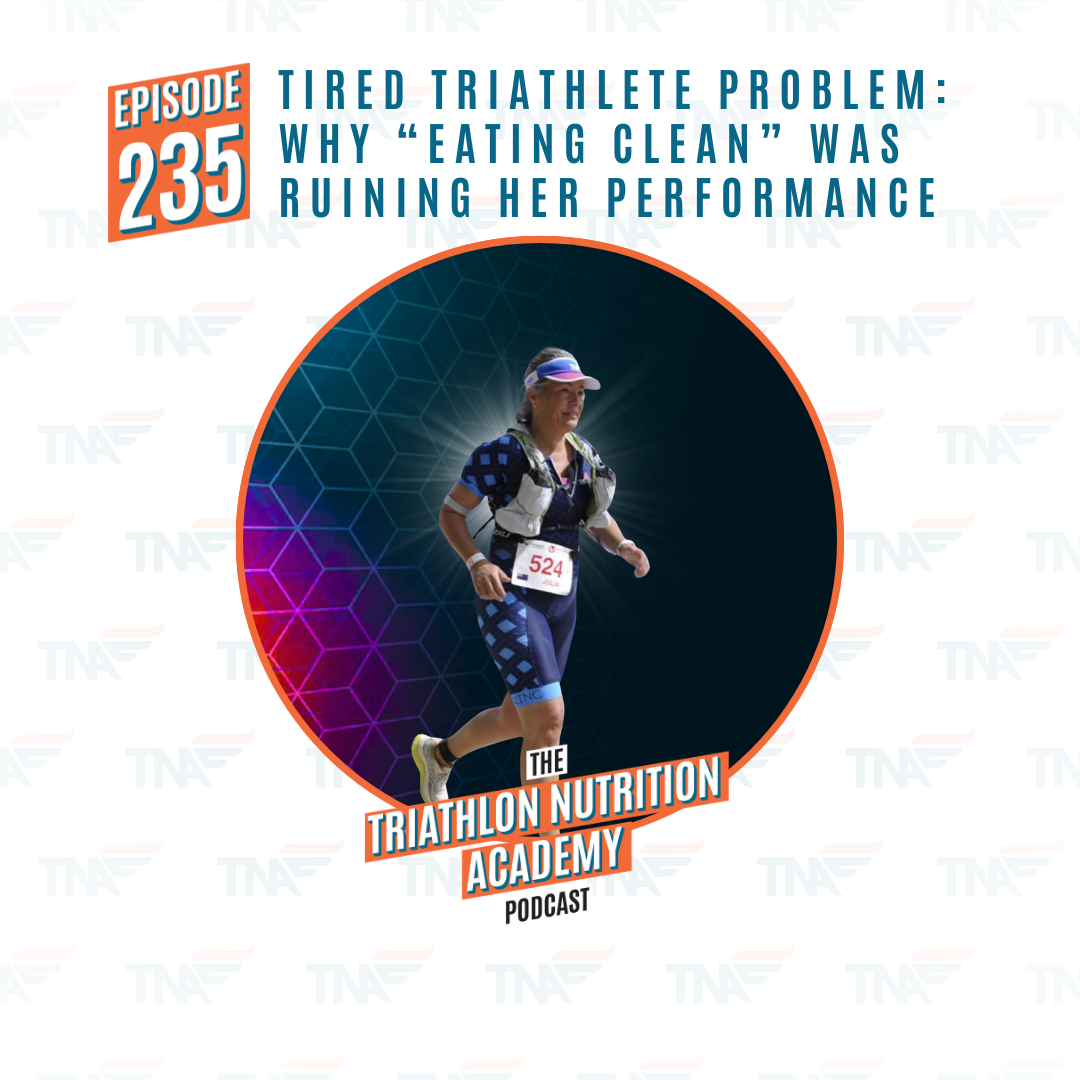
Episode 235 - The Tired Triathlete Problem: Why “Eating Clean” Was Ruining Her Performance

Training hard but still exhausted, flat and struggling to perform? You might be making the same mistake Julia was.
In this episode, I sit down with TNA athlete Julia Burgess, who thought she was doing everything right… eating clean, training consistently and ticking all the boxes. But behind the scenes, she was completely wiped out by the end of each week, dealing with gut issues, struggling to fuel properly and wondering what she was missing.
We unpack how “healthy eating” was actually holding her back, why low energy availability was at the core of her fatigue and the simple but powerful changes that completely transformed her performance, recovery and day-to-day energy. From fuelling long rides properly to fixing high fibre mistakes before sessions and finally understanding what her body actually needed, this is a story so many age-group triathletes will relate to.
Links:
Check how well you’re doing when it comes to your nutrition with our 50 Step Checklist to Triathlon Nutrition Mastery
Start working on your nutrition now with my Triathlon Nutrition Kickstart course
It’s for you if you’re a triathlete and you feel like you’ve got your training under control and you’re ready to layer in your nutrition. It's your warmup on the path to becoming a SUPERCHARGED triathlete – woohoo!
Connect with me:
To learn more about the Triathlon Nutrition Academy, head HERE | dietitianapproved.com/academy
See behind-the-scenes action on Instagram: @dietitian.approved
Follow along on Facebook: @DietitianApproved
Join our FREE Dietitian Approved Crew Facebook group
Enjoying the podcast?
Let me know what you loved about it and what you learnt by tagging me @dietitian.approved on Instagram!
Subscribe & Review in Apple Podcast!
Are you subscribed to the podcast?
If not, today's the day! I'm sharing practical, evidence-based nutrition advice to help you nail your nutrition and I don't want you to miss an episode. Click here to subscribe to iTunes!
Now if you’re feeling extra warm and fuzzy, I would be so grateful if you left me a review over on iTunes, too. Those reviews help other people find my podcast and quality nutrition advice. Plus they add a little sparkle to my day.
CLICK HERE to review, select “Ratings and Reviews” and “Write a Review” and let me know what your favourite part of the podcast is.
You're awesome! Thank you!
Episode Transcription
Episode 235: The Tired Triathlete Problem: Why “Eating Clean” Was Ruining Her Performance
Welcome to the Triathlon Nutrition Academy podcast. The show designed to serve you up evidence-based sports nutrition advice from the experts. Hi, I'm your host Taryn, Accredited Practicing Dietitian, Advanced Sports Dietitian and founder of Dietitian Approved. Listen as I break down the latest evidence to give you practical, easy-to-digest strategies to train hard, recover faster and perform at your best. You have so much potential, and I want to help you unlock that with the power of nutrition. Let's get into it.
[00:00:00] Julia: I had various intolerances, and all I was ever told is, well just cut it outta your diet I don't know what I can and can't eat. And you highlighted that I was eating too high fibre before training days. don't take dates on a long run. Of course you're going to have GI issues.
[00:00:16] It's like really obvious now, unfortunately back then I didn't know because I was told to eat. Clean,
[00:00:24] Taryn: Today's episode is a really powerful one. I'm joined by TNA athlete, Julia Burgess, who comes all the way from Timaru in New Zealand. Julia's story is one that I know so many triathletes are going to relate to because she thought she was doing all the right thing. She was eating really well. She was eating clean, she was training consistently, but she was. Absolutely wiped out by Fridays every single week, and she was struggling with her weight and she just couldn't seem to get her nutrition to work for her. And on top of that, she's navigating gluten-free, dairy-free, ongoing gut issues and a lot of confusion around what's actually going on.
[00:01:03] So today we're gonna unpack what wasn't working, what she's changed, and what her life looks like now. So welcome to the podcast, Julia.
[00:01:11] Julia: Thanks, Taryn. That's a great introduction.
[00:01:13] Taryn: So what actually made you fall in love with triathlon? Right in the beginning.
[00:01:17] Julia: So in the beginning I couldn't swim. I had a water fair, in the lane pool. If they took me away from the edge, I would, panic and Thresh in the water. So I entered a 70.3 and gave myself 10 months to learn to swim. So that's how it started. I've been doing endurance events off road running and have a passion.
[00:01:37] So I've generally been fit most of my life. So endurance events, it wasn't my first rodeo, but it's how I commit to doing something I wanted to learn. So let's enter Challenge Monica and learn to swim.
[00:01:50] Taryn: That is just crazy and it's probably a testament to the type of person that you are that you could not swim, had a fear, but you dove in the deep end and face that. Anyway, it's kind of like joining me on the [00:02:00] podcast today. It's a little bit the same. So paint me the picture about what your nutrition looked like before you joined the program. What were you actually eating day to day?
[00:02:11] Julia: So, day to day I thought I was healthy, eating clean, but it was, uh, not fueling my body. in the morning I would have fruit and yogurt, so being dairy and gluten intolerant. was a coconut yogurt. lunchtime. It would be a, a nice healthy salad.
[00:02:26] some vegetables and then tea. It would be more salad trying to keep away from. unhealthy or processed items, but as we've soon, soon learned, as soon as I joined the academy, uh, it just wasn't fueling me. there was no periodization to my meal. There was no forethought and not understanding the complexities involved in the day-to-day eating
[00:02:49] Taryn: And what was the hardest part back then? Was it. Knowing what to eat or was it something else entirely?
[00:02:55] Julia: it was knowing that your peers were able to train and not having to [00:03:00] call a SAG wagon or not being able to function as a human at the weekend thinking I was doing all the right things.
[00:03:06] Taryn: Yeah, and feeling like that every single Friday is not something that you wanna experience, but you kind of just were resigned to the fact that that was what it was like to do triathlon, which is crazy.
[00:03:17] Julia: you were not looking forward to the sessions. I really enjoy sport. I enjoy running. And so you weren't looking forward to your long run.
[00:03:25] Taryn: And what were you thinking at that point? Were you thinking this is just life now, or did you think I've gotta do something differently?
[00:03:30] Julia: No, I had to do something differently. I thought there had to be something more. especially with my endurance background, I knew there was something more to it. Um, and that's when I found you. I'd listened to a couple of your podcasts and it just resonated. Absolutely resonated with me. I was that tired at triathlete. at the time I was thinking, I. What is the secret? What's the secret to it? why don't I know this? I'm, you know, I'm, I'm a mature adult. I should know. I'm eating clean, I'm eating [00:04:00] healthy. but as we, as soon as we unlocked, like lesson one recovery, nutrition, it's like I. Why did I not know this? How had I not figured this out?
[00:04:09] Very early on, phase one, lesson one, recovery nutrition. I think lesson two is fueling for your ride, so you can't get up and do a 90 k ride on a piece of toast and a banana. and it just snowballed from there. So thank you, Taryn. It's been an amazing journey.
[00:04:26] Taryn: Oh, you're welcome. It's not something that we're ever taught at school, and unless you've done a university degree in nutrition, then it's impossible to piece it together from bits of information on the internet. I find, and a lot of people are in the same boat as you. They, they think I'm, you know, I'm an accountant.
[00:04:42] I'm intelligent, I'm smart. I can do this myself. But. It's so different to spending four years diving deep into nutrition and being able to then apply that knowledge to what you put in your mouth, how you build your meals, all of the practical applications that we need as a triathlete done for [00:05:00] you.
[00:05:00] Rather than just trying to figure it out from the internet, it's far too difficult and it's gonna take you 10, maybe 20 times longer to try and do that, and then you're still gonna have no idea if it's right for you or not.
[00:05:09] Julia: Oh, absolutely. So with joining the academy, it was your recipe database. So there was two things that were a saving grace for me, uh, not only with being dairy and gluten intolerant, but you had a weekly meal planner, which was easy to print out. And the second was your recipe database, so I could put it interchangeably.
[00:05:27] very early on I knew what meals I needed, into the academy we learned about periodization. So within the database, I knew which meals I could pick for my easy days or my heavy training days leading into Saturdays and Sundays.
[00:05:42] Taryn: Yeah. My job is to make nutrition easy for you. That is like my entire wheelhouse. So I'm glad that that helped because you're also managing gluten-free and dairy-free as well,
[00:05:53] which adds another layer of complexity that maybe a lot of triathletes don't have to wrangle. And it can be [00:06:00] genuinely complicated if you dunno what you're doing or what you're looking for. Mm.
[00:06:04] Julia: It was adaptation of. Normal food to fuel me. Trying to do it on my own was incredibly hard. because there's so many convenience foods when you are racing or fueling or talking to your peers, what do you use, what do you eat? And so I. Even picking something on the shelf and not reading the ingredients and getting gluten, it can knock me back three days straight away, three days, and even into a week or two before you start to feel normal again.
[00:06:31] The recipe database was a huge asset to me being able to look at the meals for fueling, and then on a day-to-day basis, I could go back to my standard staples and, and keep in what I needed. So the journey for me was quite a slow nine month progress that I started off with what I knew and just stepped it through slowly.
[00:06:53] Like we didn't have to change everything quickly.
[00:06:56] Taryn: Oh, I'm glad that that was so useful and I like that you just mentioned that [00:07:00] it's not as big overhaul on week one as well because that just sets people up for failure, doesn't it? When you feel so overwhelmed that you've gotta do all these things and change all these things at once and then it, people just don't do anything at all.
[00:07:12] So it's, it's actually why I've kind of systematically built the program the way that I have. So that it, it's like compound interest. We're gonna throw some accounting terms out there for you and make you comfortable it. It does snowball as we go. We do one masterclass each week, one topic, and the first one's recovery, nutrition, and like Julia said, the next one is what you do before training to fuel.
[00:07:35] Those different sorts of sessions so that within the first two weeks you're getting like the bookends around your training sessions. Right? And you might be like, okay, well what do I do on race Day Taran? And I'm like, no, hang on a minute. Let's sort out our day to day nutrition stuff first.
[00:07:49] Before educating yourself on nutrition, were you confident that you knew the types of foods that you were reacting to and what was causing your gut issues and, and how [00:08:00] you were feeling? Or were you kind of just flying around blindly? did you ever get any education around? Like proper gluten-free eating for celiac disease, even though you're not technically or officially diagnosed.
[00:08:12] Julia: So the answer for me is no. So my father was chronic celiac, being undiagnosed until he was an adult. So I was brought up in a gluten-free life. so I knew what to eat and what not to eat, but as I progressed on, I've never been officially diagnosed. when you go to your, your local gp, I had.
[00:08:33] Various intolerances, and all I was ever told is, well just cut it outta your diet so you get to a point I don't know what I can and can't eat. Like for example, the de dairy intolerance, I've been working closely with Taryn. We have been working in is it a protein or is it lactose? so the answer is no.
[00:08:51] I was never given any formal training and I have been flying blind. And that's when power arc become invaluable because I could say. [00:09:00] This is what's going on. And you highlighted that I was eating too high fiber before training days. don't take dates on a long run. Of course you're going to have GI issues.
[00:09:10] It's like really obvious now, unfortunately back then I didn't know because I was told to eat. Clean, eat very clean. So you were constantly trying to adapt and evolve what you were eating and, and completely blind without any help. and talking to other athletes and it's like, oh, before a, you know, a long run, you can have a tin of creamed rice, but that.
[00:09:33] Would never work for me because it was full of dairy. Uh, and that's when per hour. And talking with the other athletes in per hour, you gle so much more information from them too. What they can eat, what they have. Uh, because TNA is global, there's other items that are available to them on the shelf that's not to us here in New Zealand.
[00:09:53] So through, Amazon or online buying, you're able to. try different products that [00:10:00] they have tried and tested without saying no, it reacts to them as celiac.
[00:10:04] Taryn: And when I first met you. We, I had to dig a little bit deeper, but you weren't actually eating strictly gluten-free either. You had all this cross-contamination going on. You didn't really, well, you probably realized, but you were like, oh, I should be right mate.
[00:10:20] Julia: Yeah. Unfortunate it is. It's a number eight wide Shall we write over here across the ditch? And I didn't realize because we're an empty nester, there's only my husband and I and, and when our, our children were at home, you were so much more careful. And I'd say to him, I'm having this end of the Marge and I didn't realize Marge Jam, toasters, I mean the list goes on.
[00:10:40] How careful you have to be. And I think that comes back to the education I had right at the very beginning because at home with dad, we were very gluten-free household that you didn't understand the cross-contamination and how bad it really is.
[00:10:56] Taryn: Yeah, and you have a husband that's not celiac, so [00:11:00] he chooses to eat gluten in the same house,
[00:11:03] using the same toaster
[00:11:04] and the same margarine with all the crumbs in it and all those sorts of things.
[00:11:08] you've now swapped over, right? You've got your own bench, you've got your own chopping board, you've got your own toaster.
[00:11:15] Julia: Yes, yes. Everything, every set, like there's a, there's a, there's a bin that I pull out for me that he does not touch under any circumstances if he values his life. Like, um, so it is even for empty nesters, there is. There is completely different. It's segregated. Two toasters, two marges, different jams. Like he knows not to touch my shelf.
[00:11:39] You do not touch under any circumstances. My shelf,
[00:11:42] Taryn: Is he. okay with that?
[00:11:43] Julia: He's absolutely okay with it because he's learned that the, um, with celiac dairy and what we've discovered with the bloods there is, uh, mood swings involved as well. So he's finding that I'm more stable because when you're down and you're feeling [00:12:00] absolute rubbish, it impacts our whole life.
[00:12:02] And we were quite unaware of that.
[00:12:05] the highs and the lows were so variable. So when things were good, I was training, my moods were even, and then now, um, you don't get that grumpy, tired athlete.
[00:12:16] Taryn: So it's a win-win for not getting divorced or, you know, having marital issues as well. Right. Getting nutrition sorted. I love that plug.
[00:12:22] So what do you think has been one of the biggest shifts that you've made? Nutrition over the last nine months.
[00:12:28] Julia: I've overhauled the system and what I've been doing, there's more planning, there's more clarity around meals. It's not winging it anymore. So we are going out for the day and hubby knows I need to pick meals.
[00:12:40] I need to eat. And so I don't get the three o'clock slump anymore. Or if I do, I know why I'm not reaching for a high carb energy food. I'm like, whoa, back up. I need to adjust my meals. I need to have something to eat and I've got snacks or I'll take hot food and the thermos, especially with gluten and [00:13:00] dairy intolerance, I just can't rely on pulling over to, uh, getting a filled roll or, or, or convenience foods.
[00:13:06] Taryn: And you have systemised. Your whole nutrition, what are some of the other strategies you've implemented to make it more organized and streamlined for yourself?
[00:13:15] Julia: at the weekend, I meal prep, um, and I freeze. So I know my meals, I know my macros. Uh, at work, I have got a draw full of, snacks. So there's no more snack accidents, there's no more reaching for the biscuits, for the lollies. and I have a bin, a shelf at work, which has got, options. So in the freezer, I've got.
[00:13:36] Frozen meals, It gives me options for what I'm doing on the day. So if I've had a run and I need a bit more carb, I can have a rice and tuna veggie meal, or I can pick up a frozen meal. So I've got a lot more options going on there.
[00:13:50] Taryn: you are even making your own gels, which I love.
[00:13:53] How did did that come about?
[00:13:55] Julia: It. It was a big combination. So it started off because going to the event, you couldn't always [00:14:00] guarantee, because I'm far from the fastest. So when it comes to me and you've planned on having a Coke at this point, or a gel, at that point, they were gone.
[00:14:09] So there was a combination of needing to train for my GI issues.
[00:14:15] I needed to train for on-course nutrition that I couldn't always get. also, the on-course might not have been the same as what I practice with, because there's flow gels and then there's your, your sickly sticky gels. and also the macro. So in phase three, phase two, we talked about multiple transportable carbohydrates it was a real eyeopener. And then in phase three we talked about GI issues. So it was a combination of coming about getting the right carbs. So I have a different carb content for my.
[00:14:45] Cycling than I do for my running. And to get that right and the right consistency. So you gave us a confidence to buy the product, to try it. There was some disasters, I'm not gonna lie. now I know what I need, what I [00:15:00] want, and what I can consume. So I've not long completed challenge Oneika 70.3.
[00:15:04] I was able to adapt because it was a cold, freezing cold day, six degrees instead of 29 degrees with what we'd learned. I knew that I could adapt, right? I need these carbs in, but I only need, I need a lesser hydration consumption, so I wasn't reliant on premade drinks and JS to get me across the line.
[00:15:26] Taryn: It is so good. Being self-sufficient and the ability to adapt to your nutrition on the day is really valuable. So if things do go pear shaped or the weather is completely different to planned, you know what you're doing to adjust rather than being dictated a plan and having to follow up without really knowing what goes into it.
[00:15:44] Can you backtrack to your 10 months learning to swim before doing a 70.3? How did that go?
[00:15:55] Julia: Oh, it was a disaster. We talk about the [00:16:00] journey. Oh my. That was, it was awful. Oh gosh. Someone The swimming in itself was scary. Uh, and then coming out of the water and not understanding recovery, nutrition, I mean, I loved it.
[00:16:13] Don't get me wrong. I loved the sport, but it was a disaster. It was, it was character building,
[00:16:19] Taryn: So
[00:16:19] fast forward now and you've done three 70 point threes.
[00:16:23] What does your nutrition look like for all of that, those training days compared to back then?
[00:16:28] Julia: Whole 360. Absolutely 360. Through the academy, we've got the confidence so we know what we need to eat before, during, and after. We know what our macros are. So early on you went through and told us what our macros were. You, you looked at our lean body mass and our full body mess and worked out. What we needed to fuel.
[00:16:52] So, uh, carb loading. So stepping back a bit, I listened, or I signed up for your endurance essentials course and I [00:17:00] was unsure. I'm unsure if you still have that now, but that was hugely eyeopening. I thought carb loading was eating ra in pumpkin the night before a race.
[00:17:09] Taryn: URA for the non Kiwis is sweet potato. Just to translate, Julia, for.
[00:17:16] Julia: And so it was so, it was hugely eyeopening that I had no idea after doing all these events, that I had no idea what I was doing, what my macros were. Um, so fast forward into the academy, uh, as we've highlighted before, that recovery nutrition's so important into fueling beforehand. We go into carb loading the night beforehand.
[00:17:39] It's just been night and day for me. Absolutely life changing. Enjoy my training, can go out and do 90, a hundred K rides, come home and still function as a human being.
[00:17:49] Taryn: I remember the day that you were like, I did my race and I drove home and I did all my jobs, and I did the washing, and I did the groceries and I did all this, this and this, this. And I'm like, yeah, that's, that's [00:18:00] normal. for a lot of people, it's not normal. Is it? Like you do your race and you cook for the whole rest of the day?
[00:18:04] I have experienced that myself as well. Oh.
[00:18:06] Julia: Oh, absolutely. So before the academy, I did, uh, or before I signed up for 70.3, I would do off road running and I would hop in the car and you could barely drive home, let alone the stomach cramps you used to get on the, on the ride home, and you were thinking, why nobody else gets this. Why is this my normal? Why? Why am I doing this? So it made me dive deeper and start it off by listening to your podcasts.
[00:18:30] Taryn: One of the things we've been working on for you is. Wrangling your medical professionals and getting your blood done and, uh, I guess being proactive. Advocating for yourself to get the right test done at the right time. are you happy to share some of the details of those tests and what you've been working towards over the last nine months?
[00:18:50] Julia: Absolutely I can. Um, it's very new for me and I'm learning as I go, but back nine months ago, uh, you, uh, wanted me to get tested for my thyroid, and you were alluding to Hashimoto's back then and it has been a journey and it's been hard and. I'm very grateful for everything you did to believe me, believing in me, and essentially diagnosed Hashimoto's nine months ago.
[00:19:17] It's been very hard part of the journey to, for the medical system. We are understaffed here in Timaru in New Zealand, and so it's hard to get the results, the testing we need, um, and, and feeling tired and. You believed me that I was training, I was fuelling correctly and that there was more to it. And for that I am eternally grateful.
[00:19:39] I'm incredibly grateful that, that you believed in me. and so next part of our journey is to work on getting my antibodies down 'cause they're through the roof. uh, I dunno enough about Hashimotos myself, but that's where I am grateful that through power Hour that you can help me, uh, the supplements, uh, what I need to add into my diet.
[00:19:58] I [00:20:00] grateful.
[00:20:01] Taryn: You are welcome. So it's taken you nine months to get the bloods that were needed. Nine months ago to actually look and dig deeper into what was actually going on. So we did some surface level stuff in the beginning, and you've had to put your big girl pants on and advocate for yourself and ask for the right tests that I helped you guide you on what you needed to get your GP to do.
[00:20:25] And unfortunately, it's taken this long, but I'm glad you're on the right path now to having an official diagnosis, I guess, like it's very fresh.
[00:20:33] Julia: Yes, it is fresh. it's a relief really, that, uh, you believed me, that I wasn't overdoing it, I wasn't stressed, I wasn't overworking. and so that we can work through the next steps. And it's an exciting journey with us and part of us and, and bringing along the TNA community with it.
[00:20:50] Um, I believe 20% of all females. worldwide have thyroid issues, so how many other people are undiagnosed out there? Um, so if I [00:21:00] can through this podcast, if it, if it helps one more person. Our work's done.
[00:21:05] Taryn: Yeah, go and get your thyroid levels checked, but make sure you ask for the right test so that you can have the right knowledge.
[00:21:10] Julia: Absolutely, and that's what you highlighted to me. They were only testing my TSH and so you told me to go back and well told me, advised me, which on there was quite a lot and fing for the, but I'm grateful.
[00:21:25] Taryn: Do you have any advice for somebody that is maybe in the same situation where they feel like they're doing everything right, but they're just overwhelmed trying to do all the things and they still aren't really sure if their nutrition is working for our sport?
[00:21:39] Julia: I completely understand where you're coming from, trying to train as an athlete, work life balance, it's hard, it's tough. So for me it was a nine month journey, so don't be harsh on yourself. takes it small, simple steps, and it all comes together. For me, the changes were so small to start with that I didn't realize.
[00:21:59] And you look back and you can see how far you've come. Just take it day by day, do the homework. If you join the academy, do the homework, and it all starts to piece it together. Don't feel overwhelmed. Take it step by step day by day.
[00:22:13] Taryn: That's great advice. One of the things that you said to me right in the beginning was that you wish you had started it when you first came across it. So you did come through Endurance Essentials, which is a, a live training that I ran, oh no. A year ago. I'll do it again, probably with a different name, although I do like the alliteration of Endurance Essentials. But you wished you'd done it sooner and you were kicking yourself for not joining in January. When you did join in April, what held you back at that point in January that made you go? I'm, I'm, I'm not actually quite ready or I'm not gonna do it just yet.
[00:22:46] Julia: So for me, I thought it was a massive, big change. I thought that I'd be on a course and I'd have to change everything at once. So in the January we were leading into one challenge, Wanaka 70.3. And I didn't want to feel overwhelmed, and that's when it was a nine month journey. I wish I'd signed up straight away in the January for the January cohort.
[00:23:09] I wish I'd never waited till the April. Just what you do on. The recovery, nutrition day one, uh, module one. It's just huge. It's changing, and that's why, and with everything compounding, you learn as you go. So it's not, it's not a huge overhaul of what you're doing to start with. It gives you clarity and confidence to implement small changes in your day-to-day, your day-to-day life, your nutrition, your periodisation of your meals, right down to cooking, planning.
[00:23:41] And being more prepared, more prepared for your races, you can go in with the knowledge and the clarity. So yes, I do wish that I'd, I'd joined in the January cohort straight up when I first heard about it.
[00:23:53] Taryn: And how much time do you spend a week on educating yourself on nutrition? At the moment
[00:23:57] Julia: At the moment now Post Academy. Um, I still like to dive into things, but it's, it's because you've got the foundations there. That it's not, it, it's second nature there. A lot of it's second nature, so you're not having to spend, uh, when I joined the academy, I would listen to the course and I would spend, It was about an hour on a, on a Saturday when it released here in New Zealand. And then the Power Hour wasn't invaluable, so it was only about two hours a week, but it made huge changes for me. So now it's just power Hour. 'cause I've joined the alumni, which I highly recommend as well. You learn so much more and it's, it's only an hour, an hour out of a week.
[00:24:40] When you think the investment that you spend, uh, your, your training time, your catching up with coaches, race entries, everything else, to me, it was a minor investment compared to everything else I'd spent time and energy on.
[00:24:54] Taryn: As an official accountant, do you have any advice on the financial investment of the program?
[00:25:00] Julia: As an accountant, I think it's well worth it for what I was spending and medical practitioners for my, over the years before I joined TNA, I would've spent far more. as an accountant, it's really bad to say I didn't do the numbers because I was scared of what it would actually come out at. It would be horrifying.
[00:25:18] just trying to try different supplements, different. Eating habits, eating habits, different, different ways. So it's the investment itself is long-term health and wellbeing and well worth it.
[00:25:31] Taryn: And what's next on the cards for you? Julia?
[00:25:33] Julia: Oh, we've got some exciting things coming up. I'm joining, uh, TNS or CAIRs, how the
[00:25:40] Taryn: Cans. You could say cans.
[00:25:43] Julia: Cans in in June, June 26, doing another 70.3, but I've been selected for ITU, short course LON and RB Dhabi. So, and I also qualified for the long course on the back of aka. So you don't have to be the fastest, you don't have to podium. It's just Consistency
[00:26:03] Taryn: and are you going to come to Santa Cruz in the US 2027 with us for our TNA Annual Event?
[00:26:09] Julia: Potentially not at this stage because of can. And then RBB, it's probably too short a turnaround. Uh, but never say never
[00:26:19] Taryn: Okay, I'll hold you to that.
[00:26:22] Well, Julia, thank you so much for sharing so openly about. All things nutrition like, I feel like you've had a rough journey, and I know you don't mind me saying that, but it's gonna be smooth waters from here on in, and now that you are strict, gluten-free, there's no cross-contamination. You're only gonna feel better and better. It's gonna be a, it's gonna take time, but once those little microvilli heal themselves and you're absorbing your nutrition better, you're not gonna know yourself, which I'm so excited for.
[00:26:50] Julia: Absolutely you and me both.
[00:26:52] Taryn: I think you're a great example of what a lot of triathletes are experiencing. Like they we're trying really hard. We feel like we're doing all the right things, but it's still not working. You're still feeling stuck and overwhelmed and. Your testament to what can happen when you start to systemise your nutrition and bring structure to it and have that knowledge to know that what you're doing on a daily basis is working for you and not against you.
[00:27:18] So if you're sick and tired of being constantly tired and you've tried to piece it together yourself, but you just keep hitting the wall, this is exactly what the Triathlon Nutrition Academy is built for. you don't have to keep figuring it out by yourself. What could take years and years of self-research and trial and error you could fix in one triathlon season? If you'd like to join us inside the Triathlon Nutrition Academy, you can register your interest dietitianapproved.com/academy and I'll send you all the details for when our doors open soon.
[00:27:50] Thank you again, Julia. I look forward to seeing you in cans.
Thanks for joining me for this episode of the Triathlon Nutrition Academy podcast. I would love to hear from you. If you have any questions or want to share with me what you've learned, email me at [email protected]. You can also spread the word by leaving me a review and taking a screenshot of you listening to the show. Don't forget to tag me on social media, @dietitian.approved, so I can give you a shout out, too. If you want to learn more about what we do, head to dietitianapproved.com. And if you want to learn more about the Triathlon Nutrition Academy program, head to dietitianapproved.com/academy. Thanks for joining me and I look forward to helping you smashed in the fourth leg - nutrition!