
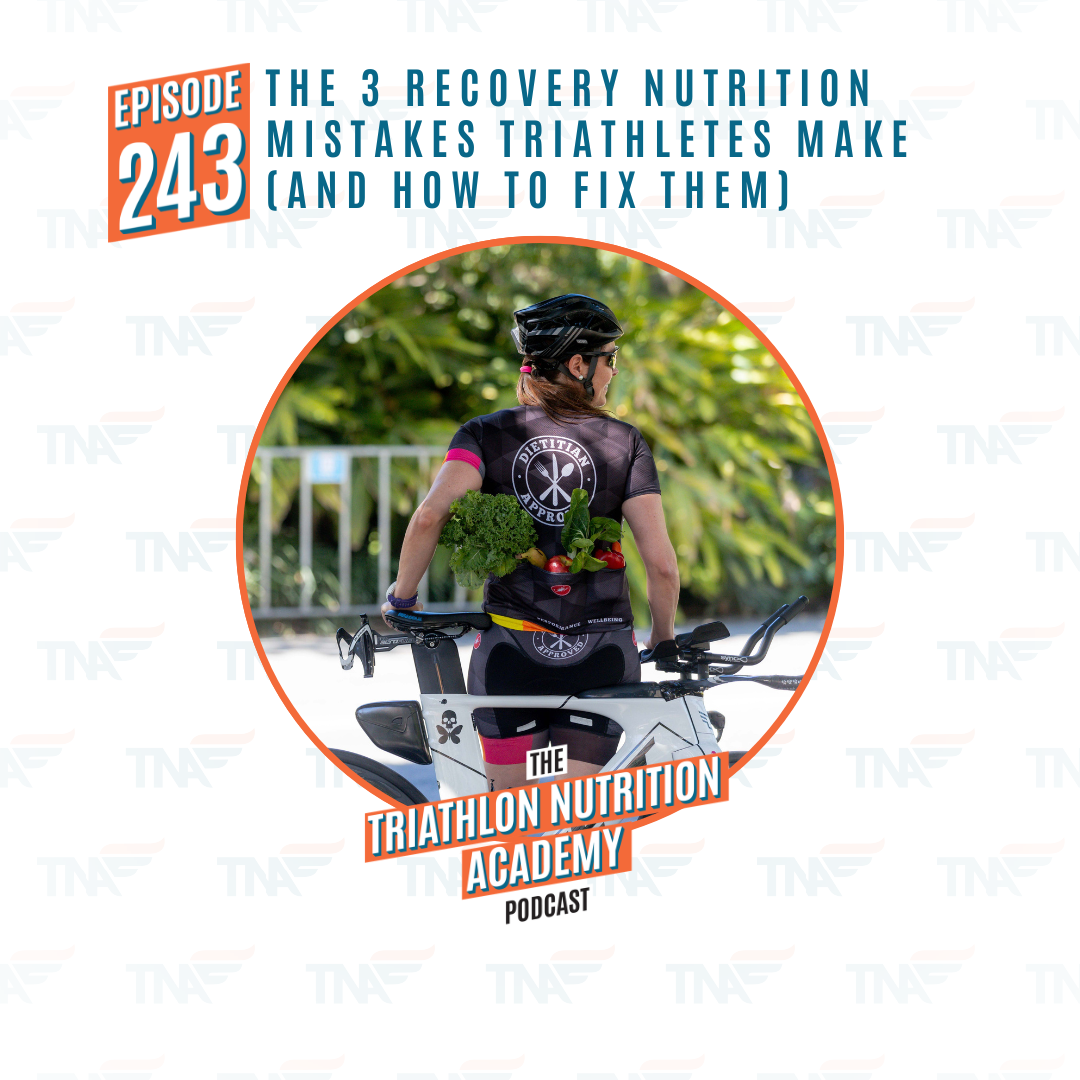
Episode 243 - The 3 Recovery Nutrition Mistakes Triathletes Make (And How to Fix Them)

You’re training hard, ticking off the swim, bike and run sessions… but still feeling flat, sore and permanently cooked by Thursday.
This week, I’m unpacking the three biggest recovery nutrition mistakes I see triathletes make over and over again, even experienced athletes who think they’ve got it sorted. We’re talking about the real reason your legs feel heavy, why you’re getting hit with the 3:30itis snack attack, and how poor recovery nutrition can quietly sabotage all the hard work you’re putting into training.
In this episode, you’ll learn:
- Why adaptation happens in recovery, not during the session itself
- The huge mistake athletes make with protein while forgetting carbohydrate
- How poor timing can slash your glycogen restoration by almost half
- The warning signs your recovery nutrition isn’t working
- What proper recovery should actually feel like when you get it right
If you’re struggling to back up sessions, constantly craving sugar, getting sick during peak training or wondering why your fitness gains have stalled, this episode is going to connect a lot of dots.
Links:
Check how well you’re doing when it comes to your nutrition with our 50 Step Checklist to Triathlon Nutrition Mastery
Start working on your nutrition now with my Triathlon Nutrition Kickstart course
It’s for you if you’re a triathlete and you feel like you’ve got your training under control and you’re ready to layer in your nutrition. It's your warmup on the path to becoming a SUPERCHARGED triathlete – woohoo!
Connect with me:
To learn more about the Triathlon Nutrition Academy, head HERE | dietitianapproved.com/academy
See behind-the-scenes action on Instagram: @dietitian.approved
Follow along on Facebook: @DietitianApproved
Join our FREE Dietitian Approved Crew Facebook group
Enjoying the podcast?
Let me know what you loved about it and what you learnt by tagging me @dietitian.approved on Instagram!
Subscribe & Review in Apple Podcast!
Are you subscribed to the podcast?
If not, today's the day! I'm sharing practical, evidence-based nutrition advice to help you nail your nutrition and I don't want you to miss an episode. Click here to subscribe to iTunes!
Now if you’re feeling extra warm and fuzzy, I would be so grateful if you left me a review over on iTunes, too. Those reviews help other people find my podcast and quality nutrition advice. Plus they add a little sparkle to my day.
CLICK HERE to review, select “Ratings and Reviews” and “Write a Review” and let me know what your favourite part of the podcast is.
You're awesome! Thank you!
Episode Transcription
Episode 243: The 3 Recovery Nutrition Mistakes Triathletes Make (And How to Fix Them)
Welcome to the Triathlon Nutrition Academy podcast. The show designed to serve you up evidence-based sports nutrition advice from the experts. Hi, I'm your host Taryn, Accredited Practicing Dietitian, Advanced Sports Dietitian and founder of Dietitian Approved. Listen as I break down the latest evidence to give you practical, easy-to-digest strategies to train hard, recover faster and perform at your best. You have so much potential, and I want to help you unlock that with the power of nutrition. Let's get into it.
[00:00:00] Taryn: Jay gets home from training. She jumps straight in the shower and then walks out the door 15 minutes later to rush to kids sport, do the grocery shopping, and the rest of the afternoon that really just belongs to somebody else and not her. She grabs something for recovery as she's running out the door, maybe it's a coffee.
[00:00:17] If she's lucky, it's a muesli bar. and her recovery nutrition does not happen She wakes up the next morning and her legs are feeling so sore
[00:00:26] They are stiff and tired before the day has even started, And she just chalks it up to a big week of training and pushes through This example is something that I see all the time Parents, busy professionals trying to shove a training session in at 6:00 AM before work
[00:00:43] Athletes who are genuinely committed to their training, doing everything right for swim, bike, and run, and then completely falling off the wagon the moment the session ends and you stop your Garmin
[00:00:55] If you've ever experienced those heavy legs, the afternoon crashes, that feeling that you're never quite bouncing back particularly well between sessions, this is probably not your fitness failing you That is your recovery nutrition strategy is failing you
[00:01:11] And there are a few very specific reasons that this happens. Hi, I'm Taryn, Advanced Sports Dietitian and triathlon nutrition specialist
[00:01:21] And today I'm gonna walk you through what recovery nutrition actually does
[00:01:25] Some of the mistakes I've seen over the last two decades that triathletes keep making without even realising it, and the signs that are gonna tell you whether your recovery nutrition is working or not
[00:01:38] and if you wanna fix it, I will show you exactly how to do that too I've built a recovery accelerator that covers the exact frameworks that we're gonna walk through today It is triathlon specific, it is evidence-based, and by the end, you will walk away with a perfectly formulated recovery nutrition plan You can grab it at dietitianapproved.com or the link is below
[00:01:59] So to get started, let's dive into what actually happens physiologically in your body when you finish training
[00:02:07] In simple terms, every time you train, you tear your muscle fibers. You deplete your muscle glycogen stores. That's the carbohydrate that you store in your muscle as fuel during exercise Your immune system takes a knock. Your hormone levels can shift And none of that is a problem. It is literally the point of training, to tear the body down so we can build it back up again.
[00:02:33] You stress your body, the body adapts, and you get fitter. That is the whole mechanism
[00:02:38] the adaptation from training happens in recovery. It doesn't happen in the session
[00:02:44] Which means that if your recovery nutrition is not working, the session worked, but the result of that session did not. You did all that work and you didn't actually collect the rewards
[00:02:57] Now, here is where the research gets interesting. A study published in the Journal of Applied Physiology found that delaying your post-exercise nutrition by two hours reduces the rate of muscle glycogen resynthesis by close to 45%.
[00:03:14] Not just a little bit, but almost half So if you're the type of triathlete that finishes a session and just gets busy doing everything else, getting a shower, getting ready for work, getting kids out the door, whatever it is that you faff about with after exercise
[00:03:30] And you don't think about what you're eating in that window, your glycogen stores are rebuilding or refilling at less than half the rate that they could be Just sit with that for a second because when you train multiple times a day or do a lot of training volume, then that is really problematic And full glycogen restoration, even with optimal nutrition, can take up to 24 to 48 hours
[00:03:57] So that means that your next session starts with a fuel tank significantly below where it should be
[00:04:04] A recent paper published in 2025 in Nutrients looked at 100 amateur endurance athletes with an average age of about 40. and they found that the average post-exercise nutrition adherence score was 5.3 out of 10, barely half marks for our high-achieving endurance athletes. More than half of the athletes surveyed
[00:04:30] Were significantly under-recovering by their own nutrition practices So that is not a small minority. That is most triathletes, I would say, and every TNA athlete who has ever walked through my door thought they had their recovery nutrition sorted. They're like, "I don't need to learn about this. I've got this sorted, Taryn," until they go through the recovery accelerator and realise that they weren't even hitting close to the mark
[00:04:58] So even though you think you're doing a good job, chances are you haven't actually got all of your targets dialled in for your unique body. I will link both those papers in the show notes if you wanna have a read, but super interesting research
[00:05:12] Now that we know that, we know what happens to our body and w- some of the reasons why recovery is so important, why do we not do it? Why is this a problem area for so many triathletes?
[00:05:25] in nearly two decades working with triathletes, including six years as a sports dietitian for Triathlon Australia, I've seen many mistakes, but the same couple keep coming up when it comes to recovery nutrition specifically
[00:05:38] The first one is having no plan, just leaving everything to chance. So the session ends, you stop your Garmin, and life takes over, right? Something always happens
[00:05:50] And eating properly after training becomes whatever is available, whatever is easy to access, rather than more specifically what your [00:06:00] body actually needs
[00:06:01] And Jade's story at the very start of this episode is not unique. I know that it's the norm, particularly for busy parents. We deprioritise our recovery nutrition in preference for the little humans that we have to keep alive
[00:06:14] And the problem with leaving it to chance is that when you're tired, when you are depleted after training, your body's hunger signals are not a particularly reliable guide around what you actually need You might not feel hungry after exercise, and that's really common for a lot of people, so they choose not to eat or they don't eat enough of the right things because their body is not telling them to.
[00:06:39] You might also crave the wrong things after exercise. You might have snackcidents Where you stand in front of the fridge or the pantry and you just eat handfuls of whatever you can see to try and fill a hole and stop you being so starving Without a plan that works independent of how you're feeling in that moment, I would hazard a guess that you are under-recovering every single day The second mistake I see is the wrong balance. So often we hear about protein, protein, protein, right? Protein matters a lot after exercise, and a lot of triathletes know that they need some protein, and so they do that, and they do that sometimes too well. often we're getting some form of protein in, but recovery nutrition for triathlon, for endurance sports specifically, is not just about protein. Carbohydrate is equally as important, and most triathletes have no idea what their target is for carbohydrate. They're just randomly guessing things or eating what they think is right. But you have your own unique number that you need to hit based on your body and your physiology
[00:07:49] Protein alone after a two-hour ride is not gonna replenish your muscle glycogen stores
[00:07:55] And yet this is what I see time and time again is these athletes focused on their post-session protein shake while their muscles are sitting there just craving carbohydrate. They're empty fuel tanks that need a refill
[00:08:10] The balance of your recovery nutrition matters so much, and the balance for a triathlete after a long ride looks so different to somebody that just goes to the gym. That specificity is why generic nutrition advice fails and misses the mark for endurance sports, and in particular triathlon, where you are trying to fit training for three sports into your week The third mistake is poor timing
[00:08:37] Timing is where a huge amount of your recovery nutrition is either won or lost The research is very clear on this. The earlier you eat after training, the faster and more completely your body can restore itself
[00:08:51] for the athlete that thinks, "Uh, I'll just eat properly at lunchtime after a 6:00 AM session," you are spending your entire morning at [00:09:00] half recovery capacity, and you're heading into the rest of your day And potentially another session for that day on significantly depleted stores. So you need to be smarter around your timing as well as what goes into your recovery. Now, any one of those three mistakes is enough to dramatically slow your progress. All three together and, man, you're working hard in training for a fraction of the return So how do you actually know if it's working?
[00:09:30] How do you know if your recovery nutrition is working for you? I'd love you to listen carefully and see if you can connect any of these dots for yourself. So here are some signs your recovery nutrition is not working. You are struggling to back up, whether that's a session in the afternoon or back up the next day, and the day after that, and the day after that, and you're just getting into a bigger hole the longer the week extends, so that by the time you get to your big, long endurance sessions, you're already cooked.
[00:10:01] sessions that should feel really manageable just feel way harder than they should. I know you've probably experienced that at least once in your career. Your legs never feel fresh, ever. Or if they do, it's brief and it's after a two-week holiday The 3:30-itis, where you have a massive crash in energy, and then that snackcidents monster is a tap on the shoulder daily visitor
[00:10:30] You are craving sugar and snacking constantly in the afternoons to try and pick yourself back up because you have done a terrible job of your recovery nutrition earlier in the day
[00:10:40] You are training so hard and you're training consistently, but your body composition is not shifting the way that you would like it to
[00:10:48] You are getting sick at incredibly inconvenient times, usually right when your training load peaks heading into a key event. Now, none of these are inevitable. None of them are just part of being a triathlete. These are all warning signals that something is not right, and the first thing I would start with is your recovery.
[00:11:11] So if we flip that now, here are some signs that maybe your recovery nutrition is working for you. You can bounce back between sessions, and you feel good doing your second, maybe third session for the day. You can back up after a really hard Tuesday double session into another quality Wednesday training session.
[00:11:32] Two days in a row of hard training, and you can back up, no problems Your energy is fairly consistent across the day. You don't have that 3:30itis where you hit a wall. You feel more energised as the day progresses, and I will add to that, you feel more energised within your sessions as well, and part of that can be because you've recovered properly to go hard in that session Your recovery nutrition is working if you are not chasing sugar all afternoon
[00:12:02] Your body is responding to the training. It is adapting, it is getting stronger, it is getting fitter and leaning out if that is the goal for you. Your FTP testing is improving time and time again, and when your training load ramps up and you're peaking, your immune system holds itself. You don't fall into a pit.Now, the difference between those two lists is not how fit you are. It's not natural talent It is honestly what happens in the two hours after every training session
[00:12:36] Because you only adapt, so you get fitter and faster, from sessions that you recover from. And the big rocks for recovery are sleep and nutrition
[00:12:47] Recovery nutrition is where your adaptation actually happens. The session is creating that stimulus And recovery is where your body is responding to the stimulus. Without the right nutrition in the right window, that stimulus doesn't convert into results Just to recap on those three mistakes that I see is no plan, wrong balance, and poor timing Any one of those three is enough to slow your progress significantly, and if you're doing all three, then look out
[00:13:19] So have a think about those signs about whether your recovery nutrition is working or it's not
[00:13:25] Because they are quite specific and recognisable when you know what you're starting to look for And if you're listening to this and going, "Holy crap, Taryn, I'm all of those things," then the Recovery Accelerator is your fastest way to fix it. It's evidence-based, it is triathlon specific, And you will walk away with a structured recovery nutrition plan That details exactly what to eat after every training session and every race. Head to dietitianapproved.com to grab it, or find the link below this episode Thank you for wrapping me around your ear holes today. I want you to prioritise your recovery after your next session, and I'll see you next week.
Thanks for joining me for this episode of the Triathlon Nutrition Academy podcast. I would love to hear from you. If you have any questions or want to share with me what you've learned, email me at [email protected]. You can also spread the word by leaving me a review and taking a screenshot of you listening to the show. Don't forget to tag me on social media, @dietitian.approved, so I can give you a shout out, too. If you want to learn more about what we do, head to dietitianapproved.com. And if you want to learn more about the Triathlon Nutrition Academy program, head to dietitianapproved.com/academy. Thanks for joining me and I look forward to helping you smashed in the fourth leg - nutrition!