
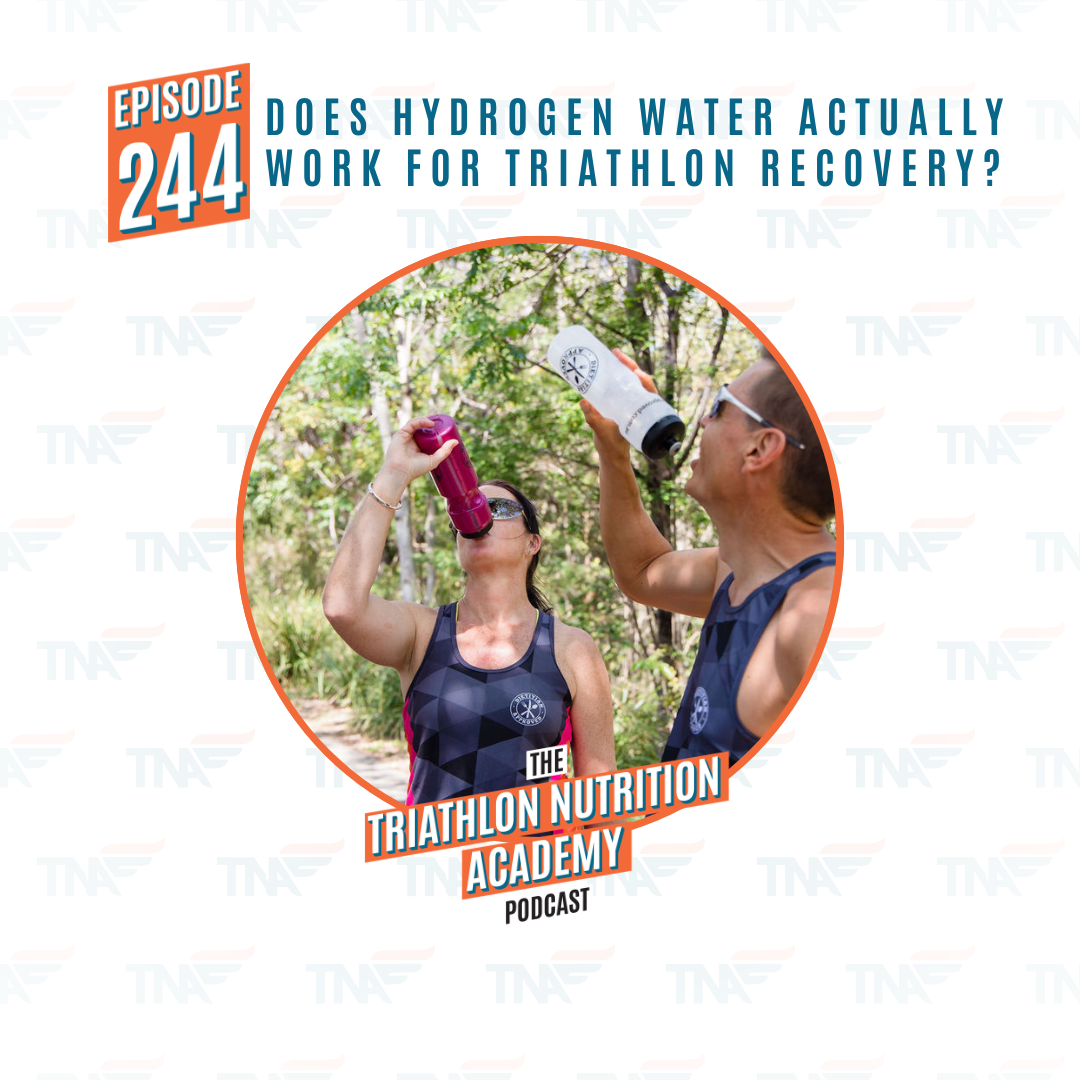
Episode 244 - Does Hydrogen Water Actually Work for Triathlon Recovery?

Hydrogen water is all over your feed right now. Tablets, bottles, little machines bubbling away on the kitchen bench, all promising less soreness, faster bounce-back and recovery at the cellular level. But does it actually do anything for you as a triathlete, or are you about to drop sixty bucks on fizzy water?
In this episode I give you my honest, no-BS breakdown on hydrogen water. What it actually is, what the research genuinely says about recovery and performance, and whether it earns a spot in your toolbox. Then I run the actual numbers on what it costs to replicate the research dose (you might want to sit down for that part) and weigh it up against where your money is truly best spent.
Links:
Check how well you’re doing when it comes to your nutrition with our 50 Step Checklist to Triathlon Nutrition Mastery
Start working on your nutrition now with my Triathlon Nutrition Kickstart course
It’s for you if you’re a triathlete and you feel like you’ve got your training under control and you’re ready to layer in your nutrition. It's your warmup on the path to becoming a SUPERCHARGED triathlete – woohoo!
Connect with me:
To learn more about the Triathlon Nutrition Academy, head HERE | dietitianapproved.com/academy
See behind-the-scenes action on Instagram: @dietitian.approved
Follow along on Facebook: @DietitianApproved
Join our FREE Dietitian Approved Crew Facebook group
Enjoying the podcast?
Let me know what you loved about it and what you learnt by tagging me @dietitian.approved on Instagram!
Subscribe & Review in Apple Podcast!
Are you subscribed to the podcast?
If not, today's the day! I'm sharing practical, evidence-based nutrition advice to help you nail your nutrition and I don't want you to miss an episode. Click here to subscribe to iTunes!
Now if you’re feeling extra warm and fuzzy, I would be so grateful if you left me a review over on iTunes, too. Those reviews help other people find my podcast and quality nutrition advice. Plus they add a little sparkle to my day.
CLICK HERE to review, select “Ratings and Reviews” and “Write a Review” and let me know what your favourite part of the podcast is.
You're awesome! Thank you!
Episode Transcription
Episode 244: Does Hydrogen Water Actually Work for Triathlon Recovery?
Welcome to the Triathlon Nutrition Academy podcast. The show designed to serve you up evidence-based sports nutrition advice from the experts. Hi, I'm your host Taryn, Accredited Practicing Dietitian, Advanced Sports Dietitian and founder of Dietitian Approved. Listen as I break down the latest evidence to give you practical, easy-to-digest strategies to train hard, recover faster and perform at your best. You have so much potential, and I want to help you unlock that with the power of nutrition. Let's get into it.
[00:00:00] Taryn: You finish a brutal Sunday brick, your legs are cooked, your heart rate is still going gangbusters, and you reach into your bag and drop a little fizzy tablet into your water bottle you watch it dissolve, you drink it down, And you tell yourself you have just done something really good for your recovery. What on earth am I talking about? I'm talking about hydrogen water
[00:00:20] It is all over the internet right now. Tablets, bottles, little machines that bubble away on your kitchen bench And the claims are big. Less soreness Faster bounce back, cleaner energy and recovery at the cellular level
[00:00:36] This is another one of those things where athletes are sending me links of products to review and ask if this is something that you should be taking
[00:00:44] One landed in my inbox this week for an athlete that's just dropped 60 US dollars on tablets
[00:00:51] before they have any idea how to plan their recovery Hi, I'm Taryn. I'm an advanced sports dietitian and triathlon nutrition specialist. I've been working with triathletes for two decades now
[00:01:04] From first-timers all the way up to elite athletes on the world stage
[00:01:09] And today I'm gonna give you my no BS breakdown on hydrogen water
[00:01:14] What is it? What does the research say, particularly about recovery? And does it deserve a spot in your toolbox
[00:01:21] Now, I'm not here to tell you that it is rubbish, but I'm also not here to sell you on it
[00:01:26] I am Switzerland, and I'm gonna walk you through where the evidence stands
[00:01:31] stick around to the end because I'm gonna help you run the actual numbers so that you could replicate the research and then weigh that up against your own recovery nutrition, and tell you where I think your money is best spent
[00:01:43] Now, if you clicked on this episode because recovery is the thing that you keep meaning to get sorted, I built a short course for exactly that. It's called The Recovery Accelerator, and it walks you through step by step exactly how to build your perfect recovery nutrition plan, exactly what to eat and when, and you can find that at dietitianapproved.com
[00:02:04] So let's dive into hydrogen water. What on earth is hydrogen water? Because water is H2O
[00:02:12] And the marketing for hydrogen water sounds far more exotic than it actually is
[00:02:18] So molecular hydrogen is H2. It is two hydrogen atoms s- it is the smallest and lightest molecule that there is
[00:02:27] it is being sold in tablet form, and I think most tablets are gonna work in the same way. A little bit of elemental magnesium reacts with the water, And the reaction releases hydrogen gas in tiny little nano bubbles.
[00:02:42] And that's gonna be the fizz that you see with any of these products
[00:02:46] Now, the theory is because these molecules are so small, it slips straight through your cells and into your mitochondria
[00:02:56] Now, I've talked about mitochondria on the podcast before.
[00:03:00] They are your powerhouse of the cell, your engine room. They are the part that makes your energy or ATP
[00:03:08] I like to think of those as the battery of the cell Now, the claim with the hydrogen is that once it is in there, the hydrogen acts as a selective antioxidant
[00:03:21] it mops up the nasty free radicals that you're gonna produce during hard training The ones that drive inflammation and soreness while supposedly leaving the useful signalling ones alone. Now, I don't know how it does that, but apparently that's what it does. Now, free radicals 101 in really simple terms, when you train and train hard, those sessions create a flood of free radicals. They are the byproduct of cellular respiration. Now some damage is the entire point of training. Some of it is just collateral, and the hydrogen l pitch is that it cleans up the collateral without blunting the good stuff
[00:04:04] So that is the theory, and on paper that actually sounds really good. Sounds amazing
[00:04:11] The real question though is does that actually hold up when you test it in an athlete? so let's get a little bit nerdy and dive into some of the research
[00:04:20] To be honest, it's a little bit of a mixed bag. There is some real signal, but there is also a lot of noise. So I'm gonna give you both
[00:04:29] Now, this first paper, I'll link it in the show notes. This is the one that all of the hydrogen water companies seem to lean on the heaviest. It was published in the Frontiers of Physiology in 2024 on elite fin swimmers doing two hard sessions in a single day
[00:04:47] Now, I'm not gonna lie , I had to look up what fin swimmers were because honestly I'd never heard of it before But it is legitimately a competitive aquatic sport where the athlete uses fins for their swimming. So you can either swim with one fin and dolphin kick like a mermaid, or have two fins and swim with a snorkel or sometimes even a scuba tank
[00:05:12] It's raced over set distances in a pool or the open water, and it is obviously really fast 'cause you've got fins on
[00:05:19] Because you're generating so much more propulsion with the fins, but it's also much harder work on the legs So there you go. I learned something new recording this podcast, and hopefully you've, you've learnt something new too. so what these competitive fin swimmers did was they drunk hydrogen-rich water or a placebo 12 hours after the second session, the hydrogen water group had lower creatine kinase levels That's a marker of muscle damage Slightly less muscle soreness compared to placebo And a small bump in jump height
[00:05:52] So they had a real measurable recovery signal, which is promising, right? Sounds like it could be legit
[00:06:00] But just hold onto that thought for a second
[00:06:02] Because how much matters enormously, and I'm gonna come back to that in our cost section later on Also, just quietly, fin swimmers are not triathletes
[00:06:12] This study that everyone has quoted in their marketing is done in 12 elite fin swimmers in a super niche sport, drinking enormous volumes of hydrogen water
[00:06:25] In a very controlled setting. Now, that is a long way from a 45-year-old age group triathlete doing a big weekend brick session and racing 70.3s
[00:06:38] Can we compare the data across those two athletes? I'm not really sure
[00:06:43] Now, when we zoom out to the bigger systematic reviews in this space, the picture kind of gets a bit wishy-washy
[00:06:50] there was a meta-analysis in the Frontiers of Nutrition published in 2024, and I'll link that in the show notes as well if you wanna get nerdy
[00:06:57] And what they tried to do was pull the performance studies together. And what they found was in aerobic endurance and VO2 max, the results were really trivial. there was no meaningful effect. when they looked at anaerobic endurance, it was also trivial. Muscular strength, also trivial So hydrogen water is not gonna make you fitter.
[00:07:18] It doesn't make you stronger
[00:07:21] So you need to keep that in the back of your mind. What did show up was a small effect size on lower limb explosive power. The hard efforts felt slightly easier. The rate of perceived exertion dropped a little bit And there was a bit faster blood lactate clearance
[00:07:37] So it might take a little edge off how hard hard sessions feel and help you clear the lactate, It was real, but it was a very small effect, and so you need to weigh up whether that very small effect is worth it or not
[00:07:52] And the bit that the marketing is just skipping in this space is the whole adaptation from training process And I think that this is the nuance and the critical thinking that is gonna be most advantageous for you as an endurance athlete. Another 2024 review looked at oxidative stress And found what they call dual effects.
[00:08:14] Sometimes hydrogen reduced the oxidative stress, sometimes it didn't, and so it was really inconsistent
[00:08:21] And what I think is a really important part to consider is that as a triathlete, you don't actually wanna mop up all of the free radicals from every session. That oxidative stress is part of what tells your body to adapt to training and to get fitter
[00:08:39] And we really learned that the hard way when athletes were supplementing with high-dose antioxidants, vitamin C and vitamin E there is literature showing that athletes just loaded up on those antioxidants thinking more is better And what the research showed is that it actually blunted training adaptations
[00:08:57] And those adaptations that you were training so hard to earn. You train, you create the stress, and then your body rebuilds stronger And if you just wipe out that stress, then you can actually wipe out part of the adaptation
[00:09:11] But the hydrogen water defense is that it's selective, that it only targets the harmful free radicals. I don't actually know how physiologically that happens
[00:09:21] But the evidence for that in real training is very young, and I would say critically it's also very thin
[00:09:30] so mopping up your everyday training signal is a genuine open question that you need to consider rather than just, like, a free win
[00:09:41] So my honest no BS review of where the research is at in this space is that it is very small studies, often tiny, like 12 people Mostly in elite athletes. Can we translate that to an age group athlete? Probably not When you're juggling all the different things like work and family and kids and stress, elite athletes have a completely different VO2 max to you, completely different physiology and training schedule
[00:10:11] The recovery markers, like the creatine kinase that I mentioned earlier, that shows a little bit of promise. But in terms of performance, the evidence shows basically nothing
[00:10:21] And the adaptation piece is a real unanswered question at this point So hydrogen water, this is very early day science. It's interesting, but it's definitely not settled And I don't think it's anywhere near strong enough that you need to make it a priority
[00:10:39] even with all of that, you might be thinking, "Fine, Taryn, the recovery markers, they looked okay in that niche fin swimmer study. Maybe it's worth a crack
[00:10:48] So let's do the thing that nobody selling you this stuff is actually doing. Let's actually add up what it's gonna cost you if you were to replicate the dosing in that research
[00:11:00] because the athletes didn't have one tablet for one day and called it quits. They drunk over a litre, 1.1.26 litres of hydrogen water a day for several days, And then they ramped it up to over two and a half litres, 2.52 litres on the big day.
[00:11:18] Now, if I take one of the products that I found on the feed as an example, each tablet makes one bottle, so roughly 350 to 500 millilitres
[00:11:27] So to actually replicate the research, you're going to need about three tablets a day for the baseline and five to six tablets a day for the heavy day
[00:11:39] Now three tablets a day at roughly one US dollar each is gonna be three US dollars a day, or about $4.50 Australian That's about 90 US dollars a month
[00:11:50] And to spread that out over a year, that's over 1,000 US dollars and closer to 1,600 Aussie dollars. Now, that's just the baseline number That's before race days, before big race simulations, before heavy weeks where that number's gonna double
[00:12:06] And if you are just following instructions and taking one tablet a day, then you're not actually replicating the research, and we don't know if that's actually having an effect or not
[00:12:17] Now, because I'm a dietician, we're gonna compare that to a perfectly formulated recovery smoothie
[00:12:23] Now, the world is your oyster when it comes to your recovery smoothie, but you might want to add some sort of liquid base like milk or soy milk. Don't do almond milk 'cause it's just expensive water. Then we're gonna add some carbohydrate, like some banana, some oats, some honey, some other frozen fruit, and there's a few other little things that we can throw in there to make sure that your recovery smoothie perfectly ticks all of your custom and individualised boxes
[00:12:48] That's gonna cost you about $2 max
[00:12:52] And if it delivers your individualised recovery targets It's going to perfectly deliver the things that we know are going to drive your recovery and adaptation from training
[00:13:04] it's gonna provide the right amount of carbohydrate to top up your glycogen. It's gonna provide protein to repair
[00:13:10] And fluid and other electrolytes and vitamins and minerals to rehydrate you and to replenish you after training. Now, that hydrogen tablet's gonna give you about 80 milligrams of magnesium in a bottle of fizzy water. No carbs, no protein, none of the actual building blocks that you need to recover and back up again to train
[00:13:30] So if we line the two up together, you've got hydrogen water And at that research dose is more expensive by a long way, and it delivers the thing that we are the least sure about, if we're honest, versus the recovery smoothie, it is half the price And it delivers on exactly what you need, and we are, like, rock solid certain about.
[00:13:52] One of these is a shiny little object, and the other is a big rock of triathlon
[00:13:57] And we know that you don't spend money on the shiny little object until you've got those big rocks sorted first
[00:14:04] And this is honestly the type of triathlete I see all the time. You're training 10 to 20 hours a week and fitting that in around work and family
[00:14:14] So many triathletes miss their post-session recovery. They are running out the door, quickly having a shower, grabbing a coffee, grabbing whatever they have access to, and then heading off to coach their kid's soccer
[00:14:25] By the next day, your legs are like concrete, and in the afternoon you cannot control the snack monster. You are so ravenous and so hungry that you cannot close the gates once you've started eating
[00:14:39] They get sick all the time, particularly when it counts. When you are heading into a key race, you suddenly pick up whatever cold and flu is going around
[00:14:48] Or as soon as your training load ramps up and you're in your big weeks, you get really run down and you get sick
[00:14:53] And this is the athlete that's spending 90 US dollars a month on hydrogen tablets to improve their recovery. But the tablets are not the problem, and they are also not the fix It is the recovery nutrition that is completely missing or not hitting the right mark to do its job properly If you sort out your recovery nutrition, the entire week changes and you are a completely different athlete It is not a nice-to-have, it's not a shiny object, it's not a sprinkles on the icing of your cake.
[00:15:25] It is the big rock foundation of the sponge that you need to be doing day in, day out. It is one of the most well-established pieces of the triathlon performance puzzle. Nutrition is a big rock. Hydrogen water is 100% in the sprinkles camp
[00:15:42] And hydrogen water is not the only gadget promising to recharge your batteries at a cellular level. Red light therapy makes pretty much the exact same pitch your mitochondria, biological activity at the cellular level, and faster recovery. But the difference with Red Light Therapy is that it's backed by six decades of research
[00:16:04] The problem with red light therapy at the moment though is that it is just exploding. It is the Wild West out there, and it is covered by a mountain of marketing hype piled on top of what is actually some good science
[00:16:20] And devices run from anywhere from a few hundred bucks to over $10,000. It is insane For months, months I went deep down the research rabbit hole
[00:16:32] And built an entire masterclass on Red Light Therapy For Athletes so that you could understand what actually works, what is hype, and how to not waste your money before you go buying a device
[00:16:44] At 67 bucks, it is well worth doing that first before you potentially invest thousands. So you can go and grab that at dietitianapproved.com/redlighttherapy So if recharging your battery is what you're looking for, then I would hands down, I'd look at red light therapy before hydrogen water Okay, that was a lot.
[00:17:06] Let me summarise it down and pull it all together for you
[00:17:10] Hydrogen water does have some real science. I wouldn't say that it's magic, but it's also not snake oil. The molecule does do what they say it does in a test tube
[00:17:24] The recovery research, it does show a bit of promise on soreness and muscle damage markers, but the performance evidence is basically nothing
[00:17:33] And for me, there is a real question mark over whether mopping up your training signal every day is actually gonna blunt your training adaptations. I'm not sure
[00:17:45] The study that looked good in our 12 elite fin swimmers, now you know what that is
[00:17:51] used three to six times the dose that's being sold in the consumer available products So if you're gonna do that properly, that is gonna cost you [00:18:00] thousands of dollars a year
[00:18:01] You could also do a super cheap whole foods recovery smoothie that ticks all of the right boxes for you
[00:18:09] that actually drives your recovery and your training adaptations, And the tablet doesn't deliver any of those boxes
[00:18:16] I think it's interesting. I probably think it's a shiny object at this point, and I also would say that it's probably not worth the investment for 99.9% of age groupers
[00:18:28] What is more important is that you sort your big rocks out first, your training, your nutrition, your sleep, and your recovery. Those guys are non-negotiable. Dial those all in first, and then revisit the hydrogen water research and see if there's anything new we can draw from
[00:18:44] So if you've been pouring money into recovery elixirs and gadgets and doing everything else, but your recovery nutrition is a total shit show, then take a step back and do that where the evidence is actually rock solid. I have built the Recovery Accelerator for you that gives you a clear plan for exactly what to eat after training and racing to tick your perfect and customised boxes
[00:19:09] You need to understand exactly what to eat to meet your personalised targets and when it matters most
[00:19:17] You can get through it in one sitting of the wind trainer or out for your long run And it includes a recovery nutrition sheet, four recipes to help get you started, and a recovery playlist so that you can solidify your knowledge while you're out going for a run or sitting on the bike
[00:19:32] It's a one-off payment, no subscription, and it costs less than one month's supply of hydrogen water tablets and it teaches you the thing that's actually gonna work. So head to dietitianapproved.com to grab it, And I'll pop the link in the show notes for you too
[00:19:47] So save your money on fizzy water, go and make yourself a decent recovery smoothie, and I'll see you next week.
Thanks for joining me for this episode of the Triathlon Nutrition Academy podcast. I would love to hear from you. If you have any questions or want to share with me what you've learned, email me at [email protected]. You can also spread the word by leaving me a review and taking a screenshot of you listening to the show. Don't forget to tag me on social media, @dietitian.approved, so I can give you a shout out, too. If you want to learn more about what we do, head to dietitianapproved.com. And if you want to learn more about the Triathlon Nutrition Academy program, head to dietitianapproved.com/academy. Thanks for joining me and I look forward to helping you smashed in the fourth leg - nutrition!