
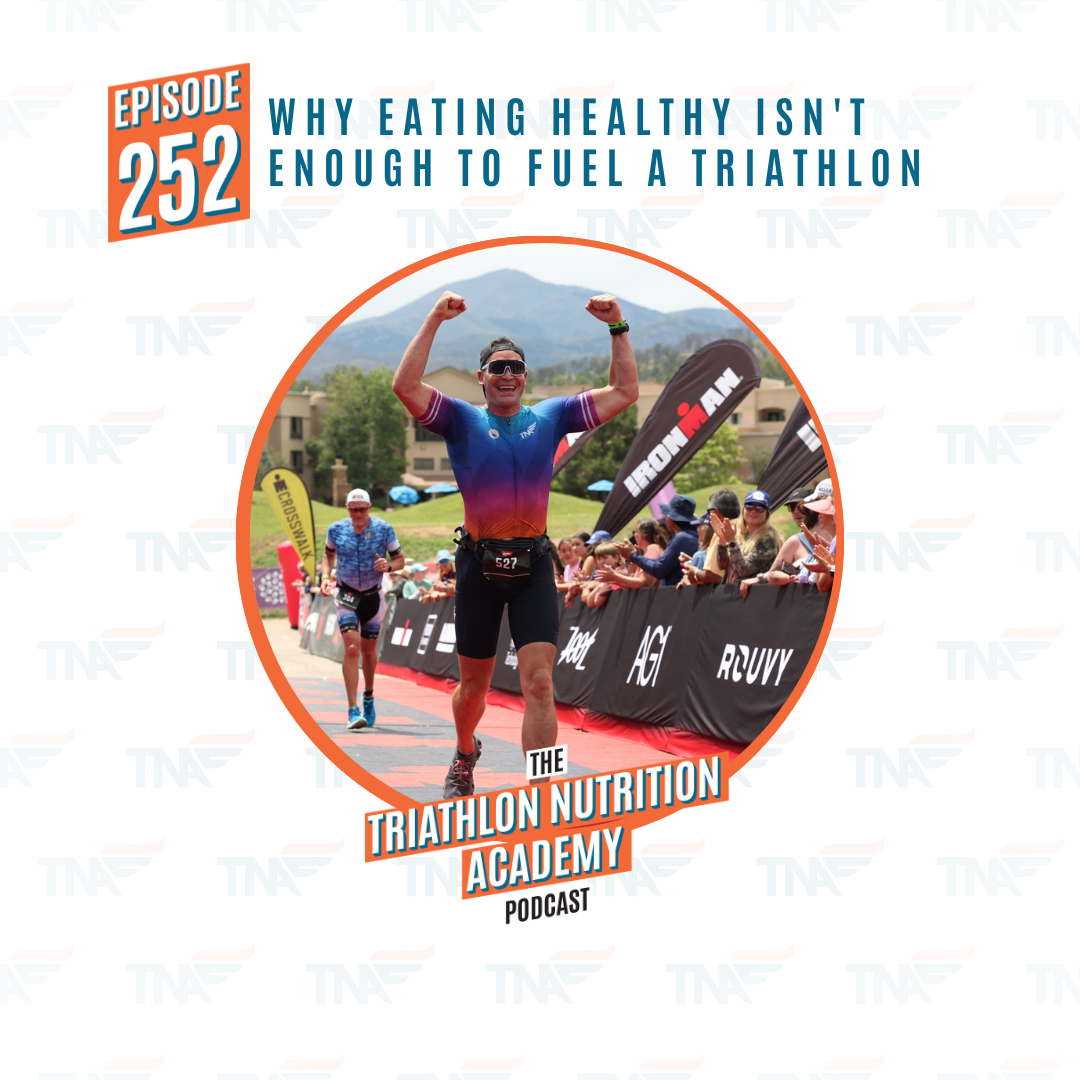
Episode 252 - Why Eating Healthy Isn't Enough to Fuel a Triathlon

You can eat really good food all day long and still have no idea how to fuel a triathlon.
Dr James Anderson is a dentist, a Triathlon Nutrition Academy athlete and one of the most organised humans you will ever meet. Smoothie bags prepped in the freezer. Snack bags packed for every work day. Quality food, every single day. He was still eating the wrong things at the wrong time for three sports, and he had no idea until he went looking for the gaps. In this episode James shares what changed between joining the Academy and crossing the line at his first 70.3 in New Mexico, including the quadrathlon that scared him into taking the detail seriously, what carb loading and sodium loading did for his cramping and headaches, and the moment on the run where his fuel stopped working and he had to think his way to the finish line.
WHAT YOU WILL TAKE AWAY
- Why eating healthy and fuelling for triathlon are two completely different skills
- What being super organised with food still misses when you are training for three sports
- How conflicting advice online leaves smart, capable athletes stuck in paralysis by analysis
- What carb loading and sodium loading did for a big athlete racing at altitude
- How to troubleshoot on course when your race nutrition stops working, instead of taking a DNF
- Why James is leaving his bike computer and Strava behind next time
Links:
Check how well you’re doing when it comes to your nutrition with our 50 Step Checklist to Triathlon Nutrition Mastery
Start working on your nutrition now with my Triathlon Nutrition Kickstart course
It’s for you if you’re a triathlete and you feel like you’ve got your training under control and you’re ready to layer in your nutrition. It's your warmup on the path to becoming a SUPERCHARGED triathlete – woohoo!
Connect with me:
To learn more about the Triathlon Nutrition Academy, head HERE | dietitianapproved.com/academy
See behind-the-scenes action on Instagram: @dietitian.approved
Follow along on Facebook: @DietitianApproved
Join our FREE Dietitian Approved Crew Facebook group
Enjoying the podcast?
Let me know what you loved about it and what you learnt by tagging me @dietitian.approved on Instagram!
Subscribe & Review in Apple Podcast!
Are you subscribed to the podcast?
If not, today's the day! I'm sharing practical, evidence-based nutrition advice to help you nail your nutrition and I don't want you to miss an episode. Click here to subscribe to iTunes!
Now if you’re feeling extra warm and fuzzy, I would be so grateful if you left me a review over on iTunes, too. Those reviews help other people find my podcast and quality nutrition advice. Plus they add a little sparkle to my day.
CLICK HERE to review, select “Ratings and Reviews” and “Write a Review” and let me know what your favourite part of the podcast is.
You're awesome! Thank you!
Episode Transcription
Episode 252: Why Eating Healthy Isn't Enough to Fuel a Triathlon
Welcome to the Triathlon Nutrition Academy podcast. The show designed to serve you up evidence-based sports nutrition advice from the experts. Hi, I'm your host Taryn, Accredited Practicing Dietitian, Advanced Sports Dietitian and founder of Dietitian Approved. Listen as I break down the latest evidence to give you practical, easy-to-digest strategies to train hard, recover faster and perform at your best. You have so much potential, and I want to help you unlock that with the power of nutrition. Let's get into it.
[00:00:00] James: The visualisation of these races and planning out all the nutrition really came in handy. And that's why I knew I couldn't do a 70.3 without a proper nutrition plan. There's no way. I would have burnt out, for sure.
[00:00:14] Taryn: If you think you eat pretty well, you're organised, you think you've got your shit together when it comes to food, then this episode is for you, because eating well and knowing how to fuel for triathlon are two completely different things. And most triathletes don't really find that out until it bites them in the butt on race day.
[00:00:33] My guest today is TNA athlete, Clydesdale and dentist, Dr James Anderson. He is big, he is tall, and he has a big engine to fuel. He was fairly convinced he had his nutrition sorted. It turns out he was very organised, he was very consistent, but he had no idea how to actually eat to support three sports, and he's the first to admit that as well.
[00:00:57] He has just finished phase three of the Triathlon Nutrition Academy program and took everything that he learnt into his very first 70.3 race in New Mexico recently, which is the longest triathlon event he's ever done. He is smart, he is organised, he likes to do everything properly, which I know a lot of us are the same, but he still had massive gaps in how he was fuelling himself.
[00:01:20] So if that might be you too, my hot tip is to get your name on the list for our next cohort of the Triathlon Nutrition Academy program at dietitianapproved.com/academy. All right, Apple Blossom, Jimbo, Dr Anderson, welcome.
[00:01:35] James: Hello. Hi, Taryn.
[00:01:38] Taryn: We'll have to share the Apple Blossom story in a second, but when did you first begin your obsession with our wonderful sport of triathlon?
[00:01:47] James: Oh, it's so easy. I was in a bike shop and I saw my first triathlon bike. I had no idea what it was, what it was meant for. I just knew that was the sexiest piece of machinery I'd ever seen in my life, and I wanted it, and I wanted to be a person that would ride something like that. I didn't buy one for years, but I did sign up for my first triathlon. And I've never told you this story, but my first little local sprint triathlon I signed up for, and the race director called me a couple of days before the event and asked me what my swim time was.
[00:02:23] I didn't include my swim time, and I didn't know. It was only, like, a 400-metre swim or something, so I just Googled it, and I was like, "Oh, what's the average swim time for 400 metres?" And within minutes I get a phone call from her saying, "Is this an accurate number? Because if it is, you should be in the Olympics."
[00:02:46] And I was like, "Whoa, whoa. Wait, wait. What? I don't know. What's the normal number for this event?" And she was like, "Yeah. Why don't we quadruple that?" And I was like, "Okay, that sounds good." So that's who you're dealing with here, somebody who kind of jumps before he thinks.
[00:03:09] So yeah, that was my first triathlon. I did sprints for three years, and then the last two years I've done Olympics. And so when they announced that the Ironman was coming to New Mexico, I had to sign up for my paisanos, you know? And so I signed up and just completed it and survived it last weekend.
[00:03:36] Taryn: I'm so proud of you. You haven't been doing triathlon for that long then?
[00:03:39] James: No, no. So many people on your program, the other athletes, they seem to really have a passion. I'm not good at it. I don't obsess about it, but it's really good for me. And I do enjoy it. Wins like this are fun, but I just often think, "Why am I doing this?" It's a lot of time and it's an expensive sport, but it's really good for me and I feel better. So yeah, I'm definitely in.
[00:04:12] Taryn: I think a lot of people are like that, right? We have all sorts of athletes inside the academy. Don't compare yourself to the people like Leanne, who was on the podcast recently, who's done, oh, 20 full distance events. We've also got people that have never even raced yet. We have the full spectrum, and you kind of fit somewhere in the middle there.
[00:04:31] James: Yeah. Well, I've been listening to you for about two years, and I listened to you for two years, tried to steal or glean any secrets I could from your podcast. But then I kind of reached a limit where I was like, "No, she's not giving anything more away here. I've got to do the program." And so I jumped in. But I had to. There's no way I could have done this race without your nutrition program. It was essential.
[00:05:00] Taryn: Yeah. And did you ever buy that bike?
[00:05:03] James: Oh, I've bought multiple. You should see. It's ridiculous. I have, I don't know, seven bikes of all sorts, but yeah, I have three tri bikes.
[00:05:15] Taryn: And plus one. You're a true triathlete if you've got more than one bike.
[00:05:19] James: Yeah. They're so pretty.
[00:05:22] Taryn: They are so pretty, and they change all the time too. The technology gets better. So how do you fit all of your training in your three sports around, you know, a full-time job and running your business?
[00:05:33] James: Yeah. Well, so I am an empty nester now, so my wife's very supportive, very forgiving of the hours that I spend. But it's hard, and I think that was part of this journey, allowing myself to miss a training session, or not go so hard, or be on the trainer instead of being outside, because I probably would have hurt myself.
[00:06:02] And you know, even the same with the nutrition. When I'd slip on my nutrition, just having a little grace with myself and saying, "It's okay, pick it up tomorrow." But it's hard, because there are just a finite amount of hours in a day and there are some days that's the last thing you want to do.
[00:06:24] Taryn: Yeah. Yep. Bit of mental resilience, which we've talked about on the podcast with Dr Hayley Perlus recently as well, which I remember you telling me you loved.
[00:06:34] James: She's great. Yeah. I want to listen to more of that conversation.
[00:06:40] Taryn: Yeah, she was awesome. So can we share the Apple Blossom story? Because I do call you Apple Blossom, and it doesn't make much sense.
[00:06:51] James: It's become a better myth than it is a reality, because our TNA Power Hour squad thinks that I have this alter ego of being an exotic dancer in Vegas, and it is so much better than the truth. But I do want to show you this.
[00:07:10] I don't know if you saw the iron-on patches that went on the triathlon suits, but they're little apples. They're little shimmery ones that we get to sew on. So I guess I'm putting my logo on yours, and so we're going to double brand.
[00:07:28] **Taryn:** You are welcome. James just raced New Mexico in our new TNA tri suit, and it looked awesome on you, mate.
[00:07:36] James: Oh yeah, and I bought one for my buddy, and so his first day wearing it was on course, and he loved it because he had never had a tri suit with pockets. Oh, it was genius. The design was fantastic. You thought of everything.
[00:07:52] Taryn: Yep. It's got to be comfortable, high performance, and you've got to carry your shit with you. You need pockets everywhere for all of your fuelling needs.
[00:08:01] James: Yeah, it was great. So sorry, my pole dancing days are over, but you know, maybe when we get the group together for one of the races, if we have enough Foster's Lager together, you could get me dancing. Show you some of my old moves.
[00:08:20] Taryn: So where did Apple Blossom actually come from?
[00:08:23] James: So one of my kids named my phone when I bought my phone. It's just an Apple phone, and so they just put the name Apple Blossom on the phone. And I think I called in to a Power Hour once and it showed up as Apple Blossom, and you almost didn't let me in. So everybody needs to know that Taryn can be... there's a bulldog in there.
[00:08:42] She can be kind of mean if she doesn't know who you are. And so she was like, "Who's this? Who's this Apple Blossom character, huh?" And so luckily I got in the Power Hour that day.
[00:08:56] Taryn: Lucky. It is a very funny story, but you'll forever be known as Apple Blossom, so hopefully you're okay with that.
[00:09:01] James: Oh, that's so great. I love it.
[00:09:04] Taryn: So what are some of the things that have changed for you when it comes to nutrition? Because before you were, like, super organised. I remember you showing me your smoothie bags that you prep for the week. You've got them all ready to go in the freezer so you can make your smoothie. You've got your snack bags organised for your work day.
[00:09:22] What were you struggling with when it came to triathlon training, though?
[00:09:26] James: Well, I thought, I really thought I'm super organised, very disciplined. I was just eating the wrong things at the wrong time. The most eye-opening course is course number one on recovery nutrition. I wasn't sure. I was kind of taking a gamble signing up for your course, and it was that very first homework assignment and Power Hour together that it just was like, "Oh, this has paid itself off."
[00:09:58] "This is exactly what I was looking for." Because I knew I was kind of winging it. I was like, "Okay, I'm getting good nutrients, but I don't know why I'm doing it the way I'm doing it." And I had a bunch of different voices in my ears. And so I really appreciate your science. Whenever we have a question for you, if you don't know the science behind it, you won't tell us that you believe in a certain product or a program or anything. So I just didn't know how to do the timing, or understand why I was eating what I was eating, even though it was really healthy food.
[00:10:40] Taryn: Yeah, you're a smart dude. You're a dentist, you've done a degree. You know, you're clever, you're organised. You showed me how organised you were. How come you couldn't kind of figure it out for yourself?
[00:10:52] James: Well, because you're such a gatekeeper on your program, and if you don't sign up for the course, you don't get it all. I had too many different counteracting voices, like I said. In fact, a few people you've had on your podcast, I've also listened to their podcasts, and it's very confusing, their point of view on nutrition.
[00:11:16] So I wasn't sure if I should be burning fat versus carbs, with somebody my size, what time of day I should be eating. So there was just a lot of missing pieces, and I felt like in your program, everything I threw at you, you had an answer. Or, well, you already had it figured out before. It was just really fun going through the steps, because I didn't even have to ask a lot of my questions because it was already laid out.
[00:11:45] And so everything just fell into place. And it's changed the way my wife and I eat every day now.
[00:11:52] Taryn: Yeah? So it's a side benefit to the whole family.
[00:11:55] James: Oh, yeah. No, she loves it. And it's so fun, because when the kids come into town they help me make my smoothie bags. Yeah, it's had a ripple effect, for sure.
[00:12:07] Taryn: Yeah, that's awesome. You're right. There's so much information out there, and it's really hard to distill that into what do I do for myself with, you know, my situation, my training program, my physiology, my lifestyle factors. All of those things go into what you should be putting in your mouth for breakfast, lunch and dinner.
[00:12:27] But as triathletes, and you're the same, right? We want to do everything really well and we want to do everything right, and so we just get paralysis by analysis. We just don't know what we don't know until you go through something like an education program, I think. There is so much overwhelming advice.
[00:12:45] Was there a moment in the program where you realised just how much that you didn't know?
[00:12:51] James: Oh, yeah. Absolutely there was. We had just finished phase one, and I had signed myself up for a quadrathlon, which was a local race. You know, New Mexico is high desert. We're right at the tail end of the Rockies, so we have some serious elevation and some serious peaks here. And so there's a race called the Mount Taylor Quadrathlon that's just crazy elevation.
[00:13:20] And so I decided, man, I've got the tools. I know what I'm doing. I've got this. And a buddy at a New Year's Eve party kind of twisted my arm into signing up for this race. And so what it entails is a bike, a run, a ski and a snowshoe, and then doing everything in reverse. It took me about nine hours to do the course, and it was a challenge, and I kind of thought I had the nutrition.
[00:13:58] I mean, luckily, I had phase one under my belt. It's the only way I would have gotten through the course. But it was difficult. But it was good because it kind of stoked the fear in me. And so the rest of the phases I took a little more serious for the 70.3, because I was like, "Oh, shoot, I've got to dial in the details here."
[00:14:20] Taryn: Yeah, an event like that you really need to dot all the I's and cross all the T's. You need to carb load, you've got your pre-race meal, you've got your race nutrition, recovery, all of it goes into that.
[00:14:32] I remember you did this. James is a visual person and he has a whiteboard that he plans all of his plans out on, so he's drawn the course and it was like all these things up a hill, and then all the things down a hill, including his timing for all of his meals and his fuelling.
[00:14:50] And yeah, it seems like a fun day out there, but it probably put you back in your seat a little bit, because I mean, you bit off way more than you could chew at that point, I would suggest.
[00:15:01] James: And I'm not a skier, and so to learn how to ski up a hill and then kind of fumble down a hill, it was an interesting day. And yeah, you're right. The nutrition wasn't quite on point yet, and I was just kind of eating what was on course. Yeah, I've definitely learned some hard lessons on that event.
[00:15:27] Taryn: Good times. But you're a quadrathlete now, not a triathlete.
[00:15:31] James: I am a quadrathlete. Yeah, you guys don't even know what you're missing. But you know, you bring up my thing about visualisation. If I can't see, whether this is in business or family decisions or any kind of big decision I make, if I can't see every step to the very end of the road, I usually avoid making that decision.
[00:15:58] And so the visualisation of these races, and planning out all the nutrition, really came in handy. And that's why I knew I couldn't do a 70.3 without a proper nutrition plan. Because I could grind through a sprint and Olympic, but there's no way I could do, you know, my 70.3 took me 7 hours, and there's no way. I would have burnt out, for sure. I couldn't have winged that.
[00:16:27] Taryn: No. And so New Mexico was your first 70.3, the longest triathlon distance you've ever raced, and that was a big deal for you. How did your nutrition go? We haven't actually talked about this. I've saved it for the podcast so that James can tell me how it went.
[00:16:43] James: It was great. It went so good, up until Taryn made me buy these Australian gummy ginger chews. She said, "You have to race with these chews in your pocket melting as you go out and making your legs sticky." But no, my carb loading went great, which is another thing that I 100% give you credit for, is teaching me carb loading, because I just had no idea.
[00:17:16] I was the spaghetti dinner guy. Then, you know, at our altitude and our temperatures, the sodium loading, it's just something I've always been missing. I've always dealt with banger headaches and kind of locking up cramps and stuff on course. And so learning about the sodium loading was key for me.
[00:17:41] So that went great. Pre-race nutrition went great. Bike nutrition was fantastic. But once I hit that run, I don't know, Taryn, something kind of went spinning off the wheels. Which was fine, because the ginger chews didn't work, and the on-course Coke didn't work for me, and I thought it did.
[00:18:05] I've tried that in the past and it worked fine. But because of the course, I was able to remember, okay, stop putting junk in your mouth, just stop putting anything in your mouth. This isn't going to last forever. Keep going. Sip a little bit of just water. Okay, now sip a little electrolyte.
[00:18:26] Now maybe add a little fuel. And so that's kind of what I did to get through the last hour of the run. So it wasn't totally clean, but man, it started off strong. It was just maybe I needed some more practice training with some of these products, you know?
[00:18:49] Taryn: Yeah, and it's your longest distance you've ever done as well. You're always going to learn something from every race that you do, and I teach my athletes the ability to troubleshoot out there so it doesn't end in a DNF, so that you can still cross the finish line no matter what goes pear-shaped. So testament to you to, one, do that distance, and two, be able to get to the finish line with a massive smile on your face.
[00:19:11] James: Yeah. It was a great finish. It was such a special day.
[00:19:16] Taryn: Was there any point during the race you were like, "Holy heck, this is awesome. I'm just flying"? Was it on the bike?
[00:19:24] James: Yeah, well, okay, so if I can just share a couple of the dramatic pieces. I went two days before, and I don't know if you knew this, I have a crazy fear of water, and the open water really makes me panic. And another thing I got from your course was just talking to the other athletes, how they deal with that.
[00:19:45] So me and my buddy got into the water two days before the race, and I had a total panic attack. And I just got in my head. I was like, "I'm going to drown. There's no way I can even do this swim." And I swam maybe 300 metres and I panicked, and I had to get out.
[00:20:10] The next day I went again, and I got in the water, and it just so happened, like coincidentally, just so happened that this married couple from my swim group was at the lake, and they were going for a swim. And I just swam next to them, and we did the whole loop. And it was, I don't know, it was just kind of a little tender mercy.
[00:20:37] I needed that. I needed to get through one lap of that lake to know that I could do it, because I can do the distance, I just, the open water freaks me out.
[00:20:49] Taryn: Well, you've only just recently got in an open water situation, like probably a month ago. I remember you telling me you put your wetsuit on for the first time and swam in open water for the first time recently. Like, holy crap.
[00:21:03] James: Yeah, it was different. And then race day comes, and you know, I had to hit the port-a-johns, and I was late getting to my transition, so there was like all the emotions and everything. But then I go to put on my swim cap and my wife had put a love note, a little support note, in my swim cap.
[00:21:26] Oh, I lost it. It was over. At that point I just got so emotional. And the swim, you know, it's only supposed to be, what, 1,900 metres? You've got to see my Strava. I swam 2,700 metres. Which is really awesome, because my swim coach, Zoe, every time I'd get out of the pool at 2,000 metres she'd be like, "I want you to do 3,000."
[00:21:56] "I want you to do 3,000. Get back in the pool. Do 3,000." And I'm like, "Oh, I've got to go home." And she's like, "I want you to get out of that lake feeling so refreshed." And so had I not trained at 3,000, you know, twice a week, 3,000 at a time. I mean, she had me, because I was trying to stay out of the mix.
[00:22:18] Oh my gosh, you should see my Strava map. It's like the perimeter of the lake. Everybody else is in a rectangle and I'm just taking the long way around.
[00:22:27] Taryn: Getting your money's worth out on course
[00:22:28] James: Yeah, heck yeah. It was just really... the bike was beautiful. I felt strong, Taryn. I thought I was a really strong biker.
[00:22:40] And I felt like it was a beautiful day. The scenery was just incredible. I was super gushy with the volunteers, because I was just having this emotional, spiritual... I was so into it, and it was like just a gust of wind. Like, couldn't have been better weather, and I felt strong. And when guys would pass me I'd be like, "Hold, hold, hold, just hold your horses."
[00:23:07] "Let it rip on the run." Like, I had some self-control. Things were going really well. Then I pulled my bike into T2 and I didn't expect my wife to be there at that transition. Oh, and I lost it again. I'm like, "I got your letter." And I got so emotional, and my friends were there cheering me along.
[00:23:31] And the run was three loops, and you know, for an event in New Mexico to have so many supporters and volunteers, it was really special. But yeah, I was having like a very expansive experience. It was kind of like when you're doing spiritual fasting, you know?
[00:23:53] Like you just feel bigger than you are. And I think you're the one that gave me this tip, and the photographer got a picture of me taking off my knee braces and my water bottles a quarter mile before my finish line pic. So I look much younger and much more whole than I really was.
[00:24:14] Taryn: It's all about the finish line photo.
[00:24:22] James: Well, the finish line photo is me kissing my wife before the finish line photo. So, you know, we just kind of fell into each other. It was just a really special thing, because she's given up a year of her husband to do this silly thing that we do. So yeah, it was really special.
[00:24:39] Taryn: Next she'll be doing triathlon with you. Watch out.
[00:24:42] James: Oh, I think she would just cook me. Yeah, she's mentally tougher than I am by far, so she would destroy it.
[00:24:53] Taryn: And is there anything you would do differently for the next one? Anything that you learned that you're like, "I'm going to do this differently"?
[00:25:00] James: So the thing that really, maybe staying on the same kind of body-mind connection, is I would have dropped Strava early on, and I would have dropped my bike computer and my stats. And what I learned through the nutrition was my body is going to tell me what it's up for, and my heart rate and my breathing, all these are much better measurements than my gadgets, which is hard for me because I love the gadgets.
[00:25:33] But I wish I had kind of known that earlier on, because I don't know, maybe I had something to prove on Strava to the two people that follow me. It was just, I didn't need that. And at the end, I wasn't recording half of what I was doing because it wasn't about numbers anymore.
[00:25:55] It was about kind of having the experience, and I like that. I liked where I ended.
[00:26:02] Taryn: Yeah. So going on feel rather than data-driven is going to be more beneficial for you, particularly if you're overthinking things as well. You're thinking, "Oh, my pace is not where it should be," or, "I'm actually going too fast," or any of that, and you just start getting in your head. But it sounds like you had this amazing, like, epiphany experience out on race course. You're like a different person at the end.
[00:26:21] James: It was beautiful. Oh, it was. And I think that's why we do it. I just feel like pressure, time and heat, it's like an autoclave machine. Like, you've got to have these things. That's the only way you change, and we want to do hard things because we want to be different and changed.
[00:26:41] And it was a positive change, for sure. I loved it.
[00:26:44] Taryn: That's how diamonds are made, right? All that pressure.
[00:26:49] So if you could go back and give pre-TNA Apple Blossom some advice, what do you think it would be?
[00:26:56] James: Hmm. Kind of what I alluded to before, with giving myself permission to miss a training session, or to enjoy the barbecue at the family reunion. You know, and I know it's something to say, but when you're in it, you just feel like everything's going to affect the day, and it doesn't really matter.
[00:27:24] I mean, it does matter, but it's not as important as those moments, you know?
[00:27:30] Taryn: Yeah, particularly when your baseline is generally good, right? Like day in, day out, it's great. Your habits are there. You've got all of your structure and your strategy set up properly for triathlon now, so one little blip is not going to break the whole dam. It's when we don't have all that really good baseline and the foundation of eating for our three sports, that that compounded over time doesn't do very well for people.
[00:27:57] And are you going to do a 70.3 again, or are you going to look at stepping up to do something a bit bigger?
[00:28:07] James: So my next event is going to be an XTERRA, so just taking things a little more off-road. And I think that'll be fun. I'm doing a sprint next weekend just to have fun.
[00:28:21] I feel like I'm kind of in the hole now, and I'm sucked in.
[00:28:29] So I don't see myself not doing a 70.3, but I don't know which one it would be. There's a part of me that really wants to go to the next level, like a 70.3 in the ocean. But that terrifies me, which is good because I like to go to my limit. So I'll probably do it.
[00:28:49] Taryn: We need to do lots more open water swim training between now and then. Okay? Deal?
[00:28:54] I love that you're wearing your shirt right now also. Have you taken it off?
[00:29:00] James: Actually the first time I put it on, but I wasn't sure what apparel is appropriate for this podcast, so I figured, oh, this is the perfect time.
[00:29:09] Taryn: As long as you've got clothes on, Apple Blossom.
[00:29:11] James: Yeah, that's right.
[00:29:14] Taryn: All right. I'll wrap us up. Is there anything that we've missed that you want to talk about?
[00:29:18] James: Oh, just I have to say the group we have, the TNA Power Hour groups, I miss it quite a bit. Like, I know there's only a handful of us together, but you learn everybody's digestive tracts, you learn everybody's little secrets of racing. I don't know, it's kind of like going through something together. And so yeah, shout out to our Power Hour crew, because I was always asking them for tips, you know?
[00:29:52] And so I'm just so appreciative to them and their friendship, and then your friendship and your support, and Lily's, and you guys are just the best. I had such a great experience. I would recommend it to anybody.
[00:30:06] Taryn: Oh, thank you. We do have awesome people inside the TNA program. I was saying that to someone the other day. I don't know how it happened, but everyone inside the program are awesome humans. We don't have any idiots. And you go through the program with your cohort, and so you do make friends and connect with people in your cohort really closely.
[00:30:28] And then at the back end, on the other side, we have our alumni program, and those guys are, like, even tighter. So I look forward to you joining that group, James. I think you're going to be a bit of a cat among the pigeons.
[00:30:39] James: I'd be honoured.
[00:30:42] Taryn: Apple Blossom, I'm so proud of you. Your first 70.3, the longest triathlon distance you've ever raced, and you fuelled it like a pro, and you're still happy, and you had this epiphany, euphoria moment out there on course. You should be absolutely stoked.
[00:30:56] James: I loved every minute of it. Couldn't have done it without you. Thank you, Taryn.
[00:31:00] Taryn: You did the hard work, mate. You did all the training, you did all the learning, you executed, so it's all on you.
[00:31:08] James: I enjoyed every step.
[00:31:10] Taryn: So James is a smart dude, right? He's a dentist, he's organised, he thought he was doing everything properly with his nutrition, but what he didn't have organised was his nutrition for three sports. We eat so differently as a triathlete compared to the general population. If you've come from just running or the gym or just cycling, it's a whole other layer of complexity when you're training for three sports in a week.
[00:31:36] So if that is you too, this is your sign to do something about it, because nobody's born with this stuff. This is not something that we learn in school. Did you learn it in dentistry school, James, when you went to uni?
[00:31:49] James: Never. Never, not even a sliver of this.
[00:31:53] Taryn: Not even in medical degrees do we really understand the intricacies of eating. And then you need to understand how to eat for you as your own little special human unicorn as well. It is definitely a skill that you can absolutely learn, just like James. So if that has, you know, put a fire under your butt and lit something up in you, then make sure you've got your name on the list for our next cohort of the academy program.
[00:32:18] Unfortunately, you won't get to join Apple Blossom in his cohort, but maybe on the other side you can meet him, and his antics definitely make Power Hour a lot of fun. So you can do that at dietitianapproved.com/academy. See you in our alumni Power Hour this week, James.
[00:32:36] James: I'll be there.
[00:32:38] Taryn: Thank you.
Thanks for joining me for this episode of the Triathlon Nutrition Academy podcast. I would love to hear from you. If you have any questions or want to share with me what you've learned, email me at [email protected]. You can also spread the word by leaving me a review and taking a screenshot of you listening to the show. Don't forget to tag me on social media, @dietitian.approved, so I can give you a shout out, too. If you want to learn more about what we do, head to dietitianapproved.com. And if you want to learn more about the Triathlon Nutrition Academy program, head to dietitianapproved.com/academy. Thanks for joining me and I look forward to helping you smashed in the fourth leg - nutrition!