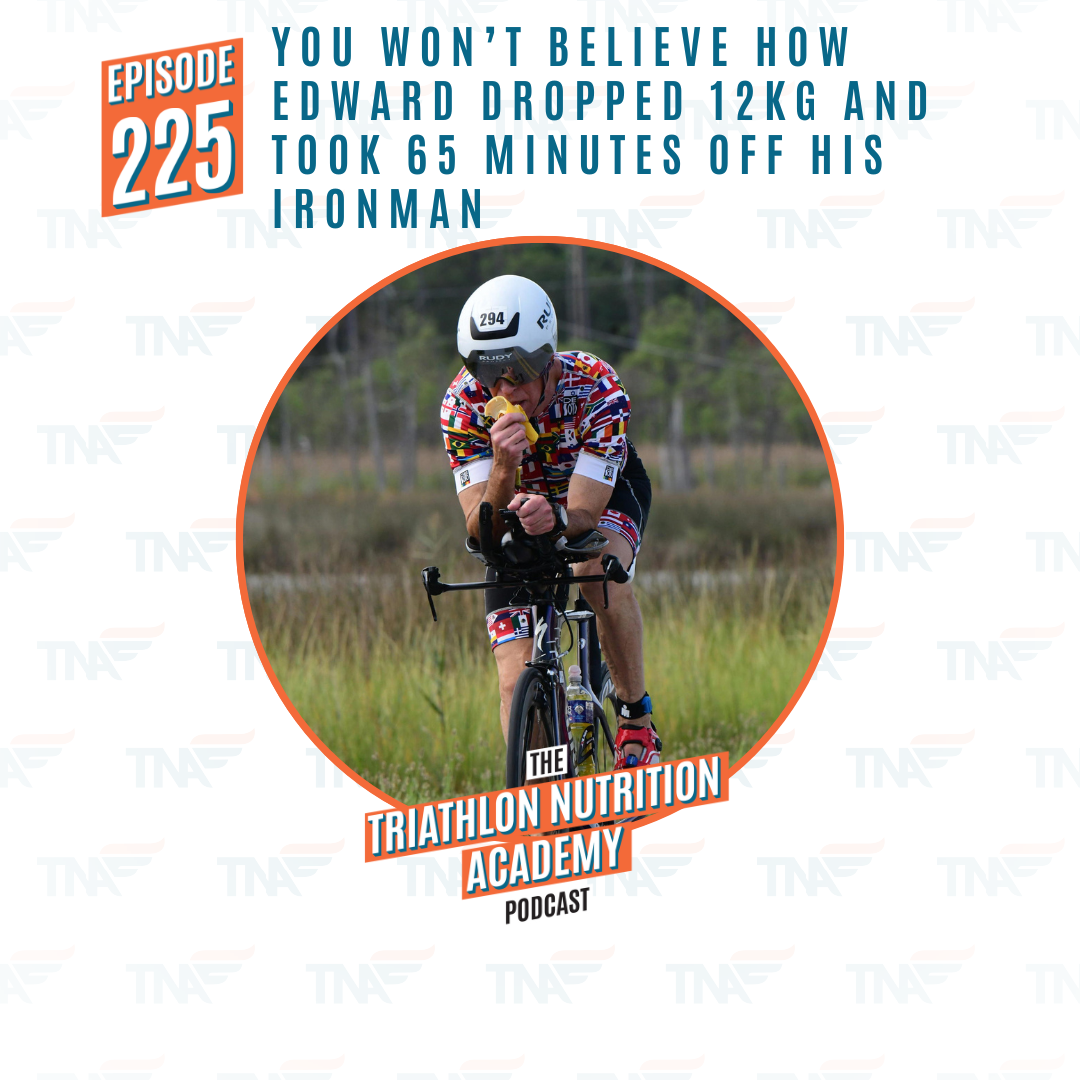
Episode 225 - You Won’t Believe How Edward Dropped 12kg and Took 65 Minutes Off His Ironman

🎧 “You don’t have to sacrifice your health or performance when life gets busy - if you get your nutrition right.”
In this episode, I’m joined by TNA alumnus and emergency room physician, Edward Walsh, who proves that even the busiest triathletes can thrive when they fuel smart.
Despite working irregular hours in one of the most demanding medical fields, Edward has dropped 12kg, avoided injury, and slashed 65 minutes off his Ironman time, finishing Ironman Maryland in 11:28. He then backed it up with a 5-hour 70.3 at Wilmington just weeks later.
We dive into:
- How Edward manages long course triathlon training around 12-hour night shifts
- The game-changing fuelling strategies that helped him stop bonking, drop body fat and set PBs
- His biggest mistakes before joining the Triathlon Nutrition Academy - and what he does differently now
- Why recovery nutrition was the turning point for performance and body composition
Whether you're juggling a chaotic schedule or struggling to match your effort with results, this episode is for you.
Links:
Check how well you’re doing when it comes to your nutrition with our 50 Step Checklist to Triathlon Nutrition Mastery
Start working on your nutrition now with my Triathlon Nutrition Kickstart course
It’s for you if you’re a triathlete and you feel like you’ve got your training under control and you’re ready to layer in your nutrition. It's your warmup on the path to becoming a SUPERCHARGED triathlete – woohoo!
Connect with me:
To learn more about the Triathlon Nutrition Academy, head HERE | dietitianapproved.com/academy
See behind-the-scenes action on Instagram: @dietitian.approved
Follow along on Facebook: @DietitianApproved
Join our FREE Dietitian Approved Crew Facebook group
Enjoying the podcast?
Let me know what you loved about it and what you learnt by tagging me @dietitian.approved on Instagram!
Subscribe & Review in Apple Podcast!
Are you subscribed to the podcast?
If not, today's the day! I'm sharing practical, evidence-based nutrition advice to help you nail your nutrition and I don't want you to miss an episode. Click here to subscribe to iTunes!
Now if you’re feeling extra warm and fuzzy, I would be so grateful if you left me a review over on iTunes, too. Those reviews help other people find my podcast and quality nutrition advice. Plus they add a little sparkle to my day.
CLICK HERE to review, select “Ratings and Reviews” and “Write a Review” and let me know what your favourite part of the podcast is.
You're awesome! Thank you!
Episode Transcription
Episode 225: You Won’t Believe How Edward Dropped 12kg and Took 65 Minutes Off His Ironman
Welcome to the Triathlon Nutrition Academy podcast. The show designed to serve you up evidence-based sports nutrition advice from the experts. Hi, I'm your host Taryn, Accredited Practicing Dietitian, Advanced Sports Dietitian and founder of Dietitian Approved. Listen as I break down the latest evidence to give you practical, easy-to-digest strategies to train hard, recover faster and perform at your best. You have so much potential, and I want to help you unlock that with the power of nutrition. Let's get into it.
[00:00:00] Taryn: Hey, legend. Welcome back to the Triathlon Nutrition Academy podcast. I'm your host, Taryn Advanced sports dietician, triathlon nutrition specialist, and semi-retired age group triathlete. Today I have a cracking guest with you. I'm chatting with TNA alumnus Edward Walsh, who is an emergency room physician, long course triathlete, and one of the busiest humans you will ever hear from. His world is full of irregular shifts, long hours on call, and probably a mental load that most of us cannot even imagine yet. Somehow, he has managed to train for three sports, lose 12 kilos, and set PBS across his entire race season. Edward joined the academy looking for a better way to manage his fueling, while just juggling all the chaos of emergency medicine.
[00:00:46] Taryn: And what he actually achieved is huge. In September, he raced Iron Man, Maryland.
[00:00:53] Taryn: In 11 hours and 28 minutes that was taking a 65 minute pb, which is just insane at that distance, and ran a sub four hour marathon off the back of 180 K bike ride, and then just a few weeks later, he backed it up with a five hour 70.3 at Wilmington, North Carolina.
[00:01:13] Taryn: So he's an absolute machine, and Today we dig into how he fits it all in where his nutrition used to fall apart, the nutrition system that he has built inside TNA and what's actually changed to unlock that level of progress for him. You're going to get so much out of this episode, particularly if you ask somebody that juggles a lot, whether that's work, family, long course training, and maybe feel like something has to give. But Edward is proof that when you get your fueling right. Everything else gets easier, so let's get into it.
[00:02:05] Taryn: Welcome to the podcast, Ed!
[00:02:07] Edward: Thanks for having me, Taryn. It's an absolute thrill to be here. I'm very excited to talk with you. I've had a blast since I've joined TNA. It's been a game changer.
[00:02:15] Taryn: Amazing. How did you find this wonderful sport of triathlon? Right in the beginning.
[00:02:20] Edward: Well, I was an athlete my whole life. I was a baseball player and as an American, this may sound odd, but I was a rugby player. Uh, my folks were of Irish and French descent, so my brother and I grew up with rugby balls in our backyard,
[00:02:31] Taryn: Rugby League, rugby Union.
[00:02:34] Edward: uh, union fifteens and then sevens later. I played all through undergrad, played for my undergraduate team, and then played in medical school.
[00:02:41] Edward: And then when I graduated from medical school, unfortunately as a resident. The work hour restrictions and the training is just too intense and there's no way to play. We work every Saturday anyhow, so we couldn't, I couldn't play in matches and so. I went to medical school, graduated, went to residency, stopped playing rugby.
[00:02:58] Edward: Started eating terrible foods because I was [00:03:00] stuck in a hospital for 36 hours at a time. Enormous stress and my metabolism slowed. I was in my mid thirties and in as an inevitable consequence of aging. I began to slow down and I got pretty chubby actually and really lost the thread with regards to fitness.
[00:03:16] Edward: And my wife started running and she was not really an athlete. Uh, she looked like an athlete. She's incredibly fit woman, and started doing these road races and I went out for a run with her and I could barely make it around this little. Two kilometer lake without just huffing and puffing. And, and I thought, man, something has gotta give here.
[00:03:33] Edward: This is ridiculous. I'm a, I've been an athlete my whole life. I still thought of myself as a, as an athlete, high performance machine, you know, you know, starting 15 rugby fullback moved to fly half 'cause I got old and my legs got slow. But, um, but, you know, I, I was not, I I got on a scale, I was 225 pounds. I, I was, couldn't fit in my clothing.
[00:03:52] Edward: And I said, something's gotta change. So I started running. That was really, really great and I'd always been, I'd run cross country and track in high [00:04:00] school and so running was familiar to me. And my neighborhood has a local sprint triathlon, literally it's a small neighborhood in the middle of Spotsylvania, Virginia, middle of nowhere, beautiful lake.
[00:04:11] Edward: and so we would do a sprint triathlon and some of the guys asked me, they knew I'd run a little bit, so they asked me to be part of the relay team. So my first triathlon was running a 5K. Which I ran and walked, uh, and that was the intro to the sport. I saw the pageantry, I saw the cool tech, I saw the swimming, which terrified me a little bit, even though I grew up on the beach.
[00:04:32] Edward: I was, I grew up in Virginia Beach, Virginia, and I was a surfer, so I thought, oh, I'm cool in open water. I'm, I'll be fine as a swimmer, that was not the case. I nearly drowned the first time I tried to swim in a pool, uh, a, a four foot deep pool. I still nearly managed to drown myself. And, but I was hooked.
[00:04:48] Edward: And so that was the. On ramp into the sport and it's been the best decision I've made, uh, as an athlete my entire life.
[00:04:56] Taryn: Now look at,
[00:04:57] Taryn: go
[00:04:58] Edward: I'm a middle of the packer, Taryn, I [00:05:00] mean, you're very kind, but, uh, you know, so, but I love the sport. I did it for fun and fitness and that's always been my, my main focus.
[00:05:08] Edward: When I'm out on the course, you know, uh, I'll sometimes think, should I be pushing harder? And then, you know, sort of, then I have this in internal struggle. Yeah, I gotta go to work on Monday, you know, have patients who are depending on me, you know, uh, and, but since I've joined. The Triathlon Nutrition Academy and rededicated myself, oh, I really took everything as an athlete down to the studs.
[00:05:28] Edward: Last, last season I had, after COVID, I just kept getting injured. I couldn't stay on point. I couldn't complete a training program. I was still not at a weight that I thought was appropriate for my frame. I was about 92 kilos, and I had tried everything I had done. Atkins, south Beach ketones, I mean all the fancy bells and whistles.
[00:05:48] Edward: Triathlete tried and true. So you sell, you can sell me anything. If you say it'll make me faster or it'll make me more arrow, I will buy it full stop. I think all of us are like that to a certain extent. And then [00:06:00] I listened to you on a Tri Do podcast and I thought, who is this charming woman with this alluring accent?
[00:06:07] Edward: But, and then I began to listen to the actual words a little bit more. I was just struck by how much they resonated with me as a scientist. I was like, this is somebody who gets it, who's objectively a scientist and is, is not trying to sell me anything or market anything. She is saying you have to do the work, but I'm gonna show you the way to do the work in such a way that you're gonna have incredible objective results.
[00:06:29] Edward: And we're not talking about any fancy tech. We're talking about basic blocking and tackling football analogy for the Americans out there. Uh, just cut it back to basics and do the right things. Be intentional and you know, the results will follow. And I, I bought in and it's been a great ride ever since.
[00:06:50] Taryn: how do you fit it all in? Now, you talked before about being a resident and you just lose all the time in your life. But now that you've, you're professional and you're a consultant, [00:07:00] you've like hit the pinnacle
[00:07:02] Taryn: at, but emergency medicine is one of the most demanding specialties. And everything is so irregular. How do you actually fit in training for three sports in your week?
[00:07:11] Edward: You know, it's paradoxically, it's hard in a lot of ways, but it's also a little bit easier. My schedule is usually four on four off. So as I look through sort of a meso cycle and I have my schedule for about three months, I can generally prioritize my workouts in such a way that I'm able to, almost like a game of te.
[00:07:30] Edward: You fit my workouts in through the blocks and the holes in my schedule. The the hardest part for me. Especially as I've gotten a little bit older, I'm 59 years old now, is my sleep cycle is just a wreck and there's, there's no way to fix that in my career. But turning around back to days after that, after the circadian rhythms reset is incredibly difficult. But I find it actually. You know, I've had an enormous amount of support. My, my, my family supports me. My wife is an incredibly [00:08:00] supportive, just an incredibly supportive partner.
[00:08:01] Edward: She's a. Elite runner. So she gets it and that's really helpful. Uh, so she understands if I have to prioritize a workout or something like that. And, uh, so that's been incredibly grateful. And Emergency medicine docs, one of the reasons I wanted to be an emergency medicine doctor is when I was a resident, I looked at the ER docs and I was like, those are my tribe.
[00:08:18] Edward: These are guys out climbing mountains and going surfing on weekends and traveling. They, they're work hard, play hard, sort of.
[00:08:24] Taryn: People. Yeah.
[00:08:25] Edward: Yeah.
[00:08:25] Edward: And I, I was like, that's my tribe. So that's one of the reasons I, I love emergency medicine, full stop. But I liked the doctors the best as well when I was trying to pick what specialty I wanted to go into.
[00:08:35] Edward: And so my group, 40 EM docs, man, they're invested in my training too. They'll, after a race, they'll, I'll get texts from everybody, Hey, what were your watts like? What was your heart rate? How'd you do, you know, did you beat so and so? Who's right? Racing, you know, and, and so they're invested in it too. And so they get it.
[00:08:49] Edward: And so I just have an enormous, uh, support system, and I'm very fortunate. Uh, just incredibly lucky to have that kind of system.
[00:08:56] Taryn: Yeah. That's amazing.
[00:08:57] Edward: challenging though. It's, there are days where, [00:09:00] you know, I have to work a night shift and then on the way home go by the pool and swim three K or something like that and that can be a bit of a chafe.
[00:09:07] Taryn: Yeah. But you still get it done though, which I love about you.
[00:09:11] Taryn: what were you doing with your nutrition before learning how to do it properly? Like how did you survive? I.
[00:09:16] Edward: Well, I would bonk a lot. I was injured a lot. I was heavier than I thought I should be. I literally was the poster child for, when you start to talk about your program, you talk about me and you say, look, you can just go in there and wing it. I literally would just. Eat a bar, drink some Gatorade, have some water.
[00:09:37] Edward: I didn't do any recovery, nutrition. my wife and I both are fairly health conscious. We always had a reasonably decent diet, but there was no intentionality to it. My wife is one of those folks who can eat whatever she wants. My son is the same way. They eat whatever they want. They never gain an ounce.
[00:09:51] Taryn: Damn
[00:09:52] Edward: You know, I have a donut and all of a sudden my pants, you know, don't fit. You know, it's just, it's, I just, I'm unlucky in that regard, and [00:10:00] I had done. Every diet that has come along in the last 20 years. You know, Atkins, I was convinced that I had to be fat adapted and low carb, and I would do that and I would lose 10 pounds like that.
[00:10:12] Edward: Then go on a 10 mile run and bon at mile eight to the point where I, I couldn't even straighten up fully and I was grumpy and I was cranky. My, I could smell the ammonia when I would do my bike ride indoors 'cause I was just burning muscle.
[00:10:24] Edward: you know, it was, it was kind of a disaster and I was getting injured and I wasn't able to stay healthy for a season really, after COVID.
[00:10:31] Edward: I, I had to defer the races in the latter half of my season in 23 and 24. And then 24, I finally got on board with you, and then I managed to salvage the last half of 2024. And then when 2025 rolled around in the off season, I really rededicated. Tore it down to the studs and I focused on stretching and pliability, mindfulness, sleep hygiene, all that sort of thing, and it's made an enormous amount of difference.
[00:10:57] Edward: And I did drop 12 kilos, which [00:11:00] I attribute to your program. It was just absolutely fantastic and I feel better.
[00:11:05] Taryn: How did you do that? What were the things that you changed to help you go from winging it to then having a clear plan and being able to drop the body fat that you had always aspired to do?
[00:11:16] Edward: Uh, there was a moment that was, I don't wanna oversell it, but it was a bit like an epiphany. You were, I was listening to one of your, I, I love listen to your, the Nutrition Academy modules while I'm on a bike or run, I put 'em on my headphones and I just listened to it. And because I am a captive audience, I, I literally absorbed that material so much better in that environment because I'm.
[00:11:36] Edward: Feel like this is part of my training. This is actually a fourth leg of my training, so
[00:11:39] Edward: I really feel like it's two, it's two for one, in my opinion. You know, I'm out there pounding the pavement or turning the pedals, and I'm also getting this knowledge, you know, directly injected into my brain. And you talked about how you wanted us to stop thinking about dieting.
[00:11:55] Edward: And you wanna start thinking about fueling. And that just resonated with me. I was like, yes, that, that the [00:12:00] lights went off. And I said, there there was nothing more precious that any of us possess. They're mind, body, and spirit. And we sometimes neglect some of that basic maintenance and think about how we treat our bikes and, you know, we sometimes treat them better than we treat our own bodies.
[00:12:12] Edward: And I recognized that I, I recognized that I wasn't doing that. I was just sort of eating whatever was available and I was doing okay. Then I said, if I start thinking of this as fuel and as a training part of my training regimen, then I'll be much more intentional. I'm much more mindful. was sort of the sort of the impetus for that change, and that's been an enormous game changer for me personally.
[00:12:33] Taryn: you eat well and you fuel well because you've just had some amazing race results, but then you've still managed to drive some fat loss while also improving performance, which is like the oh, holy grail for every.
[00:12:46] Taryn: Triathlete, Right.
[00:12:46] Taryn: Improve performance and drive some fat loss. So what are some of the like main things that you did that you can attribute to that?
[00:12:54] Edward: I, I think the fir, it's one of your first modules. Since recovery, nutrition, I was never really [00:13:00] thinking about eating or drinking anything after. I was like, oh, my stomach's a little unsettled after I trained, so I'm just gonna go. Take a nap or lay on the sofa for a few hours and now as soon as I get done my workout, I have my recovery meal.
[00:13:12] Edward: And I think that's been probably the thing that has been the springboard for me to be intentional and mindful. I certainly eat a lot more fruits and vegetables just because, you know, you sort of pound that into a, there's no choice about that, and I make sure. No, it's great and I make sure that I get my protein numbers met, um, which sometimes I will neglect.
[00:13:31] Edward: It's easy, especially in my environment in the hospital, paradoxically, there's a lot of bad food in the hospital. I don't know what it is, but there's a lot of carbohydrates, a lot of sugar, and that's just an easy thing in the middle between patients. I don't always have time to meal prep. I'm terrible meal prepper.
[00:13:47] Edward: I, I was not good at that. And there's a whole wing of your academy that I, I, I watch and listen and it just. I just, I'm just, I just don't have that skillset yet. yet. I know that's gonna be a goal for 2026. We'll see how it goes.
[00:13:59] Edward: know, [00:14:00] it, it's easy to fall into that trap of just grabbing something quick.
[00:14:02] Edward: Carbohydrate boost, get that insulin. Dopamine hit and then move on. But then you're gonna have the inevitable crash. But with the recovery nutrition as the first step that I really took, that was the first major change that I made when I joined TNA, was I'm gonna start doing this recovery meal. And that sort of led to a domino effect where I began to become more intentional about meals in general.
[00:14:24] Edward: And then of course, the holy Grail for me as an athlete and a competitive one was to now fuel. The races 'cause I had always winged it. I have some incredible disaster stories to tell you that would just, I mean, you would grind your teeth if I told you, like my first long course triathlon, how I went with a single bottle of Gatorade for the entire 56 mile, uh, bike ride, and then walked the entire half marathon.
[00:14:48] Taryn: You are not the only triathlete that's done that ever.
[00:14:52] Taryn: It happens all the time, unfortunately, but I'm hoping to change that
[00:14:55] Edward: right? One. One athlete at a time,
[00:14:58] Taryn: one athlete at a time. So you've recently done a full distance event and then backed it up really quickly with a 70.3. So I, I Man, Maryland in September was a standout for you. And then the sub four hour marathon at the end of that just astounds me to bring you home with a 65 minute pb and then backing that up with a five hour 70.3 at Wilmington, North Carolina.
[00:15:25] Taryn: How did you do that? Like You can't do that with shit nutrition. So how much of that came from getting all of your nutrition sorted?
[00:15:32] Edward: I attribute my entire season to the, this two pronged. Change that I made, one, losing some weight and just, you know, from a pure physics standpoint, you know, think about how much money we'll spend to save a hundred grams on a bike, you know, uh, and then if I, if I could drop 12 kilos, that's just gonna be an enormous benefit.
[00:15:51] Edward: And, you know, we talk about watts and arrow, but speed is the ultimate really variable. You know, in a race you want to get from point A to point B as quickly as you possibly can. Watts are obviously [00:16:00] critical. so I think losing the weight was an enormous improvement. I just felt. Instead of what the race course is doing to me, which I would about halfway through the bike, I would start to flag a bit and I would start to say, okay, I've gotta really focus on these wa gotta focus on my turnover and my heart rate.
[00:16:14] Edward: I've got to save something for the run. And I would start to have this, not anxiety, but I would start to feel the race start to weigh on me. And I would, and last year at Maryland and then at North Carolina, at that halfway point in the bike, I was, I was. What, what, it's not what the course is doing to me.
[00:16:29] Edward: It's what I'm gonna do this course because I feel amazing right now. I'm turning these pedals over and I know I'm gonna have that fast turnover on the run when I hop off the bike and the, uh, the first half of that marathon in Maryland, I was flying through that. I did think about you during that race because I did.
[00:16:44] Edward: I did suffer the second half of the marathon because I just didn't have the best plan on how to fuel the second half of the marathon. I don't like carrying things when I run, I, I just don't like anything in my hands. I may have to get over that because I struggled to fuel and I had to gel at about mile 13 and it just [00:17:00] sat right in my stomach and I started to suffer a little bit.
[00:17:03] Edward: I slowed considerably over the second half of that marathon, and so I brought that knowledge into Wilmington and I changed what I did a little bit. I fueled a little bit more aggressively on the bike with. In terms of solid food. And then when I got off the bike at, at Wilmington, I threw down a, a, you know, a really, really fast half marathon for me.
[00:17:25] Edward: And I, I always had left that race feeling like, boy, I, I'm a faster runner than I'm, uh, these splits are too slow for me. I should be running faster. And again, I would get to the halfway point in the run I would try to get into that extra gear and I just, there was nothing there.
[00:17:40] Edward: I just never had it. And last, last October when I reached back for something deeper, I had it, there was, there was stuff there and I was, I was racing, instead of just letting the course sort of unfold in front of me, I was really, really intentional about what I was trying to do. And I think that's all because I had fueled much better and I'd learned some valuable lessons.
[00:17:59] Edward: I made some [00:18:00] mistakes, which I learned from, which you had told me I was going to make. Uh, you told all of us, you told us about maybe don't use special needs as much or depend on that as much. And of course, I went to special needs and spent about six minutes in there. Um, and I, I could hear you, uh, in my, in the back of my mind saying, you know.
[00:18:18] Edward: And I learned. Uh, but, so in addition to teaching us how to fuel, you know, just some basic logistics stuff, I, I'm not the best bike handler, so sitting up and reaching behind to grab a bottle is a problem for me. I don't like doing that 'cause I know it's gonna slow me down. I'm gonna come out of Arrow.
[00:18:34] Edward: I don't wanna do that. I'm not a great bike handler as much as I try to work on that. So, just some practical tips like getting a between the arms bottle, which I had never done before. I put it on
[00:18:43] Edward: this year. It made a huge difference, right? So It's not all spreadsheets and, and nutrition.
[00:18:48] Edward: There's some really practical tips that, that help you all. They're all predicated and under the nutrition umbrella. But, uh, really just some practical tips like between the arms bottle made a huge difference for me. I was able to speed fill that [00:19:00] thing and I just popped up, filled it, and that way I was able to make sure I met all my nutrition numbers.
[00:19:05] Edward: In the old days, I would sometimes be like, I don't really wanna sit up right now. I'm feeling pretty good. I, if I, and then I wouldn't get the nutrition that I needed and I would fall behind, and then it would sort of snowball.
[00:19:14] Taryn: I think that's a benefit of working with, uh, somebody that has experience in the sport. And I always say that for whoever contacts me for help, if somebody is looking for some support as. A team athlete or a boxer or a dancer, I'm like, I'm not your gal. You need to find somebody that has done that sport and has worked with that sport so that they can understand the nuances of all of those logistics.
[00:19:39] Taryn: 'cause that's really important. And I hear that feedback a lot
[00:19:42] Taryn: from athletes that have worked with somebody else potentially that doesn't really understand. What we do
[00:19:49] Taryn: and what it's like to get up at 4:00 AM every morning and, and train and how you feel after you've done a six hour ride and all those sorts of things.
[00:19:56] Taryn: 'cause it, it can make a big difference. One of the things you, you share with me all the time is that your legs aren't getting any younger, but you are going so much faster
[00:20:06] Edward: I know it's been extraordinary.
[00:20:08] Taryn: What do you think has been the biggest game changer for you? Like you've mentioned, getting your race nutrition sorted. Recovery nutrition, which a lot of people think they have dialed, but when they actually understand what they need for them, they don't. Is there, is there one big game changer, or do you think you have many.
[00:20:24] Edward: there are many. I think it is multifactorial. Uh, one nice thing for me is, knock on wood, I haven't been injured in 15 months, and I think some of that is because I have rededicated myself. To nutrition, but also stretching and pliability and making sure that two days of the week I don't necessarily do a bun run, bike or swim, but I'll spend that entire session on flexibility, yoga, mindfulness, making sure that I'm doing, strength workouts twice a week.
[00:20:52] Edward: Literally strength workouts, not. 10 pushups and calling it a day, but being in the gym and and pushing some weight. So I've gotten stronger. I think that's made me a [00:21:00] more durable athlete and that's allowed me to train the way I know I can as opposed to taking days off or weeks off from injury or illness.
[00:21:09] Edward: And for really two years, I was just dancing between the raindrops with regards to injuries and illness. And since I've. Changed at the beginning of last season. Knock on wood, I haven't missed a single session because of illness or injury. And that's huge. I mean, for, for, especially for a 60-year-old, you know, kind of fair to Midland.
[00:21:29] Edward: Pudgy, sort of cranky, you know, doctor, you know, it's been a, it's been a, a, it's been remarkable.
[00:21:36] Taryn: Just that training availability.
[00:21:39] Taryn: Excellent. Like that is the goal, right? We don't wanna be taking a backseat from being sick or injured 'cause that's gonna take us back six months. If you can have really good training availability, then you'll build and adapt and get fitted and faster from that training block.
[00:21:52] Taryn: So that's great. Fingers crossed that we keep going in that
[00:21:56] Taryn: direction. Like think of what you can achieve. How do you fit the TNA program into your life? You have got no spare hours in a day. You said before that you listen while you're training, which is a great strategy, but how do you literally fit? You need probably one to two hours a week to, to
[00:22:14] Taryn: Get the most outta the TNA program. Where do you find that time, ed?
[00:22:18] Edward: Uh, I have a 30 minute commute, so I listen to your podcast on the way to work and on the way back I listen to it on the bike. If I have a long bike ride, it's just perfect for me to queue up a couple of sessions and I listen to 'em over and over again because each time I listen, I get something out of it that I didn't get before.
[00:22:32] Edward: Uh, so I do incorporate it into my training. I feel like that's dedicated time anyhow. Um, and so that's been the best way for me. 'cause I will say that that was a challenge for me initially when I, uh, started. I was having a hard time. Fitting it all in. I just didn't have the bandwidth and I kept. A vestige of that, okay, nutrition's fine, I need to do it, but biking, running, swimming, that's where I need to spend my, my energy.
[00:22:56] Edward: And then I gradually realized that I really have to change things if I'm gonna be successful. If I want to have the type of competitive career that I would like and that I think I'm capable of, I've gotta start changing the way I do things. And so I've gotta spend more time. Stretching and working harder on my sleep.
[00:23:11] Edward: I need to get to bed earlier. Uh, I need to improve my diet. I need to improve my brace and training, fueling. I need to make sure I'm recovering. So it was pretty multifaceted and I'm not sure I'm answering your question any differently, but I think it took me a while to embrace the concepts and once I did.
[00:23:28] Edward: I mean, the first race I did, uh, was a sprint and I had done it the year before, and I took five minutes off of sprint time, um, which is pretty significant amount of time. And I thought that was amazing. I, I mean, it was the same course, exact same run up, same training module.
[00:23:42] Edward: I'm a tri do, aficionado. I, you know, uh, and so I, I didn't change much with regards to the type of training. In fact. my volume was probably lower this year than it was the year before in terms of just miles on the bike, miles on the road, and time in the pool and time in the open water.
[00:23:58] Edward: I think I probably had maybe as much as 20% less. Uh, but I had better results. It's, it's a just an amazing program and I've been so much better for it.
[00:24:08] Taryn: Thank you. I've really tried to build the knowledge strategically so I don't overwhelm people, but also make it so accessible because I know that you're all busy, like you are like up here busy, but every triathlete is busy. When we're trying to train for three sports in a week, we're working, we've got family, we've got all this stuff going on.
[00:24:25] Taryn: So it's not meant to be this big burden. It's taking a little bit of time for yourself and investing in your high performance engine, right? Your body, this
[00:24:34] Taryn: thing that's gonna actually carry you to the finish line. It's. Not your bike, it's your body and reaping the wards for years to come. And I feel like you've only just gotten started. One question I have for you is you're a, you're a doctor, right? You're a
[00:24:48] Taryn: clever dude. How come you couldn't figure out your nutrition yourself?
[00:24:53] Edward: That is a great question and I, I don't know the answer to that. I, I have some thoughts about. The way that we approach health and wellness in the United States. At least that's my environment. And I think we don't do a really good job of teaching people how to care for themselves very well. We we're a sick culture rather than a wellness culture in many ways, and I say this at the bedside, uh, as you know, I'm immersed in, in, uh, patients who have, you know, mental illness and, and trauma and disease.
[00:25:22] Edward: And so much of it I see is in some ways pre preventable, but. By the time I see them, the, that ship has sailed. And I think I, you know, I grew up in that environment. I grew up, you know, finish your plate. We have bacon and eggs every day for breakfast. Uh, you know, we, we'd just eat an unhealthy diet. We ate a lot of fast food.
[00:25:40] Edward: Certainly I was like that in my youth. I, you know, I was 20 years old. I was still playing sports and training, but I ate whatever I wanted. I didn't spend a wit thinking about what I'm putting into my body. And I think that that's a cultural thing. And I suspect that I, it took me a while to unlearn some of that, and I finally had, I got hit over the head with it enough that I finally had to say, I'm, I'm doing this wrong.
[00:26:03] Edward: I, I'm doing something wrong. And I, as a scientist, let me objectively look at this. And that was one of the things that I really loved about your program when I first began to. Dip my toes into it because I was like, here's somebody who is a scientist person and foremost who's gonna prevent present objective data and presents it in a way that is accurate.
[00:26:21] Edward: Hey look, this is what the data's showing us right now. This is not settled science, but we think this is the way we need to go. And so let's experiment and let's dip our toes into this. And let's see. And obviously there's a lot of settled science in nutrition and what have you, and you're up at the leading edge of that for all of us.
[00:26:37] Edward: And I just said, I wanna hitch my wagon to that. Group because I think they're knocking it outta the park and I, I wanna be part of that.
[00:26:43] Taryn: Yeah, I do love how we get nerdy in pow hour sessions and you often send me, you know, curly questions or research papers and stuff like that. As a, as a fellow science-backed practitioner,
[00:26:55] Taryn: Do you have a favorite nerdy nutrition moment inside TNA?
[00:26:58] Edward: I figure out how many calories I have per bottle right. Of my sports drink, and then I'll mark, okay, this is how many sips I need to take to get to. Sharpie marker, and I have to do that every 15 minutes, and it's kind of pathetic and sad in a way that I spend so much time doing that.
[00:27:13] Edward: Uh. But I will say, you know, I think anybody who races triathlons, short course, long course, anything in between, we have anxiety, we have race anxiety. We're, you know, can I do this? What if the swim is choppy? What if it's not wetsuit legal? What if I get a flat tire? And so we're consumed with those anxieties and I was no different.
[00:27:29] Edward: I would not sleep very well the night before race. But now when I go to bed the night before race, I'm thinking, okay, how am I gonna get 90 grams of cars every hour, uh, for six hours? And then how am I gonna translate that when I have to get off? The bike and run and what's on the course and what am I gonna use?
[00:27:44] Edward: And that actually. In a way makes me more in control and I lose some of that anxiety. And I'm like, no, I, I am in control. I, this is what I can control. I can't control the weather. I can't control the other competitors. I can't control the road conditions, but I can control my nutrition, what [00:28:00] I choose to fuel my body with.
[00:28:01] Edward: And you've sort of given me, uh, and given all of us, I think in your academy, the sort of the keys to do that and the skillset. And I think it's an incredible gift and it's really paid off enormous dividends for me. And I, I suspect everybody who's. Been in part, 'cause I, you know, I know all the people that have, you know, that are my colleagues in the, in the Triathlon Nutrition Academy.
[00:28:20] Edward: And I see their results too. And it's just been, it's been wonderful.
[00:28:23] Taryn: We do talk about how many mils the volume is of your mouthful. We get into the nuances of that. That's what, that's what Ed is talking about in terms of his sips to get to this line and stuff. Like we, we go deep and I thank you for working in the metric system with me. I know
[00:28:40] Taryn: that we have a lot of Americans in the program and you guys do imperial, but science is in the metric system.
[00:28:46] Edward: Yeah. It's the only, only sensible system of measurement in the universe and why we haven't adopted it. We're stubborn in America. We are stubborn. We like to do things our own way, even to our own detriment. And the imperial system is of prime example.
[00:28:59] Taryn: [00:29:00] Yes. You heard that from an American mouth too. I did not feed that to him.
[00:29:03] Edward: Go metric.
[00:29:06] Taryn: So, Ed, what's next for you?
[00:29:08] Edward: I am, uh, just starting training for 2026. I have some high goals. We'll see how they go. I'm gonna do two 70 point threes. I've signed up for Maine in July, and then I'll go back to Wilmington. It's my favorite, was my first long course, my first Iron Man back in the old days when they used to do the full distance there.
[00:29:28] Edward: So I'm gonna do Maine and North Carolina, and I'll sprinkle in a couple of other races. Uh, I'll run a couple of road races with my wife, and I'm thinking about maybe trying for a Boston qualifier if I wanna do that. I'm not a marathoner, it's not really my wheelhouse. I like triathlon better. But a Boston qualifier would be kind of a bucket list.
[00:29:46] Edward: So I'm gonna, I'm gonna give it a, I'm gonna give it a go.
[00:29:49] Taryn: And you could do it together. It could be a family affair.
[00:29:51] Edward: Well, she's fast, so I, man, I try not to train with her. She just leaves me in the dust.
[00:29:56] Taryn: Maybe we have to do something to help you there.
[00:29:59] Edward: I know, I know. Tripper, something like
[00:30:01] Edward: that. No, just, no, no. That's, no. Sorry. Just kidding. Can we edit that? That's, I don't want that to
[00:30:06] Taryn: Don't send her this episode.
[00:30:07] Edward: Right, right.
[00:30:09] Taryn: And are you gonna join us for Santa Cruz? 2027
[00:30:12] Edward: I'm scared to fly with my bike. I have a friend who went to Marbella and they lost her bike and I just, God, that sounds awful. I know.
[00:30:18] Edward: I just, I'm drive across country.
[00:30:21] Taryn: It's a long way. I can meet you in the flesh.
[00:30:24] Edward: That would be lovely. I would look forward to that. Although I, I, I'm worried I might be disappointing in person and I feel like I would have, uh, some high standards to uphold and I think I'm a C minus TNA student.
[00:30:36] Edward: Just like in school, always. Uh, I've always been at that weekend of the bell curve, so I feel like I would cause you to grind your teeth a bit.
[00:30:43] Taryn: No way.
[00:30:44] Edward: yeah,
[00:30:45] Taryn: Look at what you have achieved. You are a very high achieving person. You need to stop for a second and reflect on your achievements 'cause they're amazing. But before we just keep barreling forwards into the next thing,
[00:30:55] Edward: I know that is true. I, I think that's an important part of it, and I do try to. Focus on mindfulness, but I'm always going a hundred miles an hour at work and it, so, and sometimes I do need to slow down a little
[00:31:05] Taryn: it's how you do fit so much in.
[00:31:08] Edward: Yeah.
[00:31:09] Taryn: What would you say to a really time poor athlete listening right now and they think that, you know, they're just too busy to work on their nutrition and get that sorted?
[00:31:17] Edward: I empathize. It's difficult and you have to prioritize and make decisions and be okay with whatever decisions you make and say that the consequences of how I plan my work week or how I plan my month of training are under my control. And I can address that in any way, shape, or form that I want. But I'm not gonna violate, or I'm not gonna, rob Peter to pay Paul.
[00:31:39] Edward: I'm not gonna. Have work suffer or I'm not gonna have my relationships or my family life suffer. And that is a challenge and you have to be creative about how you do that. And I think some mindfulness and some mapping out of of that and planning is crucial. I mean, I do this all the time. You know, I used to miss workouts because I would just.
[00:31:57] Edward: Be late for work and I'd be like, ah, man, I didn't bring my backpack. Now, the night before I go to bed, if I'm going for a swim session, my bag is packed, I have all my swim kit, I throw it in my car, and so I'm ready to go. And so there's no excuse and I just take that extra, extra few minutes and you know, when I come off a night shift, that's when I head to the pool or head to open water.
[00:32:15] Edward: And I have all my kit ready to go, so there's no excuse. I can't be like, oh man, I gotta drive all the way home and then I gotta go back to the pool. Oh the heck, I'll just go to bed because I'm tired at that point, you know? But getting in the pool I find after a night shift is incredibly therapeutic for
[00:32:28] Edward: me.
[00:32:29] Edward: And, um. Yeah, I feel like, and it's also incredibly, uh, refreshing in a, in a mindful way because I, you know, we walk with our patients through some pretty awful times, and that can take some moral injury, and it's a privilege to care for other humans who are sick. And I absolutely love what I do. there's a cost to that a little bit.
[00:32:49] Edward: And, um, just getting out and training and the, some, the hypnotic nature of swimming or turning pedals, It's just incredibly reinvigorating in a lot of ways. So, [00:33:00] you know, I, I think it's hard if you're, if you're so time crunched, uh, try to do your best to plan and, and be okay with yourself.
[00:33:06] Edward: Give yourself some grace. Um, understand that there's only so much you can, you can do in a 24 hour period and make sure you're not losing sleep or. You know, maybe pushing yourself through a workout that you're not ready for. It's okay to, know, pack it in if you're not feeling it. You know, give yourself that time to recover.
[00:33:20] Edward: Your body needs it. Your body's telling you, Hey, it's time to slow down. Pump the brakes a bit.
[00:33:24] Taryn: Yeah, good advice. It is really what you value, isn't it? And sometimes you just need to prioritize what you do value. And for me, I value nutrition and health like so highly, but not everyone does that. I realize
[00:33:36] Edward: I certainly didn't for. Three-fourths of my life, but now I've, I'm a convert. Now you've,
[00:33:41] Taryn: you drunk the Kool-Aid.
[00:33:42] Edward: I have, I have drunk the Kool-Aid, although Kool-Aid is not a great fueling source. I think, uh, I'm trying to think what I would drink instead. I like Tailwind. I some tailwind. Yeah. Gatorade's, they took that away from us in Ironman, which is frustrating.
[00:33:57] Taryn: it may come back. Depends
[00:33:59] Taryn: who's got as much. Depends who's got more money to throw at Ironman
[00:34:02] Taryn: to have their product on course. Really?
[00:34:04] Edward: right.
[00:34:05] Taryn: Well, ed, thank you so much for joining me to share your story. I know that it's gonna resonate with so many people. You're a very highly functional human, but you've achieved some amazing things when you've actually stopped for a second and prioritize your nutrition and your education.
[00:34:20] Taryn: And you were telling me earlier that you now preach what I teach you to your patients in the
[00:34:25] Taryn: hospital. Like it's come full circle.
[00:34:27] Edward: I absolutely do. I, I spend, uh, and I'm an emergency room doctor, so people come in with a, you know, their bone sticking outta their ankle. They don't necessarily want to hear about diet and sleep hygiene, but I tell them, and I, I try to package it in a way that's very positive, you know, not in lecture or anything like that.
[00:34:41] Edward: I'm like, look, you know, I'll tell you, you know, you'll have better sex drive, you'll, you'll feel better, your clothes will fit better. You know, let's just do this. You'll be healthier. And, you know, their eyes glaze over and then I start talking about prescriptions and they're like, oh, great. I can get a pill.
[00:34:52] Edward: Uh, and that's part of our culture and, and I working hard. To try to, you know, in my small corner of the universe to try to change that a little bit. but I will tell you my favorite phrase that I've shamelessly stolen from you
[00:35:03] Edward: is
[00:35:03] Taryn: no.
[00:35:04] Edward: health span. I talk to people, yes, I talk to, I'm like, look, you can be 80 years old, but if you're bedridden more bund with, you know, lymphedema and your blood pressure's through the roof and you've had a stroke, and I mean, that's living, but I'm not sure that's the way you want to live. So let's talk about living a healthy health span.
[00:35:21] Edward: And I, I've sort of changed that and I, that's become part of my standard, uh, scripted. Spiel I give to my patients. And I, I think it does resonate with them because I think we all want that. We all wanna be able to play with our grandkids and, and be, uh, you know, living our life to the fullest even when we're 80, 90 years old.
[00:35:37] Edward: Heck, the only way I'm going to Kona is if I live long enough to be the only dude in my age group, uh, in my opinion, you know? So I'm hoping to be that guy. I just want somebody to be on, I'm gonna be on a,
[00:35:46] Taryn: You can get a legacy spot. All you've gotta do is do
[00:35:49] Taryn: 12 full distance races. Right.
[00:35:52] Edward: yeah. But that sounds painful. Yeah, we'll see.
[00:35:55] Taryn: You're on that road. Well, I do. I don't think health span is definitely, it's definitely not my word, but I'm
[00:35:59] Taryn: [00:36:00] glad that you've, it's stuck with you in that sticky because it is important and a lot of people haven't really thought about that. Like, we wanna live long, but we wanna be functional in that life too.
[00:36:10] Taryn: So that's one of the things that I do bang on about inside the academy or anyone that will listen, any of my athletes to try and get them to be healthier human beings, as well as high performance triathletes as well.
[00:36:22] Edward: it reached me when I heard that. I, I just felt like that's something I need to start incorporating into my own practice.
[00:36:27] Taryn: Thank you so much, ed. If you wanna come and join us and be as much of a weapon and high performance athlete as ED is or has become,
[00:36:36] Taryn: then make sure you check out the Triathlon Nutrition Academy [email protected] slash academy. Thank you, ed.
[00:36:43] Edward: Bye guys. Thanks very much.
Thanks for joining me for this episode of the Triathlon Nutrition Academy podcast. I would love to hear from you. If you have any questions or want to share with me what you've learned, email me at [email protected]. You can also spread the word by leaving me a review and taking a screenshot of you listening to the show. Don't forget to tag me on social media, @dietitian.approved, so I can give you a shout out, too. If you want to learn more about what we do, head to dietitianapproved.com. And if you want to learn more about the Triathlon Nutrition Academy program, head to dietitianapproved.com/academy. Thanks for joining me and I look forward to helping you smashed in the fourth leg - nutrition!