
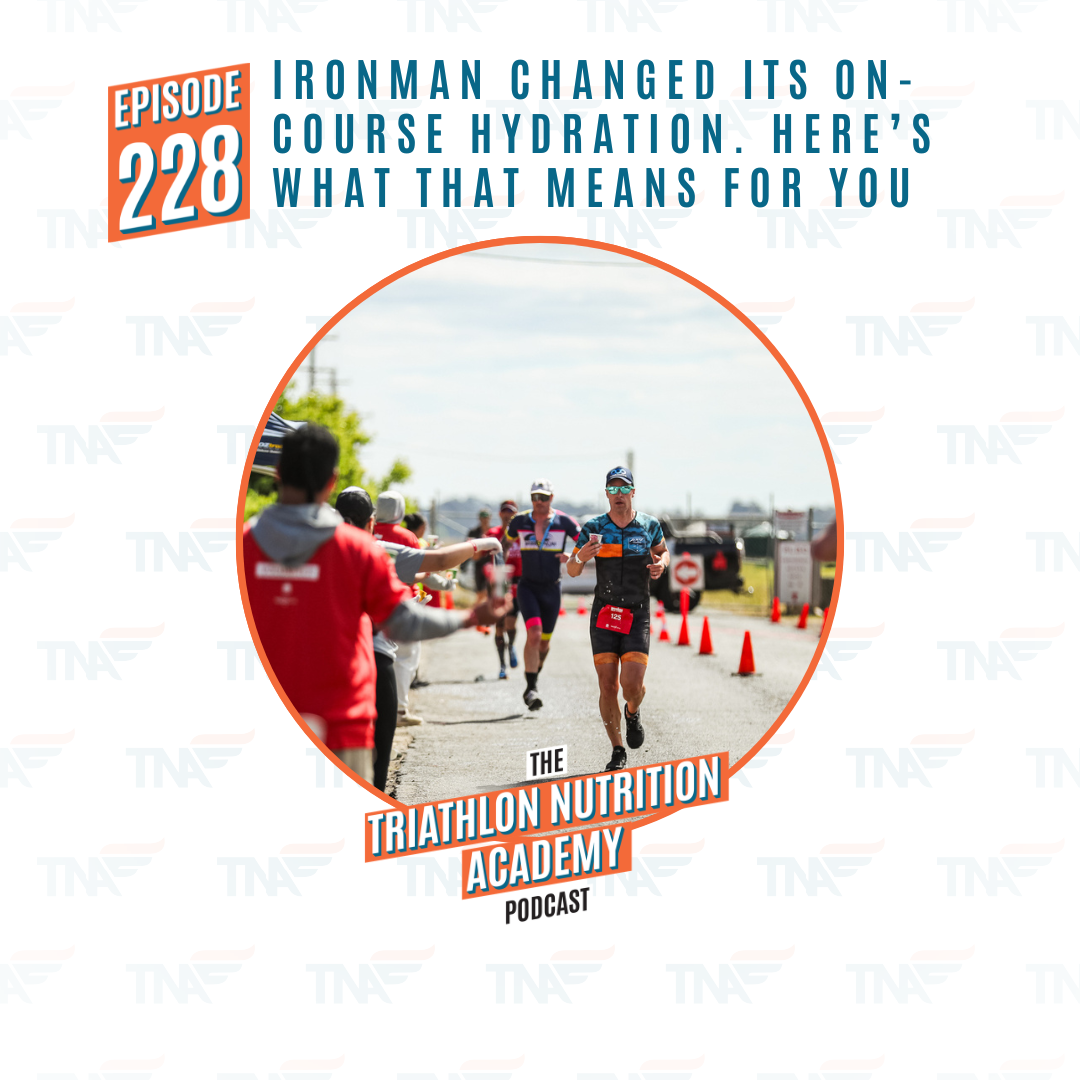
Episode 228 - Ironman Changed Its On-Course Hydration. Here’s What That Means for You

Ironman has changed its on-course hydration globally. Sounds simple. It’s not.
All Ironman-branded events have now moved to PH1000 for hydration and Maurten for carbohydrate fuelling, separating fluids and carbs completely. If you’ve relied on sports drink to do both jobs, this shift has major implications for your race nutrition plan.
In this solo episode, I break down exactly what’s changed, how much sodium you’re actually getting per bottle and how to decide whether this setup works for your individual sweat rate, sodium losses and fuelling preferences.
Because hydration and sodium are never one-size-fits-all. And winging it at 70.3 or full distance is how you end up walking the marathon.
Links:
Check how well you’re doing when it comes to your nutrition with our 50 Step Checklist to Triathlon Nutrition Mastery
Start working on your nutrition now with my Triathlon Nutrition Kickstart course
It’s for you if you’re a triathlete and you feel like you’ve got your training under control and you’re ready to layer in your nutrition. It's your warmup on the path to becoming a SUPERCHARGED triathlete – woohoo!
Connect with me:
To learn more about the Triathlon Nutrition Academy, head HERE | dietitianapproved.com/academy
See behind-the-scenes action on Instagram: @dietitian.approved
Follow along on Facebook: @DietitianApproved
Join our FREE Dietitian Approved Crew Facebook group
Enjoying the podcast?
Let me know what you loved about it and what you learnt by tagging me @dietitian.approved on Instagram!
Subscribe & Review in Apple Podcast!
Are you subscribed to the podcast?
If not, today's the day! I'm sharing practical, evidence-based nutrition advice to help you nail your nutrition and I don't want you to miss an episode. Click here to subscribe to iTunes!
Now if you’re feeling extra warm and fuzzy, I would be so grateful if you left me a review over on iTunes, too. Those reviews help other people find my podcast and quality nutrition advice. Plus they add a little sparkle to my day.
CLICK HERE to review, select “Ratings and Reviews” and “Write a Review” and let me know what your favourite part of the podcast is.
You're awesome! Thank you!
Episode Transcription
Episode 228: Ironman Changed Its On-Course Hydration. Here’s What That Means for You
Welcome to the Triathlon Nutrition Academy podcast. The show designed to serve you up evidence-based sports nutrition advice from the experts. Hi, I'm your host Taryn, Accredited Practicing Dietitian, Advanced Sports Dietitian and founder of Dietitian Approved. Listen as I break down the latest evidence to give you practical, easy-to-digest strategies to train hard, recover faster and perform at your best. You have so much potential, and I want to help you unlock that with the power of nutrition. Let's get into it.
Taryn: If you are racing an Ironman or Ironman 70.3 this year, do not skip this episode. Because globally Ironman has changed. Its on-course hydration partner again, and on the surface it looks pretty straightforwards, but when you actually pull it apart from a real world race nutrition perspective, it has some big implications for how you're going to fuel hydrate and execute your race.
[00:00:26] Last year I did an entire podcast episode on Ironman's move away from Gatorade Endurance Formula to the Mortal Hydration. And that was across North American Ironman branded courses. but this year all Ironman branded events globally are changing their hydration. Partner over to Precision Fuel and Hydrations PH 1000 as their hydration product.
[00:00:51] and all carbohydrate fuelling on course will come from the Maurten products, the gels and the solids available on course
[00:00:59] if we haven't met before. Hi, my name's Taryn. I'm an advanced sports dietitian who specialises in triathlon nutrition.
[00:01:05] And when Ironman changes something like this, my first question is always, okay, great. Now what does it actually mean for an athlete that's about to tow the start line? Because your hydration and fuelling needs are highly individual. Everyone sweats differently. Everyone loses a different amount of sodium
[00:01:24] and a blanket. On-Course nutrition setup for a race is only going to work for a select few athletes. The rest of you will have to figure out a new plan of attack.
[00:01:36] For some that setup is gonna be totally fine. It will meet your needs, but for many others, that's not going to meet your fuelling your hydration or your salty margarita needs.
[00:01:48] I work with plenty of those athletes inside the Triathlon Nutrition Academy program,
[00:01:53] and honestly, if you are racing the 70.3 or the full distance events and you are winging your hydration and fuelling, things are going to go pear shaped pretty quickly. so in this episode, I'm gonna break it all down for you. We're gonna cover what has changed on course, who that setup is really gonna work for, who it's not gonna work for. You're gonna have to understand how to be potentially a bit more self-sufficient and why it's so important to understand your own sweat, hydration, fuelling sodium, gut tolerance needs. It is non-negotiable if you wanna execute well on race day.
[00:02:30] And really importantly, what you can start doing now today in training. so you are not trying to problem solve or do some mental maths halfway through the bike leg.
[00:02:43] welcome to this episode of the Triathlon Nutrition Academy podcast. Let's dive into the details of exactly what's changed on Ironman race courses around the globe.
[00:02:53] Ironman announced at the end of 2025 that their branded events everywhere in the world, including here in Australia, have changed their official OnCourse hydration partner to Precision Fuel and Hydration's PH1000 When mixed as its intended to be, it will provide a thousand milligrams of sodium per litre.
[00:03:15] and it's designed specifically for electrolyte and fluid replacement only. It does not contain any carbohydrate whatsoever. Your carbohydrate fuelling on course is now provided separately via the Maurten Gels and the Maurten Solids, and those guys are the official fuelling partner of Iron Man branded events globally.
[00:03:36] Now I did a little bit of digging, and according to some of the events websites, the PH1000 will be served in pre-mixed bottles on the bike and in paper cups on the run course. That's as much information as I could find.
[00:03:49] I am assuming they're going to mix it to the right concentration so that it will provide a thousand milligrams of sodium per litre. But most of these products are made by the volunteers. Now I know a lot of triathletes who rely on that hydration product on course to provide both their hydration and a significant proportion of their carbohydrate fuelling.
[00:04:14] Particularly on the run course when it is harder to be self-sufficient to carry your own sports drink. So you pick it up at aid stations 'cause it's a no-brainer. It's easy, you don't have to worry about carrying stuff, and it's readily available every two Km's or bit over a mile. So this is where you're going to need to stop and think for a second.
[00:04:33] because if you are somebody that has relied really heavily on your sports drink to provide a lot of your fuelling needs, you can no longer just assume that that On-Course setup has got you covered. It is not gonna meet the needs of your race nutrition plan
[00:04:47] now, this change by Ironman doesn't necessarily mean that the system is bad. it just means that you need to understand the science behind your race nutrition plan, the way that it's structured what's on offer, and build a potentially new race nutrition plan, or become much more self-sufficient.
[00:05:06] Rather than turning up on race day, hoping that whatever is available on course is gonna work for you and magically be okay, we are not gonna do that. We're gonna be way smarter than that. The key structural change globally is that hydration and fueling are now completely decoupled, which is PFH is kind of whole philosophy, and that is across all Ironman branded events.
[00:05:28] So now that we are clear on what the on-course hydration and fuelling setup actually looks like, the next question is whether that sodium intake is actually appropriate for you, because this is where a lot of triathletes get caught out. Hydration and sodium needs are highly individual everyone has a different sweat rate.
[00:05:46] Everyone loses different amounts of sodium in their sweat, and there is no single sodium concentration that is magically going to work for everyone on the start line.
[00:05:56] You also need to understand and think through what is the sodium content of the bottle that they are going to hand to you on course. So if they give you a standard bidden, they're seven 50 mls or 25 ounces, if they mix that to concentration a thousand milligrams of sodium per litre, and they only pour seven 50 M or 25 ounces in, then that bottle in theory.
[00:06:20] Will provide 750 milligrams of sodium if they give you the little bitten, the 600 mLs or around 20 ounce bottles. And again, if they mix it to the right concentration, That bottle will provide 600 milligrams of sodium. So I think it's gonna be really important that you're always checking the event details.
[00:06:37] And then getting comfortable with doing that type of math to understand what is on offer and what you will hopefully be receiving from there. You need to ask a really simple but important question. How many bottles per hour am I realistically drinking or need to drink to meet my fluid needs? And does that sodium actually match my individual losses?
[00:07:00] for some athletes, it will, their sweat rate, their sodium losses, their drinking behaviour will line up nicely with what is available on course. But for plenty of others, that intake won't even come close. If you were someone with a really high sodium loss in your sweat or really high sweat rate compared to your so sodium loss, winging it with the on-course hydration is not gonna end well.
[00:07:25] Which is why understanding your own sweat rate and your sodium losses is so important and it's not an optional extra when you're getting into those longer distance events. It is a core part of building a race nutrition plan that is actually gonna hold together for you on race day. So once you've understood the encore setup and your own sweat rate and your own hydration needs, the next step is then translating that into a plan that works for you.
[00:07:54] Importantly, in this new setup, you need to understand where your carbohydrate fuelling is gonna come from. Are you going to rely on the Maurten gels and the Maurten solids, or are you going to BYOA sports drink? if you are someone who likes to drink your carbohydrate and do a lot of your fuelling that way, obviously you can't rely on the pH one thousands to do that, and you'll need to be so much more self-sufficient on race day.
[00:08:17] but regardless of how you're choosing to fuel, you need to practice that strategy and training. That means pressure testing that setup in conditions that are actually going to resemble your race on-course. Products Don't magically work on race day if your gut has not seen them under the stress in training, because at those longer course distances like a 70.3, like a full distance race, race nutrition failures are rarely one big, giant mistake.
[00:08:43] they are generally small mismatches that just compound all day when you're out on course. This is why I spend so much time with my athletes inside the Triathlon Nutrition Academy to get them to understand their sweat rate, their sweat, sodium losses, their fuelling needs, their gut ability, and then building a plan that is specific to them.
[00:09:05] Not just based on whatever's printed on a race website. If you want support with that and all the things that go with understanding how to eat for our sport, then you can register your interest in our upcoming cohort dietitianapproved.com/academy.
[00:09:20] if the academy is an open while you're listening to this and you really wanna get started now, The best place to start is the Triathlon Nutrition Kickstart Course.
[00:09:28] It gives you the fundamentals you need to understand your fuelling, your hydration and your recovery properly so you're not guessing or just copying someone else's plan and hoping for the best because the goal on race day isn't just to survive the day. It's to execute your race nutrition confidently so you can actually race to your potential, cross the finish line with a smile knowing that you've given it your role.
[00:09:52] So the biggest takeaway I want you to take away is that race nutrition isn't about what's on course
[00:09:58] It's about understanding your own body's needs and having a plan that actually works for you. Hydration, sodium fuelling, there is never a one size fits all, especially at those longer course distances.
[00:10:12] And the athletes who execute well time and time again, are the ones that have taken the time to understand their own needs. And practice their strategy and training so that it's dialled, they've tweaked, they've finessed it, and they know exactly what works for them. So they have full confidence when they tow the start line, their plan is gonna work for them and look, if something goes awry, they know how to troubleshoot it out there on course as well.
[00:10:36] So it's not a make or break situation.
[00:10:38] That is what I love focusing on here, cutting through the noise and giving triathletes clear evidence-based guidance that you can actually apply. Thanks for tuning in. I'll see you next week.
Thanks for joining me for this episode of the Triathlon Nutrition Academy podcast. I would love to hear from you. If you have any questions or want to share with me what you've learned, email me at [email protected]. You can also spread the word by leaving me a review and taking a screenshot of you listening to the show. Don't forget to tag me on social media, @dietitian.approved, so I can give you a shout out, too. If you want to learn more about what we do, head to dietitianapproved.com. And if you want to learn more about the Triathlon Nutrition Academy program, head to dietitianapproved.com/academy. Thanks for joining me and I look forward to helping you smashed in the fourth leg - nutrition!