
Episode 231 - From Couch To
Ironman at 48

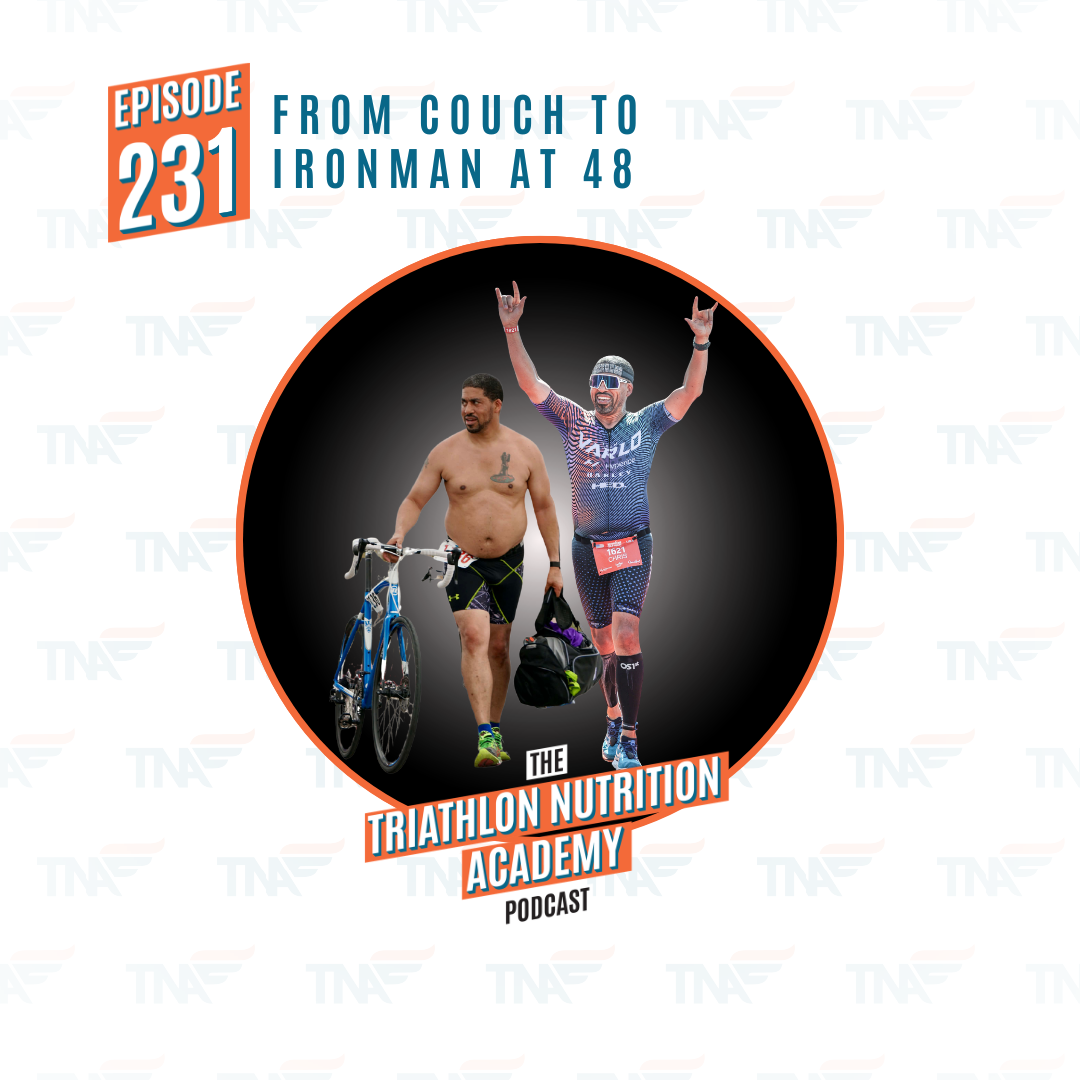
What happens when someone with zero athletic background decides to completely change their life… and accidentally signs up for an Ironman four months later?
In this episode of the Triathlon Nutrition Academy Podcast, Advanced Sports Dietitian Taryn Richardson sits down with Triathlon Nutrition Academy athlete Chris Tubbs to unpack his incredible journey from couch potato to multiple Ironman finisher.
Chris started triathlon at 48 years old, while travelling 60% of the time for work in the biotech industry. Early on, things didn’t go to plan. Despite doing the training, races were ending in DNFs, cramping, nausea and serious frustration.
The surprising part? Fitness wasn’t the problem.
Links:
Check how well you’re doing when it comes to your nutrition with our 50 Step Checklist to Triathlon Nutrition Mastery
Start working on your nutrition now with my Triathlon Nutrition Kickstart course
It’s for you if you’re a triathlete and you feel like you’ve got your training under control and you’re ready to layer in your nutrition. It's your warmup on the path to becoming a SUPERCHARGED triathlete – woohoo!
Connect with me:
To learn more about the Triathlon Nutrition Academy, head HERE | dietitianapproved.com/academy
See behind-the-scenes action on Instagram: @dietitian.approved
Follow along on Facebook: @DietitianApproved
Join our FREE Dietitian Approved Crew Facebook group
Enjoying the podcast?
Let me know what you loved about it and what you learnt by tagging me @dietitian.approved on Instagram!
Subscribe & Review in Apple Podcast!
Are you subscribed to the podcast?
If not, today's the day! I'm sharing practical, evidence-based nutrition advice to help you nail your nutrition and I don't want you to miss an episode. Click here to subscribe to iTunes!
Now if you’re feeling extra warm and fuzzy, I would be so grateful if you left me a review over on iTunes, too. Those reviews help other people find my podcast and quality nutrition advice. Plus they add a little sparkle to my day.
CLICK HERE to review, select “Ratings and Reviews” and “Write a Review” and let me know what your favourite part of the podcast is.
You're awesome! Thank you!
Episode Transcription
Episode 231: From Couch to Ironman at 48
Welcome to the Triathlon Nutrition Academy podcast. The show designed to serve you up evidence-based sports nutrition advice from the experts. Hi, I'm your host Taryn, Accredited Practicing Dietitian, Advanced Sports Dietitian and founder of Dietitian Approved. Listen as I break down the latest evidence to give you practical, easy-to-digest strategies to train hard, recover faster and perform at your best. You have so much potential, and I want to help you unlock that with the power of nutrition. Let's get into it.
[00:00:00] Chris: I noticed one time after I had begun changing my food, I would go into the airport.
[00:00:04] And I noticed as I passed security walking to the gate, I would start craving certain things Almost like Pavlov's dog, I go buy these sweets or I get this snack. I didn't need to eat it anymore, but my body was programmed to want that, so it, I had these impulses to get it. it took some time in the beginning to remain very conscious about my choices. Because I had these old habits I wasn't even aware of how, how deeply they sat that were pulling me off course.
[00:00:31] Taryn: Welcome to the Triathlon Nutrition Academy podcast. I'm your host, Taryn. I'm an Advanced Sports Dietitian, semi-retired age group, triathlete and creator of the Triathlon Nutrition Academy program, where I help triathletes turn nutrition into their secret weapon. Today's guest is one of our own
[00:00:47] A TNA athlete all the way from Texas USA Chris Tubbs started his athletic journey at the ripe age of 48. Four months after his first triathlon training session, he accidentally signed up for a Ironman. He was traveling about 60% of the time for work in the biotech industry. cramming training in, around flights, hotel rooms, boardrooms.
[00:01:11] I've seen him on like random Pelotons in gyms, in hotels, just to get his sessions done. back then he didn't even know what an Iron Man was, but somehow he got himself to the start line.
[00:01:21] Since those days though, Chris has become a multiple Iron Man finisher and a proud member of the Triathlon Nutrition Academy since 2022, but it hasn't all been smooth sailing prior to him really understanding his nutrition and in particular hydration.
[00:01:36] Like we're talking DNFs. Probably far too many supplements. I'm sure he won't mind me saying that. And you know, a really high sweat rate that he's been dubbed The Human SP Sprinkler by himself. That's his own title. And once you hear about all of that, then you'll understand why he wasn't finishing races. So today we're gonna hear from Chris and dig into what he did to turn it all around for himself. From struggling to finish races to like finally cracking the code for what works for him and his body and what was holding him back to now being able to, you know, finish nine man with less problems.
[00:02:12] Sometimes there are still problems, but it's the spoiler alert. It wasn't more supplements that got him to the finish line. So let's get into it.
[00:02:22] Chris, welcome back to the podcast. You are no stranger around here, but this is your first solo episode with me. Welcome,
[00:02:29] Chris: Hey Taryn, thanks for having me. I'm really excited to be here and talk with you. I always enjoy our conversations.
[00:02:34] Taryn: me too. Can you take us back to the very side of your career and please tell me how you accidentally signed up for an Ironman.
[00:02:43] Chris: Yeah. It's, it's one of those accidental good things. I was, uh, living most of my life just working and not exercising. And I tell people before I started training for triathlon, I was a, a championship. potato chip eater. So I would grab bags, sit on the couch and finish the bag. Then the next day I'd do it [00:03:00] again.
[00:03:00] I had consistency like you wouldn't believe, but in that, you know, I became pretty unhealthy and unhappy and I didn't realise how bad it was. Uh, it's kinda like watching the grass grow until one day. I remember this moment, over Christmas time. My son and I were gonna go see the Nutcracker.
[00:03:17] We had on three piece suits and I was really excited to go and my wife took a picture of us. When I looked at the picture afterwards, I remember seeing that my face was bloated and my shirt was so tight that the buttons were pulling apart. Like the shirt was too small and I just felt horrible. Um, and that night I, after I felt really bad about myself, when we came back to the Nutcracker, I decided that I was gonna make a change and I wasn't gonna make an easy change.
[00:03:42] I was gonna change everything. And I called it my ludicrous goal. I, I had to do something that would cause me to figure out how to change all my habits, including, oddly enough, eating, but, um, physical activity. But I knew I, I had to eat, eat differently. I just didn't know how much.
[00:03:58] Taryn: It is not like you to go guns blazing and go all in. I'm not really sure what, where that came from.
[00:04:04] Chris: Yeah, I don't know where that came from either,
[00:04:06] Taryn: And sometimes it is just a line in the sand and it can be a really defining moment and look at you now like you are a absolute weapon.
[00:04:14] Chris: I feel really good. I'm, I'm very happy with how far I've come and the potential I see things that I can do even more so.
[00:04:21] Taryn: you were the one that shared David Goggins with me too. So I feel like. There is parts of you in him and vice versa if you are looking at doing some crazy shit in the future.
[00:04:32] Chris: Yeah. Yeah. I, I, he resonates with me deeply. There are many things that he went through that I didn't do exactly, but I felt the way he described what he felt and, and went through with life and decisions he's made, um, just no excuses and full accountability for where we are. Where I am, there are consequences of my decision.
[00:04:51] So to change it, I have to make better decisions, and that's what I'm doing.
[00:04:55] Taryn: So let's talk about some of the early phases, like when I first met you and why things weren't working because you were fit, like you were doing the training then, but race after race, things were going pear shaped and it just wasn't working. There were lots of DNFs back then. What was going on at that time when in your triathlon career?
[00:05:14] Chris: Yeah, this was really early in the career and uh, there were a lot of things going on. One was, I was brand new to training. I didn't have an athletic background in high school. I swam a little bit, uh, for a year, but other than that, after that I didn't do anything. So I had to learn how to run. Spike. I knew how to swim, but not competitively in like open water and racing.
[00:05:37] But I also needed to know how to manage my time to fit in the sessions and how to follow a plan. So I was of the mindset I, as long as I was doing it, I was fine. So I would do something but not according to plan. And so I wasn't really progressing much. I felt better. I was sore. Going from not being able to run two miles to being able to run a 5K was huge for me, but it was nowhere near my goal, which at that time was to run an Olympic distance.
[00:06:03] So going from not being able to run two miles and having an old mountain bike to saying, well, if they do it at the Olympics, that's gotta be the pinnacle. That's what I knew at the pinnacle of, of triathlon. And so that was my goal, and I didn't know what was wrong other than I thought I'm just not fit enough.
[00:06:20] So I have to keep trying harder. I just have to try harder. I didn't ask enough questions.
[00:06:24] Taryn: You joined the Triathlon Nutrition Academy program back in September, 2022, and I remember. Like it was yesterday, how nervous you were to join a nutrition program and be told that you couldn't do stuff anymore. That I was gonna take all of your supplements away from you, and you didn't want me to do that because you had pinned your entire performance around everything that you were taking every day.
[00:06:51] Were you surprised? When your performance one didn't tank, it actually improved when you stopped taking all this stuff. And then secondly, how much money you were now saving as a result of that.
[00:07:05] Chris: Oh, I remember the conversation as well. I remember just having, going through knots, looking at the program, advertising and thinking about it, knowing I need this help, but my ego didn't want to say, you don't know what you're doing. So by me saying to you, I don't want you to take my things away, was me telling myself, you know, everything.
[00:07:29] So why would you really need help? It was, it was an internal struggle and so. I, I was really afraid that, um, the supplements were what was holding me up and I needed them. It's my, my little Linus blanket from the, from the peanuts. I was going through the program and I, I, I'll say brave enough to stop taking the supplements and actually changed what I ate.
[00:07:49] So I was getting most of the nutrients through food. My, my performance, to my surprise, didn't suffer. It actually improved, so I, I had more energy. I slept better. I wasn't cramping nearly as much. I still had a lot of issues because as you intimated earlier, a, a sweating problem I didn't address until later.
[00:08:08] I didn't recognize until later. But the nutrient side, improved me quite a bit. So I saved, I was probably spending. Well over $150 a month, US dollars, maybe $200 a month on supplements, because I was just buying things. I would see ads or talk to other people. They were taking things and they were better performers than me.
[00:08:25] So I thought, that's what I have to do too. That's gonna be my ticket.
[00:08:29] Taryn: Mm.
[00:08:30] Chris: And you know, it's, it's the same story. It's not.
[00:08:33] Taryn: You're not alone though. So many triathletes do that. We get marketed so heavily with all these things and we see the pros doing it, so we feel like we need to do it, and if we don't, we're gonna get left behind. But what age groupers don't have right, is those foundations of nutrition first before adding in some of those sorts of things.
[00:08:53] Whereas the pros have it the complete other way around.
[00:08:57] Chris: Yeah. I, I didn't know that.
[00:08:58] Taryn: If you wanna dive into how much Chris is saving, as well as Kelly another TNA athlete who is saving triple what Chris is saving, you can go and listen to Episode 101 back in the archives and check out that story.
[00:09:12] Chris: And as you say that, that was what we had the conversation and you said it with such confidence that I wouldn't need them, I could save the money. I did the math and thought, well, if I don't have to buy the supplements, it pays for the program. So there's nothing to lose in that regard. So it it, it did in multifold.
[00:09:30] I mean, I can't really put a price on it at this point. The knowledge that I've gained and the confidence that comes from that
[00:09:36] Taryn: When you first started, you were also traveling a lot. Like I said earlier, you were on the road every week and trying to fit in a change in nutrition in a really busy lifestyle. When you know you're at home, your wife is the one that cooks and. You can give a direction to say, this is what I need, but when you're on the road, you're at the mercy of whatever is available to you.
[00:09:59] And I remember another key like pivotal moment in your learning when I was like, you don't have to order that at a restaurant. You can order something different. You can build your plate the way that you wanna build it. And just the light in your eyes was like, oh yeah.
[00:10:17] Chris: Yeah.
[00:10:17] Taryn: You completely changed the way that you ate and fit that into your lifestyle, even though how crazy busy it was and you were on the road every week.
[00:10:25] Chris: Yeah, it's, it's actually amazing how much routine becomes truth. Uh, at least for me. I did the same thing for so long that it didn't occur to me that I just could choose something different to eat
[00:10:39] Taryn: It's funny,
[00:10:39] Chris: the other part. It's amazing. But the other part of that was. I noticed one time after I had begun changing my food, I would go into the airport.
[00:10:47] And I noticed as I passed security walking to the gate, I would start craving certain things from the store in the restaurant. Almost like Pavlov's dog, when you ring the bell, when I pass through security, oh, I go buy these sweets or I get this snack. I didn't need to eat it anymore, but my body was programmed to want that, so it, I had these impulses to get it.
[00:11:07] So it really, it took some time in the beginning to remain very conscious about my choices. Because I had these old habits that I wasn't even aware of how, how deeply they sat that were pulling me off course. So it took quite a while to to shift.
[00:11:21] Taryn: One of the biggest pieces of your puzzle is definitely the human sprinkler side of things. So in the beginning, like we're not overhauling, but you had a huge. Shift in the way that you ate to support triathlon. And that's coming from a base of no athleticism, being a couch potato, eating chips crisp as you just described, to then, you know, having to eat to support three sports That whole shift in your mindset around food was amazing and so fun to watch, but early days you thought that a lot of your problems were around fuelling and you needed to fuel more and more carbs during racing was the answer and was gonna fix all your problem.
[00:12:03] But in fact, it was not that. More carbs was not the answer. It was actually your hydration as a very heavy sweater. Understanding your personal hydration needs and how to actually support that in a race is what was the difference. So what were some of the things that you did to really understand that and unlock that next level, and how did things change for you on race day when you did?
[00:12:24] Chris: it was a slow progression, so, I knew I sweated a lot, but I didn't think it was unusual. I thought maybe because I live in Houston, that's just how it is and everybody sweats. And the first coach I had told me to drink more and, and of course I drank what I felt like drinking up. It was very stubborn and I would get lightheaded and nauseous and he would tell me that was the case.
[00:12:46] Then the other thing I learned, uh, I took a little thing through work about healthy eating and I realised I was not drinking enough fluid even in daily life, and I was mistaking that signal for hunger. So I was overeating and of course, the wrong things, and not hydrating so that when I would train, I would cramp incredibly, uh, frequently, and I, I.
[00:13:11] Didn't know what it was. So little course that I took through work and then talking with you, making suggestions about how much I sweat and then getting a sweat test made a difference to see how much I sweat and then have it compared to other people. So I'd know, and then I'd know how much to drink because I, I didn't pay attention to how much I would drink.
[00:13:32] When I ran, especially when I would bike, so five, six hours here in Houston when it's 90% humidity, and the temperature is very hot, what? 37, 38 at sea and 98 here. I didn't drink enough. I didn't pay attention to drinking, and of course I didn't drink enough, so I would like ball up in a little cramp at the end of the ride if I made it to the end of the ride.
[00:13:53] Healthy.
[00:13:54] Taryn: What is your sweat rate? Just enlighten people on how it's it's a, a little over two litres an hour. the, the measurements go from about 1.9 to 2.2 litres per hour. So
[00:14:04] Which is, which is high. It's probably, you know, high normative data. I've definitely seen high, though. Here in Australia we're pretty sweaty people also just 'cause it's so hot and so humid, upwards of sort of three, three and a half litres of sweat an hour.
[00:14:20] But you'll know if you're a heavy sweater because you're wring your clothes out after a training session, which is why you dubbed yourself the human sprinkler because it is that.
[00:14:28] Chris: Actually that name. So I did call myself that, and it came from when I would ride in a group ride. And I would look back, the water would fling off my body to the people behind the water. The sweat would fling and it was, it was just nasty, but it was, I didn't know there was nothing I could do. I was just, I would look back to see who was there if I'm changing lanes, as soon as I turned my head or my shoulders, it's just slinging sweat back.
[00:14:51] I said, oh shit. I'm like a sprinkler.
[00:14:53] Taryn: Oh man. Did people move away from sitting on your wheel as a result of that?
[00:14:57] Chris: No. 'cause they're like, it's ri it's like riding behind a brick wall. It's so easy. You know, I, I block so much wind, all, you know, I'm bigger than a typical triathlete. So
[00:15:05] Taryn: Yeah. What is, what is your height and weight?
[00:15:08] Chris: Six foot 2, 220, 225 pounds.
[00:15:11] Taryn: Yeah. Not a typical triathlete build big body mass. Lots of internal heat
[00:15:17] Chris: Yes.
[00:15:18] Taryn: equals high sweat rate.
[00:15:20] Chris: High sweat rate and, and, um, a good blocker of wind.
[00:15:23] Taryn: talk to me about the moment when you realised that fuelling wasn't the problem, it was hydration, and some of the things you did to try and rectify it.
[00:15:31] Chris: I realised that during races, so after talking with you, I was able to create a plan and during training I did it. But really during the race, I would follow the plan and realise that the cramping was better and I felt better. and so I continue to do that and be much more intentional about paying attention to how much I drink and how frequently I drink. And it, it has made a big difference. So my race is now, it's, it's not an issue. I know what I'm drinking when [00:16:00] I'm drinking it, and I've even gotten to the point where I can, I can improvise a bit if things go sideways so I lose a bottle or, um, something like that.
[00:16:08] I can. Improvise and I can feel when I'm not, uh, drinking enough.
[00:16:14] Taryn: It's a nice place to be, to have that ability to troubleshoot on the fly based on how your body's responding and feeling to things rather than just having this set plan that I will drink this amount, amount, and fuel at this amount, regardless of what's going on externally.
[00:16:30] Chris: Absolutely, and I'll, I'll adjust it. So one of the things I, I, it's been wonderful, is to be able to adjust the amount I take in based on the conditions and the intensity of the session. I didn't do that before. I didn't understand the importance of it really, but then when I did, I didn't know what to do, so I would either slam more and they were racist.
[00:16:50] When I was just slamming so much water, I would have slushy gut and get nauseous, I didn't even know how to pinpoint it, to know what to do because I, I was a heavy sweater, so I thought I just had to drink. All the time, and then that, that backfired as well. So I, I didn't, I just didn't know how to walk the, the line, you know?
[00:17:08] Uh, but slowly through, through the practice and the, and the sessions, and the plans, I've gotten much more dialed in on what my body does and what it needs.
[00:17:18] Taryn: yeah. How are your races feeling now?
[00:17:19] Chris: They feel great. I haven't been able to execute one with putting all the pieces together at one time, but I feel great at the end of races. and my nutrition and, and energy levels are high, so I'm not. Completely depleted and, and like a zombie at the end. I'm mostly frustrated at decisions that I've made that got in the way of me really performing the way I thought that I could. But it's not because fitness or the nutrition was off that
[00:17:47] Taryn: Mm, you weren't even able to finish runs. So to just to be able to cross finish lines is, is huge.
[00:17:53] Chris: Yeah.
[00:17:54] Taryn: And you just gloss over that. 'cause you're a let's keep going next type person. I.
[00:17:59] Chris: A Absolutely. Uh, so I, yeah, that's a, that's an issue. I, I don't sit and reflect a whole lot. I just think about what's next, what I do next. And, uh, I just got off, uh, I was talking with a buddy who qualified for Kona at, um, Comel, and he was already thinking about Spring and, and I reminded him, no, this is, take a moment to enjoy this and, and think about what you've done and all the work you've done to get here.
[00:18:22] And it all came together. Just slow down for a minute I can say it, but I have a lot of difficulty doing that myself. Probably. That's why I, why I can say it because I know how important it's
[00:18:31] Taryn: Yeah, I think there's a lot of people that are in the same boat, me included. One of the things you've learned is to not sign up for hot races as well, which I think is a great tip for you.
[00:18:40] Chris: yes.
[00:18:42] it took me a couple of races to put it together. Two DNFs, one 70.3 in Waco, Texas. I DNF'd on the bike with the heat. I, I just got to the point where, uh, it was pretty early in the bike as well too. And then, um, at Ironman Zell I overheated and was dehydrated and I didn't finish the bike.
[00:19:03] I got to the point where I was probably just past heat exhaustion and going into more severe, where I could barely keep my eyes open and stay upright on the bike, but I was still trying to go. I decided to call it. But that was the moment where I realised, okay, I'm not ready for hot races. I, I wanna do these races, but I've gotta do 'em in conditions where I'm more suited and adapted and that's colder.
[00:19:27] I'm, I'm more like a, I tell people polar bear wrapped in a human body. So I go, I, I did the next year I did, um, Sweden. Loved it. I swam the San Francisco Bay and the water is cold and I felt great. So that's where I am right now. Until I can figure out if I can adapt my body to the heat, I'd love to go back to coza me and race it again.
[00:19:48] 'cause it's beautiful.
[00:19:49] Taryn: You forget that you are very early in your triathlon career too. Also, it's, you know, again, a testament to your mindset is that you can do hard things and one of your hashtags is, I love all this shit. If you follow Chris on on Instagram, his handle is @iron_clydesdale. If you are looking for some good motivation and inspiration is just such a happy camper all the time.
[00:20:13] Smiling all the time. Nothing's ever a problem. Just having a good time in life.
[00:20:18] Chris: And, and I'll tell you why it's, um, perspective. So early in my career I had, I got diagnosed with prostate cancer. So right before my first Iron Man and I.
[00:20:29] Taryn: I.
[00:20:30] Chris: I had surgery like three weeks after my first Ironman, and I was the first race because I knew that I was going to go through surgery and I didn't know what was to come with this cancer diagnosis.
[00:20:41] I was just happy the whole time. There was nothing I was worried about. I went into the race, just grateful. And ever since then I've just felt appreciative of being able to push my body to do these and make my mind stronger and, and learn from them. 'cause you learn about life as well. And, uh, it has just kept me grounded because we, we don't know how long we'll be able to do this, especially if we love it.
[00:21:08] So I appreciate it. I do my best to appreciate it all the time.
[00:21:11] Taryn: A lot of people can learn a lot from that. I think one of the things that you have said to me before and something that I really love is that. You could try and piece all of this stuff together on the internet, but it's faster and way more effective to get some help to do that. So what would you say to somebody that is thinking that they can, you know, absorb all these free podcasts, figure it out with chat GPT and try and work out their own nutrition instead of getting some support and investing in their nutrition.
[00:21:43] Chris: Oh, that's, that's great point. I agree with that a hundred percent. I would ask someone, what's more important to you? Do you just want to. Take your time. Problem solving, figuring something out, running in circles, or do you want to make progress and really begin to make the best and get the [00:22:00] best out of your potential?
[00:22:01] Because if you want to do the latter, then don't waste your time chasing all of these non-specific and potentially inaccurate sources of information. Go. It takes six months, spend a couple of hundred bucks and talk with an expert and get a community of people that are learning with you so that you can grow and, and support one another together.
[00:22:22] It's a lot of fun. We have a, we have a group of of athletes that we are chatting every week and we get to talk to each other, and now we see each other at races, so we learn from each other a lot. But the important part is if you want to do these races well, and you don't want to drag it out for years.
[00:22:38] Just take the time, make the investment, and learn what you can do that's specific for you and your conditions. Then you got it. Just go race.
[00:22:48] Taryn: what is next on the cards for you? You've always got some crazy plans. You gonna come to Santa Cruz 2027?
[00:22:55] Chris: I do wanna go to Santa Cruz. So we've got the TNA event. Uh, we were just in Australia, Sunny Coast, 70.3, and uh, that was a lot of fun and I loved it and it's beautiful. The next one I will not be at, but I will go to Santa Cruz, where you all will come to the US to North America.
[00:23:13] 20, 26, uh, no big races for me.
[00:23:15] I'm, I'm in the process of, uh, learning to fly. So I'm in Flight school with my son. So we're doing it together. Um, he wants to be a professional pilot, so I'm, I'm learning with him and we're learning together and it's a wonderful experience, uh, to share. So I've pulled back on my Ironman training.
[00:23:31] I'm doing two 70 point threes next year, and then I'm going to spend eight days riding through the mountains of Japan with a couple of other people and just learning to ride better, climbing and push myself because I have a bigger goal for a much harder. Triathlon a few years later. So I wanna build some of these skills.
[00:23:53] Taryn: What are you allowed to tell us is this, this is like a carrot dela like
[00:23:58] Chris: Oh, I don't know what I wanna say it. 'cause then I'm committed. Committed. If I
[00:24:01] say it out loud. yes, I'm thinking about Ultraman
[00:24:04] Taryn: this is the epitome of Chris.
[00:24:06] Chris: yeah. do things in halves.
[00:24:08] No, no. So. The, the issue for me with regard to ultraman or the hesitation is, is not that I, whether or not I think I can do it, it's the time commitment for that level of event and the training that's required relative to what else is going on in my life. it would be some real big sacrifices. Ironman itself is very big and I'm grateful for my, my wife and my son. Being supportive of me doing, I've done 11 and four and a half years, five years,
[00:24:37] it's a lot. And I, I didn't realise it until I actually sat and thought about it, but before I asked them to support something like that, I, I wanna really reflect and, and look at where we are and see what else they want to do.
[00:24:50] Taryn: So you haven't asked your wife yet.
[00:24:56] Chris: I just, I just said, Hey, you know, I've been thinking about this thing in a couple of years, not right now, just a couple of
[00:25:02] years. And she,
[00:25:03] Taryn: plant the seed.
[00:25:04] Chris: she gives me this look like, oh shit. I know what it, what it is. When you say, I've been thinking about,
[00:25:09] Taryn: Oh, no, I love it. I love it. Okay, so we won't nobody say anything to Chris's wife please, until he's had a chance to ask her properly.
[00:25:21] Chris: sorry. Yep. So she's gonna have some wonderful things before then, before I even bring it up. Her life's gonna be grand and all kinds of goodies.
[00:25:27] Taryn: Oh my gosh. Sorry Robin. What has been the best thing you've learned about nutrition over the last couple of years working together?
[00:25:34] Chris: the best thing that I've learned about nutrition, uh, and has come from working with you, of course, is the ability to adapt my nutrition to what I'm going to do. So there's lots of specific things we've learned and they're helpful, but I think. On the whole, having enough understanding and knowledge about nutrition and about my body to be able to adjust it, to support it to various types of events is the most important piece.
[00:26:03] I can take that with me anywhere and do any kind of event, I believe.
[00:26:07] Taryn: Absolutely you can. You have the right mindset. everyone's the same. You can do hard things. You just need to put the right foundations in place so that your body can absorb the training, you understand how it works, you can troubleshoot. All of those sorts of things are key to your success.
[00:26:22] Rather than just going guns blazing into, you know, a Ironman four months into your journey and then going, oh shit, I actually need to understand how to eat for this thing.
[00:26:32] Chris: Yeah. And, and how did that happen? So we did mention that I accidentally signed up for an Ironman. I had started training for the Olympic, uh, in January, February. I, I had a coach and then I happened to have a guy at my job that I knew did athletics. So I told him I was training for this Olympic triathlon thinking, ha, it's impressive.
[00:26:53] He's like, oh yeah, that's nice. That'll be fun. Um, and I asked him if, had he done triathlons? He says, yeah, I do. Ironmans. I didn't know what Ironmans were. He had done like six or seven of them, and so he explained it to me, and of course my, my jaw fell on the floor. I was like, oh, shit, that's crazy. I could never do that.
[00:27:08] I left it alone, but within two or three weeks he had poked me enough times. He said, Hey man, I'm coming down to Texas next April. To do Ironman, Texas, you should do it with me. My first response was profane, and I said, you know, f you man, you're crazy. Leave me alone. But he must have known that I have a competitive spirit.
[00:27:29] And he just kept poking at me and poking. And eventually it didn't take long. I had said yes in my head and then I just had to have the conversation with Robin, like, Hey, guess what I'm thinking about? You know, Tim said, and um, she knew me better than I knew myself. She just, I remember the moment she was standing in the, uh, in the room and she just put her head down and laughed.
[00:27:49] She says, I was wondering when this was gonna happen. I knew in Olympic wasn't gonna be enough for you.
[00:27:54] And that's it. We, I just signed up and asked my coach. He says, I can get you ready. You just have to learn to sit on a bike for six hours.
[00:28:02] Taryn: is anything ever gonna be enough for Chris Tubs though? Because now you're already like, all right, Ultraman, it's gonna happen. And then And then do beyond ultraman?
[00:28:11] Chris: I, I haven't thought about that. I want to execute an Ironman as well as I know that I'm capable and that's a big challenge. So it's not so much how quickly I can finish, but it is how quickly I can finish.
[00:28:24] But it, it, it'll happen when I execute everything well. The time will be, what the time will be. I think it'll be fast, but. I have to stop making mistakes that I know I don't need to make, and that's being conscious and diligent and disciplined.
[00:28:40] Taryn: Yeah, I spoke to the Iron Cowboy recently on the podcast and he's done something like almost 200 Iron Man events, like full distance races. He said out of those, one worked to what he expected and it everything slot into place.
[00:28:58] Chris: Wow.
[00:28:59] 200. are not good.
[00:29:02] No, they're not. Holy crap.
[00:29:05] Okay. hope.
[00:29:06] Yeah. There's hope, but you also have to have patience is what that means. It, it's possible, but it's, it's the draw, right? We know we can do better and we're wired to seek that out
[00:29:18] Taryn: it's why triathlon's so addictive, isn't it? Because there's always something that you can do better.
[00:29:23] Any final words of wisdom for triathlete listening who might be struggling like you were back in those days?
[00:29:30] Chris: Get some help. It's worth it. You don't have to struggle and just keep falling down and figuring out on your own. Just reach out, get some help. It doesn't take very long. The time will pass quickly.
[00:29:40] You'll meet new friends and people that support you in races and what you're doing, and you'll find other people to support and find fulfillment in that as well. Nutrition is really what allows it to happen. Once you're fit, you can be fit and not have good nutrition, and you're still not even close to your potential.
[00:29:57] So learn to, to support your training and your racing through nutrition And Taryn's. Great. She's, she doesn't pull any punches. She talks straight to you. I, I, it's amazing. So she's a, a real breath of fresh air, uh, when you talk to her and when you go through your plan. So when it's your time to go through your plan. All eyes are on you. Everybody in the group is helping you and listening and giving you ideas, so it's all hands on deck to get you to where you the best place you can be.
[00:30:28] It's wonderful.
[00:30:29] Taryn: I do love that about our athletes is that we all lift each other up in a world where everyone cuts each other down.
[00:30:37] We have people in the same age group that do help each other and we all support each other, which is, I love that about it. Well, Chris, thank you so much for sharing your story with us. The highs, the lows, the DNFs.
[00:30:50] So much sweat.
[00:30:51] So much sweat. And I think you are just the epitome of a living example of it's never too late to start, is it? Like, I can't believe that you did nothing. For 48 years, the last 50 are gonna be amazing. It's particularly if you've got things like Ultraman on the cards and I, and I know that there is more in you and there's little seeds that you just don't wanna voice to me 'cause I will hold you accountable
[00:31:16] Chris: That's right. That's right. They're just little seeds. They're not enough to talk about them.
[00:31:22] Taryn: but also educating yourself like you're a smart person, you're a biochemist. You have a science degree and you're educating yourself in an area that most of us really know nothing about.
[00:31:33] We all eat, we all have a body and we think we know, but, but really, we don't know. and you are a great example to showcase it, when you do, stop winging it and just trying to fake it till you make it. Get the right support crew in your corner. Your best races are still ahead.
[00:31:48] Chris: absolutely. Absolutely.
[00:31:51] Taryn: If you do wanna connect with Chris on the Gram, he's part of our amazing athlete community within the Triathlon Nutrition Academy. He's on Instagram as the @iron_clydesdale. Is that still your handle?
[00:32:01] Chris: Yeah. Iron_clydesdale.
[00:32:02] Taryn: Yep.
[00:32:03] Chris: underscore Clydesdale.
[00:32:05] Taryn: Clydesdale, I'll link it in the show notes if just even for a bit of positivity in your day when he gets all bendy and stretchy and hashtag, I love all this shit on us.
[00:32:13] It's great. And if you're nodding along thinking, all right, that sounds like me. Maybe now is the time to do something about it. You can learn more about how I work with athletes inside the Triathlon Nutrition Academy program and register your interest for our next cohort at dietitianapproved.com/academy.
[00:32:31] Thank you for tuning in and thanks for joining me, Chris. Remember to stay hydrated.
[00:32:35] Chris: Yes, there we are.
[00:32:39] Taryn: Cheers.
[00:32:40] Chris: She is great talking with you, Taryn.
Thanks for joining me for this episode of the Triathlon Nutrition Academy podcast. I would love to hear from you. If you have any questions or want to share with me what you've learned, email me at [email protected]. You can also spread the word by leaving me a review and taking a screenshot of you listening to the show. Don't forget to tag me on social media, @dietitian.approved, so I can give you a shout out, too. If you want to learn more about what we do, head to dietitianapproved.com. And if you want to learn more about the Triathlon Nutrition Academy program, head to dietitianapproved.com/academy. Thanks for joining me and I look forward to helping you smashed in the fourth leg - nutrition!