
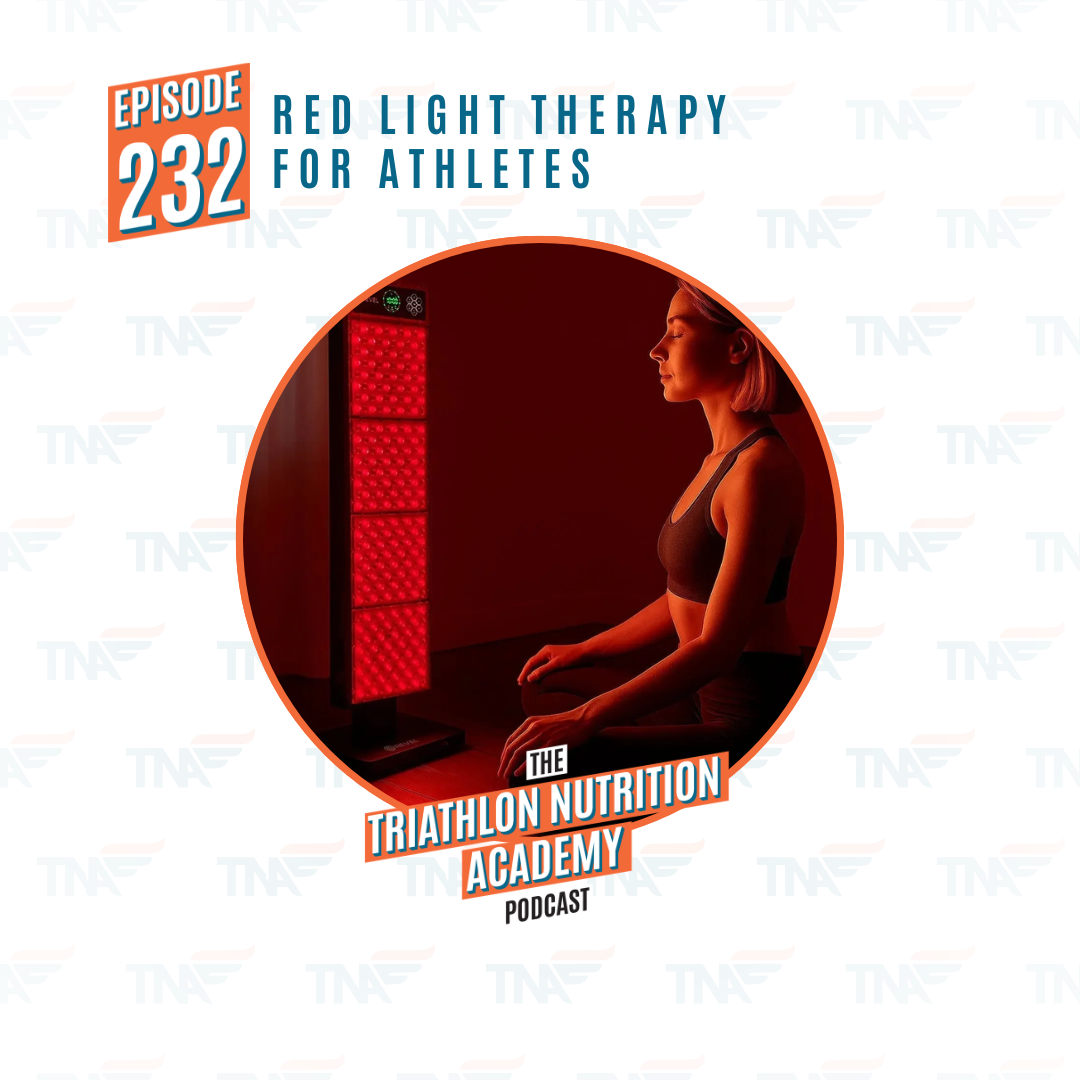
Episode 232 - Red Light Therapy for Athletes with Glen Jeffery

What if one of the biggest factors affecting your energy, recovery and long-term health had nothing to do with your training or nutrition… but the light you’re exposed to every day?
In this episode, I sit down with Professor Glen Jeffery, neuroscientist from University College London, to unpack the fascinating science of how different wavelengths of light interact with our cells, particularly our mitochondria, the energy powerhouses that drive performance, recovery and health.
Links:
Check how well you’re doing when it comes to your nutrition with our 50 Step Checklist to Triathlon Nutrition Mastery
Start working on your nutrition now with my Triathlon Nutrition Kickstart course
It’s for you if you’re a triathlete and you feel like you’ve got your training under control and you’re ready to layer in your nutrition. It's your warmup on the path to becoming a SUPERCHARGED triathlete – woohoo!
Connect with me:
To learn more about the Triathlon Nutrition Academy, head HERE | dietitianapproved.com/academy
See behind-the-scenes action on Instagram: @dietitian.approved
Follow along on Facebook: @DietitianApproved
Join our FREE Dietitian Approved Crew Facebook group
Enjoying the podcast?
Let me know what you loved about it and what you learnt by tagging me @dietitian.approved on Instagram!
Subscribe & Review in Apple Podcast!
Are you subscribed to the podcast?
If not, today's the day! I'm sharing practical, evidence-based nutrition advice to help you nail your nutrition and I don't want you to miss an episode. Click here to subscribe to iTunes!
Now if you’re feeling extra warm and fuzzy, I would be so grateful if you left me a review over on iTunes, too. Those reviews help other people find my podcast and quality nutrition advice. Plus they add a little sparkle to my day.
CLICK HERE to review, select “Ratings and Reviews” and “Write a Review” and let me know what your favourite part of the podcast is.
You're awesome! Thank you!
Episode Transcription
Episode 232: Red Light Therapy for Athletes with Glen Jeffery
Welcome to the Triathlon Nutrition Academy podcast. The show designed to serve you up evidence-based sports nutrition advice from the experts. Hi, I'm your host Taryn, Accredited Practicing Dietitian, Advanced Sports Dietitian and founder of Dietitian Approved. Listen as I break down the latest evidence to give you practical, easy-to-digest strategies to train hard, recover faster and perform at your best. You have so much potential, and I want to help you unlock that with the power of nutrition. Let's get into it.
[00:00:00] Glen: Our concern is, let's say we've got a, someone who is 35, they're using a face mask regularly. They're putting a vast amount of energy into themselves, and it's right against the skin. where are you gonna be in seven to 10 years time? we don't know. do you know? Basically that the structure of your skin is not gonna completely break down over that period of time. Your skin is constantly regenerating. the only cells in your body that remain unchanged between the age of five and the age of 80 is your retina and your brain.
[00:00:35] Everything else is being replaced. I just don't know what is gonna happen.
[00:00:40] Taryn: What if one of the biggest factors influencing your energy, your recovery, and your long-term health, wasn't your training? Or even your nutrition, but something that I think we barely think about, and that's light. For millions of years, human biology has evolved under natural sunlight, but modern life has really dramatically changed the type of light our bodies are exposed to every day. an emerging research suggests that that shift may be influencing everything from our mood to inflammation, blood glucose response, and even aging. I'm so excited to unpack this today, and I'm joined by Professor Glenn Jeffrey, who is a neuroscientist from London. He stayed back late on a Friday night to talk to me and I'm up at the stupid hours of the morning to connect with him. he has spent decades researching how different wavelengths of light interact with our cells and our health. And once you understand the biology, it completely changes how you think about your environment. So thank you so much for joining me, Glen.
[00:01:41] Glen: It's an absolute pleasure.
[00:01:44] Taryn: So lately I've been getting really nerdy on the health benefits of long wavelength light. What cited for me as a bit of a personal exploration around my own health has taken me. So deep down the rabbit hole, it is not funny over the last three [00:02:00] months. But as a sports dietitian, this is obviously not my area of expertise. So Glen has kindly agreed to help me introduce you to the concept of light and our health. And ultimately for me and for you as a triathlete, our performance, which I think every triathlete is really trying to do here. and if you're interested in diving deeper, I've just launched a brand new masterclass all about red light therapy for athlete.
[00:02:23] So do yourself a favour and go and get that dietitianapproved.com/redlighttherapy. Now, Glen, I think most people think of light as. Probably something that helps us see maybe something to do with our circadian rhythm, but your research shows how light is actually interacting with our biology at a cellular level, and depending on the type of light, either doing harm or having benefits for us.
[00:02:51] Now, before we dive into all of that, can you please explain just some of the basics of light for us, because not all light is actually the same.
[00:02:59] Glen: we see a very, very restricted range of light. the sun puts out this enormous, wide spectrum of light, which we measure in nanometers. but we've evolved to only see a very, very small fraction of that. So we see this small fraction, but if we look on one side of that fraction, we've got the UV light, which we, we don't see.
[00:03:25] And then on the other side, there's this massive extension of light coming from the sun, which we can call, put in a bag and call that infrared. our visual range goes from 400 nanometers to maybe 700 nanometers, but the infrared goes straight out to 3,500 nanometers plus.
[00:03:47] So there's this massive chunk of light that we don't see, because we don't see it, we don't pay too much attention to it. we've evolved under this light. It's got a really nice balance between the short and the long wavelength and it sets fundamental sort of cornerstones in our physiology and the way our physiology.
[00:04:10] Is regulated. so these big chunks of light that we don't see are having massive, massive impacts on us. they regulate our metabolism. They regulate the way we have enough energy to kick our legs out, bed in the morning, and they're all doing it without us being any really aware of it at all.
[00:04:28] So yeah, sunlight is broad, sunlight is balanced, and the vast majority of it you never see.
[00:04:36] Taryn: And what are some of those key biological systems that respond to the our light exposure?
[00:04:42] Glen: So, I mean, particularly for people that you know, are going to, watch your podcast, people who are interested in athletics, health, et cetera, we have to introduce the term, which I'm sure someone will be aware of, called Mitochondria. So mitochondria, there's thousands of them in every cell in your.
[00:05:01] They provide the energy for you to do things. So again, as I say, kick your legs out of bed in the morning. It's your mitochondria that are actually doing that. They're kicking legs out. So mitochondria, they make something called a TP, adenosine Tri Phosphate, which I'm, again, I suspect you've heard of.
[00:05:21] And they make your own body weight in that every day. So let's think about it's petrol. They make this petrol and you burn this petrol doing physical activities. You actually burn quite a lot of it just sitting stone and thinking. But in terms of, you know, if you run down the road, your muscles are, the mitochondria in your muscles are producing a TP, burning a TP.
[00:05:46] And when you reach a problem, when maybe you, you, you, you're getting exhausted. Your legs are hurting. One of the things that's telling you is your mitochondria actually having a bit of trouble producing enough a TP. And so you start to produce a TP in other ways, the really, really inefficient, which we call glycolysis.
[00:06:05] So mitochondria are key to everything now, you know, go back 20 years mitochondria when people weren't too interested. Mitochondria now in a whole range of environments are, they're really a hot topic. People are suddenly realising what they do. They not only regulate your metabolism, they regulate and control inflammation.
[00:06:29] They actually tell you when to die, which is, you know, pretty amazing. They're that when they put their hand up and they say, time to go, that cell dies. So we've got these things. We suddenly appreciated them. We suddenly realised what they're doing. they're regulating our ageing. All the things about equality of life, they're undermined in many diseases.
[00:06:50] And the key thing about them that we didn't know until really recently is they're watching the light. They're actually looking at the light. Now, those longer wavelengths that we can't see pass through your body and mitochondria absorb them. So if we think about mitochondria as batteries producing energy, those longer wavelengths recharge the battery, that is really, really important.
[00:07:21] So, you
[00:07:22] know, one of the things we, when people say, you know, what should, what, what should I do in this, in this situation, we, we joked, we used to say, get a dog. Because then you go out for a walk. It's not a joke anymore. It's really not. So when you are walking down the road. And let's say you've got a few layers of clothing on it's bright sunlight.
[00:07:42] You can feel the warmth on your chest through your clothes that that warmth is coming from long wavelength light that you cannot see. So the longer wavelengths are really good. The shorter wavelengths on the other side of our visual range, they're kind of a little bit of a bad news 'cause they tend to discharge the battery.
[00:08:04] But none of this matters because we've evolved in a world where we've got a balance between long wavelengths and short wavelengths and biology has lived with that balance for billions of years. It's driven evolution. And my issue, one of the issues that I have at the moment and what I'm kicking against is our parents had old incandescent light bulbs that got really hot when you touched them.
[00:08:33] And they were great because they produced the same wavelengths that sunlight produces. So an incandescent light bulb, which I'm sitting under at the moment, is absolutely great for my mitochondria. The big change came in the early two thousands when we shifted. We suddenly said, why are we producing light that we can't see that is costing us?
[00:08:58] So what we are gonna do is we are gonna make devices that only produce visible light, and that's the LED. So the LED has got no longer wavelengths, none of that infrared whatsoever. and then we've got a problem. We've got our mitochondria saying, hang on. someone's changed the rules. The consequence of that is.
[00:09:22] reduced metabolism, reduced performance. It's there. You can measure it, you can see it, you can see it in individual cells, you can see it in individuals, particularly as they age. Because as they age, they mitochondria get a bit frail. so the moving into the modern world, the built world, we spend 90% of our time in the built world now, and we're under LED lighting, which our mitochondria don't respond well to.
[00:09:50] It's not cataclysmic. What it is is it's just turning down your efficiency. and it also plays other roles because mitochondria produce atp. It's the energy, but, but what do mitochondria need themselves for? Fuel. And they actually need glucose. So if you turn down the efficiency of your mitochondria, perhaps with the blue.
[00:10:16] One of the things that happens is you draw less glucose out of your serum, and so you move towards a pre-diabetic state. big public health issues and also issues for individuals. Individuals that are ageing, individuals that are challenged, individuals who are particularly concerned about their performance.
[00:10:40] So that's the kind of the background biology and all of that is cemented. It's there, it's a fact. It's published. We know it. those points are not being debated.
[00:10:52] Taryn: this is
[00:10:53] Something that I've been looking at for months, so I'm sitting on the edge of my seat here listening to Glen talk, but this is a big problem. We evolved under natural sunlight.
[00:11:02] I think as athletes we spend a fair bit more time outside, but a lot of us just drive a desk now for our work.
[00:11:08] And we sit in LED environments all day long for 90% of the day and wonder maybe why we're feeling really stressed and tired and grumpy.
[00:11:19] one of the things that you are trying to do is actually fix the problem from the root cause and meeting with architects and thinking about the way that we design spaces now to affect the light that people are sitting under and, the plants that are inside and all that sort of stuff, which is so exciting. What are some of the negative things that are happening to our bodies when we are spending the majority of our day under those short wavelengths of light?
[00:11:43] Glen: as I say, it's not cataclysmic, but it's something that builds up over a period of time. If you've got reduced metabolism, the obvious one, the easy pick is diabetes. We have a crisis in diabetes. where have we got our crisis? A major crisis in diabetes?
[00:12:03] Well, initially not where you'd expect it's the gulf. The Gulf has got a really, really big diabetic problem. it's very clear why they've got the diabetic problem. Because in the Gulf, no one goes outside in daylight, particularly in the summer because it's just too painful. they also need to control the temperature in their buildings.
[00:12:29] So all their glass in their buildings is infrared blocking, right? You're blocking out that heat and you've got the aircons firing away inside. And on top of that, You've got nasty lighting. The golf is a place full of modern buildings. The golf is a place where people spend much more time inside than they do in Western Europe or in Australia or anywhere else.
[00:12:54] So they've got this ticking time bomb. maybe it doesn't help that a lot of them got a sweet [00:13:00] tooth, but that's not the problem. The thing is, we have long term loss of control of blood glucose and, and insulin regulation. and they, they've got it. They appreciate it. Q eight has just built this vast new, diabetic institute.
[00:13:16] I'm not quite sure they know what they're gonna do with it yet, but it's an acknowledgement of a problem. That's the real big thing. Once you acknowledge the problem, you're putting it on the table and you're saying, let, let's talk about it. This issue crops up in, in odd places, um, in all demographics.
[00:13:34] It's really clear though. So the other ways, if you think about it, if you look at these vast population studies, all cause mortality and that includes cardiovascular disease and cancers. The rate of those diseases is much higher in individuals that spend most of their time inside. It's much lower in people who spend most of their time outside.
[00:14:02] if you think about the big picture, we can talk about diabetes, but it's all cause mortality right now
[00:14:11] we may not quite know the inroad into the cardiovascular thing. We might not quite know the inroad into, cancer, but it's, it's there. It's unarguable. Yeah,
[00:14:23] Taryn: You'll have to do some research in Australia where we have much more active, outdoorsy sort of lifestyles. But then on the flip side, we have like huge skin cancer rates because the UV levels are so high.
[00:14:34] Glen: But, you know, there's a, there's a really great dermatologist who's stirring up. The dirt. Richard Weller, he's a consultant, in, Edinburgh, and he's turning this argument around, and he's actually saying their exposure to sunlight is absolutely great and necessary up to a certain point.
[00:14:54] Now, it's not my area. I'm not a dermatologist, and I don't really know that much about [00:15:00] skin. But one of his arguments is his native populations that have spent, have, have adapted their immunity to their environment, such as the Aboriginal populations incidences of cancer is extremely low.
[00:15:15] We are in the wrong place by being in Australia.
[00:15:19] And, you know, this adaptive immunity is terribly important. I discovered a, a really great fact, which is in the American Civil War, many more union soldiers died. As a consequence of waterborne disease as they move south than ever died in a conflict, and it's because they shouldn't have been there.
[00:15:40] They had, they don't have the immunity to that part of the world. So who knows, as we move on with extra generations of Australians, maybe the incidences of skin cancer will decline.
[00:15:50] Taryn: That's probably why I struggled with gut issues when I lived in London for two years. 'cause that environment was just not set up for my body. And then I came home and all issues went away.
[00:15:59] Glen: Yeah, well maybe I feel the same about it as well.
[00:16:04] Taryn: Okay. So that's some of the negatives of a short wavelength light, which I think is really important to touch on and highlight because it sparks that conversation for people to think about the environment that they're in all day and hopefully do something about it. At the end of this episode, can we move on to the health benefits of long wavelength light?
[00:16:22] I'd love you to explain some of those things and how those wavelengths do affect our body in a positive way.
[00:16:29] Glen: we've got this. It's a simple notion, but it's a correct notion that we are recharging the battery. Now as the battery runs down, what mitochondria tend to do is they tend to think about it as a battery look in your car, old batteries, they leak acid, and you get those horrible, crusty bits around the terminals.
[00:16:50] Mitochondria do exactly the same as they get old or they get challenged. They drive inflammation, they produce something called reactive oxygen species. And [00:17:00] it's the buildup of reactive oxygen species over time. That is one of the key drivers of ageing and causes death. So this is a systemic thing. Think about the whole body.
[00:17:13] The whole body under the wrong form of lighting has a higher background level of inflammation. Uh, now we can measure systemic inflammation with something called CRP, complement related protein. And very interestingly, in a city in the Midwest, you never have thought that this would happen in a place like the Midwest.
[00:17:39] They took a whole vast number of people and they measured their CRP, and they then went and planted thousands of trees. Trees are important because they reflect infrared light. And they went back to the same groups of people. Couple of years later, they measured their CRP and as a population, the CRP went down.
[00:18:04] Now why is CRP important? Well, it's a circulating protein goes around your body, so it talks to everything. And one of the main problems if you have elevated CRP, is you are walking around. You may be absolutely fine, but key organs are taking a real beating. So people with elevated CRP for a long period of time, they tend to have heart conditions, they tend to have heart failure.
[00:18:29] They you're just pushing these organs too far. There's a whole series of issues coming out now, which are not published yet, which is showing systemic issues of things like just not getting enough sunlight. One is of course, okay, we've got an issue about diabetes. But we're also, we're building up fat in our bodies.
[00:18:52] So pe animals that spend a lot of time under LED lighting are fatter, right? They're pre-diabetic, they're fatter. where else do you find mitochondria? Where's the biggest thing Apart from the eye? The next best thing is in sperm. Sperm are full of mitochondria. 'cause they're the body's athletes.
[00:19:12] They come out and they've gotta swim like crazy to get to their target. They are fundamentally just bags of mitochondria. Animals spending a lot of time under LED lighting have got reduced efficiencies of their mitochondria and their sperm look abnormal. So, you know, this is, this is hitting us from lots of different sides in lots of different ways, but it's correctable with, with those longer wavelength, like everything comes back to a balance.
[00:19:41] What is the balance under which we've evolved. So as we are deteriorating. As we we're spending too much time inside, using long wavelength light in different forms can put a very good sticking plaster over the problem regulating blood sugars, reducing, uh, complement related protein, reducing, uh, systemic inflammation.
[00:20:07] it's a rather good package to which I cannot find a critical point,
[00:20:11] Taryn: Yeah. It doesn't sound like there's any negatives to long wavelength, light exposure.
[00:20:17] Glen: It's part of sunlight. So it shouldn't have any negative effects. So one thing that we have noticed and loads of other people have noticed that they talk about long wavelength, like exposure from, say for instance you have a device which is just a few LEDs. It's not sunlight, it's a restricted, long wavelength package.
[00:20:36] If you use it too much, it's called biophasic and it just stops working. it's definitely an area where you, you would not say, more is better. It's not a case that two paracetamol are better than one For a headache, you need a fixed amount. It flicks a switch in your mitochondria and things improve.
[00:20:56] So the downside is if you use it too much, you're just wasting your time and you're burning your credit card. if you want to spend an hour on a red light bed, you are wasting your time fundamentally.
[00:21:11] Taryn: I wanna get into some of that with you in a second, but before we do that, I would love to leave listeners with some practical ideas for improving their environment
[00:21:19] Glen: I started off with rather complicated ideas like building red light devices, with LEDs. and they all, you know, they all work to a greater or lesser extent but the biggest winner we are finding, without any question whatsoever, is incandescent light bulbs.
[00:21:40] Right? So, I, I've built loads of different red light devices. I've got great results with them, but I, we using an incandescent light bulb, I am getting effects that are p. Considerably better than I've ever got with an LED. They've got a smooth infrared spectrum. They're like the sun. They go up to 3000 something nanometers.
[00:22:04] Halogen, which are a type of incandescent. When they take their, your incandescent away from you as they've done in America and they're trying to do in Britain, they can't take your halogen away from you because you need a halogen bulb in an oven. A-A-L-E-D melts, right? So they'll always be there in one form or another, and you don't need much.
[00:22:25] So, okay, there are devices, there are red lights. Most people are using far too much energy. They're using them for far too long. And all they're doing fundamentally is a lot of the time is wasting their time and not getting an effect.
[00:22:42] we did a clinical trial. We had to exclude a lady who was extremely annoyed with us. And, it was for, age related macular degeneration. And she came back unannounced about a month later, and she had a single LED and she had a Duracell battery. She joined them with her fingers and she stuck it in front of her eye and said, would it work?
[00:23:07] I was horrified. But then one of one of the lab members took it away, measured it, brought it back, and said, yeah, that'll work. So don't spend money on expensive devices. You know, you can go and get a halogen light bulb or, you know, what I tend to use, particularly in winter months, I tend to use, one of these red light lamps that physiotherapists use.
[00:23:33] And the first time I came across red light, it was in a vet school in London, just outside London. And there was a very, very big race horse there. And, it a damaged tendon and they were exposing the tendon to red light. And I, it was before the mitochondrial strike came out. I said, why are you doing that?
[00:23:52] And the guy said, this horse is worth millions. It's got a stretch tendon, so we'll do anything to actually improve that [00:24:00] one. And I said, why red light? And he said, because it works. You know, some, a lot of medicine, you know, we don't know why it works, but it does work. And classic example is anesthetics. We don't really know why an aesthetics work, but they do.
[00:24:12] And that was where the penny, kind of one of the occasions where the penny started to drop. So loads of devices, but don't, you know, just get something really simple, really basic, like a halogen lamp in the kitchen in the mornings. Forget it's there. don't press your body against it.
[00:24:33] You don't need to just get it
[00:24:35] there and walk away. Yeah,
[00:24:37] Taryn: or any of those people that work in an office all day putting a lamp on your desk for the day.
[00:24:41] Glen: it's a winner. it really is a winner at almost zero costs. So we are very, very busy trying to apply technology. So, I've been arguing strongly with critical care units. You know, you've got people who are in that life, death. Balance. And, you know, you've got these people and they've got vast amounts of equipment around the machines flashing and buzzing and all the rest of it.
[00:25:06] And we talked to critical care, I walked in and said, if we give you a light bulb, we'll improve mitochondrial function and we'll reduce blood sugars. And the first reaction was, what will it cost? And I said, nothing. We'll do it for nothing. And they were very surprised and they're a bit taken aback, but we've got two critical care units now.
[00:25:25] Big ones where we've encouraged them to change the lighting, and it costs nothing. likewise, one of the drivers for myopia in children is an absence of long wavelength light. It's, it's one or a number. now that is, it's a big issue in the Asian population, particularly in China. and here again.
[00:25:48] You only have to put a small amount of red light into a classroom, you know, one or two 40 watt halogen bulbs, bounce 'em off the ceiling and you can reduce the rate of which the eye grows. So if, if you've got myopia and your eye is growing, no one particularly cares about it at the moment. 'cause they say, we just get glasses.
[00:26:10] But when that person is 45, their eyes grown very long, their retina starts to stretch and it tears in the middle. And then you have a group of people who perhaps are in their prime in terms of their professions and their careers, and they've lost their central vision. That's not gonna happen today. So governments don't worry about it, but it will, it will be someone's problem in 40 years.
[00:26:38] Taryn: And you talked a bit about the plants reflecting the long wavelength light. Could somebody put a plant on their desk and
[00:26:44] reflect some of that incandescent light back to
[00:26:47] Glen: It is really, you know, if viewers want to kind of have a look at the effect of this, go on the web and type in, infrared light plant and do images, and you will see [00:27:00] images of a world that looks as if it's just had a heavy snowfall, all the plants and the grass is screaming at you.
[00:27:07] It's terribly, terribly bright, so it can't generate infrared light. But think about it, you know, if you were to put your plant on a window sill inside, it would take the light that's coming through and it would bounce it into the room. we had a really kind of weird, we we'd surveyed a building for, uh, an architect and as we were going through, it was an awful building.
[00:27:34] Um, and one of the ways we survey them is we go around with infrared cameras. Looking at it and there was a curtain thick, dark curtain. And we looked at it with a, uh, an infrared camera and there was a fire at the bottom of it. It was just incredible. And we lift the curtain and there was a row of plants.
[00:27:54] So plant matter is super, super important. on two occasions, we've measured the amount of infrared light that comes off the surface of a leaf. And it is just under the level at which we regard it as being therapeutic. So think about 500 leaves. Okay? That probably is doing something.
[00:28:20] So let's track back to your dog, right? Why do you feel good when you go for a walk in the park? Okay, you've got sunlight. Yeah, but you've got all these reflectors of infrared light around you. And one, one thing that is absolutely amazing is we sit in our offices, we feel pretty unpleasant about the world.
[00:28:43] It only takes us two or three minutes walking in a park to suddenly feel great. What is going on? I'm, I'm trying to bleed people in their offices, analyse their blood, and then get them to take them into a park for half an hour and bleed them again. What [00:29:00] is that signal?
[00:29:01] Because everybody, you know, you know, everybody feels good when they're in sunlight and walking in a park. They don't feel good when they're in sunlight and they're walking through concrete structures. So something has gotta do the, the plant must be playing a role somewhere.
[00:29:17] Taryn: in the athlete space in particular, but just the health space in general. There's absolutely this growing interest and just an explosion in the red light therapy devices and infrared light. So red light is technically not even the correct term because it's beyond that red visible spectrum. Why do you think this topic is suddenly exploding at the moment when it's been around for 60 years?
[00:29:41] Glen: Commercial interest is a big thing. You know the, the devices that are being sold and we've pulled apart loads of them. You get a device that's $500, you pull it apart and you realise it's got $200 worth of components, and the components are third rate. So you only need a few football players to say, I'm using this and everybody follows it.
[00:30:06] But of course they're being paid to say that they use it. Now the athlete athlete story is really interesting. So we started a, well, we didn't, someone that we knew started a study on marathon runners, in their mid to late twenties. And we got them on a, a running mill. We sampled their bloods every few minutes we've got them on an oxygen master, see their CO2 output.
[00:30:37] And we are measuring key metrics of their performance, including grip strength, endurance, et cetera. Absolute. We got absolutely nothing out of it. Absolutely nothing. And the story that develops is if you're super fair, you don't need it. You just don't need it. Okay, so we turned that round a little bit and said, what about instead of getting these guys and you know, giving them loads of red light and then getting them to go on the treadmill, what happens if we take these people after they've been beaten up by running the marathon or by playing for 45 minutes?
[00:31:20] A hard game of football? There, you get a really marked effect because in many senses it's like they're old, they mitochondria have been stressed, they mitochondria have been beaten up. When you do that, you get an effect and it's really interesting. So in terms of for use of athletes and similar sports people, what you really need to do is forget about it.
[00:31:49] In it before you, before you do anything because your body already is in a very, very good position. You're super fit, you are not super fit. When you finish, your mitochondria are in a really rough time and they will take time to recover. Your recovery times are quicker in young, healthy people if they have an exposure to long wavelength light after heavy exercise right now.
[00:32:15] If you can get them in that situation, you're reducing the probability of tendon damage, in particular, your recovery time. Certainly we get on grip strength is significantly faster. So we were actually asking the wrong question and I was a bit dubious about it initially. You know, it's stupid to take superfit people and asking them, can we make you fitter?
[00:32:39] No, stress them. It's all about stressing people. You can stress them with age, you can stress them with disease. Same sort of situation, or you can stress them with very heavy exercise. we've had a few communications with ice hockey teams in America and with a couple of football teams in the uk and all we are saying is red light environment just for maybe in 15 or 20 minutes in a changing room.
[00:33:07] You don't even have to see it, right? You can give it in the form of, as I said, incandescent light bulb. you can give it in the form of actually long wavelength LEDs. So as you're trying to recover, if your body's trying to recover after heavy exercise, and what you are really recovering is you are recovering your mitochondria, that is the key thing.
[00:33:29] Give mitochondria a hand you don't need the big panel, you know, and stand in front of it for four weeks, when you are really super fit, you're wasting your time.
[00:33:39] Taryn: It is so interesting 'cause one of the things that I did unpack in the masterclass, I've spent a long time doing a literature review on long wavelength light therapy and athletes. And the majority of the literature gives long wavelength light exposure pre-exercise because ultimately the question we wanna answer is, can this improve performance?
[00:34:00] And it's so mixed, and I'm looking forward to this new wave of research that will expose athletes post exercise and see what the effects are after that. Because in my mind, that makes more sense. Like you said, you're recharging the battery. So, you know, post heavy training,
[00:34:16] racing, like that sounds to me like the ideal time to use that and recharge and, and get back and bounce back faster.
[00:34:24] Glen: Yeah. Put it in the shower room, you've got a, let's say a really fit body. It's been stretched, stressed, really hard. Hot water is increasing the circulation, which provides oxygen and glucose to the mitochondria, have a long wavelength light in there. we've certainly talked to a few people. I think others have listened. Um, there are a number of football teams that have been talking, and I suspect they've probably gone ahead and do things. I mean, why you don't have to talk to me about it, and I probably wouldn't know about it. And, you know, a wise physio may put those lights in and the players might not even know about it.
[00:35:00] Right. But, you know, when you've got players operating at that level, if you can improve them by 1%, is significant. you've got people that are worth a lot of money, right? And if one of those people has, damaged muscle. And they're gonna be out for next week's game. That's expensive. If you can reduce the probability of them being taken out for next week's game, and, and it's, and, and it's costing almost nothing..
[00:35:28] Taryn: So if you had the attention of athletes that are listening right now, Glen, people who like care really deeply about their recovery, their performance, our health span, what would you want them to understand about light that most people are just currently missing?
[00:35:43] Glen: Well I think they've got a big advantage 'cause these are characters that are probably gonna go outside a lot anyway, you know, particularly in Australia, where the weather can be particularly good. I don't think they need vast amounts of advice from me. Right. What they need is for me to make a few comments about don't do this and don't do that.
[00:35:59] 'cause you're wasting your time, you're wasting your money and you are not improving your performance. That those are really. Points, incandescent light bulbs. If you've got a red light device, don't use it for more than a limited period of time. Use it twice in the day. Be sensible. bigger is definitely not better.
[00:36:19] Those red light beds. Each one of those LEDs is probably putting out anywhere between 50 and 80. milliwatts centimetre squared. I work at five milliwatts per centimetre squared and I get great improvements in animals and in humans And the other thing that really worries us, and we haven't quite worked out, what we're gonna do about it is you are sun. With those red light devices. Your body and life generally has never seen that much higher energy red light on its own. So we think about the face masks. The face masks do over a relatively confined period of time.
[00:37:01] They had, they do have some efficacy. Our concern is, let's say we've got a, someone who is 35, they're using a face mask regularly. They're putting a vast amount of energy into them, into themselves, and it's right against the skin. where are you gonna be in seven to 10 years time? We don't know. since I have a reputation with being brutally honest. How do you know? Basically that the structure of your skin is not gonna completely break down over that period of time. Your skin is constantly regenerating. You know, the only cells in your body that remain unchanged between the age of five and the age of 80 is your retina and your brain.
[00:37:45] Everything else is being replaced. That replacement process is a very intricate developmental process, and I'm not, I wouldn't wanna play with it, I just don't know what is gonna happen. And it, I think it draws back to my main point, be sensible. You know, more is not better. when you put those red light masks on, I've got a good friend, an audiologist, and he'd been looking in people's ears and doing things.
[00:38:13] When the red light mask is on, he can see it in your ear. So that energy is not only hitting your skin, it's actually going to the front part of your brain. It goes through skull. the skull and bone, generally low wavelength, like just passes through it. You can't even see a shadow of it. I don't wanna do that to myself.
[00:38:32] I just don't wanna do that to myself.
[00:38:34] Taryn: you need to wait 10 years for a longitudinal study to see what has actually happened.
[00:38:38] Glen: Yeah. And it's not necessary. You know, you can get similar effects with far dimmer masks, but the trouble from the manufacturer's point of view, if you've got two masks in front of you, one bright and one slightly dim, no one's gonna buy the dim one. that's human behaviour, but there's a price for it.
[00:38:56] Taryn: Yes, Glen, thank you so much for joining me today. I've learned so much from not only this conversation, but previous conversations that we've had, and I really appreciate you helping us unpack light and the science behind that and what it does to our health. And once you start digging into the research on specific wavelengths of light and how they interact with mitochondria, like things just get so interesting.
[00:39:19] And it is not just snake oil. There's actually evidence-based. Information around the benefits of that, which is very exciting. So if this conversation has sparked your curiosity, I spent the last three months digging into the athlete literature and have written a deep dive masterclass specifically for athletes on red light and infrared light therapy.
[00:39:39] If you do wanna get it in this masterclass, I break down the science in the exercise performance space, which we haven't tackled too much today, the protocols that they've used in the research and how athletes can think about applying that in a practical sense without wasting thousands of dollars on a bogus device.
[00:39:56] So if you'd like to learn more, you can find that link in the show notes or head to dietician approved.com/red light therapy.
[00:40:03] Glen: Thank you very much for promoting it.
Thanks for joining me for this episode of the Triathlon Nutrition Academy podcast. I would love to hear from you. If you have any questions or want to share with me what you've learned, email me at [email protected]. You can also spread the word by leaving me a review and taking a screenshot of you listening to the show. Don't forget to tag me on social media, @dietitian.approved, so I can give you a shout out, too. If you want to learn more about what we do, head to dietitianapproved.com. And if you want to learn more about the Triathlon Nutrition Academy program, head to dietitianapproved.com/academy. Thanks for joining me and I look forward to helping you smashed in the fourth leg - nutrition!