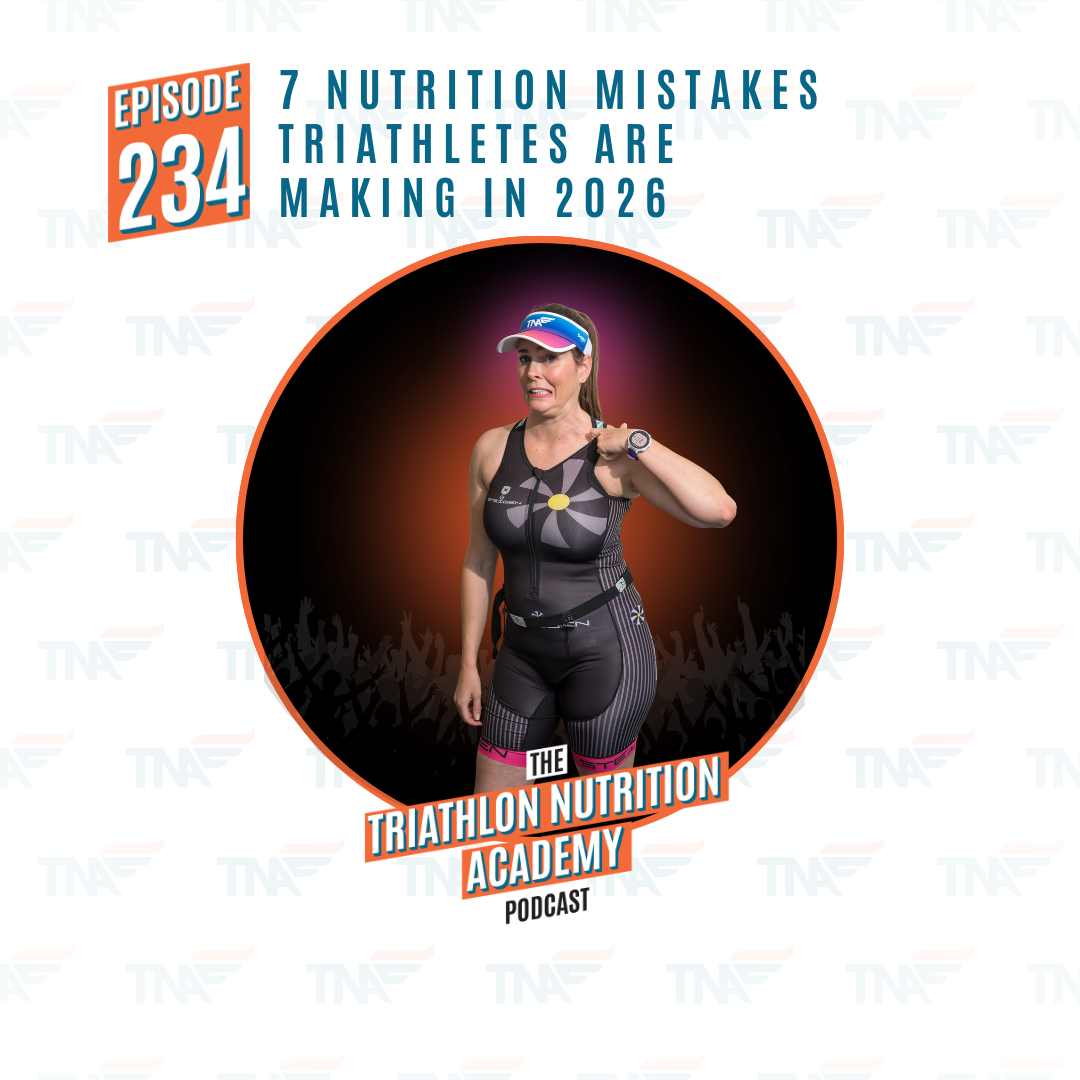
Episode 234 - 7 Nutrition Mistakes Triathlete's Are Making In 2026

Are you unknowingly sabotaging your triathlon performance with your nutrition?
In this episode, Advanced Sports Dietitian Taryn Richardson breaks down the 7 biggest nutrition mistakes triathletes are making in 2026 and why they’re holding you back from training hard, recovering properly and performing on race day.
Some of these mistakes have been around for years, but there are a few new ones creeping in, especially with the rise of AI and tracking apps. If you’ve ever felt flat in sessions, struggled with gut issues or wondered why your race day doesn’t reflect your training, this episode is a must-listen.
Links:
Check how well you’re doing when it comes to your nutrition with our 50 Step Checklist to Triathlon Nutrition Mastery
Start working on your nutrition now with my Triathlon Nutrition Kickstart course
It’s for you if you’re a triathlete and you feel like you’ve got your training under control and you’re ready to layer in your nutrition. It's your warmup on the path to becoming a SUPERCHARGED triathlete – woohoo!
Connect with me:
To learn more about the Triathlon Nutrition Academy, head HERE | dietitianapproved.com/academy
See behind-the-scenes action on Instagram: @dietitian.approved
Follow along on Facebook: @DietitianApproved
Join our FREE Dietitian Approved Crew Facebook group
Enjoying the podcast?
Let me know what you loved about it and what you learnt by tagging me @dietitian.approved on Instagram!
Subscribe & Review in Apple Podcast!
Are you subscribed to the podcast?
If not, today's the day! I'm sharing practical, evidence-based nutrition advice to help you nail your nutrition and I don't want you to miss an episode. Click here to subscribe to iTunes!
Now if you’re feeling extra warm and fuzzy, I would be so grateful if you left me a review over on iTunes, too. Those reviews help other people find my podcast and quality nutrition advice. Plus they add a little sparkle to my day.
CLICK HERE to review, select “Ratings and Reviews” and “Write a Review” and let me know what your favourite part of the podcast is.
You're awesome! Thank you!
Episode Transcription
Episode 234: 7 Nutrition Mistakes Triathlete's Are Making In 2026
Welcome to the Triathlon Nutrition Academy podcast. The show designed to serve you up evidence-based sports nutrition advice from the experts. Hi, I'm your host Taryn, Accredited Practicing Dietitian, Advanced Sports Dietitian and founder of Dietitian Approved. Listen as I break down the latest evidence to give you practical, easy-to-digest strategies to train hard, recover faster and perform at your best. You have so much potential, and I want to help you unlock that with the power of nutrition. Let's get into it.
[00:00:00] Taryn: We are well and truly into 2026, and today I'm sharing seven mistakes I see holding age group triathletes back. Hi, I'm Taryn, Advanced Sports Dietitian and triathlon nutrition expert. If you're a longtime listener or someone that's gone all the way back into the archives and started to listen to every podcast episode I've ever put out, I know what you're thinking. Haven't you done this before? Taryn? And yes, technically episode two of the podcast was called Five Nutrition Mistakes Triathlete Make, and that was way back in 2021. It's 2026 now, and the landscape has changed, and wild triathletes are still making those same mistakes that they were back in 2021.
[00:00:41] there is a whole new set of mistakes on top of the classic ones. so today I am gonna walk you through seven of those mistakes that I'm seeing triathletes make right now in 2026. Some of them will be new, but I bet at least two or three of those are going to hit a little close to home.
[00:00:58] So let's get into it.
[00:01:01] Taryn: Okay. I have to start here because this one is genuinely keeping me awake at night. Mistake number one is blindly using AI generated plans without the knowledge to sense. Check them. ChatGPT, Gemini, Claude, whatever AI tool you are using, they are not s sports dieticians with decades of professional experience.
[00:01:24] They are definitely not triathlon nutrition specialists. They are very confident and always positive. Generally text generators. That will produce a plan that looks professional. It uses all the right language and could be completely wrong if you don't have the nutrition knowledge to read that plan.
[00:01:44] Critically, you have no idea whether it's gonna be appropriate for you or not. You were just following it and hoping for the best. I did a whole episode on this episode 224, the problem with outsourcing your nutrition to AI. So go back and have a listen to that if you haven't already. But the short version is AI can be a very useful starting point, but it cannot replace understanding and that critical thinking that goes into having the experience of being an actual professional.
[00:02:15] Just like lawyers are getting pissed off that people are getting their contracts written by ai.
[00:02:20] Doctors are having all their medical problems diagnosed with AI before they see them in clinic, and so many other professions are just banging their head against a brick wall because AI is giving them information, but it may not necessarily Be the right type of information or right for you.
[00:02:36] If your plan says, eat this much on this day, and then have the exact same amount on a hard training day, obviously something is wrong and hopefully you could pick that up. But if you don't know what appropriate fuelling looks like or carbohydrate or protein or anything like that for you as a triathlete, then you aren't gonna pick that up.
[00:02:55] You're just going to follow it And wonder why you feel terrible and assume that the problem is just you. It is not you. It is the AI generated plan, and you absolutely deserve better. Then a plan that was generated in less than 30 seconds by something that has never crossed a finish line.Mistake number two is using macro tracking apps that give you numbers with no context and no understanding, and zero awareness of your nutritional needs, including your micros. This is definitely related to mistake number one because a lot of it is AI generated, but I think it deserves its own conversation.
[00:03:34] There are apps out there, and I know you know the ones I'm talking about, but they spit out your macro targets, so you've gotta hit your protein, your carbs, your fat, tick those off and you're done. Close the app. I have a few bones to pick. Firstly, how do you know that those targets are right? Most of these apps are using generic population based data formulas and algorithms. They are not accounting for your uniqueness, your physiology, your training load, your sweat rate, your gut tolerance, your stress, your sleep, your medical history. Second, if the targets aren't working for you. and I've definitely heard of lots of athletes where this is the case. you know how to adjust them? How do you figure it out so that you can adjust Based on the feedback that your body is giving you, or are you just gonna keep hitting the numbers and wondering why you feel rubbish?
[00:04:27] Third, and this is a big one, particularly for me as a dietician. Macros are only one part of your picture. Carbohydrates, proteins and fats, they will only get you so far If you want to train consistently, recover well and actually perform in our sport. You also need to understand micronutrients, iron, calcium, and vitamin D to name a few, and those nutrients don't have a dedicated column in macro tracking apps, but are critical for triathletes. if your iron stores are [00:05:00] low, they don't just make you feel tired, they completely wreck your training, and your body is obviously not working properly.
[00:05:06] Calcium and vitamin D matter enormously for bone health, particularly in the type of sport that we do. Not only that calcium is involved in every single muscle contraction, but a macro app is not gonna tell you how much you need and how to get there.
[00:05:21] These are big problems that are not going to show up when you're laser focused on hitting your macros.
[00:05:28] Not to mention antioxidants, phytochemicals, and all of those other beautiful food chemicals that we get from eating our real foods eating well and eating properly for a sport, not just to fit your macros.
[00:05:41] And for my athletes, the goal is not to track food forever. The goal is to understand food well enough that you don't need to track it, and that is what sets you up for long-term success in our sport.
[00:05:53] Mistake number three, can we please stop doing this? And that is copying what the pros do.
[00:06:00] Christian Blummenfelt just ran a 1:06:09 half marathon off the bike at Geelong in a race off the bike. Unless your run split is anywhere in that neighbourhood, you cannot fuel and eat like Christian Blummenfelt. No offense. I say this with love, but I see it all the time. You read an interview, you watch a video, you check out what they're doing at Kona.
[00:06:30] You've seen what Lucy Charles Barclay eats in a day, and then you try to replicate it or copy it or draw from that and wonder why it doesn't work for you.
[00:06:40] And that is because elite athletes have spent years training their gut learning how to eat for three sports
[00:06:47] and dialling in their plans for them. They also train anywhere from 25 to 40 hours a week. So their entire energy expenditure and food ecosystem is on a completely different universe to pretty much all age group tri athletes,
[00:07:05] and in some cases, but not all, their nutrition is managed by professionals. It is not something that they've just figured out by seeing an Instagram post or listening to a free podcast. They've actually got qualified professional advice to dial in their nutrition for them. Your nutrition needs to be built around your body, your training load, your goals, your physiology, and your lifestyle.
[00:07:29] Not someone else's, and not even someone else who is really, really freaking impressive. The comparison trap in triathlon nutrition is so real and it is costing age group triathletes. A lot of wasted time, a lot of wasted money, and definitely wasted results.
[00:07:47] Number four, treating nutrition like an afterthought until it's race season.
[00:07:52] Hands up if you've ever said or you've thought it. I'll sort out my nutrition closer to the race. I know you have. [00:08:00] I've been a sports dietician for nearly two decades now, and I've heard this from plenty of athletes that I've worked with at some point in their careers. And I do understand the logic training is the priority.
[00:08:10] Nutrition can wait or it's not that important right now. I'll nail it when it counts, and I'll flip that switch because it's really expensive. All of the products are so expensive I can't afford to fuel right now, and I'm still trying to lose weight.
[00:08:24] But the problem is that race day nutrition is not something that you can improvise. Your gut definitely needs to be trained with carbohydrate and your race. Nutrition at race intensity, and your fuelling habits need to be automated so that you're not making those hard decisions and trying to figure it out When you're, you're under peak stress and peak training load and you're fatigued,
[00:08:47] your race nutrition also needs to be so well practiced, adjusted, and refined. That process does take months, not days, and not even weeks.
[00:08:57] Every week that you delay working on your nutrition is a week of missed adaptation. It's missed recovery. training sessions that could have been better.
[00:09:06] And once you toe the start line, it's race days that under deliver all of that hard work that you've already done and put into training. Nutrition is not the last piece of the puzzle. Come on. It is the piece that holds all the other pieces together, and that is the reason why we call it the fourth leg.
[00:09:25] Mistake number five is eating the same way every single training day. This one is huge. If you're eating the same way on a rest day as you are on a four hour brick day, then obviously your nutrition is not right, and hopefully if you've been listening for a while, you would've picked up on that. as triathletes, we train across obviously three different sports at a range of intensities and a range of durations across the week, and your nutrition needs to match that. It's called periodization, where we're adjusting our nutrition to match the training demands of each session each day, each week, and is one of the most powerful things.
[00:10:03] That you can do for your body composition, your energy levels, and your performance
[00:10:07] on high load days, you need more full stop under fuelling those key sessions. Means you are training stressed, you are training under fuelled. You're gonna recover slower and potentially triggering the kind of negative hormonal adaptations that makes your body hold onto fat rather than let it go. And a cascade of events that have some long-term implications for us on lower intensity and rest days, you can pull it back, but we're not talking dramatically.
[00:10:37] we're talking enough to reflect that reduced demand, and it's more than just carbs, it's more than just calories. You need to be much more strategic around the way that you eat on all of your different types of training days so that you can get All of those beautiful adaptations going from your program.so it's not calorie cycling or anything really complicated. It is just eating for the work required, matching your food to your training. When you learn how to do that properly in practice, the application of, all right, what do I actually eat now to support this training program?
[00:11:08] Everything changes.
[00:11:10] number six, heading back to race day and it's never training your gut with your race nutrition. I have so many examples of athletes that train on something different to race day until I get to them and I'm like, what are you doing?
[00:11:22] You would never rock up to race day without having done any bike training. You wouldn't skip all your long rides and just hope your body handles six hours on race day. That would be stupid. That would be crazy. So humour me. Why are athletes doing that with nutrition? Makes no sense. Race day, gut problems. Cramping, nausea, bloating. Bonking that urgent search for a port-a-loo and holy crap, there's a massive line. What am I gonna do? Problem they are some of the most common performance limiting issues that I see, and the majority of the time, they're entirely preventable.
[00:12:00] Your gut is highly trainable. It can learn to absorb more nutrition at the intensities of race day. If you practice, it can get used to and comfortable with specific products if you practice.
[00:12:14] If the first time your gut encounters your race nutrition strategy is on race morning or even just a week out, you are taking a massive gamble.
[00:12:24] And finally, mistake number seven is thinking you can figure this all out on your own. That investing in your nutrition education isn't worth it. this one might be the most important thing I say today.
[00:12:36] There is something that happens when you put real skin in the game.
[00:12:40] When you stop trying to cobble together free advice from podcasts, Instagram ChatGPT, and you commit to actually learning for yourself, I see triathletes spend thousands of dollars on bikes, on wetsuits, on race entries. On power meters and on coaching.
[00:12:58] But when it comes to nutrition
[00:12:59] [00:13:00] as the fourth leg, it is the one thing that literally underpins all three of the other legs. They want the free version.
[00:13:07] You'll Google it, you'll ask the group chat. You'll see what ChatGPT says. And I do get it. I really do. Spending money on nutrition education feels very different to buying a shiny new piece of kit. You can't post photos of it on Strava,
[00:13:22] but what I know from working with hundreds of triathletes.
[00:13:27] Is that the ones that commit, who genuinely invest some time and money in educating themselves on their nutrition Rather than just hoping for the best. Other ones who train harder, will recover faster and perform at their best on race day, whatever that looks like for you.
[00:13:44] And they get there faster than they ever would've had if they tried to do it on their own. Boom, drop mic. There you have it. Seven Mistakes triathletes are making in 2026. blindly following AI generated plans using macro apps without understanding the full picture of how to eat for our sport. More than just hitting your macros, copying the pros when you're not operating. In the same universe, no offense leaving your nutrition until race season.
[00:14:12] There is so much work to be done in the off season, eating the same way every day. never training your gut or not knowing how to do that properly.
[00:14:19] Underestimating the value of actually investing in your nutrition education. If you heard yourself in any of those, that's good. Awareness is actually the starting point, and if you are ready to do something about it, the Triathlon Nutrition Academy Program is opening again really soon. If you are at all interested, get your name on the list dietitianapproved.com/academy.
[00:14:44] I have two very special bonuses going for anyone on that list to give them a massive headstart when it comes to your race nutrition. But the only way to hear about it and to get access to cash those in is to get your name on the list. TNA is not a meal plan dictated for you. It is not a generic one size fits all course.
[00:15:03] It is a structured education program built by triathlete specifically for triathletes from sprint distance all the way to full distance racing It teaches you how to fuel for three sports for your body, your training load, and your goals.
[00:15:18] You have access to me in Power Hour every week, so you can stop leaving your nutrition to chance and start performing to the best of your ability.
[00:15:26] If you are ready to stop making these mistakes and actually build a nutrition approach that works with your life, get on the TNA list now. The link is below.
[00:15:34] All right, my friend, train hard, eat well, and I'll see you next week.
Thanks for joining me for this episode of the Triathlon Nutrition Academy podcast. I would love to hear from you. If you have any questions or want to share with me what you've learned, email me at [email protected]. You can also spread the word by leaving me a review and taking a screenshot of you listening to the show. Don't forget to tag me on social media, @dietitian.approved, so I can give you a shout out, too. If you want to learn more about what we do, head to dietitianapproved.com. And if you want to learn more about the Triathlon Nutrition Academy program, head to dietitianapproved.com/academy. Thanks for joining me and I look forward to helping you smashed in the fourth leg - nutrition!