
Best Triathlon Gels Compared (2026): Carbs, Ratios and Cost per 100g
Jul 21, 2026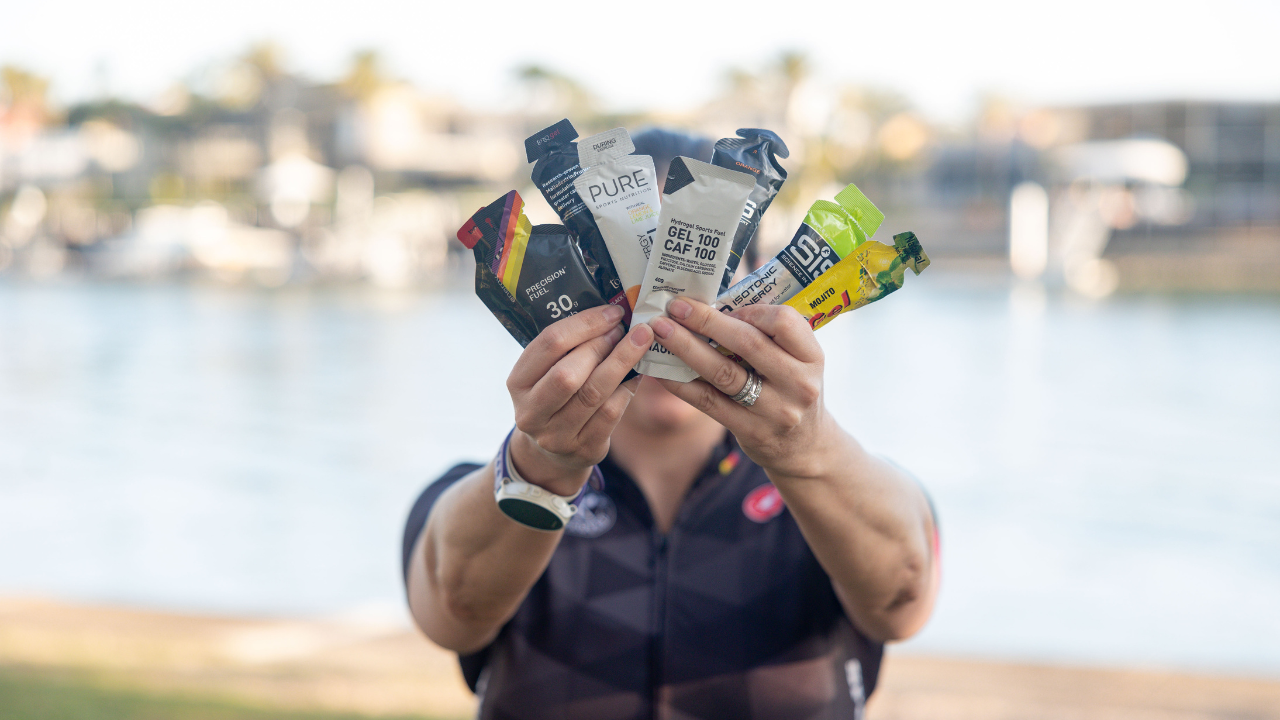
The best triathlon gel for you is the one that delivers the carbs you need, in a glucose-fructose ratio your gut can absorb, at a price you can afford to use in real training volume.
On the numbers that actually matter for age-group triathletes, three gels lead the pack in 2026: Maurten Gel 100, Precision Fuel PF 30 and SIS Beta Fuel. They carry 25g to 40g of carbohydrate per serve, all use a dual-source carbohydrate blend (two sugar types your body absorbs through separate doorways), and they range from around $13.70 to $20.80 per 100g of carbohydrate. Cost per 100g is the number to compare, not the price on the packet.
Most triathletes get this backwards. You stand in the shop staring at a wall of shiny sachets, agonising over which brand is "best", when the brand is the smallest decision you will make. What matters is how many grams of carbohydrate you get in, how well your gut tolerates it, and whether the cost lets you practise properly instead of rationing three precious gels for race day.
I am Switzerland on gels. I do not get kickbacks from any of these brands, so what follows is the evidence and the maths, nothing else. Let's get into it.
What Makes a Good Triathlon Gel?
A good triathlon gel does three jobs: it delivers a decent whack of carbohydrate in a small package, it uses a dual-source carbohydrate blend so you can absorb more per hour, and it sits well in your gut when your heart rate is high and blood has been diverted away from your stomach to your working muscles.
That middle point is the science worth understanding. Glucose and fructose are absorbed through different transporters in your intestine (think of them as two separate doorways rather than one). Use glucose alone and you cap out at around 60g of carbohydrate per hour, because that single doorway gets congested. Add fructose and you open a second doorway, lifting the ceiling toward 90g per hour and beyond.
This is not marketing. Currell and Jeukendrup (2008, Medicine and Science in Sports and Exercise) had trained cyclists ride 120 minutes then time-trial, and the glucose-fructose group rode 8% faster than the glucose-only group. An 8% improvement from the type of carbohydrate alone is enormous! For a 5-hour half Ironman that is the difference between a good day and a great one.
The ratio matters too. O'Brien and Rowlands (2011, American Journal of Physiology - Gastrointestinal and Liver Physiology) tested different fructose-to-maltodextrin ratios during hard cycling and found a 1:0.8 blend gave the best combination of gut comfort and performance. That is exactly why the newest gels have shifted toward that ratio rather than the older 2:1.
Best Triathlon Gels Compared: The 2026 Numbers
Here are the three leading dual-source gels, plus two bigger-carb options for long-course athletes, compared on what counts. All prices are Australian dollars, correct as of July 2026.
| Gel | Carbs | Carb ratio | Price each (AUD) | Cost per 100g carb |
|---|---|---|---|---|
| SIS Beta Fuel Gel | 40g | 1:0.8 malto:fructose | ~$5.49 | ~$13.70 |
| Precision Fuel PF 30 | 30g | 2:1 glucose:fructose | ~$4.67 (box of 15) | ~$15.55 |
| Maurten Gel 100 | 25g | 1:0.8 glucose:fructose | ~$5.20 (box of 12) | ~$20.80 |
| Precision Fuel PF 90 (jumbo) | 90g | 2:1 glucose:fructose | ~$9.99 | ~$11.10 |
| Maurten Gel 160 | 40g | 1:0.8 glucose:fructose | ~$8.19 | ~$20.50 |
Look at that cost-per-100g column, because it reorders everything. Maurten is the darling of the pro peloton and it is a genuinely excellent product, but at roughly $20.80 per 100g of carbohydrate it is the most expensive way to fuel on this list. SIS Beta Fuel delivers the same 1:0.8 ratio and more carbs per sachet for around $13.70 per 100g. That is a 34% saving on the exact same job!
If You Want the Best Value: SIS Beta Fuel or Precision PF 90
If cost per gram is your priority (and for anyone training 10 to 15 hours a week, it should be), then the SIS Beta Fuel gel at 40g of carbohydrate and the Precision PF 90 jumbo gel at a monster 90g are your best value. The PF 90 alone nearly covers a full hour's fuelling from one sachet, which is brilliant for a long ride when you do not want to be fumbling with wrappers.
If You Have a Sensitive Gut: The 1:0.8 Ratio Gels
If your stomach turns on you during hard efforts, then reach for the 1:0.8 ratio gels (Maurten Gel 100, Maurten Gel 160 or SIS Beta Fuel), because that ratio was the gut-comfort winner in the O'Brien and Rowlands research. Maurten's hydrogel technology (a texture that firms up in the acidic environment of your stomach) is also genuinely pleasant to get down when you are cooked, and that counts for a lot at hour four.
If You Are New to Gels: Precision PF 30
If you are just starting to fuel properly, then the Precision PF 30 is an easy entry point. It is a mild, neutral gel that does not need to be washed down with a big gulp of water, the box-of-15 price brings the per-gel cost down, and 30g is a sensible single dose. Start here, get your gut used to fuelling, then experiment.
How Many Gels Do You Actually Need Per Hour?
This is where the brand debate becomes irrelevant, because the number that changes your race is grams per hour, not logo on the sachet.
If your race is under 2.5 hours, then aim for around 60g of carbohydrate per hour, which is two PF 30 gels or one and a half Beta Fuel gels. If you are racing long course over 2.5 hours and you have trained your gut for it, then push toward 90g per hour, which is roughly three PF 30s, two and a bit Beta Fuels, or one PF 90 jumbo. I break down the full grams-per-hour framework in my guide to how many carbs per hour you need for triathlon, and it is the single most important number in your race nutrition.
Here is the catch nobody puts on the packet: your gut has to be trained to absorb 90g per hour. You do not just rock up on race day and inhale three gels an hour. That is a fast track to a portaloo DNF. Practise your race-day gel intake in training, at race intensity, for weeks beforehand. Never try anything new on race day.
Are Expensive Gels Like Maurten Worth It?
Maurten is a superb product and there is nothing wrong with using it. But "the pros use it" is a marketing hook, not a reason (the pros also get it for free). At roughly $20.80 per 100g of carbohydrate versus $13.70 for a gel with the same 1:0.8 ratio, you are paying a premium for the hydrogel texture and the brand halo, not for meaningfully better absorption.
My honest take: if the Maurten texture is the thing that finally gets you fuelling properly, then it is worth every cent, because a gel you will actually take beats a cheaper one that stays in your bento box. But if you are choosing Maurten because you think it works better than everything else, the evidence does not support paying double. Not all gels are created equal, but the gap is smaller than the price tag suggests. I compared the two Maurten options head to head in my post on Maurten Gel 100 vs Gel 160 if you have already decided to go down that road.
What About Sodium in Gels?
Do not rely on your gel for sodium. Most gels carry very little (Maurten Gel 100 has just 20mg of sodium, which is a rounding error next to what you lose in sweat). Your sodium needs to come from your drink or dedicated electrolytes, not your carbohydrate source. Treat the two jobs, fuelling and hydration, as separate. What you put in your bottle is a whole topic of its own, and I cover the foundations in what to eat before a triathlon.
Frequently Asked Questions
Q: What is the best triathlon gel in 2026?
A: There is no single best gel for everyone, because gut tolerance is highly individual. On the numbers, SIS Beta Fuel offers the best value at around $13.70 per 100g of carbohydrate with a gut-friendly 1:0.8 ratio, Maurten Gel 100 is the premium pick for texture and comfort, and Precision PF 30 is the easiest entry point for new athletes. Compare cost per 100g of carbohydrate, not the price on the packet.
Q: How many carbs should a triathlon gel have?
A: Most single gels carry 25g to 40g of carbohydrate, and jumbo gels like the Precision PF 90 carry up to 90g. The number that matters is your total per hour: around 60g per hour for races under 2.5 hours, up to 90g per hour for long course if your gut is trained for it.
Q: Why do triathlon gels use glucose and fructose together?
A: Glucose and fructose are absorbed through different intestinal transporters, so combining them lets you absorb more carbohydrate per hour than glucose alone. Currell and Jeukendrup (2008) found trained cyclists rode 8% faster on a glucose-fructose blend than on glucose alone, which is why every quality endurance gel now uses a dual-source formula.
Q: Is Maurten worth the money for age-group triathletes?
A: Maurten is an excellent gel, but at roughly $20.80 per 100g of carbohydrate you pay a premium for the hydrogel texture and brand rather than for better absorption. If that texture is what gets you fuelling consistently it is worth it. If you want the same 1:0.8 ratio for less, SIS Beta Fuel does the same job for about a third less.
Q: Can I use running gels for triathlon?
A: Yes. Gels are not sport-specific, so a gel marketed for running works identically on the bike and run legs of a triathlon. Choose based on carbohydrate content, ratio, gut tolerance and cost, and always practise them in training at race intensity before you race with them.
Bottom Line
The best triathlon gel is not a brand, it is a number. Work out your grams of carbohydrate per hour first, then pick the gel that hits that target, sits well in your gut and costs you the least per 100g so you can afford to actually train with it. On value the nod goes to SIS Beta Fuel and the Precision PF 90, on gut comfort the 1:0.8 ratio gels lead, and Maurten is a lovely premium option if the texture is your thing. Just do not pay double for a brand halo.
Sorting your gels is the fun part, but it is the icing, not the cake. If you want the free, no-nonsense checklist I use to make sure athletes have the fuelling foundations sorted before race day, grab my Triathlon Nutrition Checklist. It is the fastest way to know whether your race nutrition is actually race-ready.
Ready to fuel your training properly?
Start with the Triathlon Nutrition Kickstart Course.
The ULTIMATE
Triathlon Nutrition Checklist
Wondering how well you're nailing your nutrition to support triathlon training and racing?
Download my FREE 50 step checklist to triathlon nutrition mastery.
We hate SPAM. We will never sell your information, for any reason.
Author