
Masters Triathlon Training: Why Rest Makes You Faster
Oct 16, 2026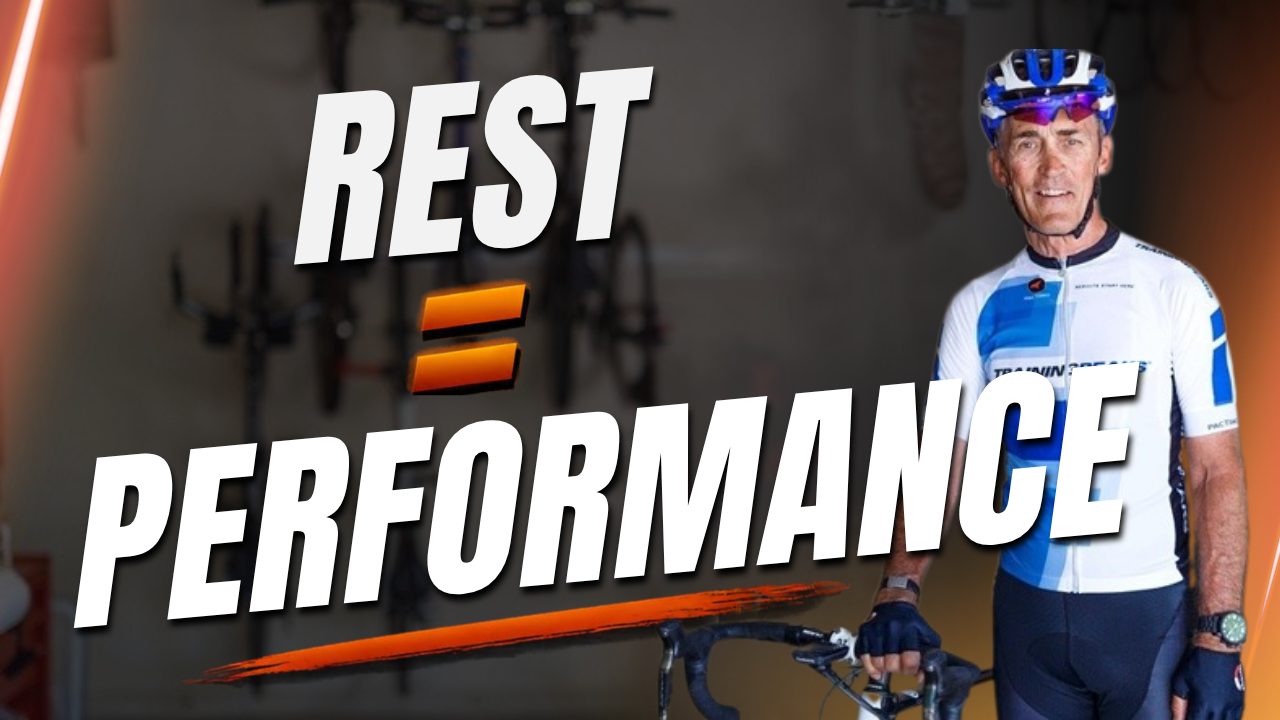
Quick answer: why does rest make masters triathletes faster?
In masters triathlon training, rest and recovery become the biggest lever you can pull for performance, because your body no longer bounces back from back-to-back hard sessions the way it did in your 20s. Coach Joe Friel recommends a 5:2 week for most athletes over 40: five easy days, one of which can be a day off, and two hard days with two or three easy days between them. Add a lighter recovery week where you cut volume by 40 to 50%, and a proper off-season where you let yourself lose some fitness, and you will usually race faster than you would by grinding through every session.
When Joe Friel was a university runner, his coach had a favourite session that Joe called intervals till you puke. It was 400 metre repeats, run as hard as possible, 10 to 30 of them at a time, five days a week. Nobody was told what pace to hit. You just ran until you could not.
Plenty of age-groupers still train with that same mindset (minus the vomiting, hopefully). I was one of them. If I had my time again, I would have gone slower more often, because I lived by go hard or go home for years.
When I interviewed Joe, the coach, TrainingPeaks co-founder and author of Fast After 50, for the Triathlon Nutrition Academy podcast, his message for masters athletes was the opposite of everything Rocky Balboa taught us. The athletes who keep getting faster after 40 are the ones who rest like it is part of the program, because it is.
What changes in your body as a masters triathlete?
Joe was refreshingly honest about this: the list is long, and none of it is pretty. The biggest change is your aerobic capacity. VO2 max (the maximum amount of oxygen your body can use during exercise) drops by roughly 5 to 15% every decade, usually starting somewhere in your thirties.
To make that tangible, if your VO2 max was 50 at 40, a 10% drop would put it around 45 by 50. That is the main reason hard efforts feel harder and you find yourself breathing heavier on sessions that used to feel moderate.
Two things drive a lot of it. Your maximum heart rate falls as you age, and after decades in the sport the walls of your left ventricle (the heart chamber that pumps blood out to your muscles) thicken, so each beat pushes out a little less blood. Joe called that combination a double whammy. Power drops too, along with muscle mass and bone density.
There is good news hiding in that list. Efficiency, which is how much oxygen it costs you to hold a given pace, barely declines with age, because the skill you have built over years of training sticks around. Your engine gets smaller, but you get better at driving it.
Why does rest matter more in masters triathlon training?
In your 20s, you could cobble together hard sessions back to back, go out partying, get up and still have an all right session. Your body absorbed it. After 40, it simply does not recover from repeated hard days as quickly, so stacking them up stops building fitness and starts digging a hole.
Joe put it bluntly: if you do the same hard workouts over and over, pushing to your limit every time, you will get the same results over and over. Fitness is built when your body adapts to training stress, and that adaptation happens during recovery, not during the session itself.
I see this in my own training. When I take a week off for whatever reason, I usually come back more motivated and often outperform my last hard week, because I have finally deloaded (backed off training load so your body can absorb the work).
Are you a tortoise or a hare?
Joe sees two types of masters athletes go wrong in opposite directions.
- The tortoise only ever goes slow. Easy training builds a great base, but without some hard work the system is never stressed enough to improve.
- The hare goes hard every time. Zone two becomes zone three, zone four becomes zone five, and any session with a training partner becomes a race.
If you are a tortoise, then you need to add two genuinely hard sessions a week, and you will probably improve quickly because your base is already big. If you are a hare, then most of your sessions need to get easier, and that is the harder habit to break (I say that with love, because I am one).
What is the 5:2 training week?
Joe offers masters athletes two structures that work.
The nine-day week
This is his preferred option physiologically. You go hard, easy, easy, three times over nine days, then add three more easy days, so you finish with about five easy days in a row before starting again. It works brilliantly for retired athletes, but it does not line up with a Monday-to-Friday job, so most people end up skipping sessions.
The 5:2 week
This is the version most age-groupers can live with. It is Joe’s real-world take on polarised training (doing most of your training easy and a small amount hard, with very little in the middle). A typical week looks like this:
- Monday: easy or a day off
- Tuesday: hard
- Wednesday and Thursday: easy
- Friday: hard
- Saturday and Sunday: easy
That gives you two or three easy days between each hard session and roughly an 80/20 split of easy to hard training.
The research backs the idea. In a 9-week study of well-trained endurance athletes, including triathletes, the polarised training group improved VO2 peak by about 12% and time to exhaustion by about 17%, while the threshold and high-volume groups barely improved at all (Stöggl & Sperlich, 2014, Frontiers in Physiology). Those athletes averaged 31 years old, so the jury is still out on the perfect split for over-50s, but the principle of keeping your easy days genuinely easy holds up.
Why aren’t easy sessions wasted time?
Many hares avoid easy training because they believe hard work is the only thing that counts, and the old lactate myth feeds that belief. The idea that lactate is a waste product that makes you slow and sore dates back to frog muscle experiments in the 1920s, and it refuses to die.
In reality, lactate is a fuel. Your body produces it all the time, even at rest, and shuttles it between cells to use as energy and to make new glucose (Brooks, 2018, Cell Metabolism).
To use lactate, your muscles need transporters called MCT1 (monocarboxylate transporter 1, a protein that carries lactate into the muscle cell). In one study, nine weeks of endurance training significantly increased MCT1 levels in muscle (Dubouchaud et al., 2000, American Journal of Physiology). Joe’s point is that this kind of adaptation is built during your slow, steady sessions, which is something hard training alone cannot give you.
How should masters triathletes plan recovery weeks and the off-season?
Rest needs to be built into your week, your month and your year, not squeezed in when you are already cooked.
Recovery weeks
After a block of training, cut your volume by 40 to 50% for four or five days. If you normally train 10 hours a week, that means around 6 hours. Take an extra day off on top of your usual one, do short, easy sessions in between, and then test at the end of the week (an FTP test, for example) to see whether your heart rate, power or pace zones need updating.
The off-season
This is the part nobody wants to hear: you have to lose some fitness. Joe was firm that skipping a true off-season always comes back to haunt you.
- If your last race of the season was an Ironman, then take about 4 weeks of very easy training, such as an easy ride every second day.
- If your last race was a sprint, then 7 to 10 days is usually enough.
Then spend some time with your family, recover properly and do not rush back in. Starting your next season too early is one of the most common ways masters athletes derail a whole year.
Should you use HRV or your wearable to guide training?
HRV (heart rate variability, the variation in time between heartbeats) is a useful window into how stressed and recovered you are, and that stress can be physical or mental. Joe checks his every morning with the HRV4Training app. It takes about a minute, and on days it is low, he trains easy. I covered how to use it in more detail in my guide to heart rate variability for triathletes.
Joe is far more sceptical of wearables in general. His Garmin regularly gets his sleep wrong by a couple of hours, which makes him question everything else it tells him. Use your device for trends, not as gospel. If your watch says you slept terribly and you feel great, believe your body. Too much data can become just another layer of stress.
Where does nutrition fit into recovery for masters triathletes?
Rest is only half of recovery. The other half is what you put back in. An easy day spent under-fuelled is not a recovery day, and plenty of masters athletes fall into a hole because they cut back on food the moment their training eases off.
Joe mentioned that the research he reads on ageing athletes keeps showing the same gap: older athletes do not eat enough protein. I explained why simply eating more is not always the fix in Protein for Masters Athletes: Why More Isn’t Working, and the wider nutrient picture is in Key Nutrients for Masters Triathletes.
Your easy days and recovery weeks are where your nutrition gets the chance to do its job. Feed them properly and they will pay you back on race day.
FAQ: masters triathlon training
Q: How many hard sessions a week should a masters triathlete do?
A: Two hard sessions a week works well for most masters triathletes. Joe Friel’s 5:2 structure pairs them with five easy days, one of which can be a day off, so there are two or three easy days between each hard session.
Q: Why do I recover more slowly from training after 40?
A: Your aerobic capacity, maximum heart rate, muscle mass and power all decline with age, so the same hard session costs you more. You can no longer absorb back-to-back hard days the way you could in your 20s, which makes planned rest essential.
Q: How often should masters athletes take a recovery week?
A: Build in a lighter block of four or five days after each training block, cutting volume by 40 to 50%. For someone training 10 hours a week, that means around 6 hours, with an extra day off and a test at the end.
Q: How long should a triathlete’s off-season be?
A: It depends on your last race. After an Ironman, take around 4 weeks of very easy training. After a sprint, 7 to 10 days is usually enough.
Q: Is lactate bad for triathletes?
A: No. Lactate is a fuel your muscles use, not a waste product that causes fatigue or soreness. Endurance training increases the transporters that let your muscles use it.
Bottom line: rest is part of the program
The biggest shift for masters triathlon training is mental. Going hard all the time does not make you tougher or faster after 40. It just makes you tired. Two quality sessions a week, genuinely easy days in between, regular recovery weeks and a proper off-season will take you further than another month of grinding. You can hear Joe explain it in his own words in Episode 264, and you can read my original write-up of our chat in How Masters Triathletes Can Stay Fast After 50.
If you have realised your easy days are not getting the fuel they need, do not stress. It is very fixable once you know what to do. The Triathlete Fuel Kit brings together my Triathlon Nutrition Kickstart course, the Triathlete’s Kitchen recipe database and the Fuel Your Adventure recipe book, so your everyday fuelling works for your recovery, not against it.
Ready to fuel your training properly?
Start with the Triathlon Nutrition Kickstart Course.
The ULTIMATE
Triathlon Nutrition Checklist
Wondering how well you're nailing your nutrition to support triathlon training and racing?
Download my FREE 50 step checklist to triathlon nutrition mastery.
We hate SPAM. We will never sell your information, for any reason.
Author