Triathlon Nutrition Strategy: Why Information Isn't Enough
Oct 09, 2026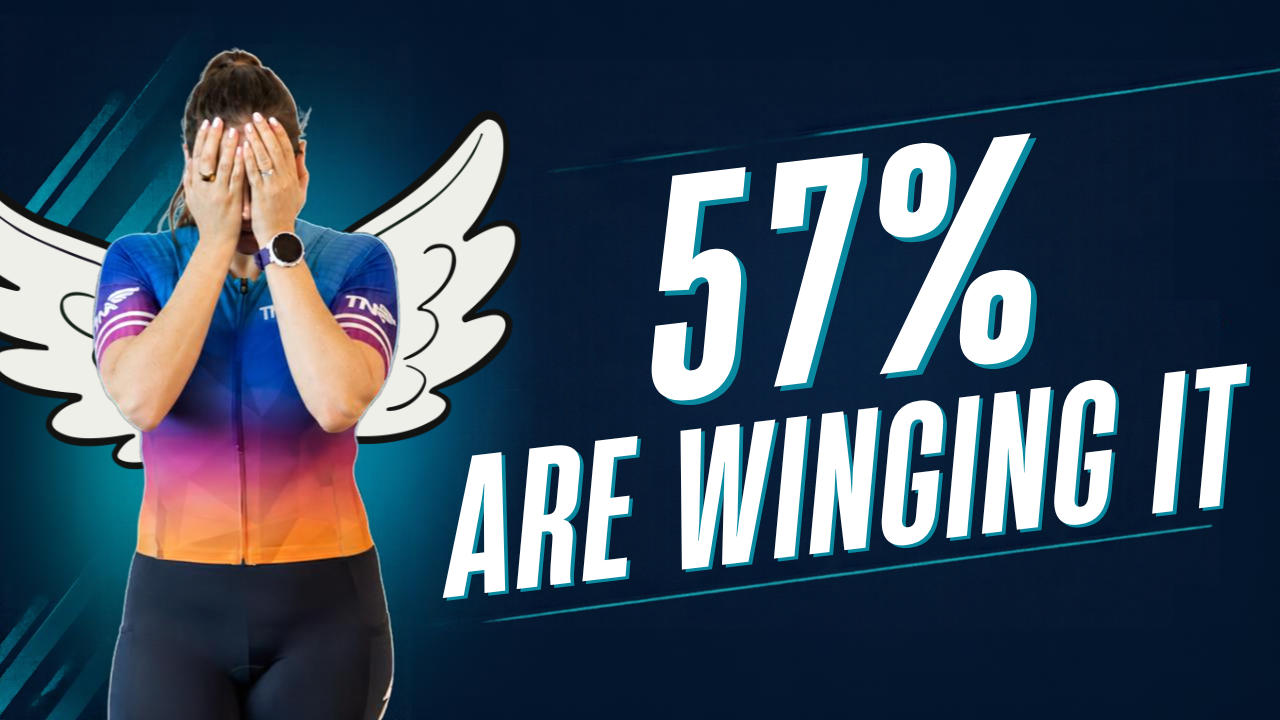
A triathlon nutrition strategy is a plan for daily training nutrition and race fuelling built on your own inputs: your training load, gut tolerance, sweat rate and sweat sodium, race distance, age, life and medical history. Most age-group triathletes already have plenty of nutrition information. What they are missing is a way to apply it to themselves, so a strategy that is specific to you, and the skills to adjust it when those inputs change, will do more for your performance than another podcast, app or AI answer.
Why does this matter for age-group triathletes?
I recently asked the triathletes who came to my Triathlon Fuel Camp what they had already spent money on to improve their performance. 70% had paid for a bike fit. 66% had paid for a coach. 50% had bought a power meter and faster wheels.
Only 20% had ever invested in a dietitian or nutritionist, and 57% told me they were winging it when it came to their nutrition.
These are not triathletes who don't care. They are smart, driven people who listen to podcasts, read articles, try the apps and ask AI. And yet not one of them knew how to periodise their nutrition (match what they eat to the training they are doing that day), and plenty had never written their race nutrition plan down on paper. The result was exactly what you would expect: vomiting, cramping, bonking, napping and lots of snackcidents.
After two decades in triathlon nutrition, I can tell you that more information is not what you are missing.
Why isn't more nutrition information fixing your fuelling?
You can find a pro triathlete's race nutrition plan in about 4 seconds. Between podcasts, YouTube, Google, ChatGPT and the supplement brand at the expo with very strong opinions about beetroot juice, you have access to more nutrition information than any triathlete in history.
If information alone fixed your nutrition, more than half of my Fuel Camp athletes would not have been winging it. The hard part was never finding information. The hard part is knowing which bits apply to you, on this training day, for this race, with your gut, your physiology and your life. That is the bit you can't Google.
The athletes said it better than I can:
- "I don't know what applies to me, when and why."
- "Sometimes I feel like I should know this already, but applying it to myself continues to be a struggle."
- "I suffer from paralysis by analysis."
If you want my full take on why do-it-yourself nutrition falls over, I covered it in Episode 237 of the Triathlon Nutrition Academy podcast.
What is a triathlon nutrition strategy specific to you built on?
"Personalised nutrition" gets thrown around a lot, so here is what it actually means for a triathlete. A strategy specific to you is built on your inputs, and there are at least 6 of them.
Your training day
A rest day, a 45-minute easy run and a 4-hour brick session need different nutrition. If your coach writes a big Saturday brick and an easy Monday, then your plate on those two days should not look the same.
Your gut
What your gut tolerates at race pace is unique to you. In one study of endurance events, carbohydrate intake ranged from 6g to 136g per hour between athletes, and serious gut symptoms hit around 31% of Ironman competitors. Athletes with a history of gut problems were more likely to suffer again (Pfeiffer et al., 2012, Medicine & Science in Sports & Exercise). This is why there is no single carbs-per-hour number that works for everyone.
Your sweat rate and sweat sodium
Across 506 athletes, whole-body sweat rates ranged from 0.26 to 5.73 litres per hour, and predicted whole-body sweat sodium concentration (how salty your sweat is) ranged from 18 to 71 mmol/L (Baker et al., 2016, Journal of Sports Sciences). Put simply, one athlete loses less than a small drink bottle an hour while another loses more than 5 litres. Copying your training partner's hydration plan makes no sense with a spread like that.
Your race distance, intensity and conditions
Even the carbohydrate guidelines change with the job you are doing. The evidence points to roughly 60g of carbohydrate per hour for efforts of 2 to 3 hours and up to around 90g per hour for ultra-endurance events, adjusted down when intensity is low (Jeukendrup, 2014, Sports Medicine). A sprint, a 70.3 and a full Ironman are 3 different nutrition jobs, and so is a hilly course on a 35°C day.
Your age and stage of life
Nutrition needs shift as we get older, and recovery is not as forgiving at 60 as it was at 30.
Your actual life and medical history
Not your ideal life, your actual one. Wrangling kids, shift work, 4am sessions before a work day, retirement or an empty nest all change what is realistic. So does managing irritable bowel syndrome, diabetes, high blood pressure or high cholesterol.
If one of those inputs changes, then your strategy has to change with it. That is why cookie-cutter information never holds for long.
What are the 3 ways triathletes try to get a nutrition strategy?
There are really only 3 doors.
- Do it yourself. You piece together free information from podcasts, YouTube and forums, then hope it holds up on race day.
- Buy a plan. Someone hands you a done-for-you plan, or you blindly follow an app. It works until one of your inputs changes.
- Learn to build your own, with expert eyes on it. You understand the why behind your strategy, so you can adjust it yourself.
Here is how door 2 plays out. One Fuel Camp athlete had a carb loading plan (topping up glycogen, the storage form of carbohydrate, in the days before a race) written by a sports dietitian for her 70.3. Now she is training for a full distance race and asked me whether she could use the same plan. The answer is no. You can't just double a 70.3 plan and expect it to work at an Ironman. Her options are to fake it till she makes it, or pay for another plan she still won't understand.
A plan you don't understand is a plan you can't fix two-thirds of the way through the bike, when the day is hotter than forecast and your race nutrition stops working. If I give you a fish, you eat for a day. If I teach you how to fish, you eat for life.
Is investing in a triathlon nutrition strategy actually worth it?
This is the first of 3 questions that keep smart triathletes sitting on the fence for months, sometimes years.
You are already paying for nutrition. You are just not paying for a strategy. You pay for supplements you are not sure are doing anything, gels and sports drink you are not 100% confident are right for you, and maybe an app subscription you have not opened in months (guilty?). You also pay race entry, flights and accommodation for a race that can fall apart on the run.
One Fuel Camp athlete added up what he spends on protein and greens powders he is not sure are right for him. It came to $2,900 a year, which is about $56 every single week. TNA athlete Kelly, who took his 70.3 time from 7 hours to 5.5 hours at 65 years young, cut about US$550 a month in supplements he didn't need once we got stuck into his nutrition. You can hear his story in Episode 259.
A carbon fibre bike might make you 1% faster, but you still have to pedal the thing and run to the finish line afterwards. A strategy you understand comes with you to every race, at every distance, for the rest of your racing life. If you think nutrition education is expensive, wait until you add up the cost of getting it wrong.
Will a personalised strategy work for back of the pack, new or masters triathletes?
The second question usually sounds like "I'm too slow for this to matter", "I haven't even raced yet", "I'm 60" or "I'm complicated".
- If you are a back of the packer, then nutrition matters more for you, not less, because you are out on course for more hours.
- If you are new to triathlon, then this is the best time to learn, because you have no bad habits to undo.
- If you are a masters athlete, then you can't get away with the mistakes you made at 30. Steve is 71, has raced more than 300 triathlons and sat on the fence for 30 years before he joined.
- If you are "complicated", then you are exactly who generic advice fails first, and exactly who a specific strategy helps most.
Curt, another TNA athlete, now eats around 1,000 calories (roughly 4,200kJ) more a day than he used to and has lost 8kg in 9 months. You can hear Steve and Curt in Episode 261. Results like that do not come from winging it.
When is the right time to sort out your triathlon nutrition?
The third question is timing, and there is never a quiet window in triathlon.
- If you are in season, then you are racing on guesswork, and every race you wing is one you don't get back.
- If you are heading into the off-season, then you have the best window you will get to learn this properly before your training builds again.
- If you are racing next weekend, then start with recovery and daily training nutrition. It is the small things compounded every day that build performance, not one thing you do on race day. And please, never try anything new on race day.
"I'll sort it out after my next race" has a habit of turning into the race after that, and then the one after that. Julia, a self-confessed back of the packer you can hear in Episode 235, waited 3 months because she had a 70.3 coming up. She calls that her biggest regret. She then raced Cairns 70.3 in just under 7 hours and had her best day ever, because she was fuelled properly.
Frequently Asked Questions
Q: What is a triathlon nutrition strategy? A: A triathlon nutrition strategy is a plan for your daily training nutrition and your race fuelling that is built on your own inputs. Those inputs include your training load, gut tolerance, sweat rate, sweat sodium, race distance, age, lifestyle and medical history. It should change whenever one of those inputs changes.
Q: How many carbs per hour should I eat in a triathlon? A: It depends on your race distance, intensity and gut. The evidence suggests roughly 60g of carbohydrate per hour for efforts of 2 to 3 hours and up to around 90g per hour for ultra-endurance races, using multiple carbohydrate types at higher intakes. Train your gut to your target in training before you race with it.
Q: Can I use my 70.3 nutrition plan for a full Ironman? A: Not without adjusting it. A full Ironman is roughly twice as long, usually run at a lower intensity and often raced in different conditions, so your carb loading, fuelling and hydration all need to be rebuilt for the distance. Doubling a 70.3 plan rarely works.
Q: Why do I get gut problems during triathlons? A: Gut problems during racing are common and highly individual. Around 31% of Ironman athletes report serious gut symptoms, and athletes with a history of gut issues are at higher risk. The type, amount and timing of your fuel, your hydration and your gut training all play a role.
Q: Is a sports dietitian worth it for an age-group triathlete? A: For most age-groupers, yes, because you are already spending money on nutrition through supplements, gels and apps without a strategy behind them. A sports dietitian helps you apply the evidence to your own training and racing, and teaching you the why means you can adjust it yourself for every future race.
Bottom line
You don't need more information. You already have more than you could ever use. What you need is a triathlon nutrition strategy that is specific to you, and the skills to keep it working when your training, your racing and your life change.
If you saw yourself in any of those 3 questions, don't stress. It is completely fixable with the right education and someone checking your work. That is exactly what the Triathlon Nutrition Academy is built to do: a 9-month program where I teach you how to fuel your own training and racing, step by step, with live Power Hours where we apply it all to your gut, your sweat rate, your blood results and your race calendar.
Find out more about the Triathlon Nutrition Academy
Studies referenced
- Baker, L. B., Barnes, K. A., Anderson, M. L., Passe, D. H., & Stofan, J. R. (2016). Normative data for regional sweat sodium concentration and whole-body sweating rate in athletes. Journal of Sports Sciences, 34(4), 358-368.
- Jeukendrup, A. (2014). A step towards personalized sports nutrition: Carbohydrate intake during exercise. Sports Medicine, 44(Suppl 1), S25-S33.
- Pfeiffer, B., Stellingwerff, T., Hodgson, A. B., Randell, R., Pöttgen, K., Res, P., & Jeukendrup, A. E. (2012). Nutritional intake and gastrointestinal problems during competitive endurance events. Medicine & Science in Sports & Exercise, 44(2), 344-351.
Ready to fuel your training properly?
Start with the Triathlon Nutrition Kickstart Course.
The ULTIMATE
Triathlon Nutrition Checklist
Wondering how well you're nailing your nutrition to support triathlon training and racing?
Download my FREE 50 step checklist to triathlon nutrition mastery.
We hate SPAM. We will never sell your information, for any reason.
Author