
Triathlon Nutrition in the Heat: How to Fuel a Hot Race
Oct 23, 2026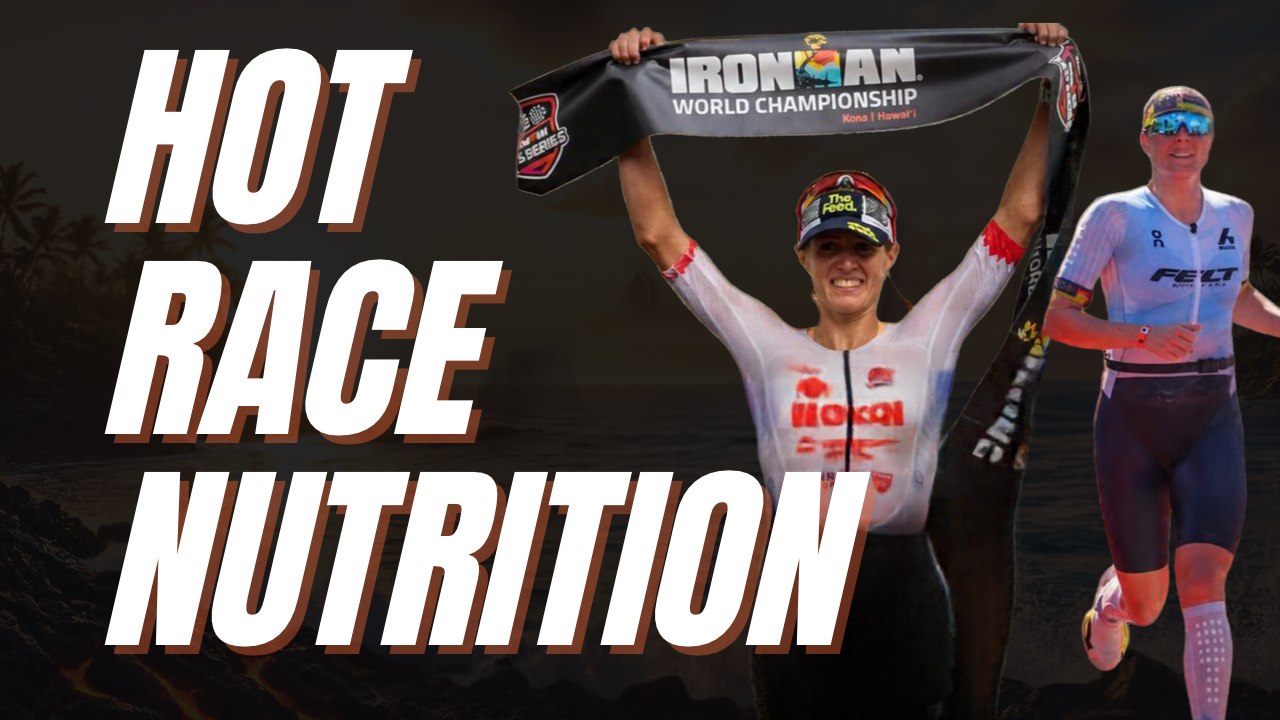
Quick answer: how should your triathlon nutrition change in the heat?
Triathlon nutrition in the heat needs its own plan, because hot conditions make you burn through stored carbohydrate faster, put your gut under far more stress and make both dehydration and overdrinking more likely. Start your race with a full fuel tank and keep fuelling on the bike rather than backing off. Drink and salt to your own measured sweat losses rather than generic rules, then rehearse the whole plan in hot sessions in the weeks before race day, because most hot races are won or lost before the gun goes off.
At the 2026 World Championship in Kona, Solveig Løvseth was leading by just over a minute with less than a mile to go. Then she fell apart, and before long she was sitting on the side of the road while Taylor Knibb ran past her to win the world title. Her manager reckons that last mile cost her close to a million dollars.
A year earlier, it was the exact opposite. Knibb was the one sitting on the side of the road, and Løvseth ran past her to win.
As an age-grouper, you’re out on course for hours longer than the pros, in the hottest part of the day, often on a race nutrition plan you built through winter. After two decades of working with triathletes, I can tell you that most hot races are won or lost before the gun even goes off.
Why does heat change triathlon nutrition?
In the heat, your body is doing two jobs at once: fuelling your working muscles and getting rid of heat. It sends more blood out to your skin to dump that heat, so your heart works harder, your sweat rate climbs and your gut gets even less blood than it usually does during exercise.
You also burn through stored carbohydrate faster. A 2025 meta-analysis of 51 studies found that carbohydrate use and glycogen (the storage form of carbohydrate in your muscles and liver) use both go up in hot conditions (Mougin et al., 2025, Sports Medicine). In one classic study, trained cyclists riding at 35°C burned 25% more muscle glycogen in the final 30 minutes than they did at 16°C, and oxidised about 10% less of the carbohydrate they were drinking (Jentjens et al., 2002, Journal of Applied Physiology).
Think of it like a road trip where your car burns fuel faster than normal and every service station (your aid stations) only lets you put a little bit back in. The tank you leave home with matters a whole lot more.
Why do triathletes fall apart in hot races?
It usually comes down to one of three things, and from the side of the road they look almost identical.
1. Overheating
Your core temperature climbs during exercise until your body pulls the handbrake. In one study, cyclists stopped at a core temperature of about 40°C (104°F) no matter how warm they were when they started (González-Alonso et al., 1999, Journal of Applied Physiology). Another found athletes reached fatigue in the heat with plenty of glycogen still in their muscles (Parkin et al., 1999, Journal of Applied Physiology). You can be well fuelled and still be cooked.
2. Overdrinking
Hyponatraemia (low blood sodium) mostly comes from drinking more than you lose, and its symptoms of nausea, vomiting, confusion and collapse can look a lot like heat illness (Hew-Butler et al., 2015, Clinical Journal of Sport Medicine). It hits age-groupers far more than the pros. At a full distance triathlon in New Zealand, 18% of finishers had low blood sodium, and fluid overload caused most of the severe cases (Speedy et al., 1999, Medicine & Science in Sports & Exercise). At the Boston Marathon, runners slower than 4 hours had about 7 times the odds of hyponatraemia compared with runners under 3.5 hours, and weight gain during the race was one of the clearest red flags (Almond et al., 2005, New England Journal of Medicine).
If you weigh more at the finish line than you did at the start, then you drank more than you lost.
3. Running low on fuel or fluid
This one builds quietly. It usually starts with an under-fuelled bike leg while dehydration creeps up in the background, and then the run falls apart.
These three need opposite responses. More fluid is the right call if you are dehydrated and exactly the wrong call if you have been overdrinking. I won’t diagnose Løvseth, who said she was feeling good until she wasn’t, but that is exactly the point. From the outside you often can’t tell which problem you have, so blanket rules like “drink more” or “drink to thirst” won’t serve you well.
What happens to your gut in the heat?
Hot races are where guts go to die (sorry, but it’s true). In one Australian study, endurance runners ran for 2 hours at 35°C and again at 22°C. A marker of intestinal damage rose by about 432% in the heat compared with 127% in the cool, and 9 out of 10 runners had gut symptoms in the heat (Snipe et al., 2018, European Journal of Applied Physiology).
The counterintuitive bit is what most athletes do when they feel average in the heat: they stop eating. When the same research group gave runners carbohydrate during 2 hours in the heat, gut damage was a fraction of what it was on water alone (Snipe et al., 2017, Applied Physiology, Nutrition, and Metabolism). If you start to feel a bit off, then backing right off your fuel can make your gut worse, not better. Your gut is trainable, but that work happens in training, not by crossing your fingers on race day.
What are the biggest mistakes with triathlon nutrition in the heat?
These are the 4 I see over and over when the forecast is hot.
Mistake 1: racing a cool-day plan on a hot day
The plan you built through winter is a plan for a different race. Athletes rock up with the same bottles, gels and plan they used all winter, then wonder why it all goes pear-shaped.
Mistake 2: drinking and salting to someone else’s numbers
Sweat rates range from about 150 mL to 3.5 litres an hour between athletes, and sodium losses from about 50 mg to 3,500 mg an hour (McCubbin et al., 2020, International Journal of Sport Nutrition and Exercise Metabolism). That top sweat rate is more than four 750 mL bidons every hour. Your training buddy’s electrolyte tablets were built for your training buddy (no offence), and blanket high-sodium advice from the internet is just as cookie-cutter.
Mistake 3: backing off your fuel on the bike because it’s hot
It feels logical, but having fuel on board protects your gut. Practise fuelling in the heat rather than abandoning it.
Mistake 4: no heat in your training
Your body adapts to heat surprisingly fast. Plasma volume (the liquid part of your blood) starts expanding within 3 to 5 days, and you sweat more and lose less sodium in that sweat over roughly 3 to 10 days (McCubbin et al., 2020; Périard et al., 2015, Scandinavian Journal of Medicine & Science in Sports). A plan you only ever tested in the cool was built for a different body. Never try anything new on race day, and a hot race day counts as new if you haven’t trained for it.
How did one triathlete rebuild her plan for the heat?
One of my Academy athletes raced Spudman, a local race in Idaho, on a scorching day. She was sweating in her wetsuit before the start, and by the run it was about 30°C (86°F) with no shade on the course. She had a headache on the bike, walked between poles on the run and finished with her shoelaces covered in salt.
Sweat testing showed she is a salty sweater, losing around 1,400 mg of sodium an hour on a hot ride. That is her number, not yours, and it would be the wrong number for most people reading this.
We rebuilt her plan for the heat, and she practised it in hot sessions in the lead-up. Less than two months later she raced the 70.3 World Championship in Nice, with its very hilly bike course and hot run along the Promenade des Anglais. She made the bike cut-off, crossed the line and called it the most amazing experience of her life. She didn’t just toughen up. She got her own data, built a plan for the heat and rehearsed it until it was second nature.
How should you prepare your nutrition for a hot race?
Race week: fill the fuel tank
Carb loading matters more on a hot day. You burn glycogen faster, and your gut is the rate-limiting step (the bottleneck that sets how fast carbohydrate can get in), so you can only top up so much on course. The tank you bring to the start line is your buffer.
Carb loading won’t stop you overheating, though. It is not a cooling strategy, so it is one piece of the puzzle rather than the whole plan. I went deeper on it in Episode 251, How Do You Carb Load for a Triathlon Without Feeling Bloated and Heavy and Episode 253, Is Carb Loading a Myth.
Race morning and on course: decide before you’re cooked
Your sodium, fluid, fuel and cooling plan should be locked in well before race day. An aid station at 2pm, when you’re hot and not thinking straight, is not the place for big maths, and that is how people end up drinking everything they’re handed. For the sweat side of the equation, go back to Episode 214, where I dug into sweat science.
Plan for when it goes wrong
After Kona, Knibb explained that what happened to her the year before shaped how she responded when Løvseth caught her. Rather than fight a battle she didn’t think she could win, she focused on cooling down, getting fuel in and getting to the finish safely. That is the bit I want you to steal from the pros.
If your hot race is in the next 12 months and you’re in the off-season right now, then this is the perfect time to build and test your plan.
FAQ: triathlon nutrition in the heat
Q: Do you burn more carbohydrate racing in the heat?
A: Yes. A 2025 meta-analysis of 51 studies found that carbohydrate use and glycogen use both increase in hot conditions, and one study found muscle glycogen use was 25% higher at 35°C than at 16°C. That makes starting with a full fuel tank more important on a hot day.
Q: How much should you drink in a hot triathlon?
A: It depends on your own sweat rate, which ranges from about 150 mL to 3.5 litres an hour between athletes. Drinking more than you lose raises your risk of hyponatraemia, so get your sweat rate measured and rehearse your drinking plan in hot sessions.
Q: What is hyponatraemia in triathlon?
A: Hyponatraemia is low blood sodium, which in endurance events mostly comes from drinking more fluid than you lose. Symptoms include nausea, vomiting, confusion and collapse. In one study at a New Zealand full distance triathlon, 18% of finishers had it.
Q: How long does it take to adapt to racing in the heat?
A: Your body starts adapting within days. Plasma volume expands within about 3 to 5 days of heat training, and sweating more and losing less sodium develop over roughly 3 to 10 days, which is why heat acclimation blocks usually run for 7 to 14 days.
Q: Does carb loading help in a hot race?
A: Carb loading helps you start with a full fuel tank, which matters more in the heat because you burn through glycogen faster. It will not stop you overheating, so pair it with a fluid, sodium and cooling plan you have practised in the heat.
Bottom line: a hot race is decided before the gun goes off
Falling apart in a hot race rarely comes down to toughness, fitness or bad luck on the day. Heat asks your body to do a different job, and the athletes who handle it best arrive with a fuel, fluid and cooling plan built for the heat and rehearsed in training. You can hear me break it all down in Episode 265 of the Triathlon Nutrition Academy podcast.
If this has you rethinking your summer race plan, don’t stress. It is very fixable once you know what to do, and the fuel tank is the easiest place to start. My Carb Loading Masterclass shows you exactly how much carbohydrate to eat, when to eat it and what to eat, so you can carb load properly without feeling heavy and bloated.
Ready to fuel your training properly?
Start with the Triathlon Nutrition Kickstart Course.
The ULTIMATE
Triathlon Nutrition Checklist
Wondering how well you're nailing your nutrition to support triathlon training and racing?
Download my FREE 50 step checklist to triathlon nutrition mastery.
We hate SPAM. We will never sell your information, for any reason.
Author