
Triathlon Gut Issues: 3 Fuelling Changes That Fixed Them
Oct 30, 2026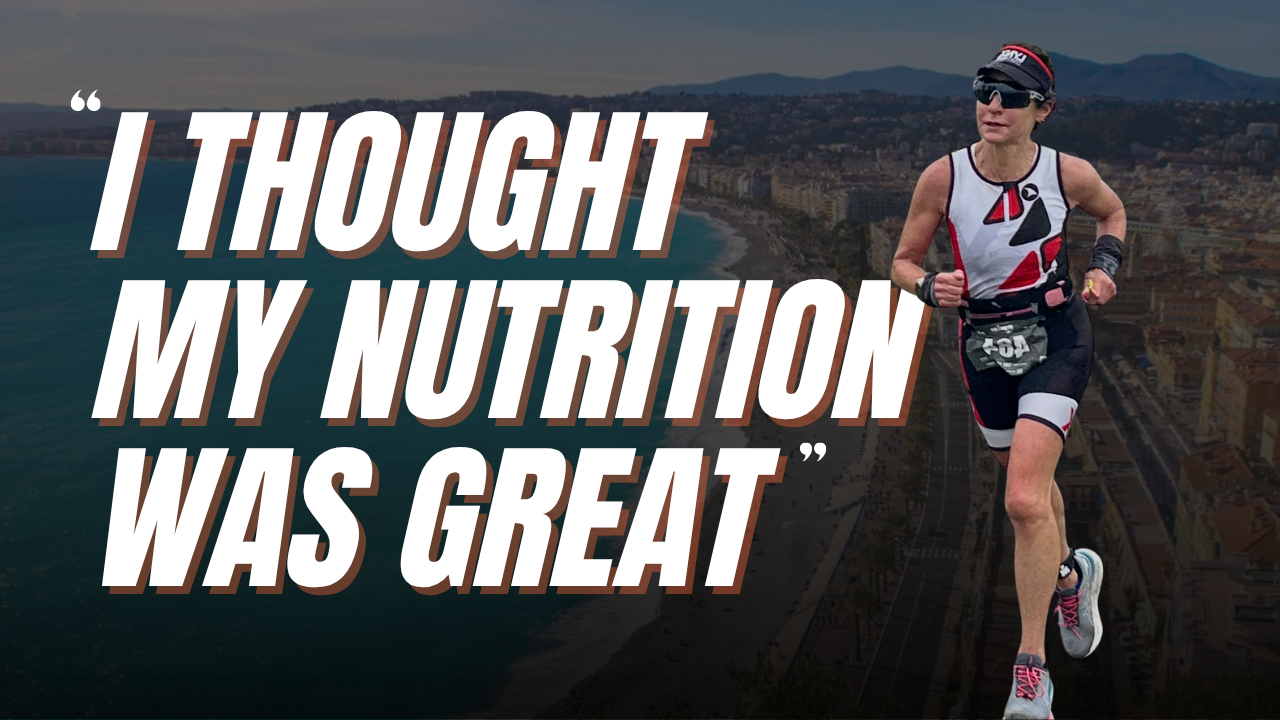
Triathlon gut issues usually come down to what you eat, when you eat it and how much your gut can handle on the day. Solid race food high in fibre, fat and protein, a high-fibre lead-in to race day and chasing a carbohydrate target your gut cannot tolerate are 3 of the most common triggers. Fixing all 3 helped Triathlon Nutrition Academy athlete Dr Marie Stevenson race the IRONMAN 70.3 World Championship in Nice with no gut issues for the first time in 8 years.
For 8 years, Marie planned her triathlon run around portaloos. She knew where the first one sat at the first aid station, and she knew where the next one was at about the 8km mark, because that is when her gut went off like clockwork.
Marie is a family doctor from Calgary, Canada. She took up running at 47, has run 30 marathons and has raced triathlon for 17 years. She thought her nutrition was great. (It wasn’t, and she will happily tell you so herself.) You can hear her tell the whole story in Episode 266 of the Triathlon Nutrition Academy podcast.
What Causes Triathlon Gut Issues on Race Day?
Gut trouble is one of the most common reasons age-groupers come unstuck on course. Somewhere between 30 and 50% of endurance athletes experience gut complaints during exercise (de Oliveira, Burini & Jeukendrup, 2014, Sports Medicine).
Part of the reason is physiology. When you are working hard, your body diverts blood away from your gut to your working muscles, heart and lungs. Think of it like running away from a lion: your body cares about getting away, not digesting the muesli bar you just ate. Researchers call this reduced splanchnic blood flow (the blood supply to your gut and abdominal organs), and it gets worse when you are dehydrated (de Oliveira et al., 2014).
The other part is what you put in. In a study of triathletes racing a half-Ironman, gut problems were more likely in athletes who ate more fibre, fat and protein or drank concentrated carbohydrate solutions (Rehrer et al., 1992, International Journal of Sport Nutrition). Every athlete with intestinal cramps in that study had eaten fibre-rich foods in their pre-race meal, compared with just 10% of the athletes without cramps.
Why Didn’t Trial and Error Fix Marie’s Triathlon Gut Issues?
Marie did not ignore the problem. She experimented. She wondered about the heat, cut back her sodium and started to suspect her protein bars, so she ate one bar in the first hour and switched to a high-carbohydrate drink for the rest of the ride.
Her old plan was 2 protein bars and some chews on the bike, then chews, sports drink and Coke on the run. When she moved to the drink, she aimed for 80g of carbohydrate an hour and got about 40g in on a good day, because it became too sickly to keep sipping.
When I asked what she would tell a patient with the same problem, she said to keep experimenting until something works. Trial and error is a sensible instinct. The catch is that without understanding what is going on in your gut, you don’t know what you are testing, so you can spend years changing the wrong variable. (8 years, in Marie’s case.)
If you have changed 3 or 4 things and your gut still lets you down at the same point every race, then it is time to look at the whole picture instead of buying the next product.
Change 1: Swap Solid Race Food for Carbohydrate Your Gut Can Handle
Looking back, Marie believes the solid food with protein, fibre and fat in it was simply sitting in her gut. That lines up neatly with what Rehrer and colleagues found in triathletes more than 30 years ago.
She now fuels with gels and has found the hourly number her gut tolerates and she can actually hit. For Marie, that is 65g of carbohydrate an hour, which works out to roughly 2 to 3 gels depending on the brand. She hit it at a 100km gran fondo, in a 70.3 relay and again in Nice.
General guidelines suggest 30 to 60g of carbohydrate an hour for longer events and up to 90g an hour for events lasting more than 2.5 hours (Burke et al., 2011, Journal of Sports Sciences). More is not automatically better. The right number is the one your gut tolerates and you can consistently get in.
If you are aiming for a number you never actually reach on race day, then aim lower and practise until it feels easy. The good news is that your gut is trainable. Practising your race fuelling in training can improve gastric emptying (how quickly food leaves your stomach) and carbohydrate absorption, and may reduce the chance or severity of gut problems (Jeukendrup, 2017, Sports Medicine).
Change 2: Cut Back on Fibre in the Days Before Your Race
For the 3 days before Nice, covering her carb load and the day before the race, Marie ate as little fibre as she could. Fibre is fantastic for your everyday health, but it passes through your gut and can increase bowel movements and gas during exercise, which is the last thing you want at the 8km mark of the run.
If you are a high-fibre eater day to day (hello, oats, wholegrains and a mountain of veggies), then switching to lower-fibre choices before a race can feel strange at first. That is normal. Practise it before a long training day or a lower-priority race, because the golden rule still applies: never try anything new on race day, and that includes race week.
Change 3: Carb Load Properly (Not Just an Extra Bowl of Pasta)
Marie’s old version of carb loading was pasta on a Monday and an extra serve of carbohydrate on the Tuesday and Thursday before a weekend race. That is not carb loading. (Sorry, Marie.)
Carb loading means topping up your glycogen (the storage form of carbohydrate in your muscles and liver) in the days before a race, so you start with a full fuel tank. Done properly, it is a lot more carbohydrate than most athletes expect.
The first time Marie carb loaded properly, she felt full, bloated and pretty gross. That is common, and it is exactly why you practise it before an A race. She used it for 3 events in the lead-up to Nice, and by then it felt normal.
The biggest difference showed up on the bike. Marie has ridden the same 100km gran fondo 3 times, and the last 10km had always been a grind. This time she felt strong, rode fast and finished feeling like she could keep going. She is quick to point out that she changed her whole approach to fuelling at the same time, so it is probably both.
If carb loading leaves you feeling heavy and bloated, I cover how to get it right in Episode 251, How Do You Carb Load for a Triathlon Without Feeling Bloated and Heavy?
Could Your Daily Fuelling Be Part of the Problem?
Race-day fuelling is the icing on the cake. Your daily nutrition is the sponge, and Marie’s sponge was a little underbaked.
When she tracked her intake, her protein was spot on. She had been eating around 2g per kilogram of body weight for 20 years (for a 60kg athlete, that is 120g a day). Her carbohydrate made up only 40 to 45% of her intake, though, and she was eating roughly 2,900kJ (700 calories) a day less than she needed. That is close to a whole extra meal, every single day.
She doubled the carbohydrate at breakfast and after training and kept her protein the same. Her weight did not change, and if anything, she felt her body composition improved. She has also noticed she is sleeping better.
If you train twice in a morning before work, then what you eat before and between those sessions matters as much as what you eat afterwards. I talked through why eating well is not the same as fuelling for triathlon with another doctor, Dr James Anderson, in Episode 252, Why Eating Healthy Isn’t Enough to Fuel a Triathlon.
Why Does Understanding Your Fuelling Beat Following a Plan?
Marie’s race week in Nice was chaos. Her flight was cancelled, she was rerouted through Amsterdam and the bag holding her race nutrition, bike tools and swim gear arrived on Thursday afternoon for a Saturday race. A mechanic then told her the morning before the race that her brake could not be fixed. (He fixed it an hour later.)
A plan someone hands you is fragile when race week falls apart. Because Marie understood why her plan worked, she rebuilt her carb load from a café next to her accommodation (bagels, muffins and chicken wraps) and picked up gels at the race village. She raced with no gut issues for the first time in 8 years and finished 12th in her age group.
You can hear how other TNA athletes fuelled the same course in Episode 259, How 5 Masters Triathletes Fuelled the Hilliest 70.3 in the World.
Is It Too Late to Fix Your Race Nutrition as a Masters Athlete?
Marie made all of these changes in about 9 months, racing in the 65 to 69 age group. When I asked what she would say to a masters athlete who thinks they eat well and wonders if it is too late to change, her answer took 4 words: it’s never too late.
If you have been racing for years, then your experience is a real strength. Pair it with a proper understanding of how to fuel for 3 sports and you have a serious advantage over the athlete who is still winging it.
Frequently Asked Questions About Triathlon Gut Issues
Q: Why do I get stomach problems on the run in a triathlon?
A: By the run you have been racing for hours, blood flow to your gut is reduced and anything heavy you ate on the bike may still be sitting in your stomach. Solid food high in fibre, fat and protein, concentrated drinks and dehydration all raise the risk. The jarring of running adds a mechanical trigger on top.
Q: What should I eat before a triathlon to avoid gut issues?
A: Choose familiar, lower-fibre and lower-fat carbohydrate foods in the 1 to 3 days before your race, and keep your pre-race meal simple. High-fibre pre-race meals have been linked to intestinal cramps in triathletes. Practise your race-week eating before a long training session so nothing is new on race day.
Q: How many grams of carbohydrate per hour should I eat in a 70.3?
A: Guidelines suggest 30 to 60g per hour for longer endurance events and up to 90g per hour for events lasting more than 2.5 hours. The right number for you is the one your gut tolerates and you can consistently hit. Marie’s is 65g an hour.
Q: Is it normal to feel bloated when carb loading?
A: Yes, especially the first time, because you are eating far more carbohydrate than usual. Choosing lower-fibre foods during your carb load helps. Most athletes find it feels much more normal after practising it a couple of times before a key race.
Q: Can you train your gut for triathlon?
A: Yes. Regularly practising your race fuelling in training can improve how quickly your stomach empties and how much carbohydrate you absorb, and may reduce gut symptoms. Rehearse your race fuelling in your long sessions in the months before your race.
Q: Is it too late to fix my nutrition as a masters triathlete?
A: No. Marie fixed 8 years of race-day gut issues while racing in the 65 to 69 age group, within about 9 months of learning how to fuel properly. Years of racing experience combined with a proper understanding of fuelling is a powerful combination.
The Bottom Line on Triathlon Gut Issues
Triathlon gut issues are common, but they are rarely something you have to accept. For Marie, the fix came down to 3 changes: carbohydrate her gut could handle at a number she could actually hit, less fibre in the days before her race and a proper carb load, all sitting on top of daily fuelling that finally matched her training.
The bigger lesson is that 17 years in the sport and a medical degree did not fix her fuelling. Learning how to fuel did, and because she understood the why, it held up when her race week fell apart. If any of this sounds like you, don’t stress. It is very fixable with the right education, and everyone’s gut is different, so your fix may look a little different to Marie’s.
Inside the Triathlon Nutrition Academy, I teach you how to fuel properly for training, racing and the rest of your life, so you can adjust on the fly when race week does not go to plan. Register your interest for the next cohort at dietitianapproved.com/academy.
References
Burke, L. M., Hawley, J. A., Wong, S. H. S., & Jeukendrup, A. E. (2011). Carbohydrates for training and competition. Journal of Sports Sciences, 29(sup1), S17–S27. https://doi.org/10.1080/02640414.2011.585473
de Oliveira, E. P., Burini, R. C., & Jeukendrup, A. (2014). Gastrointestinal complaints during exercise: Prevalence, etiology, and nutritional recommendations. Sports Medicine, 44(Suppl 1), S79–S85. https://doi.org/10.1007/s40279-014-0153-2
Jeukendrup, A. E. (2017). Training the gut for athletes. Sports Medicine, 47(Suppl 1), 101–110. https://doi.org/10.1007/s40279-017-0690-6
Rehrer, N. J., van Kemenade, M., Meester, W., Brouns, F., & Saris, W. H. M. (1992). Gastrointestinal complaints in relation to dietary intake in triathletes. International Journal of Sport Nutrition, 2(1), 48–59. https://doi.org/10.1123/ijsn.2.1.48
Ready to fuel your training properly?
Start with the Triathlon Nutrition Kickstart Course.
The ULTIMATE
Triathlon Nutrition Checklist
Wondering how well you're nailing your nutrition to support triathlon training and racing?
Download my FREE 50 step checklist to triathlon nutrition mastery.
We hate SPAM. We will never sell your information, for any reason.
Author