First Ironman Nutrition: How to Fuel 140.6km and Finish Strong
Jun 22, 2026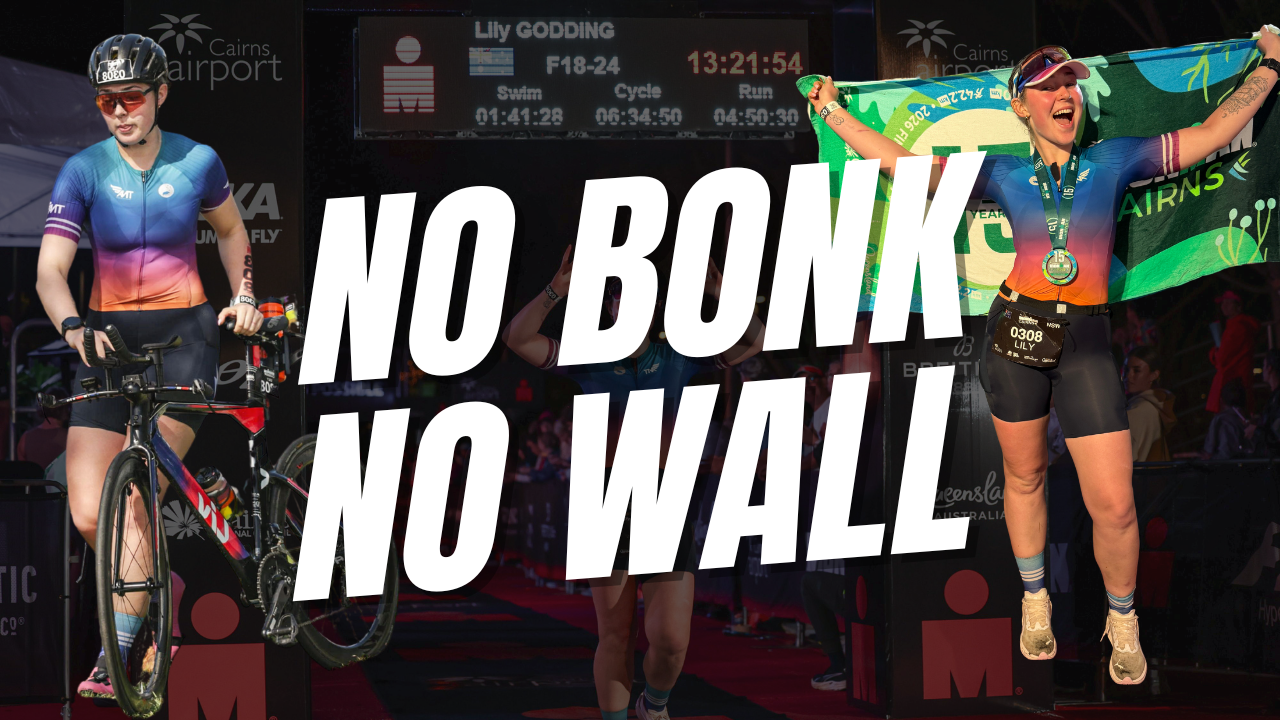
First Ironman nutrition requires consuming 60 to 90 grams of carbohydrate per hour on the bike and run, spread across gels, chews, sports drink and real food, with fluid and electrolytes calibrated to sweat rate and conditions. Athletes who use multiple transportable carbohydrates - a mix of glucose and fructose - can absorb more fuel per hour than those relying on a single carbohydrate source, which is why training your gut in the 12 weeks before race day is as important as training your legs (Jeukendrup, 2017, Nutrients). A personalised, written race nutrition plan - practised in training - is the single biggest difference between surviving your first Ironman and finishing it with something left in the tank.
Lily Godding crossed the finish line of Ironman Cairns 140.6 in 13 hours, 21 minutes and 54 seconds. She was 22 years old. It was her first attempt at the distance. The morning after, she walked down to transition and collected her own bike.
That recovery story is not luck. It is what happens when an athlete goes into a long course race with a nutrition plan they have actually practised.
What Lily told me in Episode 246 of the Triathlon Nutrition Academy podcast stuck with me: before she joined TNA, she could not have told you what her race day nutrition was. Not even close. She was hundreds of grams of carbohydrate short across a training day, her recovery nutrition was too late and not nearly enough, and on race day she was essentially winging it. Sound familiar?
Most age-group triathletes tackling their first Ironman are in exactly this position. They have done the swim sessions, the long rides, the brick runs. But when it comes to nutrition - the fourth leg - they are improvising. And in a 10 to 17 hour event, improvisation has a cost.
How Much Carbohydrate Do You Actually Need for an Ironman?
The research on carbohydrate oxidation in endurance sport is clear: the gut can process more fuel per hour than most triathletes are actually taking in during training and racing.
During an Ironman, you are burning through glycogen at a rate your body cannot sustain without replacement. The current evidence supports targeting 60 to 90 grams of carbohydrate per hour for long course racing, with athletes who train their gut and use a mix of glucose and fructose-based carbohydrates able to reach the higher end of that range (Jeukendrup, 2017, Nutrients).
Why does the glucose-fructose combination matter? Each carbohydrate uses a different intestinal transporter. Glucose saturates its transporter at around 60g per hour. Add fructose and you open a second pathway, meaning more fuel absorbed, less sitting in the gut causing distress. This is why so many race nutrition products now combine maltodextrin with fructose — it is not a marketing gimmick, it is how the gut works.
For a first Ironman athlete, a practical starting point looks like:
- Bike: 60 to 80g of carbohydrate per hour via a mix of gels, chews, sports drink, and real food if tolerated
- Run: 40 to 60g per hour, leaning toward liquid and soft formats as the gut becomes less forgiving
- Fluid: drink to thirst, not to a schedule — this reduces the risk of both dehydration and overhydration
- Electrolytes: sodium is the priority, particularly in heat and for athletes who sweat heavily
These are starting numbers. Your actual targets depend on your body weight, sweat rate, race conditions and how well your gut has been trained.
Why Gut Training for Your First Ironman Is Not Optional
One of the most common reasons athletes blow up in an Ironman is not fitness. It is gastrointestinal distress — nausea, bloating, reflux, or simply not being able to stomach anything after hour four on the bike.
The gut is trainable. Research by Costa et al. (2017, Applied Physiology, Nutrition, and Metabolism) demonstrated that the gastrointestinal system adapts to repeated carbohydrate intake during exercise, with trained athletes showing reduced GI symptoms and improved absorption compared to untrained controls. The practical upshot: if you only practise your race nutrition occasionally in training, your gut will not be ready for the sustained demand of a 10-plus-hour event.
Gut training for Ironman means:
- Practising your target carbohydrate intake on every long ride and long run — not saving your gels for race day
- Using the same products you plan to race with (aid station offerings included, if you know them in advance)
- Progressively increasing your per-hour carbohydrate intake over the 12 weeks before your event
- Eating before morning training sessions to teach your gut to process fuel from the start of exercise
Lily's nutrition plan included gut training across her build phase. On race day, she said her nutrition went "to a T" - six and a half hours on the bike, everything consumed at the right time, not once feeling like her stomach was off. That does not happen by accident.
What Your First Ironman Race Nutrition Plan Should Include
A race nutrition plan is not a rough idea. It is a written document you can follow when your brain is not working properly at hour nine.
For a first Ironman, your plan should cover
Pre-race (the night before and race morning)
Carbohydrate loading in the 24 to 48 hours before your race increases muscle and liver glycogen stores above what normal eating achieves. Your race morning meal should be carbohydrate-rich, low in fat and fibre, and eaten at least two to three hours before the swim start. [LINK: episode on carb loading for triathlon]
Swim
You will not fuel during the swim. Focus on starting the race well-hydrated and not going out too hard — both of which affect how well your gut functions for the rest of the day.
Bike
This is your primary fuelling window. Your gut is most receptive on the bike because you are in a less jostled position than the run and your intensity is lower. Start fuelling in the first 20 to 30 minutes - do not wait until you feel hungry, because by then you are already behind. Carry at least one water bottle with your own electrolyte mix as a security blanket, as Lily did, so you are not entirely dependent on aid station timing.
Run
Expect your gut tolerance to drop. Shift toward liquid carbohydrates - cola, sports drink - and soft formats like chews. If your race plan includes cola at aid stations, practise this in training; some athletes cannot tolerate it and finding out at kilometre 30 of the marathon is not the time.
Contingency
Have a plan for what you will do if your primary fuel source fails. What is your backup if you cannot stomach gels? Having an answer before race day means you will not panic.
The Biggest First Ironman Nutrition Mistakes to Avoid
After working with hundreds of age-group triathletes through the Triathlon Nutrition Academy, these are the patterns I see most often in first-timers:
Starting too late on the bike. Athletes wait until they are hungry or until a certain time has passed. Fuel early - the first 30 minutes on the bike is prime absorption time before fatigue starts to affect gut function.
Not practising race nutrition in training. Your long rides and long runs should replicate your race nutrition plan. If you have never taken 70g of carbohydrate per hour in training, do not attempt it on race day.
Ignoring recovery nutrition. What you eat and drink in the 30 to 60 minutes after your race matters for how you feel in the days that follow. Post-Ironman recovery nutrition should prioritise protein for muscle repair alongside carbohydrate to begin restoring glycogen (Burke et al., 2011, Journal of Sports Sciences). Lily collected her own bike the morning after Ironman Cairns. That kind of recovery is not coincidental.
Letting social media set your targets. The algorithm feeds you what you have been looking at, and for female athletes in particular, a lot of what comes up is weight-loss framing rather than performance fuelling. As Lily put it: there is just so much information out there, and maybe one percent of it is worth listening to. The noise is loud. The evidence-based answer is quieter, but it exists.
Frequently Asked Questions: First Ironman Nutrition
Q: How many calories do I need for an Ironman?
A: Calorie needs vary significantly by body weight, race pace and conditions, but most athletes will burn between 6,000 and 10,000 kilojoules across an Ironman. Rather than tracking calories on race day, focus on your hourly carbohydrate target - typically 60 to 90g per hour on the bike and 40 to 60g per hour on the run — which gives you a practical, executable number to work with.
Q: Can I use aid station nutrition only for my first Ironman?
A: Relying entirely on aid station nutrition is a risk. You cannot guarantee what will be stocked, whether products suit your gut, or that you will be cognitively sharp enough at hour eight to make good decisions. Carry your own primary fuel source and use aid stations to supplement and for fluid. Know what the race is providing in advance and practise with those products if you plan to use them.
Q: When should I start eating on the Ironman bike leg?
A: Start fuelling in the first 20 to 30 minutes of the bike, even if you do not feel hungry. Waiting until hunger hits means you are already behind on your energy stores. Early fuelling is also easier on the gut - your body is less fatigued and digestion is more efficient at the start of the ride than at hour five.
Q: What should I eat the night before an Ironman?
A: A carbohydrate-rich meal that is familiar, easy to digest and low in fat and fibre. Pasta, rice, bread, potato - whichever high-carbohydrate foods your gut tolerates well are your best options. Pair with a moderate amount of protein and avoid anything that has caused GI issues in training. Keep the meal size manageable; you do not need to eat until you are stuffed.
Q: How do I know if I've done enough gut training before my Ironman?
A: If you have consistently hit your target carbohydrate intake across your long training sessions without significant GI distress, your gut is ready. If you have been skipping fuel in training or experimenting with products late in your build, you have more work to do. Three to four long sessions where your gut performs well on your race nutrition plan is a reasonable benchmark.
Finishing your first Ironman with something left is not reserved for the athletes with the most talent or the most training hours. It comes down to going in with a plan - one that is personalised, practised and built on how nutrition actually works in a long course race.
If you want that plan, the Triathlon Nutrition Academy builds it with you across a full 36-week program. You will leave with a fully customised race nutrition plan for every distance, a carb loading protocol, and a gut training approach that works. Register your interest in our next cohort at dietitianapproved.com/academy.
Listen to Episode 246 of the Triathlon Nutrition Academy podcast to hear Lily Godding share exactly how her nutrition held up across Ironman Cairns 140.6 - and what she would tell any first-timer thinking nutrition can wait
Ready to fuel your training properly?
Start with the Triathlon Nutrition Kickstart Course.
The ULTIMATE
Triathlon Nutrition Checklist
Wondering how well you're nailing your nutrition to support triathlon training and racing?
Download my FREE 50 step checklist to triathlon nutrition mastery.
We hate SPAM. We will never sell your information, for any reason.
Author