
Triathlon Nutrition: Why Healthy Eating Is Not Enough
Jul 31, 2026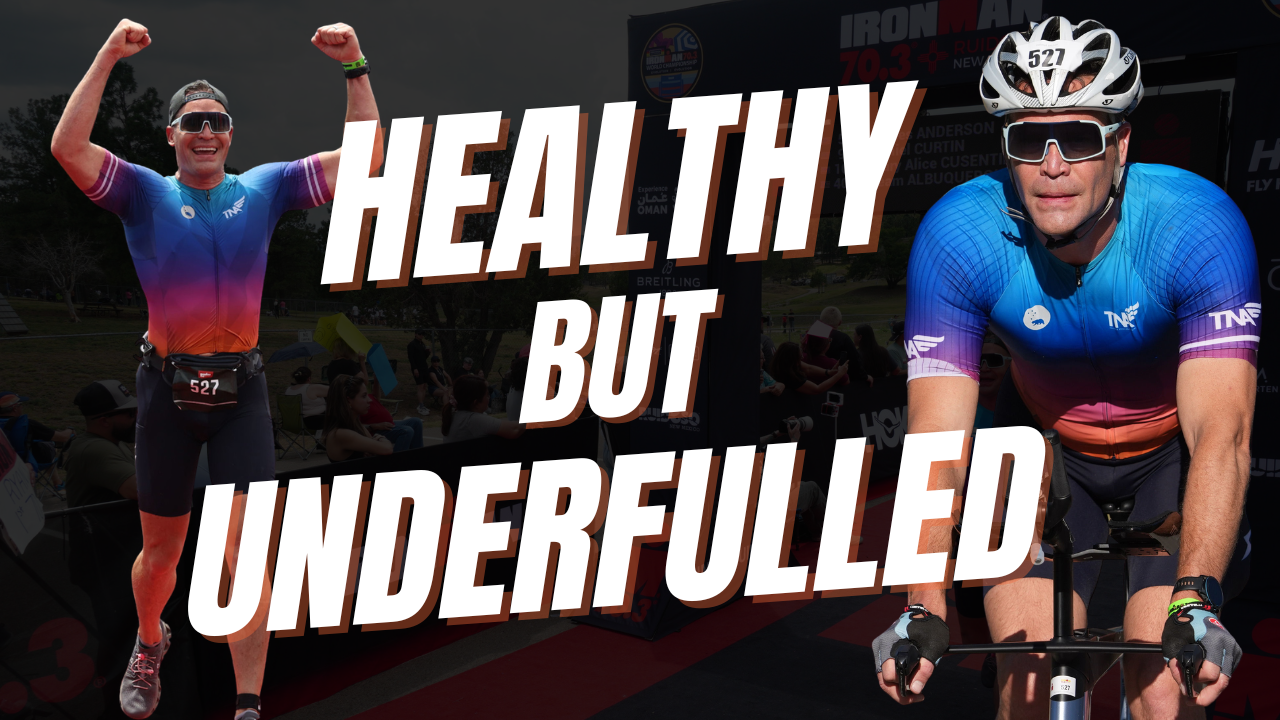
Triathlon nutrition is not the same thing as healthy eating. Healthy eating asks what is on your plate. Triathlon nutrition asks how much carbohydrate you need for the training load in front of you, when to eat it relative to your session, and what you take in while you are actually moving. Plenty of age group triathletes eat beautifully and still turn up under fuelled, because nobody ever told them that fuelling three sports is a separate skill with its own numbers.
I see it every single intake of the Triathlon Nutrition Academy. Someone joins who is doing everything right on paper. Meals prepped. Food quality excellent. More discipline than most of the people they train with. They arrive assuming nutrition is the one box they have already ticked, and they are stunned to find out it is the box holding them back.
It is not a willpower issue and it is not a character flaw. It is a gap in the information, and it catches the organised athletes more often than the disorganised ones. If you have built a system that works brilliantly for everyday eating, you will naturally assume that system holds up under 10 to 15 hours of training a week. It does not, and here is exactly where it comes apart.
Triathlon Nutrition and Healthy Eating Are Not the Same Skill
Healthy eating is built around one question. Is this food good for me. That question has served you well your whole life and it is still worth asking.
Triathlon nutrition asks four more questions on top of it. How much fuel does today's training actually demand. When does that fuel need to go in. What goes in during the session. And what goes in afterwards so tomorrow's session is not a write-off.
You can answer the first question perfectly and get every one of the other four wrong. That is the whole problem in a sentence. A grilled chicken salad is a great lunch and a terrible pre-session meal 45 minutes before a hard bike set, not because there is anything wrong with it, but because it does not carry enough carbohydrate to do the job you are about to ask of your legs.
How Much Carbohydrate Does a Triathlete Actually Need Each Day?
This is where most athletes fall in a hole, and the numbers make it obvious why.
Daily carbohydrate targets scale to training load, not to how healthy you are trying to be. The joint position stand from the Academy of Nutrition and Dietetics, Dietitians of Canada and the American College of Sports Medicine sets it out clearly: roughly 3 to 5 g per kg of body weight per day for light training, 5 to 7 g/kg for around an hour a day, 6 to 10 g/kg for one to three hours a day of moderate to high intensity work, and 8 to 12 g/kg for the extreme end of 4 to 5 hours a day (Thomas, Erdman & Burke, 2016, Journal of the Academy of Nutrition and Dietetics).
Make that tangible. If you weigh 75kg and you are training one to three hours most days, you are looking at somewhere between 450g and 750g of carbohydrate a day. A medium banana has about 25g. Two slices of bread, about 30g. Suddenly a "healthy" day of eating that would keep a sedentary person in great shape looks like half a tank of petrol for the work you are asking your body to do.
And this is not a target you hit by eating more of everything. It is a target you hit by putting carbohydrate in the right places, which brings us to the bit almost nobody gets taught.
Why Does Timing Matter So Much in Triathlon Nutrition?
Because glycogen (the storage form of carbohydrate in your muscles and liver) does not refill on demand. It refills over hours, and it refills fastest in the window straight after you finish. Miss that window repeatedly and you start every session slightly emptier than the last one, which is what "I train hard but I feel flat all the time" actually is.
Three timing decisions do most of the work:
- Before. If your session is over 60 minutes and it matters, then eat carbohydrate 1 to 4 hours beforehand, sized to how much time you have.
- During. If your session or race runs past about 2 hours, then you need fuel going in as you go. Around 60g of carbohydrate an hour is the working number for most sessions in that 2 to 3 hour range, climbing towards 90g an hour for genuine long course efforts, and above roughly 60g an hour you need multiple types of carbohydrate to absorb it properly rather than just more of the same gel (Jeukendrup, 2014, Sports Medicine).
- After. If you have another session within 24 hours, then recovery starts as soon as you stop, not whenever you get around to dinner.
None of that is exotic. It is just not something you would ever arrive at by eating well, because eating well has no reason to care what time your brick session finished.
Why Do You Still Cramp and Get Headaches If You Eat Well?
Because sodium (the electrolyte you lose most of in your sweat) has almost nothing to do with the quality of your diet and everything to do with your individual sweat, your body size, the heat and how hard you are working.
The variability here is enormous. Sweat rates in athletes range from about 0.5 to 2.0 litres an hour, and sweat sodium concentration ranges from roughly 10 to 90 mmol/L (Baker, 2017, Sports Medicine). In plain numbers, that means one athlete can lose close to nine times more sodium per litre of sweat than the athlete riding next to them. Same course, same weather, wildly different needs.
So if you are a bigger athlete racing in heat or at altitude, or you are consistently getting thumping headaches and locking-up cramps late in a race, that is not a sign you need to eat cleaner. It is a sign your sodium strategy has never been set up for the athlete you actually are. This is precisely what changed things for Dr James Anderson, a dentist and Academy athlete who had spent years assuming his cramping was a fitness or toughness issue.
If You Are So Organised, Why Is It Still Not Working?
James is worth sitting with for a minute, because he is the version of this most triathletes will recognise.
He had smoothie bags prepped and stacked in the freezer. Snack bags packed for every work day. Quality food across the board. He is a dentist, so he is not exactly short on the ability to learn technical material. And by his own admission, he was eating the wrong things at the wrong time and had no idea why he was eating what he was eating.
Two things were going on, and they are the two things I see most.
The first is that he came into triathlon fuelling one sport's worth of demand. Almost everyone does. You arrive from running or cycling or the gym with a pattern that suited that sport, then triathlon stacks three of them, often in the same day, and the recovery window from this morning's swim starts competing with the fuelling window for tonight's run.
The second is noise. Athletes today are not short of information, they are drowning in it (which is arguably worse). Should you train your body to burn fat or carbohydrate. Should a bigger athlete eat differently. Should you train fasted. Ask any of those online and you will get ten confident, contradictory answers, so capable people end up in paralysis by analysis, doing nothing in particular with great consistency.
James took the whole thing into his first 70.3. His carb load went well. His sodium plan finally addressed years of headaches. His pre-race and bike fuelling went to plan. Then on the run, the chews and the on-course cola stopped working, which happens, and instead of unravelling he backed off, took plain water, added electrolyte, then reintroduced fuel and walked his way back into the race. That is the skill. Never try anything new on race day, and know how to troubleshoot when the plan you did practise stops cooperating.
You can hear the whole conversation in Episode 252, and if carb loading is the part you are least confident about, Episode 251 covers that in detail.
Frequently Asked Questions
Q: Is healthy eating enough for triathlon training?
A: No. Healthy eating covers food quality, which matters, but it does not cover how much carbohydrate your training load demands, when to eat it, or what to consume during a session. A triathlete training one to three hours a day may need 6 to 10 g of carbohydrate per kg of body weight daily, which is far more structured than general healthy eating advice.
Q: How much carbohydrate do I need per hour during a triathlon?
A: For efforts of about 2 to 3 hours, around 60g of carbohydrate an hour suits most athletes. For long course racing, up to about 90g an hour is the target, and above roughly 60g an hour you need multiple types of carbohydrate rather than a single source so your gut can absorb it. Practise the amount in training first, never on race day.
Q: Why do I cramp during races even though I eat a healthy diet?
A: Cramping is far more likely related to your individual sweat and sodium losses, the conditions and your pacing than to your diet quality. Sweat sodium concentration varies from roughly 10 to 90 mmol/L between athletes, so a generic electrolyte approach can leave a heavy or salty sweater well short.
Q: Do I need a nutrition plan for a sprint or Olympic distance triathlon?
A: Yes, though it is simpler. Sprint and Olympic racing is short enough that during-race fuelling is minimal, but your daily fuelling, pre-race meal and recovery still determine how you train in the weeks beforehand and how you back up afterwards. Most athletes only discover the gaps when they step up to 70.3.
Q: Can I learn triathlon nutrition myself or do I need a dietitian?
A: You can absolutely learn it. It is a skill, not a talent. The catch is that the free information online is contradictory and none of it is filtered for you, your body size, your training load or your gut, so most athletes waste a year or two experimenting before they get a system that holds up under pressure.
Bottom Line
Eating healthy and fuelling for triathlon are two different skills, and being excellent at the first one does not hand you the second. Nobody is born knowing how to fuel three sports. You will not pick it up at school, and as James found out, you will not pick it up in a dental or medical degree either. It is learnable, and once you have it, it is yours for every season that follows.
If you have read this and quietly recognised yourself, do not stress. It is a genuinely easy fix with the right advice, and you are not starting from scratch, because the organised habits you have already built are the hard part.
Learn the whole system properly with the Triathlon Nutrition Kickstart Course.
REFERENCES USED
- Thomas, D. T., Erdman, K. A., & Burke, L. M. (2016). Position of the Academy of Nutrition and Dietetics, Dietitians of Canada, and the American College of Sports Medicine: Nutrition and Athletic Performance. Journal of the Academy of Nutrition and Dietetics, 116(3), 501-528. https://doi.org/10.1016/j.jand.2015.12.006
- Jeukendrup, A. (2014). A Step Towards Personalized Sports Nutrition: Carbohydrate Intake During Exercise. Sports Medicine, 44(Suppl 1), 25-33. https://doi.org/10.1007/s40279-014-0148-z
- Baker, L. B. (2017). Sweating Rate and Sweat Sodium Concentration in Athletes: A Review of Methodology and Intra/Interindividual Variability. Sports Medicine, 47(Suppl 1), 111-128. https://doi.org/10.1007/s40279-017-0691-5
Ready to fuel your training properly?
Start with the Triathlon Nutrition Kickstart Course.
The ULTIMATE
Triathlon Nutrition Checklist
Wondering how well you're nailing your nutrition to support triathlon training and racing?
Download my FREE 50 step checklist to triathlon nutrition mastery.
We hate SPAM. We will never sell your information, for any reason.
Author